Floating Microschools: Adaptive and Mobile Learning Environments

We’ve been thinking a lot about microschools across the United States over the last few years, and certainly, they’ve garnered a lot of media attention. Certain policy moves and philanthropic attention have increased opportunities to reimagine the microschools that exist in the country and to launch hundreds of new microschools in both the public and private sectors.

So for us, we define microschools with a big tent. We think about microschools as small learning environments with typically less than 150 students that offer personalized and student-centered learning experiences. And we’ve been focusing mostly on microschools in the United States. Today, we want to take a pause and think more globally.

When we think globally about education, a couple of big things matter here. Net enrollment in primary schools worldwide has increased from 72 percent in 1970 to almost 90 percent in 2018. These are really big strides, but still, 250 million children remain out of school.

These are students who could be attending school but are unable to for a variety of reasons. Most of these out-of-school children are in rural areas. They’re less likely to finish primary school or transition to secondary school. They often score worse on tests.

And ultimately, this translates to lower incomes and life outcomes. While violence and poverty can be primary drivers, often these students live in education deserts—places where it’s hard to access school because it’s too far to walk, there’s no transportation, or environmental factors play a role.

I sat down to chat with Mohammed Rezwan, who has actually done something about this. He has spent over 20 years increasing school access for Bangladeshi students through a floating school program. Really, microschools in every sense of the word, except that they’re on rivers.

Given the large-scale climate change challenges and the flood danger that 60 percent of Bangladeshi citizens are impacted by, this is a real solution to a real challenge that has a massive impact. Students deserve to keep learning, and Mohammed is tackling that challenge. 


Introduction and Bangladesh Background

Nate McClennen: So, let’s start off with the big picture: a little bit about the context of the opportunities and challenges in Bangladesh as a country, and the education system in general, just to give our listeners who are more U.S.-centric some idea of the context.

Mohammed Rezwan: Bangladesh is a low-lying delta, and 46 percent of the population here lives within 10 meters above sea level, and another 33 percent live within 5 meters. So, when the monsoon season starts, which is in June every year, a lot of water comes from the melting glaciers of the Himalayas. We have a network of thousands of rivers, canals, and wetlands, but our river system cannot hold that much water.

It overflows, and we get flooding every year. This is a country where one-fifth of the country’s area is water. When the flood comes, then another one-fifth goes underwater. When the big floods come, then two-thirds of the country goes underwater. The floods not only destroy crops and educational institutions, but they also prevent people from getting basic services.

Education and income-generating activities in rural areas become a big challenge. During the monsoon season, 750,000 children are affected; their education gets impacted by the flooding. Right now, we have more than 4 million children out of school.

Because of COVID-19, 20,000 schools were closed. Bangladesh had one of the longest school closures in the world. This is the situation in Bangladesh. In the remotest areas, it becomes very difficult to build schools because if you build schools, they are going to be destroyed.

So the only education option in such areas is the floating schools.

Nate McClennen: Sounds like a huge challenge. How did you come up with the original idea for the floating schools? You’re, I think, an architect by training. So how did this solution come about? What was the first idea?

Mohammed Rezwan: I was born and grew up in one of the riverside communities where we are working. When I was a child, it was a challenge for every child there, and it still is in rural, flood-prone areas. When the floods come, then all the areas go underwater. If you have a boat, that can ensure you go to school.

Our family-owned a boat that helped me go to school, but I saw many of my friends and relatives who could not go to school. And I always thought that I should do something for my community in the rural areas. In Bangladesh, there are traditional floating gardens in southern Bangladesh that have been there for more than 400 years.

Farmers there go to floating markets on boats. They sell and buy vegetables there.

These two things inspired me: if water can be a challenge, then at the same time, we can make solutions using the waterways. We can use boats, we can create floating spaces that can ensure schooling for the children.

As I studied architecture, it was easy for me to think of the floating space. Bangladesh is a country where we not only have flooding but also cyclones. Every year, we get one or two cyclones. Sometimes there are big cyclones. This country’s people never give up. After every big cyclone and flood, they stand up again, prepare themselves, rebuild the community, and prepare for the next big natural disaster.

There are strong resilience qualities here. I thought that if I could connect these people with new knowledge and resources, they could do wonderful things. Taking inspiration from floating gardens and floating markets, all these things actually helped me design floating schools.

In 2002, we introduced the first school boat. It was not only a new solution for bringing school to flood-prone areas but also a new concept globally, and it was not easy at the beginning. There were a lot of challenges. Communities were skeptical. So, on day one of introducing the floating school, we got one student. Within a week, we got a few more, and eventually, we got 30 students. They came one by one. Their parents saw the impact because in the rural areas, parents are much more concerned about the safety of girls. If the girls need to travel a long way to go to school, the parents are not encouraged to send them to school. In our case, they can watch and see the girls getting an education at their doorsteps.

It saves time because these children have their parents in the fields, so they do not need to walk a long way. They can get an education at their doorsteps. When they saw that this floating school, this floating space, can bring benefits not only to their children but to the whole family, it created the demand in the rural community for more floating schools. We introduced more boats and provided information and skills training. We introduced libraries on bigger boats and floating training centers with multimedia equipment.

All these boats are powered by solar energy, and we decided to share the surplus energy with the community. We introduced solar lanterns. We recycled the traditional lantern into solar. There was a need for healthcare facilities in the rural communities. I designed floating health clinics.

We found that the traditional floating garden doesn’t work in northern parts of Bangladesh. I designed a new floating structure that has floating decks, a vegetable garden, and fish enclosures—all on water—three types of income-generating activities for the landless people. Because in Bangladesh, half of the population is landless, and more than 30 percent of people live below the poverty line.

It helps people grow traditional varieties of crops. In that way, a family can save money for the future education of the children, and they can take better care of the children. So it’s an integrated development approach that helps not only the children but the full family and the whole community.

It helps them prepare for present challenges like flooding. At the same time, it helps them get better preparation for future big floods. The Intergovernmental Panel on Climate Change predicted that by 2050, 16 percent of Bangladesh’s land may go underwater, resulting in 20 million climate refugees.

Another organization in the U.S., Climate Central, says that it would not take that long. It can happen very quickly within the next six years. It means that by 2030, around 40 percent of the land can permanently go underwater. So this is the situation in Bangladesh.

And then India has built fences all along the border with Bangladesh. So these Bangladeshi people must have their own solution to stay on this land of water.

A Closer Look at the Model (and the Boats)

Nate McClennen: Yeah, so amazing solutions. Let’s think a little bit about the resilience and thoughtfulness of the Bangladeshi people.

In the United States, we call it wraparound services. This idea that it’s not just a school but all the things that go along with it: income generation for agriculture, healthcare needs, adult skills, and upskilling. Can you describe, because we don’t have any floating schools in the United States, maybe a few schools on boats, how big these boats are? How many students study on them? And what does a day look like? You said that their parents can see them getting an education on the boat. So how does the system work? How big are the boats? How many kids? And what does a day look like on any particular boat?

Mohammed Rezwan: In rural Bangladesh, boats are built with wood and bamboo. All the materials are sourced locally, and the local people build the boats with their indigenous or traditional knowledge of boat building. I thought of using that knowledge, local labor, and materials. I know that if we design boats and create space with all these locally found resources, then it will help this project sustain for a long time. The community will be able to manage it. It will not be a new thing to them. It will be built by themselves, maintained by themselves, and operated by themselves because the boatmen, the teachers, and the boat builders are all from the same community. So it will create a strong relationship.

That’s why we used the traditional or indigenous knowledge of boat building. These boats are bigger than traditional boats. The floating school or school boat is 55 feet long and 11 feet wide. But the bigger boats are 65 feet by 13 feet.

These are made with bamboo, wood, and different types of materials sourced locally. These boats have flat bottoms so that they can easily travel through the flooded lands. We have wooden floors, inclined bamboo-strip walls, side-high windows, and the roof is placed at a height so that you can easily walk through.

There are no columns or posts inside the interior. When you enter the boat, you will find open space with seating arrangements. The boat has a big cabin that can fit 30 students with seating arrangements, a computer with internet access, and it is powered by solar energy. Some boats have a small room used as a library, but in a school boat, we have a book library.

Within the classroom, a boatman is responsible for looking after and running the boat. On each school boat, we have 30 students per class or session. The school boat works as a combination of a school bus and a schoolhouse. It collects students from different riverside areas or stations or villages, docks at the last destination, and arranges classes on the boat. After the class, it drops students off at the same places. In this way, our school boat works throughout the day, arranging three classes, each with 30 students, for a total of 90 students per school boat.

It works six days a week and provides education up to grade five. These children come from landless families, where it is normally a challenge to get three meals a day. The house condition is very poor, and these are flood-prone villages. When the water comes during the monsoon, these families or communities are affected by the floods.

On the school boat, we have to follow the government curriculum. At the same time, we have our own environmental curriculum. I not only designed the school boat, but as an architect, I also write school books for the children. We have an environmental curriculum that focuses on biodiversity, protecting the environment, and informing children about the sources of pollution so that they can share the information with their families and communities.

The children graduating from the floating schools can stay in touch with education through our floating libraries, where we provide training on computers and have 1,500 books. We also have training centers where girls and women can get training on new skills so that they can generate income and delay their marriage in the community.

We have boys’ and girls’ clubs that work together in preventing early marriage in the community because Bangladesh ranks number four in terms of early marriage, with one-third of the girls getting married before the age of 15. Early marriage is one of the challenges, and our work addresses this challenge.

Nate McClennen: So great context and very helpful. I think in my head I can understand what’s happening. I understand that the boats do three classes of 30 students a day. They’re teaching a national curriculum, but they’re also teaching a very context-specific curriculum that you’ve designed around rivers and environmental situations and conditions.

Right now, how many floating schools are there? Have you been able to measure the impact? How many students have been served? What’s the difference in these lives? You’ve been at it for 20 years, so it’s a long time. How do you measure success? And then how many floating schools are there?

Mohammed Rezwan: At our organization, we have 26 school boats working in districts in northwestern Bangladesh, reaching around 2,340 children a year. Our work has inspired other organizations over the last 12 years. Communities within Bangladesh and outside of Bangladesh—in Indonesia, Vietnam, Cambodia, the Philippines, India, Pakistan, and countries in Africa—have taken our idea of floating schools. They have built floating schools. So far, I think in total, more than a few hundred floating schools are floating through rivers, canals, and wetlands in these eight countries globally.

We also have two floating playgrounds. These are educational boats with two tiers. On the lower deck, we have a classroom that is also used as a training facility. I designed circular seating arrangements to create more interaction between the teacher and students and to accommodate more students in the limited space.

On the lower deck, we also have a library, books, and computers. On the upper deck, we have a playground with monkey bars and swings. On the side of the boat, we have slides. The children slide down from the upper deck to the lower deck. This means a lot to them. There is an observation deck on the top of the boat where children can have a bird’s-eye view of the community.

It creates strong interest among them in nature and science.

This educational playground supports our floating schools and the children in the community. It has been a wonderful space for them to spend time since the beginning. We introduced the first school boat back in 2002.

Over all these years, we have reached around 25,000 children, and around 22,500 children have graduated from floating schools. Seventeen percent of them are involved in different types of jobs in cities and towns. The rest of them are having very good lives in the rural communities.

They are involved with small businesses or agriculture in their communities. I can tell you one story. I got a national award in Dhaka. At the award ceremony, one young man came to me with a camera because he was a photographer at that event.

He told me that he was one of the students of our floating schools. The children studying in the floating schools are not only working as photographers; they are working in online data entry. They have been working in different sectors.

Nate McClennen: That’s amazing. That’s a pretty big impact: 25,000 children, 22,500 who have graduated from the floating schools. This is an amazing project. It’s probably taken an incredible amount of energy and a great team. You probably don’t sleep very much thinking about it.

What’s next for you? Do you want to keep adding more floating schools, or what are your next big ideas? Because clearly, you’re always creating and building something. So what’s next for you?

What’s Next for Floating Schools?

Mohammed Rezwan: At present, throughout different types of activities—schools, libraries, training centers, health clinics—we are directly reaching 75,000 people a year, and another 75,000 are indirectly impacted. So 150,000 people are benefiting from our services right now. We want to double that beneficiary reach and move to more remote communities throughout the country.

We have a plan to introduce another 35 boats over the next five years. At the same time, we can see the strong impact of climate change in other communities globally. For example, we got a call from Papua New Guinea. In Papua New Guinea, many communities don’t have access to education. Children cannot go to school. They do not have all the necessary support they need. When I talked to a community member there, I thought that we should go there. So in the future, we have a plan. We want to help these communities globally so that they can design and build their own school boats.

It will be a customized school boat considering the context and needs of that community. We are working on strategies to help communities around the world that are at the front of climate change. These are some of the priorities. We are still working on the floating gardens. Recently, we introduced a housing unit with the floating garden to see how that can help shelter people and their goats and other things during the monsoon season. We have a strong focus on building strong floating communities that can help people live on this land of water when part of Bangladesh is flooded.

Nate McClennen: That’s amazing. I appreciate the vision. I love the idea of how to replicate it in other countries. It sounds like that’s already happening, and you have visions of how it can happen even more. I want to wrap up by summarizing some things that I’ve learned from you, and I’m grateful for your time today.

One thing, and I think it’s important for our listeners to understand, is the scale that you’re working at. Often in the United States, microschools are small, with 15 to 20 students, but we’re thinking about how they can have a larger impact. You are a great example of that happening. A couple of takeaways for me are, first, the idea that one boat you started back in 2002 has now had a global impact. Small things can turn into big things. I love the idea of wraparound services—thinking not only about the students but also their families and livelihoods. Whether it’s through gardens, healthcare, upskilling, training, shelter, or playgrounds, all these pieces are important as the country becomes more and more underwater for parts of the year.

The third takeaway is the power of local employment and local agencies. You’re using local boat drivers, local boat-building techniques, and local teachers. How do we get local communities to own the project?

I also love the idea of curriculum based on the rivers. I’m interested in how we help students understand their places better so they can take better care of those places. Finally, the idea of scale is important for those of us in the business of trying to make the world a better place. It feels like you and your organization have started to think about how to take this idea from Bangladesh and replicate it in other places. Those are my takeaways from today. Thank you, Mohammed!

The post Floating Microschools: Adaptive and Mobile Learning Environments appeared first on Getting Smart.

from Getting Smart https://www.gettingsmart.com/2024/06/24/floating-microschools-adaptive-and-mobile-learning-environments/

Learning Environments Don’t Just Need Generative AI, They Need an AI Operating System

What would it look like to fully integrate AI into a learning environment? In the last few months, we’ve seen a surge of announcements about the vast potential of AI in applications. With Microsoft’s Co-Pilot and Apple’s Apple Intelligence, some integrations are taking a system-wide approach, crafting entire AI operating systems and hardware. 

Some districts are already experimenting with integrated rollouts. Desoto ISD is pioneering the implementation of a district-wide AI OS, demonstrating its commitment to elevating academic performance and ensuring technological advancements are accessible and engaging for all students.

“The district’s leadership team is committed to adopting game-changing AI technology from Knomadix to accelerate learning and bridge academic gaps,” said Dr. Usamah Rodgers, DeSoto ISD’s superintendent. “This approach enhances educational delivery while equipping students with the skills necessary for future success in an increasingly technology-driven world.”

This initiative is fueled by a collaboration between Knomadix and Big Thought Institute. Knomadix brings expertise in digital learning environments, while Big Thought Institute contributes its experience in cultivating a positive culture and climate to strengthen instructional practices. Currently, Knomadix has integrated AI-driven educational resources sourced from Texas HQIM (High-Quality Instructional Materials) and other publishers, such as Eureka Math, Carnegie Learning Math, and Stemscopes Math.

“Technology is changing rapidly, and learning environments need to meet the moment by integrating positive climate and a youth-centered culture with responsible technology adoption that meets young people where they are and pushes them to grow in constructive ways,” said Greg MacPherson, Chief Big Thought Institute Officer. “DeSoto ISD’s visionary thinking about technology makes them the ideal partner to help meet the moment alongside.”

Knomadix has been building its AI OS for the past 10 years. When the pandemic hit, “it spotlit the holes in digital learning,” said Ramesh Balan, CEO of Knomadix. “Coupled with Generative AI, this situation accelerated our vision by at least 5 years.”

Knomadix positions itself as a foundational and navigational tool in this new digital terrain, guiding educational leaders and publishers through AI implementation. By offering an AI-driven learning experience design and delivery platform, Knomadix ensures schools are thriving through change. This method provides proactive support and enhances the learning experience without interrupting the flow of education.

AI-supported instructional models act as personalized teaching tools, delivering core content, modifying tasks, and providing real-time feedback based on each student’s performance level. This ability to adapt to each learner’s needs offers several key advantages:

  • Real-Time Adaptation: AI systems understand where a student is on a proficiency map in real-time and can offer scaffolds to help students meet learning outcomes.
  • Personalization and Agency: These systems enable personalized learning experiences, giving students greater control over their learning paths.
  • Targeted Support: AI delivers customized learning recommendations and support based on how students perform on activities and respond to questions.

This system offers a dynamic toolkit that creates guided 1:1 AI-powered tutoring for each lesson, adapting to individual learning speeds and preferences, and facilitating a more personalized educational experience.

One significant advantage of Knomadix is its content-agnostic framework, allowing it to integrate seamlessly into any subject area or educational sector. This flexibility is invaluable for educators and curriculum developers, providing tools to create tailored educational experiences for varied learning styles. The platform’s intuitive drag-and-drop authoring tools empower educators to design and deploy multi-modal AI-driven lessons easily.

From Knomadix.com

Initial feedback from district instructional staff, campus leaders, teachers, and students has been overwhelmingly positive, with many highlighting the enhanced engagement and improved understanding of complex concepts. Immediate feedback and tailored learning paths have significantly contributed to a more effective teaching and learning environment.

The students have shared some of the following: 

  • “Knomadix AI shows me each step and lets me know exactly where I made the mistake. Learning is easier because I get instant feedback.”
  • “I really enjoy the fun games and competitions in Knomadix lessons. It’s awesome that Knomadix gives me answers without me even having to ask questions. I like when it tells me how to do things correctly and helps me figure out problems.”
  • “Knomadix AI gives me challenging questions which makes me think a lot before I can answer. I also like how it knows when I’m stuck and shows me how to solve the tough problems.”

Chief Academic Officer Stephanie McCloud expressed enthusiasm about the potential of AI, stating, “Our leadership team and campus leaders are thrilled about the significant impact that AI and the Knomadix solution can have on our instructional growth and the delivery of personalized instruction by our teachers.”

Knomadix enhances the collaboration between teachers and AI through a hybrid model that leverages shared data insights. This collaboration allows educators to refine their teaching strategies and interventions based on real-time data, optimizing educational outcomes and ensuring that each student’s needs are met efficiently and effectively.

For school leaders, the message is clear: embracing Knomadix’s AI solutions can lead to more engaged learning environments and better educational outcomes. As we continue to navigate these changing times, Knomadix offers a promising path forward, ensuring every student has access to personalized, high-quality education.

The post Learning Environments Don’t Just Need Generative AI, They Need an AI Operating System appeared first on Getting Smart.

from Getting Smart https://www.gettingsmart.com/2024/06/20/learning-environments-dont-just-need-generative-ai-they-need-an-ai-operating-system/

Virtual Voyages: Augment and Virtual Reality Point Toward an Immersive Learning Future

Remember those endless worksheets we all slogged through in school? They’re not inspiring and offer a limited snapshot of student understanding. Seeing surface-level learning worksheets coming home with my children is even more frustrating. These are not the types that capture rich learning experiences; they’re the fill-in-the-blank, multiple-choice versions that are easy to grade but don’t measure or celebrate deep learning. As a teacher, I often added scenario questions, short essays, and creative prompts. And like many educators, I tried to avoid traditional worksheets.

Imagine your child’s high school history class being transported to ancient Rome. Instead of just reading about it, students could put on Virtual Reality (VR) headsets and walk the bustling streets of the Colosseum, chatting with virtual Romans and learning about their way of life. This is the future of immersive learning, offering personalized, engaging, and relevant learning experiences that transcend traditional teaching methods. With the rise of immersive environments in the gaming world, our young people are already accustomed to dynamic and engaging learning experiences. Imagine them leveraging these same skills to explore historical periods, scientific phenomena, or the challenges of space travel. 

Immersive learning involves immersion in the learning experience. It can be a physical, in-person experience, or, in the case of this article, can leverage virtual reality (VR) and augmented reality (AR) to create simulated environments where the learner actively engages. VR and AR offer distinct experiences:

  • VR: Fully immerses you in a computer-generated world. Explore the pyramids in Egypt or walk with dinosaurs – VR puts you right there!
  • AR: Overlays digital information onto the real world. See 3D historical figures come to life in a textbook or point your phone at a car engine to see labeled parts. AR blends the physical and digital worlds.

VR and AR work together beautifully. Chris Dede of Harvard Graduate School of Education explains augmented reality as mobile, context-aware technology that enables users to interact with visualizations and simulations within a physical setting. VR creates immersive environments for practicing skills, while AR provides additional information in the real world. This combined approach can personalize the learning experience based on an individual’s needs and interests. 

Immersive learning is not just about fancy gadgets. It is about creating learning experiences that are: 

  • Engaging: Forget about boredom claims or the work is too easy or irrelevant. Think virtual field trips to another country or learning about art through virtual conversations with artists.
  • Relevant: Immersive learning allows learners to solve realistic problems in simulated environments. They can transfer that learning to the real world and within their local and global communities. Imagine designing a sustainable city in VR or collaborating with learners from another country on a global climate change project.
  • Creative: These technological advances open up many possibilities. Students can create virtual museums, design historical clothing, or even film documentaries while learning important skills and achieving learning outcomes.

Experiencing productive struggles in learning is part of the process, and supportive technologies should not remove this opportunity. Students grapple with complex problems and refine solutions through simulations, growing their critical thinking skills. AI-assisted immersive learning can guide students to useful information, ask probing questions, and suggest avenues of inquiry, leading to a deeper sense of purpose as they discover what truly excites them.

Examples of Immersive Learning 

  • Language learning: Struggling with French? Language learning often requires immersive experiences or extended interaction with fluent speakers. Imagine practicing with a virtual tutor in Paris, learning slang and cultural references by “living” in the city.
  • Science: Ever want to shrink down to the size of an atom? With VR, students can explore the wonders of the microscopic world or travel through the cosmos like a real astronaut. OptimaED has a VR microschool that offers virtual field trips as part of the online curriculum.
  • Math: The 3D shapes in geometry can often be tough to visualize. Immersive learning allows students to manipulate these shapes in a virtual environment, making some complex concepts easier to grasp. Students could design buildings, test structural integrity, and iterate their designs, all within a safe and controlled digital space. [See this example of Calculus and VR]
  • Cultural Exploration: Simulations (Sims) for culture and history have long been an instructional practice. Add to these with the addition of technology. Learners can take a virtual tour of ancient Egypt, economic challenges around a created civilization, or a focus on transportation or sustainable resources. 

VR and AR are powerful tools on their own, but when used together, they create an even more personalized and engaging learning experience. VR can take you to the heart of a subject, while AR can provide additional layers of information within the real world. This flexibility allows educators to tailor learning to individual needs and interests.

Making it Happen: From Simple Steps to Transformation

You don’t need a huge budget to get started with virtually supported immersive learning. Here are some tips for educators, parents, and education leaders.

Educators:

  • Start Simple: Where available, swap traditional resources for digital versions. Many free VR field trips and interactive quizzes are available online. Check out Google Arts and Culture for virtual museum tours.
  • Level Up: Use VR simulations* in science labs or incorporate AI-powered language apps to supplement learning experiences. In addition to the many 2D versions currently available, review new advancements like Google Cardboard and Dreamscape Learn. *More tools are listed below.
  • Get Creative: Encourage student-driven projects using VR and AR technologies. Students can create virtual historical reenactments, design buildings in a simulated city, or collaborate with learners worldwide. Check out Roblox Education for more examples.

Education Leaders: 

  • Teacher Training Boot Camp: Organize workshops where teachers can play with VR headsets, explore cool AR apps, and learn the basics of these immersive technologies. Consider externships to businesses using cutting-edge tech as inspiration. See this video for more real world examples.
  • Sharing is Caring: Create communities where teachers can swap stories, best practices, and even some immersive learning fails. Workshops and online forums support collaboration.  
  • Unleash Creativity: Offer advanced training on creating or customizing VR and AR content. Teachers can design tailored immersive experiences for their students. Imagine students learning about the Civil War through a VR experience created by their history teacher!
  • Tech for Every Learner: Ensure all learners can access immersive learning tools. This might involve working with mobile app developers or securing grants to provide VR headsets and devices. 
  • Building a Roadmap: Develop a clear plan for integrating immersive learning and make it a reality. Engage with the school community [See Portrait of a Community] to set goals, timelines, and ways to measure progress. 

Parents and Families:

  • Stay in the Loop: Learn about immersive learning technologies and their use in your learner’s school. Talk with your learner’s teachers regularly and investigate resources available in your community, such as youth centers and libraries. 
  • Mindset Matters: Encourage your learner to see challenges as opportunities to learn new skills. A positive attitude is key to navigating complex and new learning technologies.
  • Balance: While immersive learning offers significant benefits, it is important to balance screen time with physical activity, social interactions, and other related learning activities. 
  • Explore at Home: Look at affordable VR and AR apps that align with your learner’s interests and learning goals.

The Future is Immersive

This is not a fad; it is the future of education. By embracing these immersive technologies, we can create learning experiences that spark curiosity, ignite creativity, and prepare students for our ever-changing world. This journey toward a new era of learning has begun. Imagine classrooms transformed – not just places to absorb information but interactive playgrounds for the mind where students’ faces light up as they explore new worlds and subjects in a whole new way. This shift from passive learning to active engagement will lead to a deeper understanding and a lifelong love for learning.

The post Virtual Voyages: Augment and Virtual Reality Point Toward an Immersive Learning Future appeared first on Getting Smart.

from Getting Smart https://www.gettingsmart.com/2024/06/18/virtual-voyages-augment-and-virtual-reality-point-toward-an-immersive-learning-future/

Jeffco Open School: A Journey of Six Learner-Designed Passages

In 1969, a group of parents petitioned the Jefferson County School Board to establish a school that honored the development of the whole child. Since launching as an elementary school in the west Denver suburb of Arvada, the Open School has provided a vibrant learner-centered alternative. After adding high school grades, merging with similar schools, and moving to Lakewood in 1989, the Open School has served as a mature model of P-12 progressive education.

Students at the Open School work closely with their advisors to develop a personalized course of study and take personal, social, and intellectual risks to discover the joy of lifelong learning. “There is an emphasis on self-direction, learning through experience, shared responsibility, and the development of life-long skills,” the JCOS mission explains. 

The P-12 school serves about 550 students with 250 in high school. It was formed around five goals that are visible in the hallways: rediscover the joy of learning, seek meaning in life, adapt to the world as it is, prepare for the world that might be, and create the world as it ought to be.

Ninth grade starts with a “disorientation” backpacking trip to reset expectations of the high school journey ahead. There are no sports and few extracurricular activities. Instead, the school hosts about 40 trips a year. Family contributions, school scholarships, and donations cover travel costs. Travel-based learning “gets students out of their comfort zone,” explained a junior. Recent trips have included Mexico, Costa Rica, and Africa. Canoeing the boundary waters of northern Minnesota is a perennial favorite. 

A high school student said, “Advising might be the most important feature of the school.” Advisory groups (about 16 students) meet with their advisor every morning. Students build relational skills, plan travel, and design projects in their Advising block.

Inspired by the indigenous pedagogy of Australia, Walkabout is the final phase of the Open School program in which each student demonstrates readiness to function as an adult by completing six passages. In their last three years of high school, students work with their advisors to sequence, plan, and conduct passages. 

  • Adventure Passage: a personal quest–the mythical hero’s journey–that involves leaving the familiar, facing challenges, and experiencing success. 
  • Career Exploration Passage: explore a career related to interests, passions, talents, and experiences. Essential components include a personal profile, interviews, hands-on experience in the chosen career, a résumé, an investigation into the training or education necessary to enter the field, and an exploration of related fields.
  • Creativity Passage: explore a concept, develop a design, and carry out a process to make a unique personal final product. It is the process of generating ideas, planning, solving problems, making changes, and reflecting on the process. 
  • Global Awareness Passage: the opportunity to see the world and help “create the world as it ought to be.” The goal is to broaden global perspectives and experience success in making a difference. 
  • Logical Inquiry Passage: a mental challenge, following a process to discover an answer to a question or problem of personal relevance. The process includes framing and investigating a problem. It demands reasoning, problem-solving, research, investigation, data collection, analysis, synthesis, conclusions, and self-critique.
  • Practical Skills Passage: develop a useful skill that will yield a product besides a journal or written description. It could include learning a second language, personal finance, cooking, or improving communication skills.

The Passages are a beautiful framework for student-directed learning. It is comprehensive and specific enough in each domain to provoke multidimensional growth while being flexible in sequence and substance allowing each learner to make the journey their own. 

Interviewed students were articulate about the purpose and design of each passage. They were intentional about the sequence of passage and travel experiences and serious about reflection and documenting growth.   

Graduation requirements are expressed as 15 competencies—in personal, social, and intellectual domains—which are demonstrated through passages, travel experiences, service learning, and classroom assessments. 

Most Open School learning is multi-age. Students enroll in a multi-age grouping such as Early Learning Center (typically grades 1-3) or Foundations (typically grades 7-9), and the vast majority of course offerings are multi-aged.

Open School classes are ungraded. Students write narrative self-evaluations to complete classes and teachers respond by indicating whether a student has achieved an appropriate level of proficiency. One of the Open School learning goals is “To assess student learning in ways that challenge students to demonstrate personal, social, and intellectual growth.”

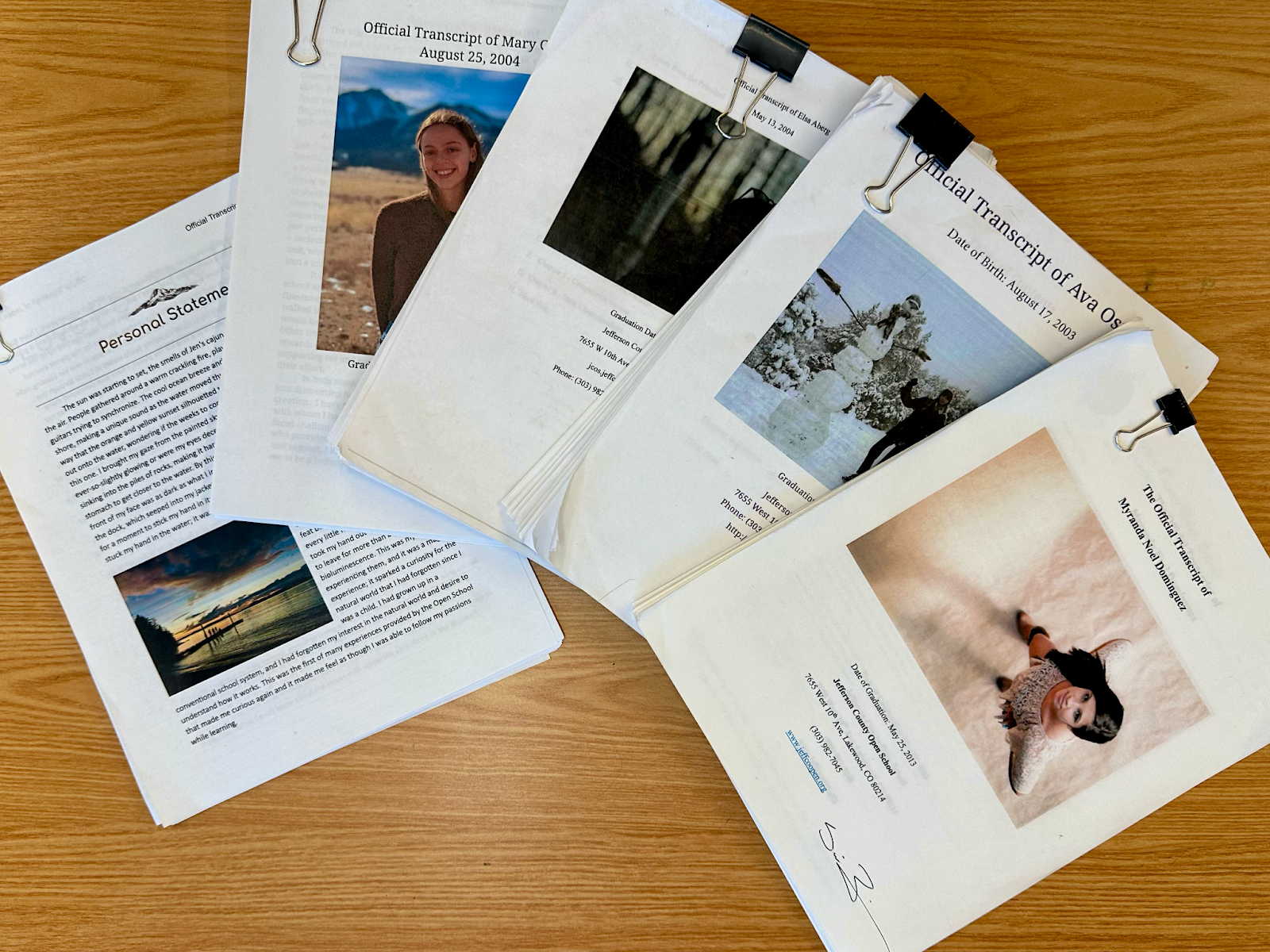
High school transcripts are 30-60 page descriptions of capabilities and the learning journey that developed them. Open School graduates can usually access the college of their choice with an extended transcript. 

Principal Melyssa Dominguez has been at Open School for 13 years. She has watched hundreds of Open School graduates flourish including her daughter. She places students at the center of their educational journey and empowers young people to discover their own path. Dominguez believes in the power of experiential learning as a means to inspire students to achieve beyond self-imposed limitations.

Each senior has their own personal graduation ceremony known as a Final Support meeting where a group sits in a circle while the student speaks about their high school experience and hears from friends, family, and staff with advice, appreciation, and shared memories. At the end of these meetings, each graduate is presented with their diploma by their Advisor and the entire group. Dominguez concluded, “Final Support meetings are one of the most beautiful expressions of our unconventional school.”

The post Jeffco Open School: A Journey of Six Learner-Designed Passages appeared first on Getting Smart.

from Getting Smart https://www.gettingsmart.com/2024/06/17/jeffco-open-school-a-journey-of-six-learner-designed-passages-2/

Portrait of a Community to Empower Learning Transformation 

Imagine a bustling school gymnasium filled with parents, students, educators, and local community members. The energy is palpable as diverse voices share their hopes and dreams for the future of education in their community. A single parent juggling two jobs stands up to speak. Despite rarely attending school events due to their busy schedule, they are here to shape a nurturing and inclusive education environment. This is the power of community convenings – a transformative approach to education that invites everyone to the table. This is the start of a Community Portrait.

The Portrait of a Graduate—a collaborative effort to define what learners should know and be able to do upon graduation—has likely generated enthusiasm in your community. However, the challenge of future-ready graduates persists: How can we turn this vision into a reality within our diverse and dynamic schools, especially amid the current national political tensions and contentious curriculum debates?

The answer lies in active, inclusive community engagement. It’s about crafting a Community Portrait that reflects the rich diversity of our neighborhoods. This approach, grounded in the same principles used to design effective learning systems, seeks to cultivate deep, reciprocal relationships within the community. When young people are actively involved, the potential for meaningful change increases exponentially.

John Dewey once said, “Education is not preparation for life; education is life itself.” This underscores the importance of actively designing our educational environments with community involvement. Whether we permit chance environments to shape our students’ experiences or intentionally design them to reflect our community’s values makes a difference. By fostering these designed learning environments, we can ensure that education is a lived experience shaped by and with our community. 

Gathering in a Polarized World

Political polarization underscores the necessity of shared agreements and robust support for our learning systems. Engaging the broader community is not just beneficial; it’s essential. School leaders must navigate shared aspirations and address critical questions:

  • What are our community’s hopes, dreams, and aspirations for its young people?
  • What skills and mindsets do our children need to thrive in a rapidly changing, complex world?
  • How can we design equitable learning experiences in our school systems?

This community-centered approach enriches the Portrait of a Graduate, ensuring the educational ecosystem aligns with stakeholders’ values and needs. It brings diverse voices to the table, fostering inclusivity and co-creation, ultimately shaping an educational landscape that is both intellectually and emotionally safe for students.

Real-World Engagement Examples

The Community Portrait can be a powerful way to invite people into the vision of a school and /or district and create a renewed sense of belonging. Imagine the following examples: 

  • A single parent (or guardian) juggling two jobs: Maria, a single mother of three, has her hands full working two jobs to make ends meet. Participating in school events has always been a challenge for her. However, she attends a Community Portrait meeting, eager to share her vision for an education system that supports all students, including her children. The room listens attentively as she speaks about the importance of after-school programs and flexible scheduling. Her ideas are met with appreciation and understanding, transforming Maria from a bystander into an active participant in shaping an inclusive educational environment.
  • A family with swing hours or caregiving responsibilities: The Johnsons, a family new to the community, have parents working swing hours while caring for an elderly grandparent. Despite their busy schedules, they attend a Community Portrait meeting. They share their experiences of struggling to balance work, caregiving, and their children’s education. Their input on creating more supportive and flexible school schedules resonates with many. Through this involvement, the Johnsons feel a newfound sense of inclusion and integral to the community’s vision.
  • Local small business owners: James, a local shop owner, often hires recent graduates to work in his store. He participates in the Community Portrait process, sharing the skills and qualities he seeks in employees. James emphasizes the importance of practical skills like communication, teamwork, and time management. His feedback helps align the education system with real-world needs, ensuring graduates are better prepared for the workforce. James’s involvement not only enhances the employability of graduates but also strengthens community ties, fostering a stronger connection between local businesses and schools.

The Community Portrait invites diverse voices into the work, fostering a deep sense of belonging and collective purpose in shaping the educational future.

Five Stages for Co-Creation of a Community Portrait

Diversity forms the fabric of America and its democracy, encompassing various identities, perspectives, and experiences—race, ethnicity, culture, religion, gender, sexual orientation, socioeconomic status, abilities, and more. A diverse community fosters inclusivity, mutual respect, and equal opportunities for all its members.

We must move beyond simplistic labels and stereotypes to define our community inclusively. Instead, we should recognize the multifaceted nature of diversity. As showcased above, our community comprises individuals with unique stories, histories, and values that shape their identities and perspectives. By valuing this complexity, we create a more accurate, inclusive, and stabilizing vision of the future. The Community Portrait is a logical and powerful starting point for this important work. Additionally, bringing people into the fold just got easier with emerging technology.  Below are the five stages to adopting the portrait model… with an infusion of AI. 

  1. Engage with the Broader Community: Understanding and incorporating the community’s hopes, dreams, and aspirations into the educational vision is critical. AI can help draft personalized messages and ensure timely communication, making it easier for community members to stay informed and engaged. With smart tools, school districts are better able to send tailored newsletters to parents, highlighting events and news pertinent to their child’s grade level or upcoming community engagement sessions.
  2. Define the Portrait of a Graduate: Tailor the vision to reflect students’ desired knowledge, skills, and mindsets, aligning it with the community’s aspirations. AI tools can process feedback from parents and students, identifying common concerns or suggestions to improve school programs.
  3. Align the System with the Portrait of a Graduate: Ensuring that the entire educational system, from policies to practices, aligns seamlessly with the vision, promoting equitable and enduring experiences. AI-driven listening platforms can help education leaders monitor online mentions, gauge public sentiment, and identify emerging topics, allowing schools to address issues and opportunities proactively.
  4. Empower Educators with the Portrait of an Educator: Providing educators with the tools, resources, and support needed to bring the vision to life in classrooms. Every teacher just got a new student teacher. AI-powered chatbots and virtual assistants offer real-time support in the classroom, helping educators reach their defined portrait goals.
  5. Equip Leaders with the Portrait of a Leader: Empowering educational leaders with the competencies and qualities necessary to champion and steer the systemic change towards a learner-centered, forward-thinking environment. Leadership analytics and AI-driven training modules can help leaders develop strategies to implement the Community Portrait effectively.

By embracing shared wisdom and crafting representative Community Portraits, we are building a more inclusive, dynamic, and forward-focused learning community. Integrating AI into this process enhances communication, feedback, and alignment, ensuring that the vision reflects the diverse voices and needs of the community. Margaret Wheatley wisely noted, “There is no power for change greater than a community discovering what it cares about.”  Leveraging emergent technologies like AI helps us to uncover these shared values while addressing potential biases to ensure an education system that is intellectually and emotionally safe, inclusive, and responsive to the evolving needs of our students and society.

The post Portrait of a Community to Empower Learning Transformation  appeared first on Getting Smart.

from Getting Smart https://www.gettingsmart.com/2024/06/13/portrait-of-a-community-to-empower-learning-transformation/

Adaptive Leader Istation Joins AI-Powered Reading Tutor Amira Learning 

Founded by Dick Collins in 1998 in Dallas, Istation rode the 15-year blended learning wave to become a leader in second-generation edtech by providing personalized and adaptive learning in K-8 reading and math.  

Founded by Mark Angel in 2018, Amira Learning was the first intelligent reading assistant using predictive AI to provide personalized tutoring to primary school students. Results from the first three years were impressive gains in fluency and automaticity

At the ASU-GSV Air Show, Angel announced Amira 2.0 with the power of generative AI to enable voice interactions and comprehension conversations and improve tutoring judgments and interventions. Angel calls it “third-generation edtech” meaning it is voice-enabled, evidence-powered, immersive, self-improving, conversational, and individualized. The new version of Amira brings a stronger emphasis on comprehension and works up to fifth grade. It helps to understand and define reading comprehension difficulties.

Today, the two companies announced a merger yielding a combined 15% market share and serving over 1,800 school districts. Amira’s impact-proven AI will complement the Istation product, which will remain fully operational and independent of Amira. 

Amira’s Large Language Model, benefiting from more than 10 billion spoken words, is well-versed in an extensive range of accents and dialects. It will be paired with Istation’s extensive content library of video lessons for students and lesson plans for teachers to provide leading-edge gamified content. 

“Amira Learning has the most sophisticated speech recognition for elementary students in the world, ahead of Amazon, Google and other giants,” said Dick Collins, CEO of Istation, who will transition into a new role as Co-Chairman of the Board. 

Amira Learning has raised more than $40M from investors, including Owl Ventures, Authentic Ventures, Vertical Venture Partners, Houghton Mifflin Harcourt, Outcomes Collective, Google Assistant Fund, Amazon Alexa Fund, ReThink Education, and GSV Acceleration.

Discussion & Conclusions

Second-generation edtech brought the promise of personalized and adaptive learning experiences. When combined in blended learning initiative with improved access (ie broadband and devices) and professional learning, it produced moderate gains in standardized measures of grade level achievement. For example, Houston’s iconic PowerUp initiative helped make it what many considered the best urban district (listen to a podcast with superintendent Terry Grier).  

When Amira launched in 2018, nearly every school was wired with near 1:1 access. Most American elementary students spent some time each week in a second-gen edtech app including iReady, Istation, DreamBox, Achieve3000. However, results were mixed (at least in standardized measures of grade-level proficiency in reading and math) as a result of chaotic deployments and uneven use patterns. (See our recent publication Unfulfilled Promise for an extended discussion on the last forty years of edtech.) 

With the promise of full personalization, conversational interface, and immersive experiences, the introduction of generative AI in 2020 launched a two-year explosion in venture investment in AI startups and the beginning of the end of second-generation edtech. 

In 2023, the edtech venture market collapsed and growth capital dried up. Schools lost enrollment and ESSER funds and hit a pause on new purchases and renewals (especially after districts figured out they were using an average of 2,591 ed tech tools). For companies like Istation, the edtech winter made reinvestment challenging and merging with an AI-capable partner more attractive. 

For Amira, Istation brings a big sticky national network of school partners with enough runway to supercharge the app with gen AI features. They also get a K-8 math platform. The combined entity will increasingly compete with AI tutors like Khanmigo, Flexi from CK12, Microsoft Reading Coach, and edu-tuned LLMs 

Given new AI-powered competition and weak access to venture capital, edtech M&A activity is trending up. We’ll see more deals like this where third-generation firms acquire second-generation for scale. We’ll see second-generation firms seeking rejuvenation by acquiring third-generation firms (like Imagine Learning acquiring CueThink). 

Stay tuned, we’ll see more AI-induced combinations in the second half of the year (and most of them won’t pan out). Amira’s agility with AI, their commitment to the science of learning, and their sterling cap table make them a partner to bet on.

The post Adaptive Leader Istation Joins AI-Powered Reading Tutor Amira Learning  appeared first on Getting Smart.

from Getting Smart https://www.gettingsmart.com/2024/06/11/adaptive-leader-istation-joins-ai-powered-reading-tutor-amira-learning/

Student Enterprise: Invite Learners to Launch a Media Agency or Publication

Long trend: student enterprise. NFTE, Uncharted Learning, CAPS Network, FFA, StartEdUp, WIT, and others have been supporting youth entrepreneurship in and out of school for decades. Student enterprise also has a long history in journalism student-led publications (see PalyMac), broadcasts, and more recently sports marketing. Entrepreneurship is a trending interest of Gen Z and is more important than ever in the economy.  

Important trend: client projects. Work-based learning has been growing with career academies and renewed interest in CTE. Six years ago, a subset of WBL called client-connected projects became a focal point of the Real World Learning initiative in Kansas City where they are defined as authentic problems that students solve in collaboration with professionals from industry, not-for-profit, and community-based organizations….and allow students to: engage directly with employers, address real-world problems, and develop essential skills.

Career academies in the NAF network have long-valued client projects. During the pandemic, NAF developed a client project platform KnoPro to extend access (see feature).

More than 40,000 client projects have been hosted on Riipen for 640 higher education partners. This spring, the UC Chamber of Commerce Foundation brought Riipen hosted Employer Identified Challenges (EPIC) projects to high school learners through nine regional intermediaries. 

Important new trend: linking client projects together into a student-led enterprise. 

This spring, Allison Koelzer Nelson helped two dozen students launch the CAPS Network Student Media Agency. Participating students jump on Slack to get client assignments about social media, content creation, graphic design, video editing, and more. Students use Canva Pro and Loomly to build and execute social media campaigns. 

What started as The Center for Advanced Professional Studies, a next-gen career center of Blue Valley Schools (SW Kansas City), has become a network of more than 105 affiliates extending access to professions-based learning for upper division high school students nationally. Network members share core values (below) and gather for a summer huddle (register here for the KC Huddle, June 24-26). 

The first client of the Student Media Agency is the CAPS Network itself (a great reminder that school systems can support lots of different kinds of work-based learning experiences directly). An early assignment was to interview their CAPS Director and create a post about them for LinkedIn, Facebook, and Instagram. 

Why a Student Media Agency? Nelson said, “CAPS Network believes in the power of student voice! We see this as an opportunity to showcase and uplift student voices from across the Network. Students will, in part, be reporting on student stories from across the Network to be showcased on CAPS Network social media channels.” 

Students from across the national network collaborate on projects. The Student Media Agency gives students the opportunity to explore what it’s like to work at an agency, exploring and honing their skills in marketing, content creation, graphic design, video editing, professional communication, and more.

Two Birds from One Stone 

Almost ten years ago, Boise nonprofit One Stone launched Two Birds and the afterschool student-led marketing and digital media agency has been conducting fee-based client work since. It’s one of several studios (e.g., coding, recording arts, social change, maker) engaging youth in community-connected work. Eight years ago, One Stone launched Lab51 High School making studio work available in and out of school. 

In the second year of Two Birds, student leaders said that the first time he received client feedback it was brutal, but it created an indelible view of what quality looked like. Students use design thinking to incorporate client feedback and iterate toward client satisfaction. The result of high expectations and strong support is a beautiful work product evident behind Parth Kashikar in the featured image above. Parth participated in two years of the Two Birds program including a summer internship. After a Masters in Design at Penn, Kashikar serves as a designer at John Deere.  

Journalistic Learning

The biggest and best high school journalism program is hosted at Paly Mac, the Media Arts Center at Palo Alto High School. Rejuvenated 40 years ago by Esther Wojcicki in a portable behind the school, the program features a dozen student-led publications and a state-of-the-art facility (see feature). 

In addition to strong written communication, Paly MAC pathways teach leadership and teamwork, research and marketing, project management, and business management. Each of the Paly publications is a thriving brand with a sustainable business model. An incubator course taught by Paul Kandell engages student teams in developing new publications or reformatting old publications–a great way to teach entrepreneurship in high school.

As a Graduate Teaching Fellow in Journalism at Oregon in 2011, Ed Madison visited PalyMac and met Wojcicki. They formed Journalist Learning, a project-based approach that teaches research skills, critical thinking, writing, collaboration, and oral communication through programs including Effective Communicators. It includes 30 lesson plans that can be incorporated into Junior English (or other courses). During the 10-week assignment, groups of four select and research a community topic, identify and interview experts, and write, edit, and publish an article.

The Effective Communicators Program has served 15,000 students since 2015. Dr Madison, now an Associate Professor at Oregon, said that teacher stipends and 8 hours of online training are key to the success of the program. Madison notes that “By engaging in self-directed learning, students of all socioeconomic backgrounds discover their voice and improve academic outcomes.”

Working with Playlab Education, Journalistic Learning introduced Murrow, a free AI-powered writing coach. Since November, about 12,000 students have used Murrow to brainstorm ideas and gain feedback on drafts. JLI recently announced a suite of premium tools for students, teachers, coaches, and journalists. 

Conclusions

Work-based learning (or professions-based learning) is more important than ever to cultivate contribution-ready skills and develop vocational identity: 

Internships have played an important role in WBL but they are hard to secure, vary in quality, and tough to schedule. Client projects are a trending alternative (or supplement) because they are easier for a community organization to sponsor and support, and fit more easily into a traditional high school schedule (i.e., a unit within a core, CTE, or elective course) 

Entrepreneurship (as mindset and skillset) is more important than ever for all young people whether they aspire to impact as a founder, independent contributor, or intrapreneur. America’s leading engineering schools share a framework of three competencies: opportunity recognition, solution design, and delivery impact. 

KEEN Framework

Client projects can develop these priority competencies but they are new, different and can be difficult to set up. That’s why learner experience networks like CAPS, Journalistic Learning, NFTE, Uncharted Learning, EPIC, and KnoPro can be useful. They frame opportunities, make community connections, enable collaboration, and often provide professional learning for teachers. 

While individual client projects can be highly beneficial, there is a real value added from stitching together projects into enterprise experiences (like Two Birds, CAPS Student Media Agency, and the publications of PalyMac) because it often builds leadership and marketing muscle while developing financial and technical literacy.

The post Student Enterprise: Invite Learners to Launch a Media Agency or Publication appeared first on Getting Smart.

from Getting Smart https://www.gettingsmart.com/2024/06/10/student-enterprise-invite-learners-to-launch-a-media-agency-or-publication/

Career Pathways In A Rapidly Changing World: US Career Pathways Story

By: Paul Herdman

The U.S. Career Pathways Story: Federal Inspiration, Local Innovation

In the last decade, the United States has seen a massive shift in the national consciousness around college and careers. Many of us in the education reform community were focused on a “Bachelor’s or Bust” mentality. That is, that the attainment of a four-year degree was the only bar to shoot for; anything less was seen as selling our kids short. A few shifts have started to change mindsets:

  • Cost. While having a four-year degree or more is still helpful in the labor market, college costs and related debt have made four-year degrees less attractive. (See McKinsey analysis here.)
  • Options. The labor market has evolved such that in addition to high-skill, high-wage jobs and low-skill, low-wage jobs, there is a growing “middle-skill” sector of good jobs in IT, healthcare or advanced manufacturing that have good compensation and career trajectories, and require some education and training beyond high school, but not four years. (See more on this from Bob Schwartz.)
  • Investments. Philanthropy, employers, and national (federal) and sub-national (state and local) government have invested in the idea of blending real-life, career-connected learning into the general education system. The reason? A growing awareness of the gap between what employers need and what young people are getting in secondary school. (See Jobs for the Future’s “The Big Blur” for more and OECD longitudinal analysis.)

While much has been written on this topic (see resources below), this post, in the context of our OECD study of five Anglophone countries, will attempt to provide a backdrop on what was happening at the federal level in the U.S. over the last several decades to help catalyze this shift in career pathways and offer a snapshot of how this work is evolving in two very different statesDelaware and Texas.

With over 330 million people spread across 50 states, this is a story of local innovation inspired by a federal framework. To understand what’s happening in each of the states, it’s helpful to understand how education policy decisions are made in the U.S.

Federal versus local decision-making. To start, the U.S. Constitution was silent on the role of the federal government in public education when it was signed in 1787. Eighty years later, in 1867, a U.S. Department of Education was established with a staff of four to capture statistics on how the nation’s students were doing. Today, 150 years later, after increased funding for low-income students in the 1960s, and deep investments to increase equity of access based on race, gender, ability, and language status in the 1970s, this federal agency, while still the smallest cabinet-level agency, has over 4,400 staff and an annual budget of about $68 billion USD.

That said, the influence of the federal government on how states and localities educate their children is limited. In terms of every dollar spent on a public school in the U.S., only about seven to 10 cents comes from the feds with the remainder largely split, about 47 to 45 percent, between local and state, respectively. This bent toward local control is compounded by the fact that these schools are governed by over 20,000 local education agencies (about 13,300 school districts and 7,800 charter schools). In short, the system is designed to put decision-making in the hands of locals. In theory, this creates a very responsive system, but it also contributes to a highly variable one in terms of strategies and outcomes.

When it comes to connecting work-based learning with general education, one could argue that its origins have been around for a couple centuries. The closest forerunners to today’s career pathways are Career Academies, which were started in the late 1960s in Philadelphia and expanded significantly in the ‘80s through organizations like National Academy Foundation (NAF). Like the career pathways of today, they blended career education with meaningful work-based learning, but they tended to comprise small learning communities within schools, while today’s career pathways tend to incorporate early college access, be offered schoolwide and be more embedded in statewide strategies.

Building on the Carl D. Perkins Act of 1984, a federal act that provides funding for career and technical education to secondary and post-secondary institutions to prepare students for the workforce, in 2014, a federal Working Group was created to deepen this effort. Consisting of the White House National Economic Council, the Office of Management and Budget, and 13 federal agencies (including Education and Labor), this group informed the definition of a career pathways system with the signing of the Workforce Innovation and Opportunity Act (WIOA). This framing and an initial national investment of about $2.4 billion USD helped catalyze action across the states.

Delaware. In Delaware in 2014, local leaders were still recovering from the economic crisis of 2009 and had growing concerns about the disconnect between young people graduating high school and the world of work that awaited them.

In response to concerns of then-Governor Jack Markell and influential business leaders, namely members of the Delaware Business Roundtable Education Committee (DBREC), delegations of Delawareans started to visit and learn from countries like Singapore, Switzerland and Germany that were doing a better job of blending education and workforce development.

In 2015, Governor Markell put a stake in the ground with his Delaware Promise to ensure that 65 percent of 25–34 year-olds in Delaware had a degree or certification by 2025.

There was already a pilot program in which 27 students at the state’s largest high school were learning about Advanced Manufacturing through a partnership with a local community college and a growing energy company. The idea had promise and significant room to grow.

Luke Rhine, Delaware’s Director of Career and Technical education at the time who joined me as a part of the Switzerland delegation (and is now a Deputy Assistant Secretary in the U.S. Department of Education), shared the following on those origins:

Many of the folks leading the charge in the state wanted to ensure that we were benchmarking ourselves against those that were leading internationally and not just nationally. So, from day one, I have always enjoyed the perspective that we want to be the best in the world, not the best in our given region.Interview, August 2023

Over the next decade, a mix of public and private players worked together to develop a common vision for what a comprehensive system of career pathways could look like. In partnership with the Pathways to Prosperity Network, a national partnership with Harvard University and Jobs for the Future, Delaware created a common strategic plan and worked across industries through a cross-sector steering committee to implement the plan. (For more details, see Bellwether Education Partners’ Policy Playbook on Delaware that articulates seven strategies to create, implement, scale and sustain career pathways here.)

There were several key inflection points in the growth of the career pathways movement in Delaware:

  • Initial catalytic investments from national philanthropy: Investment company JP Morgan Chase and national foundation Bloomberg Philanthropies helped Delaware launch a statewide Office of Work-Based Learning within Delaware Technical Community College and, in addition to supporting pathways broadly, helped the state build out more immersive pathways in healthcare, much of which is now supported by state funding.
  • Braided funding from the Department of Education involved aligning the metrics for all the federal funds that typically go to the schools with siloed, discreet reporting requirements. By aligning those funds around common metrics, more dollars were available to schools, and the DOE then worked with each district or charter school to implement the state-approved career pathways model in a simple-to-implement structure.
  • Pathways 2.0 was launched in 2021. Amid COVID-19, when the potential for pathways to stall because students couldn’t be in school or work placements, Rodel worked with several national foundations (Bloomberg PhilanthropiesWalton Family Foundation, and American Student Assistance) to secure $7.5 million USD against a $15 million USD plan for 2022-25, for which current Governor John Carney invested the remaining $7.5 million with federal American Rescue Plan dollars. This enabled the state to start pathways earlier in the middle grades; go deeper with employers by launching the new Tech Council of Delaware (TCD) to better link young people with the growing tech sector; and go faster with the acceleration of apprenticeships. (See full case study here.)

In 10 years, Delaware has grown from that pilot of 27 students in one pathway to over 30,000 students or close to 70 percent of its secondary students in 24 career pathways that involve a meaningful work-based learning experience, a cluster of three career and technical courses, industry-recognized credentials, and access to postsecondary courses.

While every high school in the state now offers career pathways, the challenge going forward is to build the policies and systems to continue to equitably scale and sustain the work.

Texas. In Texas, a mix of philanthropic investments was also catalytic to piloting some innovative approaches, and those ideas were scaled with some thoughtful legislative actions.

Back in 2003, the Bill and Melinda Gates Foundation in Seattle, Washington, helped create the Texas High School Project at the Texas Community Foundation. (See more on the THSP here.)  These efforts led to new partnerships among high schools and higher education institutions called “early college high schools.” The initial motivation behind ECHS’s was the need to address the declining graduation rates for Texas high school students, as well as the low percentage of minority, low-income, and first-generation students earning higher education degrees or credentials.

In 2010, the THSP relaunched as Educate Texas to better represent the broader scope of work needed to improve the system. Similar to the Delaware Promise, and inspired by the Texas Higher Education Coordinating Board’s 60X30 plan (2015), Educate Texas worked with the state to achieve their collective goal of 60 percent of Texan 25–34-year-olds holding a degree or credential by 2030.

To help meet this goal, Educate Texas partnered with a cross-section of leaders to expand the P-TECH model, or Pathways in Technology Early College High School (a model started in New York City in 2011). This involved building formal, three-way partnerships with employers, high schools, and higher education partners. The primary focus of these partnerships was to work with high-need students and connect them to high demand occupations, particularly in Science, Technology, Engineering and Math (STEM).

The first P-TECH school in Texas was started in 2016, and today, just eight years later, there are 276 (and 236 ECHS). Because there are more than 5.5 million students in Texas, the student population served by P-TECH schools is less than five percent, but the question remains, how did the model grow so fast?

While there are likely several drivers, one appears to be that legislators have leveraged the proof points established by philanthropic investment into legislative actions.

Ryan Franklin, Senior Director for Policy and Advocacy at Educate Texas described it this way,

One of the things Texas has done well over time is support the front end of legislation and then reward the back end as a way of sustaining it. For example, the legislature will do things to invest in technical assistance on the front end and a state investment might pair with a philanthropic investment to expand it. Multiple systems coming together are so necessary to making a change.Interview, February 2024

This has played out in several laws:

  • House Bill (HB) 3 (2019), which incentivized college, career and military outcomes at the high school level and provided support and funding for the creation of P-TECH schools
  • HB8 (2023), which changes how community colleges are funded around similar outcomes
  • HB2209, which codified funding to incentivize the creation of new pathways partnerships in rural communities known as Rural School Innovation Zones

That said, Ryan shared that there’s still work ahead. He stated that, “while the legislation of the last several years has moved us forward, there are still some efforts needed to better align the outcomes between secondary and postsecondary education.” (Interview February 2024)

Big picture. While the federal government has significant influence through a range of investments like PerkinsPell and WIOA, and a coherent, four-part federal strategy called Unlocking Career Success, federal funds are typically dwarfed by the state and local funds going to educate American students. As Amy Loyd, Assistant Secretary of Education at the Office of Career Technical and Adult Education, at the U.S. Department of Education shared with me in an interview in August 2023:

It’s fascinating to see how different states engage in the work. Education in the United States is almost entirely the purview of states to determine. States hold the reins in our education system.Interview, August 2023

As I step back and look at how the U.S. compares to the other four Anglophone countries in this study, three differences stand out.

Secondary and postsecondary education are more blended. One, with the exception of a growing “dual credit” effort in Canada, the career pathways effort in American senior secondary schools has intentionally been integrated into credentialing and credit attainment in higher education much more so than the other countries. Given that 72 percent of the jobs in the U.S. will require education or training beyond high school by 2031, this seems appropriate.

Philanthropy plays a much bigger role. Two, as stated above, not only does governance tend to differ in the U.S. by encouraging more local control than countries with heavier national influence like Scotland, but philanthropy doubles down on the variability by investing in many innovative new approaches. With more than 119,000 private grantmaking institutions in the U.S. collectively giving out close to $34 billion USD a year* to education in no particular way other than the subjective determinations of those grantmakers, it’s not surprising that the U.S. produces a lot of creative pilots. Where the U.S. tends to struggle is taking those ideas to scale.

Intermediaries are critical to connecting the dots. And third, this set of conditions has likely contributed to the importance of “intermediaries” at multiple levels. While all five of the countries in this study had organizations that served to connect the schools, employers and higher education partners, the funds for these efforts in the countries other than the U.S. largely came from the public sector and were therefore consistent within a given jurisdiction.

In contrast, in the U.S., intermediaries tend to largely be funded by a mix of public and private sector funds, and they exist at multiple levels. At the state level, Educate TexasRodel and Delaware’s Office of Work-Based Learning connect the dots among national and local funders, build relationships with employers and school districts, and also help advocate for systemic change. Local or regional intermediaries, like the Rural Schools Innovation Zone in South Texas or Code Differently in Delaware can connect employers with schools, manage work-placements, and in some cases, serve as the employer of record. Collectively, these state and local entities attempt to create seamless experiences for students from high school to higher education and a career.

National intermediaries also play a critical role by networking across regions and states. Through organizations like Pathways to Prosperity NetworkStradaPolicy Innovators in Education Network, Grantmakers For EducationJobs for the Future or Education Strategy Group, the U.S. works to accelerate our collective learning curve and stitch together a patchwork quilt of a national strategy. It’s colorful and creative, producing a lot of inspired and smart approaches, but coherent and aligned, it is not.

A U.S. challenge and a two trillion-dollar opportunity. The inherent structural challenge in the U.S. is that it is designed to be controlled locally and therefore filled with many small-scale innovations, but slow to make fundamental, systemic changes.

However, since 2020 in response to climate change, concerns about global competitiveness, and an aging infrastructure, there are over two trillion in USD going into a range of new efforts to reduce carbon emissions, like investments in clean Hydrogen hubs and electric vehicle charging stations, as well as investments in infrastructure  and efforts to improve our global competitiveness such as new investments to build semiconductors. Across all these investments, workforce training is required, and the people needed to do the work are simply not yet there at the scale needed. This represents a big opportunity to accelerate U.S. career pathways efforts. If some states can build the policies and systems needed to seamlessly connect the interests of secondary students to these high demand fields, we could see a large-scale shift in how Americans navigate from school to a career.

This blog was originally published on Rodelde.org.

Paul has been president and CEO of Rodel of Delaware since 2004. He is a founding member of the Vision Coalition, one of the nation’s longest standing public-private partnerships. The group works to transform Delaware’s public schools to world-class status. 

The post Career Pathways In A Rapidly Changing World: US Career Pathways Story appeared first on Getting Smart.

from Getting Smart https://www.gettingsmart.com/2024/06/06/career-pathways-in-a-rapidly-changing-world-us-career-pathways-story/

6 Ways State Policymakers Can Build More Future-Focused Education Systems

By: Jennifer Kabaker

In states across the nation, we see growing momentum to shift education systems to be more personalized, competency-based, and equitable. About ten years ago, only about a dozen states were working to create waivers and flexibility from seat-time-based credits. Today, every state has some sort of policy in support of competency-based systems. While that progress is truly remarkable, there is more work to be done. How might state policymakers interested in creating more relevant, meaningful, and personalized systems continue to build on this momentum? 

The Aurora Institute has spent years working with states looking to advance competency-based systems, and has identified a set of key state policy levers that policymakers can put into action to build more personalized and competency-based systems. These shifts should be guided by a vision–co-constructed with local leaders, community members, students, and families–for what students need to know and be able to do upon graduating.

Here are six levers state policymakers can put in place now to set up their systems for future success:

Establish a Vision by Developing a Profile of a Graduate

A Profile of a Graduate (PoG), also known as a Portrait of a Graduate, describes the essential knowledge, skills, and dispositions each learner needs to excel in post-secondary learning experiences, careers, and civic life. State PoGs serve as guiding visions, designed in consultation with communities and public stakeholders, and can be used as inspiration for more district-level PoGs. Additionally, state leaders could consider embedding this portrait model in the whole system: including leadership, educators, self-portraits and more. 

Example: The Profile of a Virginia Graduate describes the knowledge, skills, experiences, and attributes that the state believes its graduates need to be successful in college and/or the workforce and to be “life ready.” A life-ready Virginia graduate must: achieve and apply appropriate academic and technical knowledge (content knowledge); demonstrate productive workplace skills, qualities, and behaviors (workplace skills); build connections and value interactions with others as a responsible and responsive citizen (community engagement and civic responsibility); and align knowledge, skills and personal interests with career opportunities (career exploration). Source: Virginia DOE

Create the Conditions for Equitable Learner-Centered, Competency-Based Education Systems

State policymakers should use their Profile of a Graduate to guide the creation of new policies and structures that support that vision, including identifying which existing state policies do not support that vision and then working to create greater alignment. For example, states may look to create innovation zones to ensure that schools and districts have the guidance and supports necessary to take advantage of opportunities for flexibility, or work to create and launch competency-based education pilots that support educators and school leaders in the design and implementation of new teaching and learning approaches that support the state vision of student success. 

Example: In 2016, the Idaho State Department of Education was authorized to approve 10 innovation schools per year, over a five year period. The Idaho code of law notes, “participating schools and districts will evaluate existing laws and administrative rules to receive flexibility from laws and policies that impede local autonomy, allowing them to be agile, innovative, and empowered to adapt to local circumstance.” 

Transform Systems of Assessments

    Moving away from an over-reliance on large-scale, summative assessments means supporting more balanced systems of assessments that support meaningful, positive, and empowering learning experiences for learners and yield timely, relevant, and actionable information. To enable this shift, state policymakers can support the development of local competency-based performance assessments or portfolios, and invest in building assessment literacy among administrators, educators, and others, among other things. 

    Example: New Mexico is working to move away from standardized assessments in graduation requirements through its New Mexico Capstone Community of Practice. Communities across the state are developing Portraits of a Graduate and multi-year capstone programs aligned with those Portraits as alternative forms of assessment.

    Align Accountability and Data Systems

    By aligning accountability and data systems with state Profiles of a Graduate, state leaders can ensure that they’re collecting the information they need to determine whether students are on a path to success and holding systems accountable for student progress. A key piece of this work is developing a reciprocal accountability approach, where all parties–educators, administrators, families, learners, and community members–are accountable to each other for outcomes and goals to create an environment where each party works together to achieve success. State lawmakers can also support the development of digital learning and employment records infrastructure and digital wallets that learners own for a lifetime of building knowledge and skills.

    Example: New Zealand offers a case study of reciprocal accountability systems by balancing national benchmarks and structures with local autonomy in operationalizing expectations. The country centers its accountability system on a transparent, results-based outcomes framework that is shared with communities, families, students, and stakeholders. 

    Support Educators to Thrive in a Competency-Based System

    Shifting to a competency-based system means shifting teaching practice and requires state policymakers to be intentional about supporting educators in this shift. One way state policymakers can do this is by working with educators to co-design state guidance around creating more collaborative roles and communities of practice for educators. Additionally, state policymakers should ensure educator licensure and credentialing can be awarded based on demonstrations of mastery, including competency-based validation of skills.

    Example: A micro-credential program developed by UCLA’s ExcEL Leadership Academy was approved for ESOL teacher certification in Rhode Island. The program offers a progression of 12 micro-credentials focused on the skills and competencies educators need to serve multilingual learners (MLLs) effectively. For more examples of educator competencies, check out the Portrait of an Educator Gallery.

    Redesign Learning Experiences 

    State policymakers can set the stage for learners to engage deeply in real-world, meaningful, and future-focused learning experiences. For example, they can decouple academic progress from seat time, age, or grade level, enabling students to progress based on demonstrations of knowledge and skills through a variety of pathways. They can also develop policies to support district and school leaders to provide students with hands-on, high-quality work-based learning experiences co-developed with employers and learning community partners. 

    Example: In Alabama, state leaders are developing in-demand career pathways that align with workforce development programs, such as industry-recognized and registered apprenticeships through the state’s Office of Apprenticeship.

    State policymakers play a key role in creating the conditions necessary for young people to thrive in their educational experiences. Taken together, these levers can set the stage for advancing more equitable and effective K-12 systems that support the needs of each learner, in turn, building brighter futures for all of us.

    The post 6 Ways State Policymakers Can Build More Future-Focused Education Systems appeared first on Getting Smart.

    from Getting Smart https://www.gettingsmart.com/2024/06/04/6-ways-state-policymakers-can-build-more-future-focused-education-systems/

    What is Efficacy Research in Education and How Do I Know if Edtech is Really Working?

    By : Sierra Noakes, Kip Glazer and Pati Ruiz

    “Does this edtech tool work for my students, and in my classroom?” 

    It’s a question many have asked, though the answer isn’t always easy to find. As ESSER and stimulus funding come to an end, district leaders are suddenly tasked with determining which of the record number of edtech tools they should invest in moving forward (an average of 2,591 edtech tools are accessed by each school district over a school year). To measure effectiveness, researchers have traditionally used randomized controlled trials (RCTs) as the gold standard. However, this methodology is time-consuming, expensive, and yields results only after a long period of time. We need to consider the value additional methods of measurement can provide to authentically evaluate edtech tools at a pace that will support districts with these decisions now. 

    RCTs are well-designed research studies that may offer causal findings. RCTs offer the promise of determining whether an edtech tool directly increases student learning or not. Originating from the medical field where researchers determine if a medicine has an intended outcome for patients, RCTs offer a promise of being able to pinpoint a cause. However, there are several challenges to implementing this model for edtech research:

    • Control over variables: Demand for control over variables is simply unrealistic in a school setting. Unlike in medical research where subjects take the medicine or placebo consistently in regular intervals, students can be absent from school, WiFi or devices can fail, or schools may close due to a global pandemic. Any interruption typical in a school setting can disqualify an edtech research study from maintaining the RCT title.  
    • Pace of change: Even after meeting the minimum requirements for the Every Student Succeeds Act (ESSA) Tiers of Evidence by conducting a multisite study with over 350 students, the post-research process of data analysis, peer-review, and final publications can take years. By the time the study is available publicly, the original technology can already be more than a year or two old. Considering how quickly technology changes, we need a method that aligns with the pace of change. 
    • Metrics of success: Unlike medicine which typically cures a singular disease, metrics of success for edtech tools can be extremely varied. Improved testing scores, educator satisfaction, or even rate of adoption can all be considered as an indication of success. 
    • Practicality: Edtech Impact found in 2021 that only seven percent of edtech suppliers use RCTs to consider impact. It is clear that exclusively relying on RCT is not practical. 

    RCTs are not the appropriate method to use when we want to determine the effectiveness of edtech tools rapidly. Instead, we should reexamine what success looks like with an edtech tool. The education field has often considered increased testing scores alone as a metric for success; however, we believe learning is more than acquiring discrete pieces of knowledge. It is fundamentally a human experience that requires social and cultural interactions. Expanding the research basis we use to inform decisions is essential in this next phase of decision-making, especially including qualitative studies to better understand an experience holistically. Many students are facing unprecedented challenges and world events leading to increased suicide rates, depression, and chronic absenteeism. Now more than ever, the need to elevate the significance of learners’ experiences, their sense of belonging, engagement, interest, and excitement about learning and being at school has intensified. The question we must ask is whether a tool has created a greater sense of community for students or further alienated learners. As such, student experience should be considered as a success indicator. 

    To accomplish this goal, researchers need to elevate the status of qualitative research in edtech by always using mixed methods when evaluating the effectiveness of an edtech tool. This will allow us to ask much more nuanced questions. For example, rather than asking, “Did a tool work?” we can ask, “Why did a tool not work for all students?” With qualitative data, such as student focus groups and classroom observations, we can learn deeper insights such as students of color sharing that they did not feel represented in the math problems used by the product, which often led them to feel disengaged with the learning. 

    The question we must ask is whether a tool has created a greater sense of community for students or further alienated learners.

    To authentically measure the effectiveness of edtech tools, skilled learning scientists at Digital Promise have collaborated with multiple organizations and a variety of practitioners including district leaders. As a result, Digital Promise has launched the Evidence-Based Edtech product certification as a way to operationalize this effort. The certification welcomes submitted studies that consider correlational, quasi-experimental, and randomized controlled trials research, and require findings to be fully reported, whether positive or negative, and disaggregated by learner subpopulations. 

    Our goal is to assess the quality of research that falls outside of ESSA Tier 1, which exclusively represents RCTs. We aim to support education leaders with information about the reliability of evidence that vendors share and increase the amount of evidence available to the field by recognizing the quality of non-RCT edtech research. 

    The Evidence-Based Edtech product certification enables Digital Promise to evaluate the reliability of the product’s evidence basis, along with an evaluation of the product’s theory of change. Our assessors also evaluate the quality and relevance of learning sciences research used to drive specific and distinct design decisions within a product and ensure the product’s research basis is easily accessible to the public. 

    Most importantly, the Evidence-Based Edtech product certification allows those who select and purchase edtech to know with confidence that a product has been vetted through the learning science lens. Our team has worked with district leaders to develop these district resources to support the integration of evidence into edtech evaluation and decision-making. 

    District leaders have fewer dollars to move forward with edtech products, and they deserve access to quality information about the potential impact an edtech tool can have on their community. Mixed-methods, correlational, and quasi-experimental research can provide a reasonable turnaround time to support decision-making that incorporates evidence. Evidence, too, can help justify decisions to teachers, school boards, and communities as district leaders have to make significant cuts to the number of tools available across their district. 

    Sierra Noakes is the Director of Edtech Evaluation and Contracting at Digital Promise. 

    Kip Glazer is Principal at Mountain View High School.

    Pati Ruiz is the Senior Director of Edtech and Emerging Technologies at Digital Promise.

    The post What is Efficacy Research in Education and How Do I Know if Edtech is Really Working? appeared first on Getting Smart.

    from Getting Smart https://www.gettingsmart.com/2024/06/03/what-is-efficacy-research-in-education-and-how-do-i-know-if-edtech-is-really-working/

    Design a site like this with WordPress.com
    Get started