Centering Learners by Design: Shaping the Future of Education

America’s education system was a groundbreaking effort to help a growing nation thrive in the 19th century. Now, 200 years later, the world has changed; the horizon looks drastically different. Collectively, we need to redesign our education system to enable all of our children — and, by extension, our nation —  to thrive today and tomorrow. “Horizon Three” or “H3” names the future-ready system we need, one that is grounded in equity serving learners’ individual strengths and needs as well as the common good. This series provides a glimpse of where H3 is already being designed and built. It also includes provocations about how we might fundamentally reimagine learning for the future ahead. You can learn more about the horizons framing here.


What are your desired outcomes for young people? When engaging in the co-design process to create an ideal learner-centered ecosystem, this is the question we always start with at Learner-Centered Collaborative. Across the 40+ public school systems we work with, we bring together key stakeholders—parents, youth, teachers, principals, district leaders, community members, and industry experts—who offer remarkably similar aspirations no matter their geographical or cultural context. We consistently hear different versions of: “We want young people to be safe, happy, successful, resilient, effective communicators and collaborators, and to have the agency and confidence to chart their paths based on their strengths, goals, and opportunities.”

However, many students express that school feels irrelevant. They feel the experiences, constraints, and busy work don’t prepare them with the skills we all hope they will gain and the world demands they have as Antonia Rudenstein describes in her article, What should Young People Get Really Good At? Data backs this up: indicators like attendance, disengagement, and stress show a clear disconnect between the experience in schools and the skills necessary to thrive now and in the future.

In today’s rapidly evolving world, the traditional school-centered model no longer prepares students for life beyond the classroom. To truly serve every learner, we need to shift to a learner-centered paradigm, where schools are reimagined as dynamic community hubs that place learners and their growth at the heart of every decision. This shift isn’t just about a narrow view of academic success; it’s about nurturing the whole learner. In these environments, learners embrace challenges, navigate complexity, leverage technology, solve problems, and learn how to learn as the world continues to change.

Realizing our aspirations for young people requires us to consider how, what, and where they learn. Many districts are bringing their Portrait of a Learner to life by moving from school-centered systems to learner-centered systems. Promising models are emerging, offering innovative approaches and pushing the boundaries of what is possible. We don’t believe there is one right way—there are many, shaped by your goals, community, and context. As Tom Vander Ark highlights, we need more school models to continue to expand our collective view of what is possible. The following examples offer a glimpse into how school systems are leveraging these models and centering learners by design.

Designing for Learning

In Lamont Union School District, a K-8 district in Central California, they launched a new elementary microschool where 4-6 grade levels are placed in multiage classes to learn and collaborate on community projects. Although it is in the beginning stage, they are already seeing increased engagement and progress on their Portrait of a Learner outcomes. Superintendent Dr. Lori Gonzales recently shared that the microschool is helping “build collaboration, a resilient learner, and someone who really is able to articulate in a different manner.” As Sujata Batt highlighted in her article, The Next Horizon, with a bold and compelling vision from school and district leadership and support from the community, educators are collaborating, learning, and designing new and better opportunities for the learners they serve. 

Students at Lewisburg School in Logan County, Kentucky similarly engage in exploratory programs to gain exposure and access to different experts and community members. They explore ideas of interest to them and solve problems they find important through passion projects. 

The learners shared that they get to take part in the Ranger Academy where all students choose topics of interest for exploration such as sewing, building, cooking, and community service projects. One group shared they had put on a fundraiser to raise money for Ally, a fellow student who needed money for a health condition. Three girls put together a program called “New Kids on the Block” to ensure each new student had a person to connect and sit with at lunch along with a welcome bag of goodies to make them feel like part of the community. Another group saw a need for their teachers’ desks and workspaces to be more organized and worked with their teachers to build organizers.

Although they acknowledge that sometimes it’s hard to collaborate with others, and it can take a while to figure out how to do a project, nor do you always get it right, they learned more than just content knowledge. They loved learning about new things, working from their strengths, meeting new people, seeing different perspectives, and above all, engaging in personally meaningful work addressing real challenges in their community.

As Paul Mullins, the former Superintendent of Logan County schools shared with me, “We aren’t just creating students, we are creating better citizens.” In talking to these students, it was evident that they are already able to engage in our communities productively and work to make their communities and world a better place. 

Learning that Matters

In Laguna Beach (CA), the district has been encouraging and supporting teachers to engage in lesson redesign and creating opportunities for students to engage in authentic, project-based learning. Logan Teeple, a high school senior, shared in his TEDx Talk, How Crashing Teaches Us to Fly, how he learned through his Authentic Exploratory Research class. He highlights, “We choose what we want to learn and how we want to learn with guidance from an expert on the field as our mentor.”  

In addition to his project, his peers have a wide variety of topics they are exploring based on their unique interests. The content is not prescribed, but it isn’t irrelevant either. These students have to develop both knowledge and skills to research, use calculations, and scientific concepts. They have to understand politics, civilizations, and motivations to create new ideas and solutions. Ultimately they have to read, write, and communicate effectively to share their lessons learned as well as influence people to pay attention to their ideas.  

As Logan and his classmates dive into the research, he notes they are learning deeply about a lot of content such as how multiethnic countries collaborate (or don’t), how to install new traffic policies, and how to make a plane fly. But, he notes, “We aren’t doing this through slide shows or boring online assignments. We are getting our hands dirty and our minds confused for the joy of learning. This is real education.” Logan’s example highlights that instead of focusing on content and its specific role in the future of education, maybe the better focus should be on what is the best approach to learning the content and why it matters. 

Creating Pathways to Success

The Forney ISD Opportunity Center in Dallas is forwarding a bold reimagining of the traditional high school experience by offering a learner-centered environment tailored to meet the diverse needs of its students. Moving away from a one-size-fits-all model, the Opportunity Center provides a more flexible, personalized learning experience that allows students to pursue academic and career pathways that align with their individual goals and interests. 

With a focus on real-world skills, community engagement, and student agency, the center creates a supportive space where learners can thrive academically, socially, and emotionally. By integrating hands-on learning opportunities, mentorship, and access to a range of resources, Forney ISD is redefining what high school can be, ensuring that every student is empowered to take ownership of their education and future success.

The Future of Education is Learner-Centered

Shifting to a learner-centered paradigm—a vision that transcends outdated, school-centered models reinvigorates and redefines schools as essential hubs within their communities. By redesigning public schools around the principles of flexibility, personalization, and community engagement, we can build a system where every student has the opportunity to succeed.

A learner-centered approach empowers students, families, and educators to shape learning experiences that are relevant and responsive to individual needs, eliminating the one-size-fits-all structure that has long constrained public education. By centering public schools in this transformation, we can both preserve and enhance them as critical, accessible resources that serve the whole community—ensuring the future of our education systems are robust and adaptable institutions that evolve with the changing times.

This blog series is sponsored by LearnerStudio, a non-profit organization accelerating progress towards a future of learning where young people are inspired and prepared to thrive in the Age of AI – as individuals, in careers, in their communities and our democracy. 

Curation of this series is led by Sujata Bhatt, founder of Incubate Learning, which is focused on reconnecting humans to their love of learning and creating.

The post Centering Learners by Design: Shaping the Future of Education appeared first on Getting Smart.

from Getting Smart https://www.gettingsmart.com/2024/10/03/centering-learners-by-design-shaping-the-future-of-education/
A Profile in Experiential Leadership: The Impact of the Gentlemen’s and Ladies Leadership Clubs

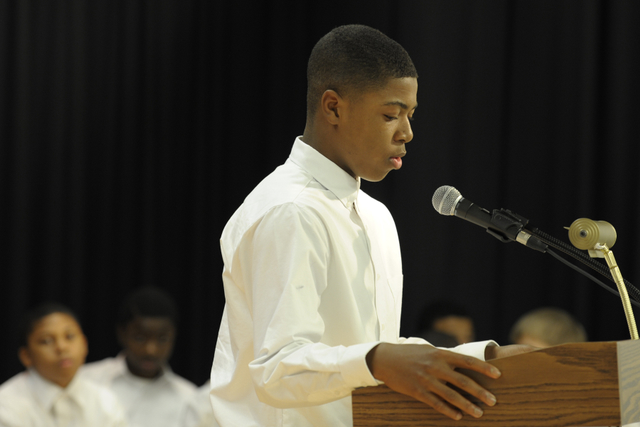
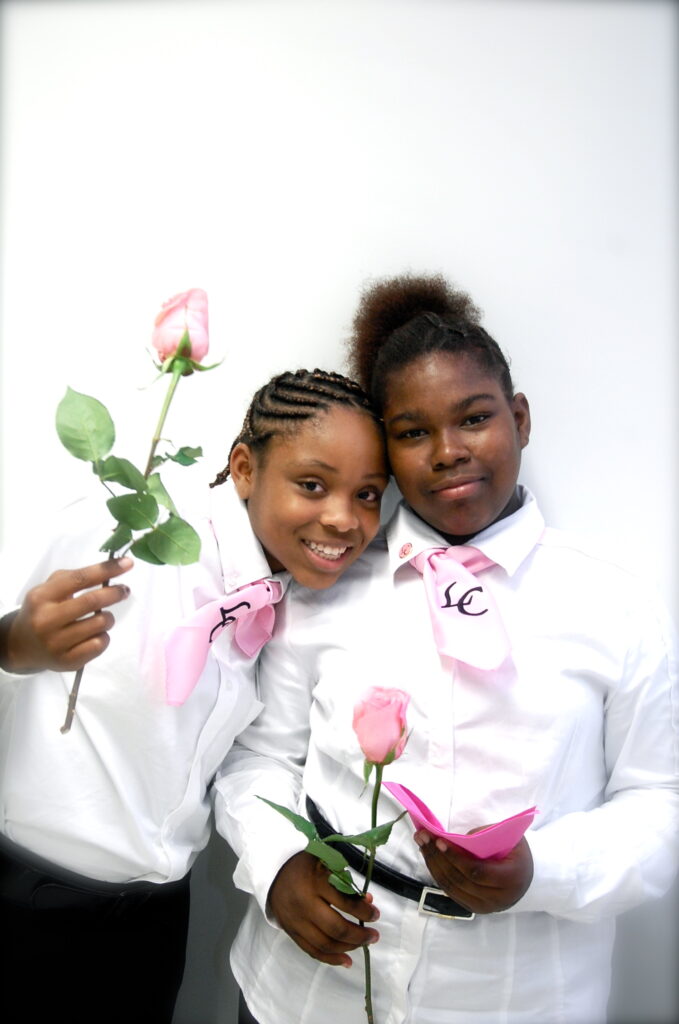
Experiential leadership programs encourage participants to make decisions, take initiative, establish relationships, and be accountable. They provide a foundation of abilities and experiences that may be utilized and modified for real-world events and difficulties in the future. Experiential leaders are encouraged and expected to be curious and ask questions, to experiment and use creativity, to employ problem-solving abilities, and to take ownership—of experiential leadership programs. Participants and learners may examine their values and walk away with a broader perspective and set of skills after each encounter. Opportunities to develop leadership skills may not be easily accessible for today’s at-risk adolescents. Many youth-serving groups cater mainly to students from wealthy households. The Gentlemen’s and Ladies Leadership Clubs (GLC, LLC, respectively) exemplify experiential leadership for middle school students, providing equity and access for all! 

Ladies and Gentlemen

Almost thirty years ago, Dr. Stephen Peters asked for thirty young middle school students. That request was made in the form of a question: Will you become part of my management team?  

Initially established in 1996 as The Gentlemen’s Club, Dr. Stephen Peters formed a partnership with teachers and the school community. The Gentlemen’s Club was conceptualized as a means of capturing children, inspiring their dreams, and giving them hope.

Many student members have become the first in their families to attend and graduate from college.  These alums are making valuable contributions to their families, employers, employees, and the world. The Gentleman and Ladies Leadership Club process facilitates sideways accountability to the degree that it helps create the conditions for both scalable and sustainable success. Further, students are engaged in the ownership of their own educational experience. “We have entered a time when students no longer rely on us to help them prepare for jobs; they need our assistance and guidance to navigate how to create their careers. 

The Process

The curriculum in these programs is shaped by the “Do You Know Enough About Me to Teach Me” model (Peters, 2006).

And covers topics that are relevant to students’ developmental stages, interest levels, and current events and aligned with their dreams and aspirations. While 2 and 4-year college trajectories are encouraged, the program also realizes that students’ dreams and aspirations are aligned with the desire to go into the workforce and/or into the military. The program abides by the following structure :

  • Weekly meetings to reinforce curriculum.
  • Weekly progress reports common language (accountability, responsibility, purpose)
  • Guest speakers, mentors, and role models from the community
  • Service Projects, Dress for Success, and Table Etiquette.
  • Field Experience, Job Shadowing, Digital Badges, and Summer Literacy Summit

The Impact

Case Study

Over three years, 500 middle school boys participated in GLC in Detroit, MI; Atchison, KS; St. Louis, MO; and Orangeburg, SC. Each week, they learned etiquette, leadership, respect, honesty, goal setting, college prep, accountability, peer pressure, self-esteem, learning styles, communication, and public speaking. Teachers completed weekly progress reports and incorporated them into a point system—i.e., academic performance, attendance, and behavior—high points allowed participation in extracurricular activities.

Table 1 shows significant increases in attendance and drastic decreases in behavioral incidents/disciplinary offenses for all grade levels. Academic progress for grades 5, 6, and 8 increased by a letter grade (e.g., from letter grade C to B). For 7th grade, there was an increase of 7.4% within the same letter grade. In addition, surveys showed an increase in students’ motivation and engagement in the learning process.

Classification Attendance Pre/Post Behavior Pre/Post Grades Pre/Post
5th grade 44%/91% 87%/17% Avg. GPA = 2.3/Avg. GPA = 3.3
6th grade 45%/91% 71%/15% Avg. GPA = 2.6/Avg. GPA = 3.3
7th grade 44%/89% 85%/17% Avg. GPA = 2.7/Avg. GPA = 2.9
8th grade 52%/90% 92%/18% Avg. GPA = 2.5 / Avg. GPA = 3.2

I spoke with Dr. Stephen Peters about why experiential leadership programs are important in developing young leaders and what he sees in the future of the Gentlemen’s and Ladies’ Leadership Clubs.

Q: Dr. Peters, what did you see was missing from your school that formed the genesis for the Gentlemen’s Club? 

A: Our school’s culture was not “student-centered,” and we needed to amplify student voice strategically and intentionally as one of our core values. Relationships between adults and students needed improvement, and the Gentlemen’s Club served as a bridge to repairing and recalibrating these connections.

Q: Why do you think experiential leadership programs are essential in and out of school? 

A: They are essential because the foundation of what historically and traditionally occurred in the home is no longer happening to the degree it did in the past. There is a gap, and experiential leadership programs like the GLC fill that gap through the experiences and lessons provided through our program’s curriculum and process.

Q: There is a significant emphasis on character, leadership, discipline, and etiquette in schools in Asia, more so than on test scores and grades. These values are considered crucial for a well-rounded education. 

A: While testing is here to stay, I am a firm believer that we must do more than prepare students for the test. Most students I have worked with in the past and continue to work with can perform well on standardized tests; they just need a more well-rounded educational model that facilitates preparation and readiness for a world that does not always embrace who they are or desire to become.

Q: Do you believe that schools in the US should urgently embrace models that focus on character, leadership, discipline, and etiquette, like the Gentlemen’s Club? 

A: I do not believe that one size fits all models. I believe educational delivery should be customized to the school and students in that school to the degree that all offerings are relevant, meaningful, and purpose-oriented. Moreover, the operating systems in these schools should be aligned with the realities our children face daily.

Q: If so, as your program shows, do you believe that grades will significantly improve? 

A: Yes! Grades are the result of focus, relevance, and effort. Many of our participants simplify the complexity of our work by simply stating, “When I look good, I feel good, and when I feel good, I act good.” A student’s self-esteem is connected to and aligned with their daily experiences. School should not be a place students dread but rather a place they cannot wait to return to; it builds on the day before and the following weeks and months. Further, it shifts the emphasis from becoming successful to responding when I am not successful—one of life’s most valuable and essential lessons.

Q: What is your master plan to replicate the program nationwide, and how can school districts get involved? 

A: Over the last 28 years, our program has been implemented in over 20 states and continuously provides life and leadership experiences for our ladies and gentlemen that prepare them to be “future-ready” leaders. We welcome opportunities to partner with districts, schools, communities, and organizations that believe we can make a positive difference in the world by making a difference in our children, one dream at a time.

The post A Profile in Experiential Leadership: The Impact of the Gentlemen’s and Ladies Leadership Clubs appeared first on Getting Smart.

from Getting Smart https://www.gettingsmart.com/2024/10/01/a-profile-in-experiential-leadership-the-impact-of-the-gentlemens-and-ladies-leadership-clubs/

Reimagining Schools in a Climate-Challenged World

By Cameron Paterson

Our education system faces significant challenges. Young people are signaling their discontent through declining attendance, increasing disruptive behavior, and concerning levels of mental health issues – tangible expressions of the desire for an educational experience that better resonates with the aspirations and demands of the contemporary world. Increasing numbers of school refusers and reports from over three-quarters of Australian students that they didn’t fully try in the latest PISA tests underscore the urgency.

Perhaps not so disconnected, renowned climate scientist Joele Gergis warns of a future where temperature increases of 4.0 to 7.0 degrees Celsius by 2100 could become a reality, presenting humanity with a critical choice between extinction and transformation. She writes, “We need you to stare into the abyss with us and not turn away. Australia’s climate is fast becoming more extreme and unpredictable, edging us closer towards breaching thresholds that will make it very difficult, if not impossible, to adapt to…. If we don’t put the brakes on industrial emissions immediately, children alive today will inherit this nightmarish future.“ The growing presence of microplastics, now making up approximately 0.5% of the average human brain’s weight and having increased by 50% in brain tissue since 2016, is a sobering reminder of the environmental degradation we face.

As we confront these challenges, it is essential to infuse education with the awareness that we stand at a pivotal juncture. We must redefine success as a future where humans thrive sustainably, inseparable from the well-being of our planet. Every teacher is now a Climate Teacher, playing a pivotal role in shaping eco-conscious minds.

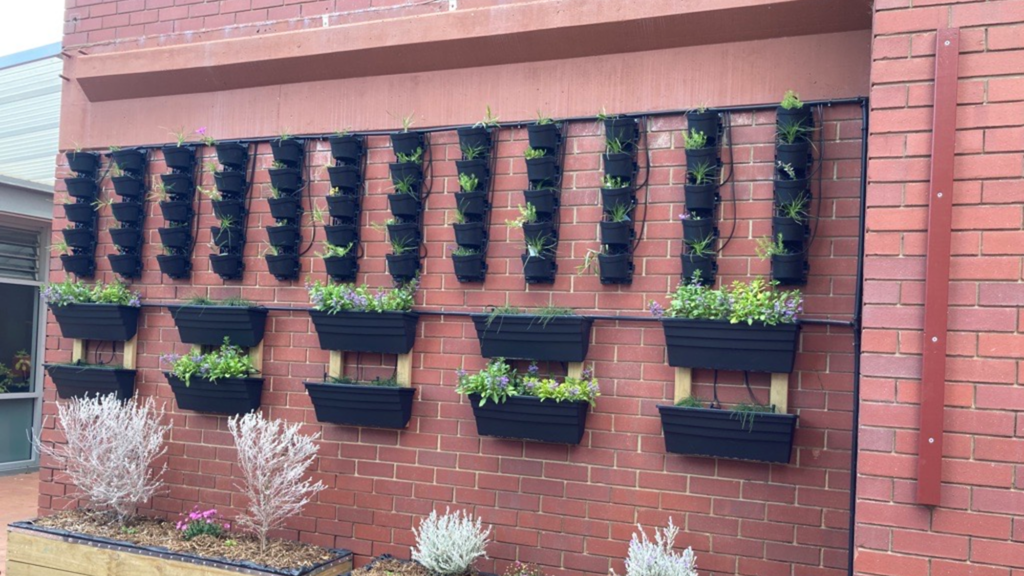
Addressing eco-anxiety requires action, and for young people this can be growing food, caring for animals, and greening schools. The state of Victoria in Australia now has a wonderful Environmental Sustainability in Schools Policy. The UK has committed to appointing sustainability coordinators in every state school by 2025. Wesley College in Melbourne, Australia, is partnering with Inspire Citizens and several forward-thinking initiatives are in the pipeline:

Declare a Stance on the Climate Emergency. Inspired by Ecolint, schools can formulate a clear position on the climate crisis. A public declaration will demonstrate commitment to addressing the climate emergency and galvanize the community into action. By aligning values with climate realities, schools can act as leaders in societal change.

Reorient Professional Learning Toward Sustainability. Professional learning and coaching are shifting to integrate sustainability and the United Nations Sustainable Development Goals (SDGs). As staff grow in their understanding, they can inspire students to see global challenges through a lens of ecological and social responsibility.

Enhance Service Learning Through Systems Thinking. Service learning is being expanded using systems thinking tools. Through training from Compass Education, both staff and students will develop the skills to understand and address complex global problems. This approach fosters a deeper sense of responsibility and empowerment as students contribute to sustainable solutions within their communities.

Establish a Schoolwide Service Learning Framework. A cohesive framework for Service Learning will map out grade-level expectations and project progression. This will ensure a structured, consistent approach to embedding service into every stage of a student’s journey. A manual will guide teachers and students alike, promoting long-term, meaningful engagement.

Systematize and Celebrate Service Contributions. Recognizing and celebrating service contributions regularly through newsletters, social media, and community events will boost morale and inspire others to participate. This ongoing public recognition helps cultivate a culture where sustainability and service are both valued and celebrated, reinforcing their importance in school life.

Create a Comprehensive Scope and Sequence for Sustainability. A detailed map covering all grade levels will be developed to ensure a cohesive and progressive approach to sustainability. This scope and sequence will guide curriculum design, ensuring that every student, from Elementary to High School, engages deeply with sustainability topics. It ensures that students gain both knowledge and practical experience over time.

Pursue Eco-Schools Accreditation and Join the Alliance for Sustainable Schools. By working towards Eco-Schools Accreditation and joining The Alliance for Sustainable Schools, schools can align with global best practices in sustainability. These affiliations will not only enhance credibility but also provide access to a network of like-minded institutions, fostering collaboration and innovation.

Students at Perth College in Australia did a heatmap of the school and then greened the hotspots.

Beyond traditional sustainability, the concept of regeneration beckons—a paradigm that goes beyond avoiding harm to actively repairing and restoring the damage inflicted upon the planet. It’s time to shift from an extractive approach to a regenerative one, giving back more to the environment than we take. In Australia, the Woodleigh Institute is building an alliance to propel change in education through a focus on systems thinking, well-being, and regeneration.

The world is experiencing a profound cultural transformation, perhaps even more demanding than the Scientific Revolution. As we confront the urgency of the climate crisis, the rise of Asia, and the exponential growth of artificial intelligence and robotics, we stand at the threshold of a new era. The solutions to these global shifts may lie in the integration of Indigenous wisdom, which emphasizes deep connections to nature and sustainable living, offering invaluable insights for navigating this unprecedented change.

The challenges facing our education system demand a profound shift in perspective, acknowledging the discontent of young people as a crucial signal. Book learning isn’t enough in a climate-changed world. We must prioritize the development of schools explicitly designed to cultivate people who can thrive in a world undergoing transformative change. The canary in the coalmine of youth disengagement, combined with the urgency of warnings from climate science, underscores the need to reimagine education as a cornerstone for a sustainable and regenerative future. 

The post Reimagining Schools in a Climate-Challenged World appeared first on Getting Smart.

from Getting Smart https://www.gettingsmart.com/2024/09/30/reimagining-schools-in-a-climate-challenged-world/

Kindling the Spark: How the Portrait of a Graduate Becomes the Catalyst for Transformation

America’s education system was a groundbreaking effort to help a growing nation thrive in the 19th century. Now, 200 years later, the world has changed; the horizon looks drastically different. Collectively, we need to redesign our education system to enable all of our children — and, by extension, our nation —  to thrive today and tomorrow. “Horizon Three” or “H3” names the future-ready system we need, one that is grounded in equity serving learners’ individual strengths and needs as well as the common good. This series provides a glimpse of where H3 is already being designed and built. It also includes provocations about how we might fundamentally reimagine learning for the future ahead. You can learn more about the horizons framing here.


By Mike Duncan

It is often said that every system is uniquely designed to get the results it gets. The American education system, as it stands today, is designed to produce students who can digest knowledge and apply those facts to a series of tests — standardized and normed so we can compare manufactured apples to manufactured apples.

It’s no surprise that students struggle to find meaning in this forced march through a curriculum that holds no special value to them. Is it possible that the decades-old system designed to improve success for all students unintentionally engineered joy and value out of the process, ignoring the very thing that makes us human – curiosity, exploration, and discovery?

Courageous education leaders across the country have responded. Hundreds of school districts have adopted a Portrait of a Graduate, many of them with help from Battelle for Kids (BFK), that define the durable skills – such as critical thinking, communication, and creativity – that students need as they matriculate through the education system and become productive adults.

As Antonia Rudenstine highlighted in another post in this series, we’re headed into a VUCA world (volatile, uncertain, complex, and abstract) and it’s important that we do the work to think about what skills and capabilities our young people need. These durable skills, combined with evolving requisite knowledge and literacies,, are critical for helping students find success in what’s next.  

We often see well-meaning educators and districts point to their Portrait of a Graduate as the destination. It’s certainly a checkpoint on the journey to system transformation, but it’s not the end goal.

Instead, the Portrait of a Graduate is a catalyst for change.

As a former superintendent, adopting a Portrait of a Graduate in my district shifted my focus from test scores to infusing education with meaning and joy, emphasizing real-world applications and fostering student agency.

How do you take a Portrait of a Graduate and kindle the spark of this type of change? 

Here are three ideas to create the conditions for success based on Battelle for Kids’ extensive work with districts over the past decade. 

Ask the Students

The Portrait of a Graduate is locally developed and reflects the values of the community the school district serves. To accomplish this, the Portrait of a Graduate should be informed by diverse and representative community voices to create a collective, unifying vision. The Portrait can never be completed in isolation without these community voices.

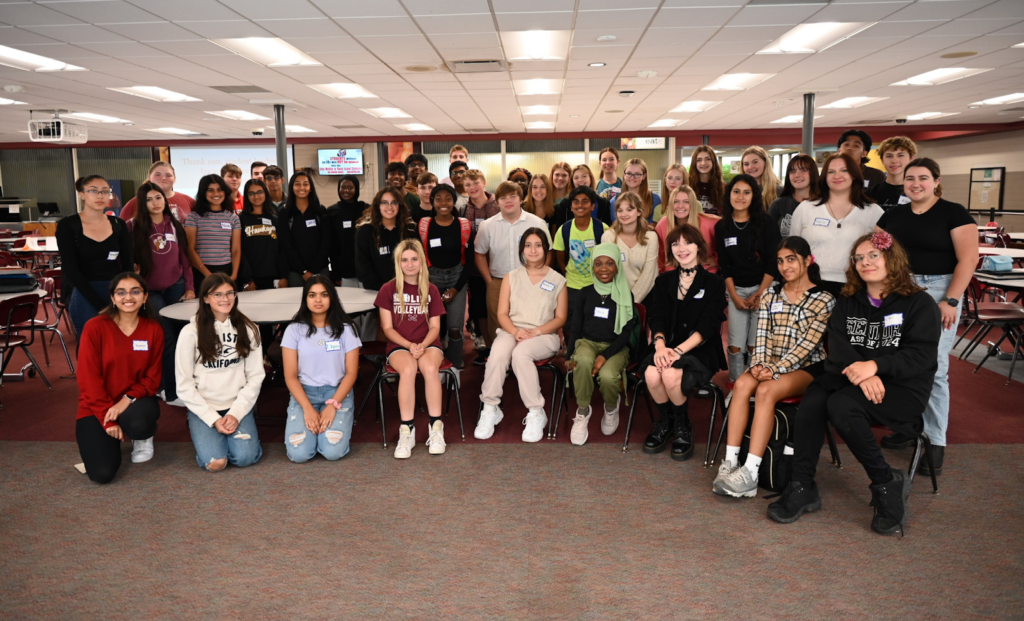
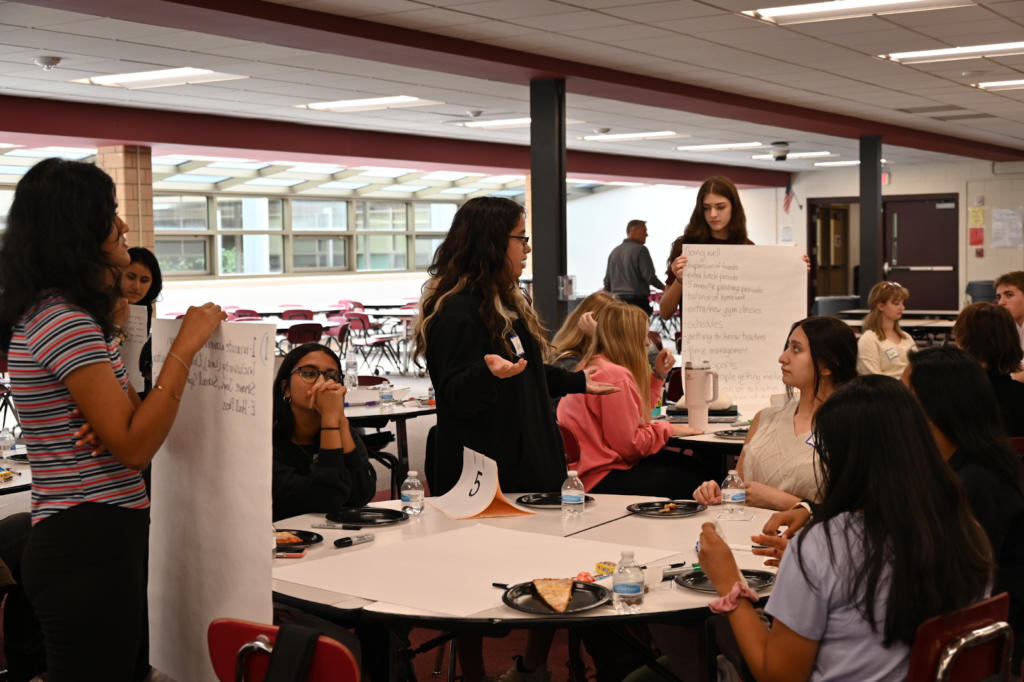
Perhaps the most important voice to include is that of the students. They are the stakeholders who will be impacted the most but oftentimes are called upon the least for input. This not only empowers students by building their agency but also demonstrates to other students the impact of their voice. This is a great opportunity to model community design processes to both include young people and teach them valuable skills and mindsets. 

Battelle for Kids worked with Vineland Public Schools in New Jersey to develop their Portrait of a Graduate. In addition to its community design team, Vineland tapped two teams of students to meet directly with BFK’s Jessica Harding, who was facilitating the design process for the district. 

“The students had such a rich conversation and added so much to the process,” said Harding. “I always encourage superintendents and school leaders who are leading a project, ‘Listen to the students.’ We are creating this Portrait of a Graduate – what they want should be considered. The kids really do know what they want.”

Leaders in the Moline-Coal Valley School District in Illinois took it a step further. When they were ready to develop a Portrait of an Educator, in alignment with their Portrait of a Graduate, they tapped the people who they believed knew best what to look for in educators – the students.

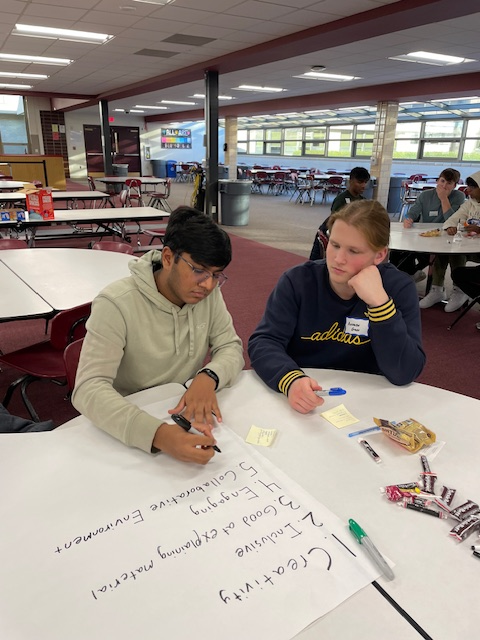
Over the course of a school year, more than 60 Moline-Coal Valley students took part in a Superintendent-Student Advisory Council. The student-led group was solely responsible for identifying six competencies and accompanying descriptions that comprise the district’s Portrait of an Educator.

“Nothing about them without them! It is this mindset that inspired our Portrait of a Moline-Coal Valley Educator,” said Superintendent of Schools Rachel Savage, Ed.D. “The student-led and completely student-generated list of core competencies captures the voice of our most important customers, our students.”

As created by students, the competencies in the Moline-Coal Valley Portrait of an Educator include:

  • Understands Students’ Lives
  • Is Upbeat, Positive, and Relatable
  • Communicates Effectively
  • Is Confident, Competent, and Prepared
  • Is Timely and Fair
  • Is Passionate and Creative

“To achieve our desired results, it is essential to engage students and provide a platform for them to take an active role in their own learning,” added Savage. “This new tool will help ensure we are hiring the type of educators that our students can depend on to help them reach their fullest potential.”

The students also informed the development of a logo – featuring the likeness of a superhero, no less – to represent how they see educators and how they feel educators want to be seen by students.

If it’s not obvious by now, the kids really do know what they want.

Make it Easy for Teachers

Like any successful initiative in education, teacher buy-in is crucial. These are the people who will bring the Portrait of a Graduate to life in the classroom. How do we make this easy for teachers – especially for those who may be reluctant to embrace change?

In Louisa County Public Schools (LCPS) in Virginia, they built momentum around their Portrait of a Graduate through impactful and relevant professional learning. 

LCPS knew it needed to turbocharge its efforts to spread and scale the 5 C’s – Citizenship, Collaboration, Communication, Creativity, and Critical Thinking – in its Portrait of a Graduate. 

To accomplish this, LCPS invested in professional learning with the creation of “Launch,” an ambitious district-wide professional development conference that had the feel of a national event. The conference offered more than 80 different sessions focused on the 5 C’s to spark inspiration in teachers.

“This was not a one-size-fits-all type of event. We prioritized voice and choice,” said Justin Grigg, Assistant Superintendent of Instruction. “Teachers chose what sessions they attended and then brought those insights back to their classrooms.”

Many districts have also accelerated success by creating tools and resources for teachers, including grade-level rubrics, “I Can” statements, and sample performance tasks. 

The North Carolina Department of Public Instruction (NCDPI) is perhaps the best example of this strategy of empowering educators. NCDPI worked with Battelle for Kids to develop a comprehensive set of resources to help schools and teachers successfully implement the North Carolina Portrait of a Graduate.

Educators from across the state were involved in the design of these resources, collaborating to create classroom-ready materials and field-tested performance tasks. NCDPI published the resources on its website for easy access and continues to support educators with professional learning.

“What is so exciting about these performance tasks is that they were created by teachers for teachers! They are student-tested, standards-aligned, and ready to be used across the state,” said Catherine Truitt, State Superintendent of Public Instruction. “Infusing hands-on learning and career exposure into everyday lessons will increase student engagement and show them the real-world relevance of their education.”

Meet Your Community Where They Are

Sometimes we see initiatives fail because we don’t take into account the diverse needs of the community we serve. There are barriers to access and inclusion that can derail good intentions if we’re not mindful. 

When Columbus City Schools (CCS) in Ohio was ready to launch its Portrait of a Graduate, it was important that all stakeholders were able to easily access and understand the attributes and what they meant for students. In a district where more than 100 different languages are spoken in homes, this was not an easy task.

Part of the launch efforts included printing materials for families in various languages beyond just English. Wanting to scale the accessibility even further, CCS created Portrait of a Graduate posters in multiple languages so students walking the halls could read them in their family’s native language.

“This work is a testament to our belief in an inclusive education that uplifts every student, regardless of their background,” said Superintendent Angela Chapman. “It’s about empowerment, equity, and fostering a future where every learner will thrive.”

CCS also considered its youngest learners, “translating” the Portrait of a Graduate descriptions into simpler terms that elementary students could more readily comprehend. The district used these descriptors on “kid-friendly” posters designed as a self-portrait for students to see themselves within.

Similarly, Hardin Public Schools in Montana honored the cultural input and history of the community it serves when the district launched its Portrait of a Graduate in two languages – English and Apsáalooke. Hardin serves the Crow Reservation in southern Montana, and 90% of its students are Native American. 

“We chose to create a version that incorporates the Apsáalooke word for each of our core competencies as a way to respect the cultural background of the majority of our students and the history of where we live and work,” said Superintendent Tobin Novasio. “We hope this will also help create that sense of belonging we are working toward for our students.”

That’s what this work is all about—creating meaning and a greater sense of belonging and self in students. Horizon Three (H3) of education demands authentic learning experiences that equip students with the knowledge and durable skills necessary for work and life. The Portrait of a Graduate is one catalyst that can spark this change within education systems and alongside the community. 

Mike Duncan, Ed.D., joined Battelle for Kids in August 2023 and serves as the organization’s president and CEO. Prior to his role, he was one of Georgia’s longest-serving superintendents, as well as a high-school principal, high-school and middle-school assistant principal, and middle-school teacher.

This blog series is sponsored by LearnerStudio, a non-profit organization accelerating progress towards a future of learning where young people are inspired and prepared to thrive in the Age of AI – as individuals, in careers, in their communities and our democracy. 
Curation of this series is led by Sujata Bhatt, founder of Incubate Learning, which is focused on reconnecting humans to their love of learning and creating.

The post Kindling the Spark: How the Portrait of a Graduate Becomes the Catalyst for Transformation appeared first on Getting Smart.

from Getting Smart https://www.gettingsmart.com/2024/09/26/kindling-the-spark-how-the-portrait-of-a-graduate-becomes-the-catalyst-for-transformation/

Why High-Quality Learning Opportunities Must Be Accessible to Every Student

In August, we published the following design principles, which we believe are core for every learner to thrive. In this blog, we present our rationale for elevating accessibility – that all students deserve access to high-quality learning opportunities that support long-term success and a strong sense of belonging.

Design Principles

Accessible

All students deserve access to high-quality learning opportunities that support long-term success and a strong sense of belonging.

Personalized

Every learner is different. By providing (or supporting learners to co-author) personalized approaches that meet challenging outcomes, we increase the chances of success for every learner. Competency-based approaches can ensure proficiency on all outcomes.

Purposeful

Learning experiences should help students find and develop a purpose or purpose mindset to make a difference in the world.

Joyful

When learning leads to awe, wonder, joy, or engagement, outcomes are stronger. Joy can be supported by strong relationships with others (peers, mentors, teachers, etc.).

Authentic

Building learning experiences that are culturally-connected, contextualized, relevant, place-based or real-world increases engagement and outcomes.

Challenging

Every learner deserves to be intellectually challenged with high expectations.

Definition

What do we mean by high quality? For us, this means access to high-quality instruction, curriculum, and assessment. While culture and climate are also critically important, we leave that to our discussion around our design principle of “joyful.” High quality also reflects outcomes of both belonging (a student’s sense that they are part of and can contribute to a community) and success (students reach the outcomes that set them up for life in school and beyond).

Evidence

Why did “Accessible” rise to the top as one of our design principles? According to recent studies, belonging (with its correlated opposite – loneliness) has increased in adolescents since 2012. Loneliness is negatively correlated with positive affect and life satisfaction; loneliness is also positively correlated with adverse academic outcomes. So, belonging matters and is directly correlated with accessibility. If you cannot access high-quality learning opportunities, your sense of belonging decreases. 

We also know that evidence exists that instruction and curriculum are directly correlated with student success. Much research points to the importance of high-quality teachers as a critical factor in student outcomes. Additionally, high-quality curricula can positively impact outcomes across different demographics. Good teachers who can offer and support a high-quality curriculum lead to the best chances of a student reaching their long-term success goals. Unfortunately, access to high-quality instruction and curriculum is distributed inequitably across the educational landscape – from district to district and from teacher to teacher.

Examples

Many organizations work to ensure access to high-quality learning opportunities. These organizations focus on helping students access opportunities within and beyond their current school.

Organizations that increase access beyond their current school often reduce or eliminate barriers to high-quality learning experiences. 

  • Questbridge provides support and resources to increase access to higher education organizations.
  • Education Trust supports policies and practices to help dismantle education’s racial and socio-economic barriers.
  • One Goal addresses the opportunity gap for students focused on post-secondary education. 
  • The Center for Learning Equity ensures that students with disabilities have equitable access to high-quality public education.

While these organizations are critical to helping students access future opportunities, we often think about program design opportunities within an existing school or learning community. Interplay Learning increases access to trade certifications through virtual reality platforms in low-funded schools or areas where finding certified instructors is more complex (such as rural areas). Popular microschool models, while often emerging in the private sector, also exist in the public space. Access to microschools may be a key lever in increasing access to high-quality learning experiences. Efforts by ASU Prep Digital, Purdue Polytechnic High Schools, Lamont School District, Escondido School District, and Issaquah School District all address access issues by building high-quality microschools within public districts. Equal Opportunity Schools supports schools by increasing the number of under-represented students in advanced courses such as AP or IB.

Recommendations

At a basic level, high-quality learning experiences should be accessible to every student. The most important levers to pull include:

  1. Implement universal learning plans. Create personalized learning plans for every student to address their individual needs and goals. See Vermont’s approach as an example.
  2. Increase access to experiential learning. Provide opportunities for all students to engage in real-world learning experiences. This is not just for students in advanced classes; it should be available and designed for all learners.
  3. Invest in Teacher Development: Provide personalized, ongoing professional development and coaching connected to learning sciences to increase every teacher’s instruction and curriculum design level. High-quality learning starts with skilled educators. 
  4. Leverage Technology for Equity: Expand access to digital learning tools and resources, especially in underserved communities. Technology can bridge gaps in education by providing personalized, interactive, and engaging learning experiences.
  5. Foster Community and Family Partnerships: Strengthen collaborations between schools, families, and local communities. These partnerships can offer students additional support networks and resources that enhance learning, such as mentorship programs, community-based projects, and access to extracurricular opportunities.
  6. Support Inclusive Learning Environments: Create culturally responsive and inclusive classrooms that meet the needs of all students. This ensures that all students feel represented, valued, and supported.
  7. Expand Access to Specialized Programs: Increase opportunities for students to engage in specialized learning experiences, such as STEM programs, arts education, and career pathways, regardless of socioeconomic background or geographic location.
  8. Adopt Flexible Learning Models: Provide students with flexible scheduling options and varied learning formats, such as hybrid or online learning options. This allows students to access education independently and accommodates different learning styles and needs.

After reading this, does this still sound like one of the six most important design principles? Email us at mason@gettingsmart.com to share your feedback!

The post Why High-Quality Learning Opportunities Must Be Accessible to Every Student appeared first on Getting Smart.

from Getting Smart https://www.gettingsmart.com/2024/09/24/why-high-quality-learning-opportunities-must-be-accessible-to-every-student/

Educators discuss the state of creativity in an AI world

By: Joe & Kristin Merrill, LaKeshia Brooks, Dominique’ Harbour, Erika Sandstrom

Another school year is in full swing and one of the most discussed topics in education is the integration of artificial intelligence in classrooms. 

The conversation has sparked an interesting debate: is AI enhancing or eroding creativity among students? A new report from Canva reveals that 62% of educators believe student creativity has increased over the past few years. We recently spoke with several edtech-savvy educators from all across the U.S. to get their thoughts on the state of creativity in the classroom and to discuss their process for integrating AI. 

Kristin Merrill, 4th Grade Teacher, Certified Microsoft Innovative Educator

Joe Merrill, 1st Grade Teacher, Certified Microsoft Innovative Educator (Naples, FL)

Using AI levels the playing field for creativity. Now, there’s no need for someone who thinks they can’t draw to avoid illustrating a picture. With AI, they can still use those creative thoughts to bring their vision to reality. We also believe it is vital to educate our students on the importance of using AI responsibly. 

This year, we are using the app School AI, which allows educators to create Spaces (or chatbots) that can be used to help coach or tutor our students, act as a historical figure, or character from a book, and much more. These Spaces can be tied directly into standards, and the educator is able to monitor the conversations between the students and AI to help ensure the responsible use of the technology. 

We believe that AI acts as a source of inspiration. There are times where you enter a prompt, and the results may not be exactly what you had envisioned. Maybe you need to be a bit more creative with your prompt, or perhaps how it is worded. We spend a lot of time teaching about prompting the AI, and we explain the importance of phrasing exactly what the students are looking for. These skills transition into other curricular areas, so they’re quite beneficial!

LaKeshia Brooks, Virtual K-12 math teacher, Microsoft Innovative Education Expert, Education Imagine Academy (Wichita, KS)

AI encourages creativity, not only among students but with teachers as well. As a teacher, having the ability to bring lessons to life and personalize curriculum for my student’s needs is a major time saver that allows me to explore other classroom resources and work independently with students.

This year I have the opportunity to teach Digital Literacy to 6th graders using Common Sense Education resources and instruct students on AI. As a math teacher, AI looks a little different for my students. I am currently using AI-assisted models like Microsoft Math Solver to help them see the step-by-step process of solving a problem and boost their confidence as they work asynchronously. Overall, I plan to increase my students’ exposure to and experience with AI this year.

Dominique’ Harbour, Educational Technology Specialist, Atlanta Public Schools (Atlanta, GA)

I support the integration of AI by training teachers on how to effectively and creatively deploy artificial intelligence with students in the classroom. I highlight the pros and cons of AI and provide ideas and strategies for its use. We allow teachers to engage with our recommended AI tools from a student’s perspective to help them see what the user experience is like. I also emphasize the skill of prompting to maximize its efficiency.

I believe that AI can absolutely enhance and support creativity in the classroom. As with all technology, however, the focus shouldn’t be on the tool itself but on how the tool is used within a lesson. With the correct guidance and parameters, I have seen firsthand how AI can help students brainstorm ideas, visualize abstract concepts, and generate images. For example, I led a Canva project with high school students where they explored their own superpowers by creating an AI-generated video, helping them engage with creativity and self-expression.

Erika Sandstrom, Digital Media Teacher/Digital Learning Coach, Peabody Public Schools (Boston, MA)

I believe AI can significantly enhance and support creativity in the classroom by providing tools that encourage student expression and innovation. For instance, I have used Canva AI tools to design breathing bubble backgrounds that allow students to recreate memories and express gratitude for places and experiences they can’t capture in real footage. I have also used Adobe Express Firefly to design unique and tailored backgrounds and scenes for our Animate from Audio characters, infusing humor and creativity into our lessons.

AI allows for a more personalized learning experience, where students can explore creative ideas without the limitations often imposed by traditional classroom settings. This year, I’m harnessing AI tools like Magic School AI for script writing and Curipod for interactive lessons with real-time feedback. This approach allows students to express themselves freely, without the fear of peer pressure. It’s been incredibly rewarding to see my quieter students light up when I praise their fantastic answers in Curipod, all while using AI-generated nicknames that protect their privacy. The integration of AI feedback tools as a co-teacher in the room enriches the overall learning experience, making it more engaging and less stressful for both students and educators.

The post Educators discuss the state of creativity in an AI world appeared first on Getting Smart.

from Getting Smart https://www.gettingsmart.com/2024/09/23/educators-discuss-the-state-of-creativity-in-an-ai-world/

What Should Young People Get Really Good At?

America’s education system was a groundbreaking effort to help a growing nation thrive in the 19th century. Now, 200 years later, the world has changed; the horizon looks drastically different. Collectively, we need to redesign our education system to enable all of our children — and, by extension, our nation —  to thrive today and tomorrow. “Horizon Three” or “H3” names the future-ready system we need, one that is grounded in equity serving learners’ individual strengths and needs as well as the common good. This series provides a glimpse of where H3 is already being designed and built. It also includes provocations about how we might fundamentally reimagine learning for the future ahead. You can learn more about the horizons framing here.

By: Antonia Rudenstine

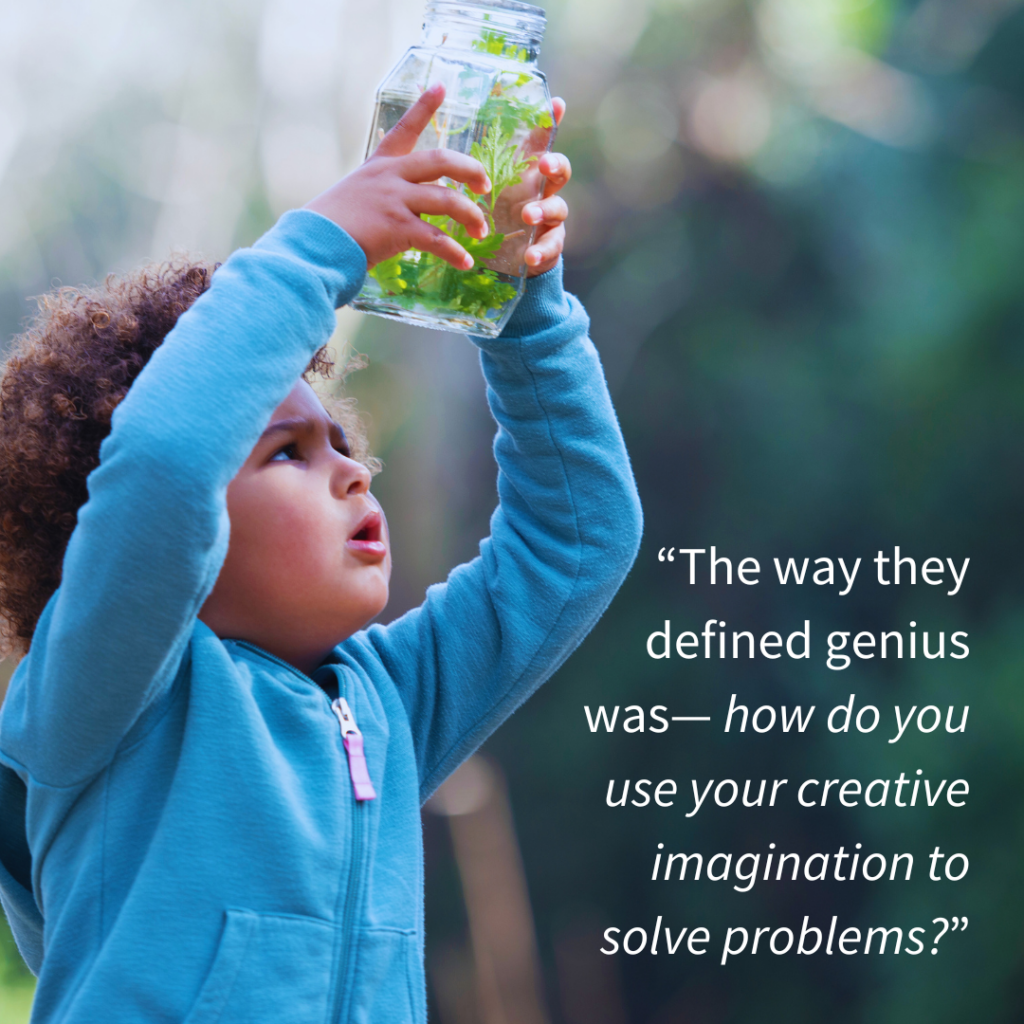
A few days ago I came across an Instagram reel that reminded me of what the potential of learning can be, and what happens when the learning models we design miss the mark. The reel describes a study that George Land undertook on behalf of NASA, attempting to understand how to identify genius. The punchline: At five years old, 98% of young people met NASA’s definition of genius. They tested this same group every five years, with shocking decreases in the %. When tested as adults, only 2% were able to use creative imagination to solve problems.

Check out the reel–less than 2 minutes–of young geniuses at work. Or George Land’s TEDxTalk-13 mins.

If you’ve ever spent time with a 5-year-old, you’ll remember how magical their brains are: How they brim with questions: Why is the sky blue? Where do people go when they die? Why is my friend sad? Is today tomorrow? Who made the world? (thanks to ChatGPT for this list).  

You find them wandering around playgrounds picking up rocks and sticks and buttons and glass to incorporate into their play. They tell stories and create drawings, sculptures, and paintings. They design games with complex scenarios and rules and experiment with objects in order to figure out how things work. 

In short, they are budding scientists, designers, philosophers, artists, and social scientists, engaged in refining future-ready skills. Their approach is transdisciplinary: their games and questions and design solutions are not limited to the knowledge and skills of science or math or ELA: they are building schemas that make connections that traverse the walls of our disciplines. They make meaning by following their interests and curiosity, not abiding by the rules of circumscribed content. 

So what happens between age 5 and adulthood? Land’s theory: the more time young people spend in school–with increasingly limited opportunities to explore, tinker, iterate, and experiment–the less able they are to engage in the intertwined skills of creativity and problem-solving: the less opportunity they have to develop their genius. 

I ultimately left the classroom to explore three related questions, that have continued to animate my professional life for thirty years: 

  • What should young people get really good at?
  • What should young people do all day: what’s worth the commitment we ask them–and their families–to make: 180 days a year for 13 or 14 years? 
  • How can we design learning communities that place these questions at the heart of the work, and continue to iterate on the model in response to our rapidly changing world?

For me, the answer is to embrace this current moment to rethink the enterprise. The current VUCA (volatile, uncertain, complex, and abstract) moment has created a unique opportunity to reimagine what’s possible. For example, with the mainstream hyper-adoption of of AI, we no longer know what procedural knowledge (facts, information, formulas, processes, etc) young people actually need to learn: 

  • Do they still need to memorize the formula for the Pythagorean Theorem, the steps for the scientific method, or what onomatopoeia means? 
  • Or do they just need to know what these are, and be able to ask ChatGPT–or other tools we can’t yet imagine–to create an experiment, write a poem, or design an architectural model? 
  • Or, even more likely, can they just ask ChatGPT to create a poem on a particular topic, and ChatGPT will decide if onomatopoeia is a good structure?

I do not ask these questions lightly: we truly do not know what schema-building will look like from this point forward. (As a side note, it would be very helpful to have research entities launch longitudinal, interdisciplinary studies to help us understand how young people develop schemas when they use AI tools to undertake projects, and to identify the schema being developed.)

What we do know is that knowledge, skills, and learning are at an inflection point that is so profound it is difficult to fully grasp: 

While this can be overwhelming and unsettling, it’s also an exciting opportunity to create school models that keep the vision of 5-year-old geniuses at the heart of the enterprise. Learning experiences in these learner-centered communities could have four foci: 

  • Deep understanding of Key Concepts–as a replacement for prescribed content limited to the four core content areas
  • Mastery of Core Thinking Processes–as a replacement for the rote learning of procedures
  • Development of Future Ready Competencies–as a replacement for age-based, discipline-based skills
  • Engagement with Relevant and Meaningful Projects, Designs, and Products–as a replacement for activities, worksheets, tasks, and assessments that develop and measure lower-order thinking skills

Key Concepts

While I am a strong advocate for unlocking ourselves from the bindings of the 4 core content areas that the Committee of 10 enshrined in 1894, and the standards movement further instantiated with No Child Left Behind, I am an equally strong proponent of the deep study of ideas and knowledge. 

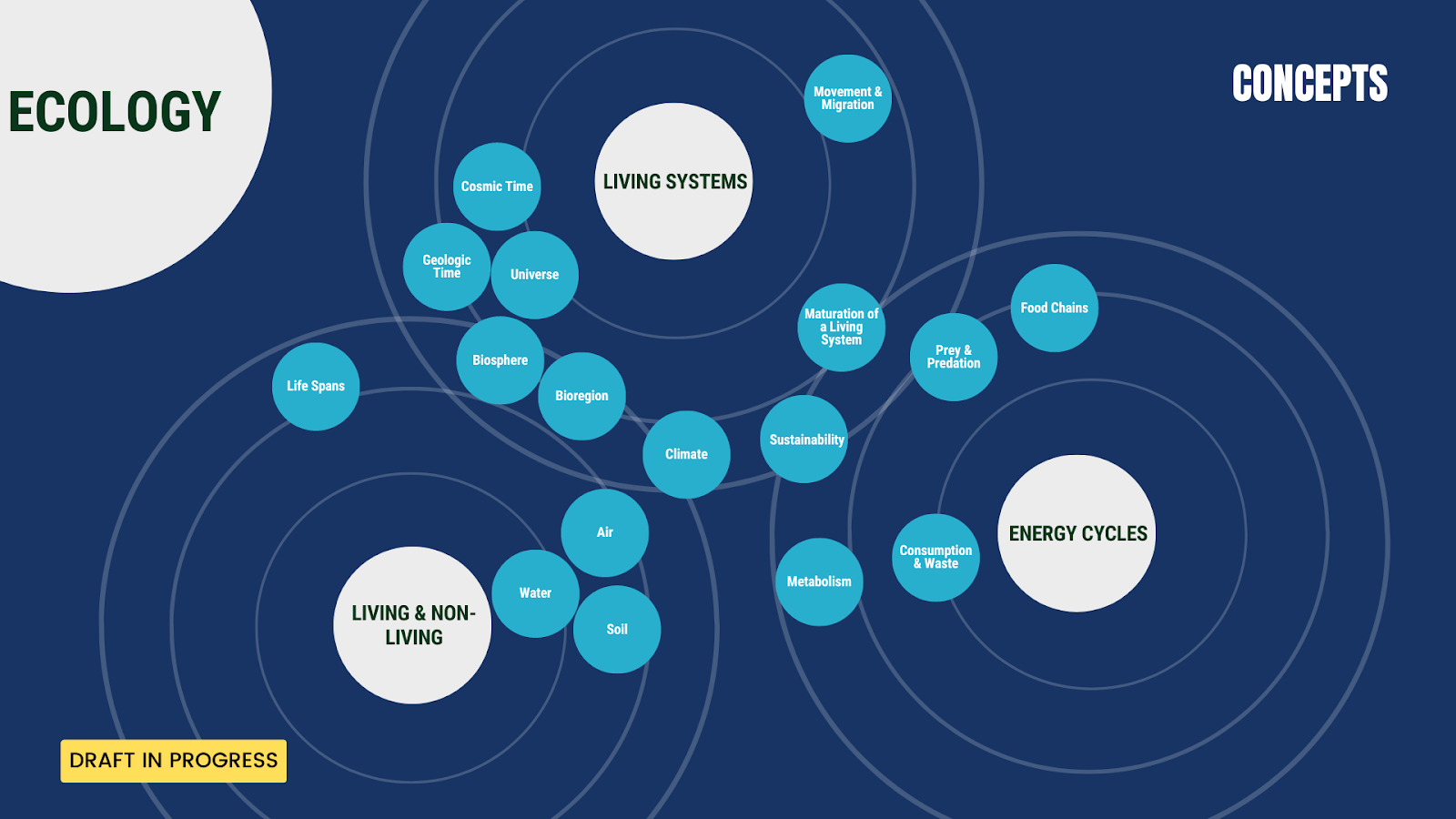
What I am excited about is the possibilities of a “third way:” Could we identify a far more limited set of interconnected key concepts and knowledge that we believe all young people should learn–some disciplinary and some inter- and trans-disciplinary? For example, a set of Life Science Concept Clusters

And then, map a very broad set that young people COULD explore, using their agency to make decisions about the path to follow: some community-specific, some grounded in the lived experiences, culture, and history of many peoples, some grounded in new information and ideas, and some grounded in work and community needs of the future. 

For example, Kara Bobroff so eloquently describes the ways NACA honors Indigenous ways of knowing could be honored, cultivated, and instantiated, as they are in the NACA-inspired schools network, while other communities and peoples might center different experiences. This both/and approach provides communities and families with many choices, acknowledging the truly fluid state of information and ideas. Simultaneously, it establishes a set of vetted concepts, without a top-down set of requirements. The difference: the vetted concepts tap into knowledge and ways of knowing far beyond the 4 core content areas.

Core Thinking Processes

These are the “key processes that can help young people create value in the real world” as they work with key concepts: processes such as the Scientific Method, Design Thinking, and the Creative Process. Sujata Bhatt built The Incubator School around core processes specific to Entrepreneurship. At Lemelson/MIT they apply a core process specific to Invention Education, guiding high school InvenTeams to develop patentable solutions to real-world problems. 

Core processes are a powerful tool for learning and creation. Young people who understand their architecture can use them–over and over again, with different concepts and content, and across different contexts–as they design, create, and produce a wide array of projects. Using these processes repeatedly supports their development of self-efficacy and agency

Future Ready Competencies

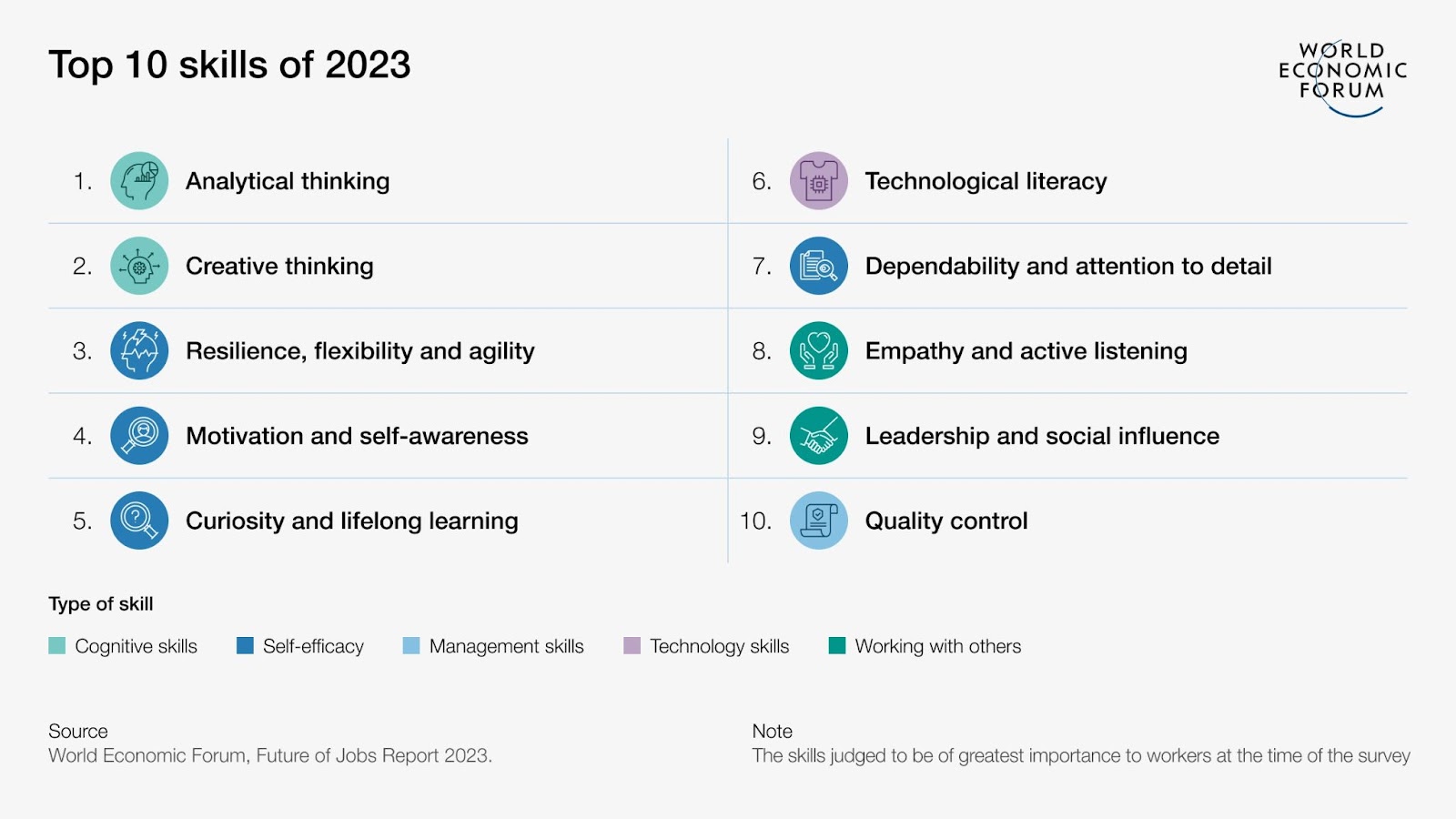
It used to be that one could find predictions for the future of work stretching out 10 or even 20 years. Since the release of large language models, such as ChatGPT and Claude, the timelines for these predictions have shrunk to 3-5 years. For example, in 2023, the World Economic Forum limited itself to naming the 10 most important skills for THAT year:

(https://www.weforum.org/publications/the-future-of-jobs-report-2023/in-full/)

While America Succeeds’ Durable Skills Framework describes a similar set of skills prioritized by CURRENT employers. These are essential contributions, helping us understand the current and near-future demands of the workplace. However, futurist Nikolas Badminton reminds us: “It’s not which jobs will be automated, but when they will be automated: every part of the economy will be affected…[but] while there will be a shift towards automation, I think we’ll be a world of the human and machine working together in symbiosis…We will be freed from repetitive work to do more creative things together. I call this new world the ‘wisdom economy’.” 

So, at this precipice, it is critical to ask: What should young people get really good at? Which competencies are the “right” ones for a wisdom economy, a creative economy, or an economy that requires strategic, analytical thinking? 

There are an increasing number of competency frameworks to choose from, and while I’m partial to reDesign’s Future9–which starts with UNESCO’s four premises for lifelong and life-wide education: “learning how to learn, learning how to do, learning how to live, and learning how to be”–I am also a believer in the power of communities to define what’s important. 

As communities undergo the work of articulating core competencies, it may be helpful to pressure-test new frameworks, using a few questions:

Are our competencies:

  • Aligned with the Science of Learning and Development (SoLD): i.e. can young people or adults actually LEARN these? Many frameworks identify values and beliefs that aren’t so easy to explicitly teach or learn, which can set up young people for failure.
  • Enabling young people to develop a deep understanding of their community’s culture, history, and lived experiences? 
  • Ensuring young people can create thriving lives for themselves in 2040 and beyond–as community and family members, and as individuals who live, learn, and work in the future world? 
  • Observable (and therefore measurable) in classrooms, communities, and the workplace? 
  • Designed with developmentally appropriate learning progressions grounded in the research about how each competency is actually learned, across a finite number of stages?
  • Supporting the deep study of key concepts, knowledge, and skills; alongside the application of essential core processes that will matter in 2040 and beyond? 

Competency design is complex, technical work. Large language models can help us create these better and faster, particularly if your starting point is an existing framework that was designed to attend to each of these questions. AND, as we design, we must all hold these frarmeworks lightly, adapting them in response to the rapidly changing world. 

Relevant, Meaningful Projects, Designs, Products, Artifacts, And More 

We know that student engagement leads to increased motivation, which can then prompt the development of agency and a sense of self-efficacy. We also know that students’ engagement in K-12 education has been an issue for a long time. In pre-pandemic 2018, 53% of high school students reported high levels of disengagement on a Gallup Survey. 

In 2024, the Walton Family Foundation-Gallup Survey reported that less than half of students say their schoolwork positively challenges them (49%), or aligns with what they do best (46%).

Drilling down into the 2024 survey results, students report more engagement when the topic is something:

  • they want to learn more about 
  • presented in an interesting way
  • learned in a hands-on way
  • useful in the real world; everyday life; a current or future job
  • that uses technology to support learning
  • challenging

In short, they want their learning to mirror the learning of five-year-old geniuses. Perhaps this list can become the starting point for the co-design of learning experiences with young people, where:

  • A broad array of key concepts can be explored in depth
  • Future-ready competencies can be developed through practice and demonstration
  • Core thinking processes can be employed by young people as they create truly meaningful projects, products, designs, and artifacts that speak to the cares, concerns, interests, and passions of young people while addressing the issues, challenges, and problems of the current world. 

If we take this on as part of the design of a new learning ecosystem, we will need new models to bring it into being. As Tom Vander Ark explains in the blog post that launched this series on Horizon 3 Learning (think of the Far Horizon, which has become the Near Horizon): “New schools can bundle new goals, new strategies, and new tools into coherent models. While they expand access to next-gen learning, they illustrate the way forward for transformation” (Why we Need More Schools). 

And, if we are going to reimagine the learning enterprise, we must commit to designing new learning communities for the adults who will launch them: preservice programs, apprenticeships, leadership development, and ongoing capacity building for educators and community members engaged in the work, organized around a future-facing vision of competencies …but these are topics of future blogs. 

Antonia Rudenstine, Ed.D. is the Founder and Executive Director of reDesign.

This blog series is sponsored by LearnerStudio, a non-profit organization accelerating progress towards a future of learning where young people are inspired and prepared to thrive in the Age of AI – as individuals, in careers, in their communities and our democracy. 

The post What Should Young People Get Really Good At? appeared first on Getting Smart.

from Getting Smart https://www.gettingsmart.com/2024/09/19/what-should-young-people-get-really-good-at/

Gen AI Demands We Teach Critical Thinking

A couple of days ago I sent my wife a text that included a link to this TikTok video, which gave some pointed advice about healthy oat milk brands.

Her response, as expected, was short: “Is this real?” I had prepared myself by reading a half-dozen articles from reputable health and nutrition websites so I could confirm or debunk the video before she yelled at me for disparaging her favorite beverage. “Yes,” I told her, “this is real.” Later that day, armed with research, she purchased a recommended brand of oat milk.

The question “Is this real?” is a call to action for critical thinking. Generative AI by its very nature requires the reader, listener, or viewer to interrogate all content. I will argue in this blog that the piles of mis- and dis-information that bombard us daily demand that we as educators equip our students with the critical thinking skills they need to carve through the nonsense.

First, A Definition

I went back into the literature to find a workable definition of critical thinking, settling for that offered by “Skills for Today: What We Know about Teaching and Assessing Critical Thinking,” my favorite report on the topic. The report’s authors, after an extensive research review, identified the following as integral features across a variety of critical thinking frameworks:

• looking at evidence and seeking justification;

• selecting pertinent information;

• distinguishing relevant from irrelevant facts;

• analyzing the credibility of an information source;

• determining the strength of an argument;

• identifying relationships and alternatives;

• discerning examples and counterexamples;

• recognizing assumptions, biases, and logical fallacies;

• defending ideas and hypotheses;

• drawing valid conclusions and inferences.

The authors distilled these features into a new framework, which features one domain of critical thinking that will serve educators and learners well in the age of AI-generated content: argument analysis. 

Peter Falcione (2009) wrote that “argument analysis involves drawing conclusions based on evidence. Analysis of arguments involves breaking information down into their component parts, identifying claims and evidence, clarifying information needed to make a decision, and determining whether a conclusion is supported by evidence or logic.” 

If we teach our students that critical thinking process they will be better able to identify fake Yelp reviews, the paid reviews on Amazon, and the mounds of disinformation aimed at them by bad actors in politics, health care, and commerce.

Media Literacy Has a Hidden Core

Over the course of two decades, a dedicated team (of which I was a proud member) at the Partnership for 21st Century Learning researched, wrote, and then promoted the Framework for 21st Century Learning.

The framework includes a long section on Information Literacy Standards, including the subcategories of information literacy, media literacy, and information and communications technology literacy. In related work, the team at Common Sense Media put together extraordinary resources around media literacy.  If we pull apart the media/information literacy work done at P21 or Common Sense Media, we find a common core at the heart of this concept: critical thinking.

From P21: “To be effective in the 21st century, citizens and workers must be able to exhibit a range of functional and critical thinking skills related to information, media and technology.”

From Common Sense Media: “Specifically, it helps kids learn to think critically. As kids evaluate media, they decide whether the messages make sense, why certain information was included, what wasn’t included, and what the key ideas are. They learn to use examples to support their opinions. Then they can make up their own minds about the information based on knowledge they already have.”

Is Critical Thinking Teachable?

Well, yes. 

Research has shown that there have been four major methods of teaching critical thinking:

  • General:  Stand-alone critical-thinking courses that are divorced from any particular discipline or domain.
  • Infusion: This approach involves explicitly teaching principles of critical thinking embedded in specific subject-matter content within a discipline.
  • Immersion: This approach does not explicitly teach critical-thinking skills; rather, there is an assumption that students will naturally develop critical thinking as a result of exposure to high-quality instruction in the discipline.
  • Mixed: A hybrid approach, combining elements of both the general approach and either the infusion or immersion approach.

Similar studies indicate that the infusion model improves student learning the most. I am cheered by this because my stump speech on 21st-century skill development includes the line that students “must be creative about something, they must critically think about something, they must collaborate about something, and they must communicate about something. And that something is content.”

I am also pleased that research supports the efficacy of project- and problem-based learning in promoting critical thinking. It’s good to know that a pedagogy you have focused on for the last 30 years actually works.

Listen to Your Students

Students are beginning to clearly voice their frustrations and worries about fake AI-generated content. 

MisinfoDay started in 2019, three years before the launch of ChatGPT. It was the offspring of a popular course, Calling Bull$$$$: Data Reasoning in a Digital World, offered by the University of Washington. MisinfoDay has a simple mission: “An annual media literacy educational event bringing together high school students, teachers and librarians to learn how to navigate complex information environments and make informed decisions about what to believe online.”

Gen AI forces us to ask “Is this real?” every day. Our students are telling us they need the critical thinking skills required to find a meaningful answer to that question. Folks, consider yourself fortunate when your students tell you they want to learn something that you should be teaching anyway.

The post Gen AI Demands We Teach Critical Thinking appeared first on Getting Smart.

from Getting Smart https://www.gettingsmart.com/2024/09/17/gen-ai-demands-we-teach-critical-thinking/

Uplifting Hispanic Heritage While Empowering Tomorrow’s Leaders in Education

At Getting Smart, we believe that education is a powerful tool for honoring the diversity and rich history that has shaped the world we live in today. Hispanic Heritage Month (celebrated annually from September 15 to October 15) offers an important opportunity to celebrate the achievements, cultures, and contributions of Hispanic and Latinx communities in the United States. As educators, learners, and advocates, it’s essential that we not only reflect on the past but also take meaningful action to create a more inclusive and equitable future for all.

The Rich History of Hispanic Heritage Month

Hispanic Heritage Month originated in 1968 when President Lyndon B. Johnson established Hispanic Heritage Week. In 1988, President Ronald Reagan expanded the celebration to 30 days starting on September 15 and ending on October 15. These dates were chosen because they coincide with the independence days of several Latin American countries, including Costa Rica, El Salvador, Guatemala, Honduras, Nicaragua (September 15), Mexico (September 16), and Chile (September 18).

Hispanic Heritage Month recognizes Hispanic and Latinx individuals’ profound influence on shaping American history, culture, and society. From civil rights leaders and educators to artists and scientists, their contributions are integral to the American story.

Trailblazers Who Paved the Way

Hispanic and Latinx leaders have made significant contributions to education, inspiring generations to pursue knowledge, equality, and justice. This Hispanic Heritage Month, we honor four trailblazers whose work has had a profound impact on the field of education:

  • Sylvia Méndez: As a civil rights activist, Sylvia Méndez played a crucial role in the landmark court case Méndez v. Westminster. In 1947, her family successfully challenged school segregation in California, paving the way for the historic Brown v. Board of Education decision that ended racial segregation in U.S. public schools.
  • Miguel Cardona: Serving as the 12th U.S. Secretary of Education, Miguel Cardona is committed to addressing educational equity and ensuring all students, particularly those from marginalized communities, have access to high-quality education. His leadership is shaping the future of education, advocating for diversity and inclusion.
  • Ellen Ochoa: As the first Hispanic woman to travel to space, Ellen Ochoa has had an inspiring career as an astronaut, engineer, and former director of NASA’s Johnson Space Center. Beyond her achievements in STEM, Ochoa is a passionate advocate for increasing the representation of women and people of color in science and education.
  • Sonia Sotomayor: The first Hispanic Supreme Court Justice, Sonia Sotomayor has become a role model for students, particularly those from underserved communities. Her story of perseverance and dedication to justice has inspired many to pursue careers in law and education, and she continues to advocate for educational opportunities for all.

Championing Equity and Representation

Several organizations are leading efforts to increase representation, equity, and opportunities for Hispanic and Latinx students, educators, and leaders. Here are some doing outstanding work in this space:

  • Latinos for Education: This national nonprofit is dedicated to ensuring that Latinx leaders are at the forefront of the education system. Their leadership programs, policy advocacy, and community engagement efforts work to elevate Latinx voices in the education sector.
  • UnidosUS: UnidosUS has been a long-time advocate for Hispanic and Latinx communities, focusing on everything from education and civil rights to workforce development and immigration. Their educational initiatives are aimed at closing achievement gaps and creating pathways to success for Hispanic students.
  • Hispanic Scholarship Fund: This organization has provided over $650 million in scholarships to Latinx students and is committed to empowering families with the knowledge and resources to complete higher education.

We believe in the power of community-driven change and are inspired by the work of Latinx leaders and organizations driving progress in the education system at Getting Smart

Inspiring Change in Education

As we celebrate Hispanic Heritage Month, we must go beyond reflection and celebration. The future of education depends on our commitment to inclusivity, equity, and representation. Here are a few ways we can take action:

  • Elevate Latinx Voices: Whether through supporting Latinx educators, engaging in conversations about representation, or bringing diverse voices into leadership roles, we must actively seek to uplift the voices of those who have historically been marginalized.
  • Invest in Leadership Development: Organizations like Latinos for Education are building pathways for Latinx leaders to rise and impact the education system. Get involved by 
  • mentoring or supporting leadership initiatives.
  • Advocate for Policy Change: Join the efforts of organizations like UnidosUS to push for educational policies that close achievement gaps and expand opportunities for Latinx students.
  • Cultivate Culturally Responsive Classrooms: Incorporating diverse perspectives and experiences into the curriculum helps students develop a global understanding and appreciation for different cultures.

As we honor the rich heritage of Hispanic and Latinx communities, let’s commit to making lasting changes in education. Together, we can create a more equitable and inclusive future for all learners. ¡Sí se puede!

The post Uplifting Hispanic Heritage While Empowering Tomorrow’s Leaders in Education appeared first on Getting Smart.

from Getting Smart https://www.gettingsmart.com/2024/09/16/uplifting-hispanic-heritage-while-empowering-tomorrows-leaders-in-education/

The Next Horizon

By: Sujata Bhatt

America’s education system was a groundbreaking effort to help a growing nation thrive in the 19th century. Now, 200 years later, the world has changed; the horizon looks drastically different. Collectively, we need to redesign our education system to enable all of our children — and, by extension, our nation —  to thrive today and tomorrow. “Horizon Three” or “H3” names the future-ready system we need, one that is grounded in equity serving learners’ individual strengths and needs as well as the common good. This series provides a glimpse of where H3 is already being designed and built. It also includes provocations about how we might fundamentally reimagine learning for the future ahead. You can learn more about the horizons framing here.

Some Good News

Every day you read grim news about K12 education. That’s not what you’re going to read about here. In this new blog series, we’re here to give you hope. 

All across the country, there are folks who have experienced the grim news, often before it made the headlines, and they’ve been taking steps to create a different present and future. 

They’re building locally, regionally, and nationally; in schools and school systems; in nonprofits and startups; in community organizations and policy shops. They’re gathering stakeholders and value networks to ensure that transformation is possible and sticks. They’re working to accomplish one common goal: redesign the education system to prepare young people to thrive and construct a common good in a world of accelerating change. 

These are not folks tinkering around the edges, creating the next iteration of the horse-and-buggy or the adding machine. They’re taking on our big assumptions about education; the core grammar of schooling, to leap us to the self-driving car or the AI-powered smartphone. We call this the Third Horizon or H3 Learning.

Humans are at the center of the H3 educational system. The emphasis is not first and foremost on structural elements like standards or test scores or evaluation systems or credit hours or even technology, but rather on humans having conversations and creating innovations to solve real problems to meet human needs. This new system redesigns the structural elements to enable education to grow humans and to feel human again.

We live in a world where things often feel out of control, or at least out of our control. Institutions seem huge and unbending, moving forward with a will of their own. Change feels impossible. In this series, we want to highlight that great things can happen when small groups of humans come together to build the world they want to live in.  

A Lasting Example

Reggio Emilia is a tiny little region in Italy most widely known for the hard Parmesan cheese you put on spaghetti. It also has a long tradition of parent-created preschools. In 1945, right after WWII ended, some exhausted, frustrated mothers came together to make a change. They sold a leftover tank, three trucks, and a few horses to raise money, got a local farmer to donate some land, scavenged bricks from bombed buildings, and built a preschool that they hoped would create a better, freer future for their children. Over time,  that one school became a network with child-centered values that now has thousands of schools across the globe – with 1200 in the US alone. 

Reggio schools are deeply human places. In the words of the psychologist/teacher with whom the mothers partnered, the goal is “to make a lovable school, industrious, inventive, liveable, documentable and communicable, a place of research, learning, re-cognition, and reflection, where children, teachers, and families feel well.”  Community is at the heart of Reggio, as is learner agency. Young people learn from caring adults, they learn from each other, and they learn from their environment. And the adults equally learn from them. 

In the Reggio method, learners are invited to experience materials that may provoke them into taking some sort of action. Unlike traditional education with clear learning objectives attached to specific curricular materials and teaching activities, the Reggio approach is more open-ended and emergent. It assumes that the learner is curious and will explore what compels them.  It assumes the learner will create and build, given materials, experiences, nurturing care, and opportunities for reflection. This personalized approach to building learner agency is a lasting example of what is possible in an H3 education system.

Sparking Meaningful Conversations

The past two decades have seen a lot of education reform initiatives, primarily focusing on ensuring that all children are capable readers and writers, and have strong foundations in math. Kentucky, as a state, has taken a different approach. For over a decade, they’ve been exploring deeper learning, a grassroots and grass tops approach to rethinking how communities and schools can come together to nurture and grow young people to thrive in a changing world. They are collectively and locally exploring what H3 might look like.  Two years ago, Tony Wagner, Ulrik Christensen, and I were writing a book on mastery learning, and we had heard that Allen County Public Schools were shifting from traditional learning to project-based learning

As a part of our research, we asked two 6th graders, Melanie and Cassie, what had been meaningful learning for them. They both told us about a project that explored how to bring more business to the county to make it a better place to live. Middle schoolers decided what sorts of businesses they were interested in bringing into their community. They were then tasked with designing a prototype of the business, as well as a prototype of a toy that could be sold to raise money to bring in the business. Melanie and her group, for example, wanted a new restaurant so they designed a restaurant (Melanie, who wants to be an architect, created the floor plan). They then built a toy restaurant on wheels, complete with branding and minifridge. 

Tony and I weren’t really sure what this project was all about. There seemed to be some disconnects: Toys? Fund-raising? Was this a food truck? What the heck was happening here? But we stayed quiet and listened. 

Trey Harper, the assistant principal of the school, explained what happened next: “Then some members of our community came in and listened to kids’ presentations about their businesses and the toys. They helped them with two of the graduate portrait competencies our community had decided were important – ‘accountable collaborator’ and ‘effective communicator’.” 

The community members then chose three toys as winners. The students and community built them on a large scale and put the large-scale models into the county’s parade to highlight the work that the school had been doing around project-based learning.

At this point, Tony and I were even more unsure of where this was heading. It seemed to us that this might be the sort of project that made people skeptical about project-based learning. Was there rigor here? What was the actual learning? What was the actual connection to Allen County?

Then we got our first surprise. The middle schoolers were even bigger skeptics than we were. They understood that this was just a start. They appreciated that the project had something to do with the real world, but they argued that it had the potential to be even more connected. Melanie and Cassie, two 6th graders you’ll remember, suggested it needed to “continue to stay in the real world, and not like ‘what if’ something happened’.” They cared about their community and wanted to help make it a better place for real.

All the adults and young people in the room listened intently to the 6th graders. Travis Hamby, the superintendent, apologetically explained that these were early days, and the teaching team was still learning about project-based learning. 

What happened next though, struck Tony and me as remarkable. The superintendent, the assistant principal, two 6th graders, a couple of high school students, a teacher, and Tony and I all engaged in a robust conversation of equals around how this and other projects might have been designed differently. Eleven-year-olds felt empowered to voice their thoughtful opinions on their own learning experiences, and adults – including adults in power –  listened to them, and vice versa.

There was no showboating, no blame or recrimination, no defensiveness or self-justification. 

These are the sorts of work-in-progress, ‘let’s roll up our sleeves to build and improve’ conversations we need many, many more of. 

This blog series is designed in that spirit, as an invitation to explore what learning can be and a provocation for you to take action to make something that’s not grim news but rather hopeful and moving towards the next horizon. 

We look forward to starting an H3 conversation with you. Please read our blog posts, reach out to us via comments below or this form, build things, and reach out to us again to share what you’re building.

This blog series is sponsored by LearnerStudio, a non-profit organization accelerating progress towards a future of learning where young people are inspired and prepared to thrive in the Age of AI – as individuals, in careers, in their communities and our democracy. 

Curation of this series is led by Sujata Bhatt, founder of Incubate Learning, which is focused on reconnecting humans to their love of learning and creating. 

The post The Next Horizon appeared first on Getting Smart.

from Getting Smart https://www.gettingsmart.com/2024/09/13/the-next-horizon/

Design a site like this with WordPress.com
Get started