Project-Based Learning Programs Support Creativity and Entrepreneurship in Specialized Space

By: Hannah Pier-Herendeen

Forest Hills Northern High School (FHN), located in Grand Rapids, Michigan is home to several nontraditional education pathways offered to students in the Forest Hills Public Schools district. Two of the district’s programs, Project NEXT and the STEM Academy, coexist within FHN and strive to bring the “real world” into the classroom and prepare their students for successful futures. These programs are thriving in a newly developed space, in response to their growth, that now reflects the innovative work being done by their students.

Project NEXT

FHN took a bold step to offer their students a new way of learning through a project-based program called Project NEXT in 2018. Project NEXT is a 4-year parallel path program of study that was driven by the school and teachers’ visions to provide students with hands-on and collaborative ways of learning. Educators participated in project-based learning training through the Buck Institute for Education to gain the knowledge and skills needed to support the curriculum. The program originally began as a pilot initiative in the media center with just a handful of students. At the time, a modest investment was made in the pilot program by designing and refreshing the school’s media center with new, flexible furniture more conducive to next-generation, collaborative learning.

As the program has grown in popularity and success, it was clear this type of learning required more dedicated space to continue. Redesigning the school’s west wing to accommodate those musts started with converting a courtyard into a central learning commons, known as the Design Center, which acts as the hub of the program. Project NEXT now supports over 90 students in the high school and continues to grow as students express interest in this new way of teaching and learning. 

“This project was really unique because the architecture complemented the already established program and better supported the curriculum,” said GMB Project Lead, Chris Arntzen, about the project. “We were able to work with the district and teachers to create really intentional spaces based on the class work they had already practiced.”

The goal of Project NEXT is to prepare students for life through soft skills like communication, teamwork, public speaking, and independent thought. The specially designed spaces are intended to be multipurpose, flexible, and connected to achieve the program’s vision. Students in the program must identify and propose solutions to real-world problems, so spaces that fuel collaboration and creativity were essential. The Design Center includes a dedicated presentation area, an extension of a classroom set up for technology/computer lab overflow, and a mimicked coffee shop area. Next to the commons, each grade level has its own classroom pod of four classrooms and a breakout space. The pods can be interconnected for collaboration and co-teaching as needed.
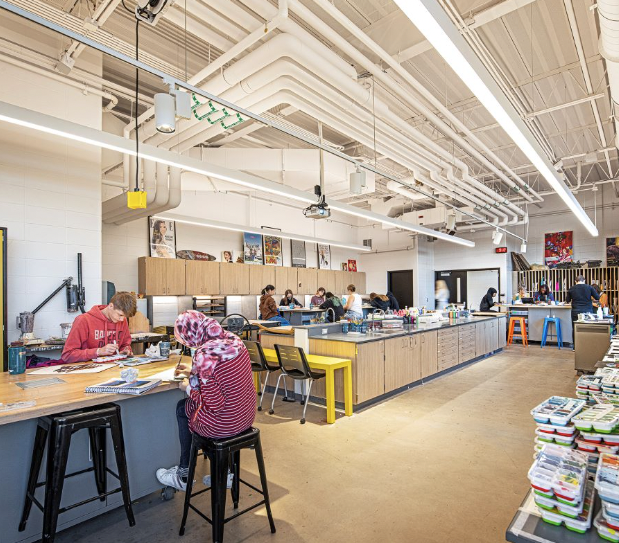
Designed with the flexibility of the program in mind, the art room features plenty of storage, movable furniture, and access to supplies. Image credit: John D’Angelo Photo

“Students engaged in their learning tend to enjoy school more, retain their learning for a longer period, and build the necessary skills to succeed after high school,” said former Forest Hills North High School principal, Jon Gregory. “The new space allows for this type of learning to occur in a variety of ways due to the flexibility of the space and furniture. Students have commented on how easy it is for them to collaborate and engage with each other in their learning.”

STEM Academy

The Forest Hills STEM Academy is a program that is grounded in actionable learning and has been providing students with interactive learning opportunities since 2015. Coursework includes a thematic and interdisciplinary approach that gives students foundational skills and builds relevant connections in STEM education.

The original setup for the STEM Academy included a couple of science labs with connected instructional classrooms and refurbished classrooms that acted as maker spaces. With continued success in the program, and the addition of another hands-on learning program called Gone Boarding, the STEM Academy has found itself working alongside Project NEXT in the new Design Center. STEM Academy students can now split their time between more traditional academic classrooms and the commons area, which was designed with flexibility and multiple learning styles in mind.

One tangible outcome of the STEM Academy’s unique program is flourishing in the new space and turning their students into budding entrepreneurs. Handmade in the Hills is a soap business organized and maintained by sophomore STEM Academy students studying chemistry. Students are responsible for the development, packaging, marketing, and selling of soaps that come in different shapes, colors, and scents. Students are learning practical skills in manufacturing, mathematics, industrial arts, economics, and more from just this one portion of their curriculum. The success of this self-sustaining business also impacts students beyond just academics; it also develops their core life skills like teamwork and problem-solving.

“A lot of our students come back (to Forest Hills) and say that what they learned in presenting, collaborating, communicating really made a difference in their post-graduation life,” said Austin Krieg, STEM Academy chemistry teacher who leads Handmade in the Hills. “Giving students the opportunity to learn where they will do their best work is a unique aspect of our programs.”

One of the goals of project-based learning is to create cross-pollination between disciplines and build cohesion between curriculums in art, science, and beyond. The Design Center and adjoining science labs, art room, and woodshop can be used by any student at Forest Hills, creating a sense of unity throughout the school and creating opportunities for everyone.

“There is something for every student,” added Krieg.

The post Project-Based Learning Programs Support Creativity and Entrepreneurship in Specialized Space appeared first on Getting Smart.

from Getting Smart https://www.gettingsmart.com/2023/07/10/project-based-learning-programs-support-creativity-and-entrepreneurship-in-specialized-space/

Marketing Plans for Schools Over the Summer

The summer break presents a valuable opportunity for schools to engage with their target audience, build brand awareness, and attract new students for the upcoming academic year. Implementing a well-designed marketing plan during the summer months can help schools stay top-of-mind, communicate their unique value proposition, and showcase their offerings. 

This article explores effective marketing strategies for schools to leverage during the summer.

Develop a Summer Campaign Theme:

Create a compelling summer campaign theme that aligns with your school’s values and goals. The theme should reflect the unique aspects of your institution and resonate with your target audience. Consider themes such as “Summer of Exploration,” “Ignite Your Potential,” or “Unleash Your Creativity.” Use this theme consistently across all marketing materials to establish a cohesive brand image.

Engage with Current Students and Parents:

Stay connected with your current students and parents over the summer. Send regular newsletters or email updates to inform them about upcoming events, important dates, and changes for the next academic year. Share summer reading lists, educational resources, or tips for maintaining academic skills during the break. 

Host Summer Camps and Workshops:

Organize summer camps, workshops, or enrichment programs to attract new students and showcase your school’s offerings. Offer a range of activities that align with your school’s curriculum or specialty areas. Promote these programs through targeted advertising, social media campaigns, and community outreach. 

Collaborate with Community Organizations:

Forge partnerships with local community organizations, such as libraries, museums, or recreational centers. Collaborate on joint initiatives or sponsor relevant events. 

Utilize Social Media Platforms:

Leverage the power of social media platforms to promote your school over the summer. Create engaging content, including videos, photos, and stories, to showcase the school’s facilities, extracurricular activities, and student achievements. Run targeted advertising campaigns to reach potential students and their families. 

Develop a Referral Program:

Implement a referral program to incentivize current students, parents, and alums to recommend your school to their friends and family. Offer rewards or discounts on tuition fees for successful referrals. Provide referral cards or unique referral links that make it easy for your community to share information about your school with others. Recognize and appreciate those who participate in the referral program.

Alumni Engagement:

Engage with your school’s alum network during the summer. Share updates on alum achievements, organize reunions or networking events, and encourage alums to share their success stories. Alums can become powerful advocates for your school, referring potential students and promoting your institution through word-of-mouth.

A well-executed marketing plan during the summer months can significantly impact a school’s brand awareness and student enrollment. By developing a summer campaign theme, enhancing your online presence, engaging with current students and parents, hosting summer camps, collaborating with community organizations, utilizing social media platforms, implementing a referral program, attending local events and fairs, engaging alums, and monitoring results, schools can effectively market themselves and attract new students for the upcoming academic year.

Tacoma Adding More Personalized Learning Opportunities

Tacoma, Washington is home to a growing number of choice schools that offer personalized learning opportunities for its students, reflecting a trend towards more flexible and diverse educational programs. Tacoma Public Schools has taken a collaborative approach to developing its choice schools, working with teachers, parents, and community members to create schools that reflect the needs and interests of the local community. These learning options offer students unique opportunities to explore their interests and passions in a meaningful and intentional way. 

Most recently, Tacoma Public Schools kicked off the planning and building of the Maritime Skills Center that will serve students across south Puget Sound and expand choice opportunities. With the Port of Tacoma covering nearly 2,500 acres of the area surrounding the school district, it was natural for the Port and the school district to partner and support learners and a healthy maritime workforce. Set to open in 2025, the skills center will four main focus areas:

  • Sustainability
  • Technology & Innovation
  • Transportation & Logistics
  • Skilled & Technical Trades

Choice schools and personalized pathways are a growing trend in education, providing learners with more options and flexibility. These options allow students to choose from a range of programs, from arts-focused schools to science and technology academies, and even schools that focus on social justice and community service.

High School student at SAMI

One such choice school in Tacoma is the Science and Math Institute (SAMi). SAMi is a public high school campus that shares space with the Point Defiance Zoo. The school offers a curriculum focused on science, math, and technology. The school is designed to be project-based, allowing students to take on real-world problems and apply their learning to hands-on projects that often involve place-based approaches that include the zoo and surrounding parks and beaches. 

High school students at SOTA

Another choice school in Tacoma is the Tacoma School of the Arts (SOTA). SOTA is a public high school that provides students with a creative and immersive arts education. The school offers a wide range of programs, from theater and dance to visual arts and music. SOTA’s curriculum is designed to help students develop their artistic talents while also providing them with a strong academic foundation.

The IDEA School focuses on a student-centered education to create a community of learners who are engaged in meaningful, challenging, and collaborative work alongside teachers, adjunct professors, and experts from the field. They provide a variety of programs including pathways around Engineering and Design. These pathways can unpack into areas around circuitry, industrial design, robotics, game design, green architecture, animation, and music production. The key design principle for learning is shaped by project-based learning and the art of prototyping and the process of design thinking. The grading emphasis for this learning environment is on the learning process and the growth captured along the way more than an averaged outcome mark.

Students at IDEA

Tacoma Public Schools provides a second chance program through the Open Doors Youth Re-Engagement Program, called Willie Stewart Academy. This option is for students between 16-21 years of age who have dropped out or are at risk of dropping out of high school. The program offers an individualized approach as an alternative pathway for students to obtain their diplomas. The program provides students with instruction, study skills, career guidance, and social-emotional support as they work towards obtaining a GED certification. They offer wrap-around services to help students from various life circumstances. 

The Jobs 253 program is a specialized initiative catering to Tacoma Public School sophomores and juniors. It provides a comprehensive learning experience by offering 40 hours of job training and experience that will help them develop work readiness skills, such as resume and interview preparation, while also boosting their self-confidence and personal growth.

John Ketler sharing about the history of SAMI with visitors from Bostonia HS, San Diego (Nerel Winter and Travis Lee).

Tacoma Public Schools’ commitment to choice schools is part of a larger effort to rethink urban education. The district is working to provide students with more options and opportunities to succeed, no matter their background or interests. Tacoma Public Schools is leading the way in personalized options for its students, families, and community through ongoing investments in education and innovation. 

The post Tacoma Adding More Personalized Learning Opportunities appeared first on Getting Smart.

from Getting Smart https://www.gettingsmart.com/2023/06/29/tacoma-adding-more-personalized-learning-opportunities/

Recording Arts as Reengagement Social Justice and Pathway

After a successful career as a recording artist, David “TC” Ellis created Studio 4 in St. Paul to spot budding music stars. It became a hangout spot for creative young people, most of whom had “dropped out of school due to boredom and a sense that school wasn’t relevant to their lives and dreams.” 

Ellis began thinking about a new kind of high school that would reengage learners through musicology and “put them on a positive tangent.” He created a pilot program for 15 learners in 1996. After being blown away by their genius and with the support of community groups, Minnesota’s early charter school policy, and a grant from Edvisions, Ellis and colleagues opened the High School for Recording Arts in 1998. 

For Ellis, it was spiritual and for the students, HSRA became a haven. HSRA now serves about 320 students with personalized project-based learning through an asset-based approach. Through the lens of Family, Respect, Community and Education, most students engage in courses that teach music production and the business of music. HSRA provides state-of-the-art music production facilities including two recording studios, practice rooms and a live performance room. 

HSRA students also hone their business acumen through the first student-run record level. Another Level Records is a student-operated music record label that empowers firsthand experience in developing media content, negotiating contracts, and publishing music by HSRA students and other artists (See Four Seasons MacPhail Project).

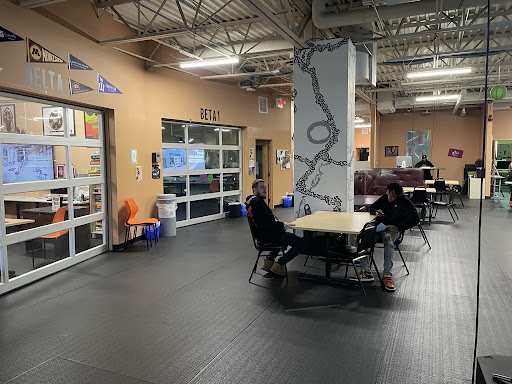
HSRA understands that the work doesn’t happen without deliberate patience, authentic relationship building and bringing in adults that value deep diversity. Modeling the change agents that HSRA wants learners to come, a strong focus is placed on community partners serving as advisors to allow teachers to focus on teaching. HRSA has a staff of (non-teaching) advisors each with dedicated space (Delta and Beta1 advisory shown above). Advisors check in with students in the morning and host an advisory period for an hour after lunch. The advisory space is open all day as an alternative to class for students that need extra support. Advisors support at least 4 college visits and help all learners fill out FAFSA forms. Two social workers provide additional youth and family support. 

The need to develop a building that catered to the HSRA model led to a partnership with Fielding International. Through multiple renovations, Fielding International worked with HSRA to adapt a commercial building into a unique learning environment that’s divided into advisories around a central learning commons. 

The design process began with sharing personal stories about the creative process between students and architects, finding common ground. Fielding listened to their music and developed an understanding of the student’s desire to express themselves through performance. The architect Aldo developed an understanding of their need for a safe space, and secure enough to be their best selves.

The centerpiece of the school is the Learning Commons, also known as “The Black Top,” equipped with a large Live Studio, smaller collaborative suites for engineers and performers, and a pre-production commons, that provide students with the necessary tools to produce high-quality work. The gym’s fold-down stage further enables them to showcase their talents in all-school and community performances.

There is no shortage of talent that contributes to the success of HSRA. In 2011, sam seidel published Hip Hop Genius: Remixing High School Education, the story of the first decade of HSRA. In 2021, seidel, the Director of the K12 Lab at the Stanford d.school, released the 10-year anniversary edition Hip-Hop Genius 2.0: Remixing High School Education with forewords from Gloria Ladson-Billings and D Smoke, and contributions from David “TC” Ellis, Tony Simmons, and Michael Lipset who reflected on leading HSRA through its second decade.  

Tony Simmons joined Ellis at Studio 4 in 2001 and became Executive Director of HSRA in 2013. With 60% of learners’ justice-involved, Simmons thinks of HSRA as a re-engagement school that is asset-based with full wrap-around services. 

Tony Simmons and Michael Lipset are sharing the successful elements of HSRA through 4 Learning. The sister organization to HSRA helps schools reengage young people through the application of the recording arts and other creative endeavors. They share creative programming and studio design strategies with educators creating career pathways and microschools.

4Learning Sites

California YouthBuild Charter Schools: Moreno Valley Site at Rising Stars Business Academy
YouthBuild Charter Schools: East LA Site at La Causa
Wisconsin Sun Prairie East High School
Sun Prairie West High School
Prairie Phoenix Academy
Illinois Perspectives Math & Science Academy

Timothy David Jones, Founder of Techniques4Learning and Chief Visionary Officer for HipHopEd, Inc. is HSRA’s Director of Innovation & Hip Hop Pedagogy (see podcast). Jones uses his skills and frameworks to promote the intersections of hip-hop, youth development and education. He facilitated an activity with us by having us read and listen to a song by Dave East entitled “On My Way 2 School.” The song depicts what happens as two brothers navigate their neighborhood on the way to school. The song ends with an interaction between Dave East and a teacher who talks down to him with no recognition of the realities that surround the school where he teaches and shapes the students that enter the building. After a spirited conversation about what can be done within our schools to be more connected to realities that students face on the way to school, we entered the studio where some students had listened and discussed the same song and were recording verses of their own. The impromptu song wasn’t complete until there were contributions made by Timothy and TC Ellis. (On My Way 2 School HSRA Remix).

The post Recording Arts as Reengagement, Social Justice and Pathway  appeared first on Getting Smart.

from Getting Smart https://www.gettingsmart.com/2023/06/28/recording-arts-as-reengagement-social-justice-and-pathway/

E.A.R.N. The Right: Empowering At-Risk Youth with Opportunity

Oftentimes, youth who are involved in or at risk of being involved in the juvenile justice system are being impacted by other life challenges or disabilities. These situations may have greatly affected their emotional, mental, physical, and behavioral health. The juvenile justice system is based on the idea that children and teens are not inherently violent or mean. There is a strong belief that young people can and will live healthy, productive lives if given the chance to do so instead of being thought of as hopeless and kept away from their communities. 

A report by American Progress says, “Developing and implementing a clear education continuum for youth as they enter, stay in, and return home from a juvenile detention facility can make the difference between having access to opportunities and being forced to drop out of school.” One thing is evident when we think about the many problems with the criminal justice system today: too many young people do not get the help they need to do well. On any given day, close to 60,000 kids under 18 are in jail, and more than 500 are under the age of 12.

One program striving to change this risk factor for recidivism is E.A.R.N. the Right Inc. The goal of E.A.R.N. the Right, Inc., (ETR) is to empower at-risk youth and prepare them for opportunity, says Joe Sicilio, founder of ERT.

A person standing in front of a large screen

Description automatically generated with medium confidence

Coach Joe and the EARN the Right team believe that “success is not an entitlement – one must EARN the Right to be successful.” EARN the Right teaches adolescents communication and social skills so that they may successfully advocate for themselves throughout their lives. ERT teaches youth how to climb above their current situations and achieve their professional, educational, and personal goals. Over the last decade, EARN the Right has worked with over 1,000 young people and those who serve them.

I sat with Joe Sicilio (Coach Joe) for a Q&A about the program:

What made you start EARN the Right?  

I really do not know how to answer this. The only thing I can say is that it was put on my heart to reach out to our youth providing them with skillsets that will allow them to self-advocate in educational, workplace and community settings.

What is your main goal for the students in the program?

One of the main goals is to have them understand they are worth it, and to instill self-confidence in them so they will want to move forward in a positive manner. 

What are some of the positive outcomes of the program?

We have discovered leaders who never knew they were leaders. We have had kids open up and talk through some of their circumstances. We have discovered career paths. We have even had students go on and get their Highschool diploma, and GED, and even go on to Higher Education.

Describe the impact of EARN the Right on a particular Student.

In our program, there is a lot of role-play. As we started the program at Camp Aspen one of the young men was so nervous and shaking, he would not role-play. Come to find out he was the lowest-ranking person, the other guys did not want him to participate because they would have to if he did. As the classes continued and we were able to work independently he began to open. Role-playing became easier and he led his group in an activity and was the lead presenter. We found out he loved technology, so the role played was selling me a cell phone using the skill sets learned in EARN the Right. He was then when released and went on to Tech School in the upstate.

What is your vision for the next few years?

My vision is to grow the EARN the Right organization so we can reach more of our youth. Connect with the students as they move forward to provide mentoring. Our goal is to connect them with local businesses for employment opportunities. For those who excel in the program, we want to bring them back into the loop to help facilitate the EARN the Right program. 

E.A.R.N. the Right, Inc. has done over 500 hours of community service by delivering the E.A.R.N. the Right workshop to the South Carolina Department of Juvenile Justice and school districts throughout the state.   

The post E.A.R.N. The Right: Empowering At-Risk Youth with Opportunity appeared first on Getting Smart.

from Getting Smart https://www.gettingsmart.com/2023/06/27/e-a-r-n-the-right-empowering-at-risk-youth-with-opportunity/

A Transformative School Year with AI

I have been speaking and teaching about AI in my classroom for more than five years. I was curious to understand where we see it in the world and how to teach about it in our schools. I was also fascinated by the capabilities of AI for learning and in the world. 

I reached out to several educators and some students to find out what they thought about the changes we are experiencing in education, especially with these emerging technologies. There are, of course, concerns, ongoing conversations, and definitely excitement, although sometimes hesitant excitement, about what these technologies might bring to the world of education and work. 

Educator predictions

Nicole Biscotti @BiscottiNicole, Educator 

“AI has exploded on the scene and everyone is trying to figure it out at the same time which is exciting. A lot of educators are afraid that kids will use technologies like ChatGPT to cheat and have even banned its use. The reality is that kids have been cheating since the beginning of school and we have an exciting opportunity as educators to shape the narrative around this new technology. Biscotti plans to continue to learn as much as she can about how to use AI to better support her students. She says as an educator, “I feel that I am obligated to prepare my students for their future, not my past. These tools will only improve and they are here to stay. It’s imperative that kids are familiar with them and know how to use them or we risk sending graduates out into the workforce at a competitive disadvantage.”  

Dr. Michael Harvey @doctor_harves, Pedagogical Prognosticator from Blenheim New Zealand

“AI/emerging tech has yet to really shape this past school year. Questions are being asked of what learning is and the role of assessment, but the actions to this change are yet to be realized.” He is thinking about /planning how to transition assessment tasks to a process rather than a product model. As for the future, Harvey thinks that “the next school year will bring pushback from the establishment and for those who want to progress in education a movement away from assessment of learning to assessment for learning and the role of AI to support student independence in learning.”

Alex Isaacs @mr_isaacs_math, Edtech Specialist from Long Branch Public Schools 

“Emerging tech has helped teachers gain time while assisting with lesson planning, quick questions, and providing feedback to students in real-time. It has also helped increase data analytic capabilities by providing insights into student performance trends and instructional practice.” He plans to delve more into emerging technologies and how they can benefit the teachers and students in his school district. By participating in multiple coaching cohorts, including GoGuardian and Pear Deck, he hopes to gain more insight into helping his colleagues with these platforms. As for the future, “the discussions surrounding the ethical use of emerging tech will continue next school year.” He believes that more edtech platforms will increase their integrations of AI-related tech to provide differentiated instruction and personalized pathways to every learner.” Check out his AI-themed Wakelet collection that he and colleague Lois Alston created.

I believe that emerging technology has provided and created new opportunities for students.

Lola, grade 11

Vicki Van Matre @MsVanMatreArtRm, Teacher at Bluffton High School and  ISTE Certified Instructor 

Next year, Vicki will be teaching a class called the” 3rd class” for their new Education Professions pathway. One basis for this class is introducing technology’s role in the modern classroom. She was planning on discussing AI and how it could help the teacher but also discuss how to use it appropriately as a student. Her plans focus on involving students more in learning about ChatGPT by writing a lesson for them and having them make modifications where necessary. She also wants her students to experiment with a variety of technology to see “what THEY think would work best in the classroom.”  While she uses technology in her art room, she has not yet experimented a lot with DALL E to see if I want to use AI for any of my art classes. However, she believes that if she does choose to use it, most likely it would be with the senior independent study students to have them experiment with it. 

Student reflections

Student, grade 10

“As soon as I was introduced to AI, I knew that it would change the world. The more I interacted with it, the more I understood its vast potential.” He shared that he “may or may not have used it to complete a few small assignments (Never in Spanish).” His uses were more as a study tool, in particular for reviewing for Chemistry. He would ask it to give a simple definition and an example and it worked perfectly to help him process the information and content better. He believes that “AI by itself is mediocre at best. However, when collaborating with humans, it can do amazing things.” As for benefits, he has an interest in starting an online store but has never really had the time and he hopes that with the help of AI to get a jumpstart this summer. “The school will look right through all the great things that AI is capable of and try to prevent it from being used completely.”

Lola, grade 11

“I believe that emerging technology has provided and created new opportunities for students. The new ideas and aspects of technology accessible to students now provide new experiences and can help to improve a student’s capabilities and knowledge about the subject they are studying.” Looking ahead, “I believe that by next school year, technology will continue to grow and emerge in new ways that will allow students to continue to have opportunities that will enhance their learning environment.”

Dimitri, grade 8

“AI and a lot of new tech has helped me with coming up with ideas for projects or providing me with a summary of a book, if I forgot something that I had read or I didn’t understand it.” As for the next school year, “I hope we will be allowed to use ChatGPT in class to help us understand books and literature more.”

With the rapid advancements in AI and emerging technologies, there are now incredible opportunities available to us and as we reflect on the past year, it becomes evident that AI and emerging tech have revolutionized education in ways we never imagined.

The post A Transformative School Year with AI appeared first on Getting Smart.

from Getting Smart https://www.gettingsmart.com/2023/06/26/a-transformative-school-year-with-ai/

Bridging the Gap Between School and the Real World Starts With Agency

For a complex future, we need nimble learning models that can respond to challenges in real time and rapidly personalize to serve a diverse student population. 

Red Bridge School is a novel educational institution nestled in the vibrant city of San Francisco. Renowned for its innovative and student-centered approach to learning, Red Bridge School is prototyping new models of engagement and student advocacy. From its holistic teaching philosophy to its commitment to fostering responsible global citizens, the school offers a transformative educational experience that nurtures the minds, hearts, and spirits of its students. 

This school prioritizes developing agency in all of its learners and embeds choice into every aspect of the learning environment. Students are given the space to explore and learn in spaces that mimic a modern office setting. Whether preparing for an outside learning experience, developing prompts for ChatGPT to co-create poetry or drafting individual learning goals, open spaces and personalized learning allow students to choose where and what they learn. We’ve highlighted a few of the key features that make Red Bridge a unique place to learn. 

Autonomy Levels

Students are encouraged to self-advocate for themselves at bi-annual promotion periods throughout the year. These autonomy levels are largely separate from academic achievement and are a demonstration of mastery of work habits. The work habit domains that students are instructed in and evaluated on are Communication, Time Management, Goal Management, Resource Management, Focus, Initiative, Self-Knowledge and Collaboration.

Self-Directed Demonstrations of Learning

Rather than strict assessment timelines driving the learning, students are able to sign up when they are ready to demonstrate what they have learned. Students keep up with how they’re progressing toward academic and work habit goals through a badge/learning credit system. Each student has a binder that documents the badges/learning credits for the competencies that they have earned. This puts more agency and power in the hands of the young people to co-author their learning. 

Learning Guides and Content Specialists

Rather than have teachers serve all roles, instead, Red Bridge has split the role into learning guides and content specialists. This two-pronged approach echoes the two tracks of autonomy and academics and allows the Red Bridge team to lean into their strengths while supporting the learners. 

Nimble curriculum (chatGPT example)

While visiting, we saw a recent exercise that was crafted in response to the launch of ChatGPT. This was a one week sprint that kicked-off by questioning the differences between human and AI. Then, each student prompted ChatGPT to write a poem. After reading the generated poem, the student then edited the poem to “make it better” and had DALL-E generate a supplemental image. 

Red Bridge also places emphasis on social and environmental responsibility. Students are encouraged to think beyond themselves and become active participants in shaping a more compassionate and sustainable world. Engaging in community service projects, environmental initiatives, and social justice discussions, students develop a deep understanding of the global issues facing humanity and cultivate a sense of empathy and responsibility towards others.

Microschools and Lab Schools

Small models enable us to pilot new ideas and new ways of being. The flexibility to move beyond traditional rules and regulations allow for enhanced innovation. Each model is unique and provides ways to see demonstrations of student agency, the benefits of personalization and the importance of community. When students are safe, supported and motivated, their social skills and emotional intelligence are strengthened. 

For more information on microschools, including how to get started, check out our series page

The post Bridging the Gap Between School and the Real World Starts With Agency appeared first on Getting Smart.

from Getting Smart https://www.gettingsmart.com/2023/06/23/bridging-the-gap-between-school-and-the-real-world-starts-with-agency/

Districts Must Consider The Portrait of a Whole Child

During a time when the prevalence of depression among young people is increasing, it is crucial to adopt an approach that acknowledges learners as holistic individuals, moving beyond mere data points or rigid test scores. Students should not be reduced to their standardized performance or grade point averages. While we recognize this truth, we continue to face the challenge posed by outdated evaluation systems and divisive national discussions regarding learning expectations.

Our choice in what we measure reflects our values, but we must also engage in conversations about how to effectively support what we value. It is not enough to focus solely on the outcomes; we must also consider the processes and support structures that enable learners to thrive.

Stephanie Malia Krauss’s book, “Whole Child, Whole Life: 10 Ways to Help Kids Live, Learn, and Thrive” addresses the concern of kids giving up or burning out before reaching adulthood. Krauss, who has experience as a classroom teacher, school leader, and national leader on education issues, explores the importance of understanding and addressing the holistic needs of children in order to promote their overall well-being.

Whole Child Portraits: Moving beyond demographics and determinants, Krauss challenges the traditional approach of profiling children based solely on academic and demographic factors. Instead, she advocates for a broader perspective that considers a child’s individuality, health and developmental milestones, and the context in which they exist.  

“At its worst, profiling dehumanizes children. It depicts them without dimensions and details, leaving us to sort, group, assume, and judge. At its best, profiles are a jumping-off point – a collection of data and insights that begin to tell us who a kid is and what they need to thrive.”

By turning profiles into portraits, educators, and caregivers can gain a deeper understanding of each child’s unique strengths, struggles, and needs.  

10 Whole Life Practices 

  1. Meet basic needs
  2. Prioritize mental health
  3. Invest in personal interests
  4. Nurture healthy relationships
  5. Build community and belonging
  6. Embrace identities and culture
  7. Attend to the past and the present
  8. Act with a 100 year mindset
  9. Be a force for good
  10. Seek awe and wonder

Whole Life Practices: Ten proven practices to support young people’s well-being throughout their lives. These practices extend beyond academic and cognitive development to encompass physical and mental health, personal interests, spiritual development, and more. By considering and addressing these aspects in unison, educators and caregivers can support children’s overall growth and development.  

It is important to note that Krauss emphasizes the significance of adults attending to their own growth in this process as well as the need for cross-training among educators and caregivers to ensure they have a comprehensive understanding of health-related issues that may impact children’s learning and overall well-being.

Aim for Wholeness: Assessing well-being involves recognizing when children are thriving and understanding which indicators to look for. Krauss encourages the use of developmental growth charts that extend beyond academic milestones, encompassing social-emotional and physical progress. By having a comprehensive grasp of a child’s well-being, educators and caregivers can provide targeted support and interventions when necessary.

Stephanie Malia Krauss provides valuable insights and practical strategies to ensure children thrive in all aspects of their lives. Understanding the whole child is crucial for their success, both now and certainly in the future.

For more information on Whole Child, Whole Life you can visit the book website at WholeChildWholeLife.com. Images in this blog are taken directly from the book and created by Manuel Herrera.  

The post Districts Must Consider The Portrait of a Whole Child appeared first on Getting Smart.

from Getting Smart https://www.gettingsmart.com/2023/06/22/districts-must-consider-the-portrait-of-a-whole-child/

Centering Relationships at Anastasis Academy

By: Scott McLeod

Although a number of innovative elementary and middle schools are leaning into deeper learning, they often are overshadowed by conversations about internships, alternative credentialing, capstone experiences, and other new pathways at the high school level. As a Senior Fellow for Getting Smart this year, I am visiting and sharing about K-8 schools that are helping to prepare students for these new secondary pathways.

One of my favorite nearby schools is Anastasis Academy, an independent microschool serving grades K-8 in Centennial, Colorado. Kelly Tenkely founded Anastasis twelve years ago. Inspired by Pandora’s Music Genome Project, she initiated the Learning Genome Project at Anastasis with the belief that learning could be better personalized for children.

Anastasis’ primary strength is its relationship-centered approach. While the smaller size of the school clearly helps, the core of this work is an intake process that ensures that educators really know every child. At the beginning of the year, teachers have individual conversations with each student and family using custom-designed card decks and protocols to uncover students’ thinking and learning interests. For example, a student might be asked to respond to a series of prompts such as I like to work alone or I like bright lights and respond with a Like me, Sometimes like me, or Not like me card. Similarly, students might be given prompts such as I like to fidget, I like to plan, or I like when things are written down. Teachers take extensive notes and ask follow-up questions to solidify their understanding of each child.

Parents and guardians of prospective students also engage in conversations with Anastasis staff to unpack their own experiences and beliefs about learning and schooling. For instance, they might be asked to reflect and respond to a series of prompts such as In my school experience, learning was separated into different subject areas or The purpose of learning in my school experience was to complete and turn in work. These intake processes are critically important for ensuring a good pedagogical fit between students, families and the school.

Armed with deep knowledge of students’ interests and learning orientations, Anastasis deploys a spiraling, inquiry-driven, student-centered curriculum. Learning threads occur along a continuum from kindergarten through eighth grade and draw from the Common Core, Next Generation Science Standards, and other robust learning frameworks. For instance, at Anastasis an example Measurement competency in Level B is Relationship of metric and power of 10, while example Measurement competencies in Level E include Surface area of cylinders and the Pythagorean theorem. Similarly, a Level B writing competency is Organizes ideas in nonfiction while Level D competencies are Writes paragraphs and Varies sentences. All learning is mastery-based, and students regularly reflect on their acquisition of desired competencies at different developmental levels such as Novice, Apprentice, Practitioner, Scholar, and Change Maker. 

Throughout the school year, students’ preferences, passions, and predispositions help shape both their learning experiences and the physical spaces in which that learning occurs. Creative lighting, furniture, and room designs come together in different ways to create a variety of opportunities for children to learn, reflect, and collaborate. At any given moment, students at Anastasis might be listening to an audiobook in a cozy corner, working individually or in pairs at small tables on a passion project, or sitting on couches in a larger group while planning the next phase of their community-based service learning initiative.

Learning at Anastasis is almost invariably an active, hands-on collaboration between teachers and the students in their classroom. The curriculum is organized into cross-cutting, vertically-articulated, thematic blocks such as Who We Are, Where We Are in Place and Time, How the World Works, or Sharing the Planet. Within those broad themes, there is room for extensive creativity as teachers and students work together to accomplish and personalize mastery of essential learning standards.

Although it’s an independent school, Anastasis is not flush with resources. Anastasis intentionally pegs its tuition to the per student expenditure of the local school district, in an attempt to show that much of what it does could be replicated in a more traditional public school system if so desired. Yet despite those resource constraints, students at Anastasis go on weekly expeditions into the local community, occasionally go on larger expeditions out of state, and have access to on-site resources such as a school garden. In addition to hosting an annual conference for educators called 5Sigma, Anastasis also has worked with several other schools to help them adopt some of its practices, in locales as diverse as North Dakota, Texas, and Rwanda. If you’re interested in deeper, relationship-centered learning, Anastasis is well worth a visit.

This post is part of our New Pathways campaign sponsored by ASA, Stand Together, and the Walton Family Foundation.

Scott McLeod, J.D., Ph.D., is a Professor of Educational Leadership at the University of Colorado Denver. He is also a Senior Fellow at Getting Smart, investigating innovative elementary and middle schools that help prepare students for new pathways in high school.

The post Centering Relationships at Anastasis Academy appeared first on Getting Smart.

from Getting Smart https://www.gettingsmart.com/2023/06/19/centering-relationships-at-anastasis-academy/

Design a site like this with WordPress.com
Get started