Effective coaching supports teachers’ professional development and improves classroom practices. As education evolves, so should coaching methods to empower educators to thrive.
Reflective Practice
Encouraging reflective practice is a cornerstone of effective coaching for teachers. By engaging in regular self-assessment and reflection, teachers can identify areas for improvement and build upon their strengths. Coaches can facilitate reflective discussions by posing thought-provoking questions about classroom strategies, student engagement, and learning outcomes. These discussions empower teachers to take ownership of their professional growth and set personalized goals for improvement.
Video Analysis
Using video analysis as a coaching tool allows teachers to gain valuable insights into their teaching techniques and classroom dynamics. Coaches and teachers can collaboratively review recorded lessons to identify successful teaching moments and areas for refinement. This method offers a unique perspective, fostering constructive feedback and promoting a culture of continuous improvement.
Peer Observation and Feedback
Encouraging peer observation and feedback fosters collaboration and trust among teachers. Coaches can facilitate peer observation sessions, where teachers observe each other’s lessons and provide supportive feedback. This process promotes shared learning experiences and allows educators to implement innovative teaching strategies inspired by their colleagues.
Professional Learning Communities (PLCs)
Creating professional learning communities is an effective coaching method that encourages teachers to collaborate and share best practices. PLCs offer a platform for teachers to engage in meaningful discussions, explore research-based strategies, and collectively address challenges they encounter in the classroom. Coaches can facilitate these communities, providing resources and guidance to stimulate rich discussions and problem-solving.
Coaching teachers is essential to fostering continuous growth and development in the education sector. Through reflective practice, video analysis, peer observation, and professional learning communities, coaches can empower teachers to enhance their instructional practices and positively impact their students’ learning experiences. These coaching methods nurture a culture of collaboration and innovation and contribute to a more effective and rewarding teaching environment.
As the educational landscape continues to evolve, embracing these coaching strategies will be instrumental in ensuring teachers have the necessary support to excel in their roles. By investing in their professional growth and providing them with the tools to succeed, we can foster a thriving educational community that benefits educators and their students.
What if you could combine the immersive benefits of an internship with the problem-solving and deliverables production involved in managing a project? You can gain the benefits of both with a client project, the latest learner experience design trend in high school and college education.
Client projects can be extremely valuable experiences because they engage in real complex organizational problems and develop design thinking, problem-solving, and project management skills. Like internships, they provide immersive career exploration opportunities. Often conducted in teams, client projects build collaboration and leadership skills.
Client projects meet or exceed the PBLworks Gold Standard for project design with a couple amped up elements:
A Challenging Problem or Question is identified by or with a community partner (business or civic) and
Public Product is not just a presentation, it’s a commitment to delivering value to the client.
Following are two frameworks for client projects in higher education and five groups of examples of high school systems supporting client projects.
Two HigherEd Frameworks for Client Projects
Riipen connects students to employers through real work projects. The venture-backed Canadian edtech startup is bridging the gap between higher education and employment. Students at more than 430 educational institutions work with 28,000 employers on real projects that add value to organizations while developing in-demand skills. Riipen awards badges which are defined by employers and instructors.
The 55 engineering schools that make up the Kern Entrepreneurial Engineering Network (KEEN) share a commitment to developing an entrepreneurial mindset. The KEEN framework adds opportunity recognition and impact delivery to traditional engineering design.
The Rowan College of Engineering had a solid foundation of experiential learning but the KEEN framework added a focus on stakeholders and value creation. After joining KEEN, Rowan students were stimulated to think about designs all the way through. “They are equipped to address why they’re doing the design, understand who it will benefit, and think about the context and impact on various stakeholders.”
Client Projects for High School Learners
CAPS Network
When Donna McDaniel opened the Blue Valley Center for Advanced Professional Studies in 2008, it set a new standard for career education. The CAPS team explains, “Students fast forward into their future and are fully immersed in a professional culture, solving real-world problems, using industry-standard tools and are mentored by actual employers, all while receiving high school and college credit.”
Juniors and seniors from five high schools usually attend CAPS in half day blocks where they engage in client projects and entrepreneurial experiences in six strands (eg., bioscience, business, healthcare, engineering).
On my last visit to CAPS in southwest Kansas City, I met three young men building an airplane in the lobby and three young men launching app-based businesses (below).
Corey Mohn took over CAPS leadership in 2014. An entrepreneur turned educator, Mohn saw the opportunity to develop a network of affiliated programs and by 2018 there were dozens of member programs nationwide. The CAPS Network was included in HundrED “most impactful innovations that are changing the face of education in a post-COVID world” and recently added its 100th affilate. (See feature.)
Real World Learning in Kansas City
Also inspired by the success of CAPS, the Kauffman Foundation sponsored Real World Learning initiative in metro Kansas City includes 85 high schools in 35 systems that are adding internships and two kinds of projects:
Client Projects: Learners analyze and solve authentic problems, working in collaboration with other learners and professionals from industry, nonprofit, civic or community-based organizations. Work involves authentic methods and tools used by professionals in the work environment. Experience includes mentoring and evaluation by working professionals. Output is viewed as value-add by external stakeholders and resume-worthy.
Entrepreneurial Experiences: Students identify a compelling social or market problem and mobilize resources to research and solve it. Leveraging input and support from multiple stakeholders, students iteratively analyze, prototype, implement, reflect and adapt potential solutions. Outputs of an entrepreneurial experience include a market and stakeholder research summary, a ‘business plan that includes an assessment of costs and benefits associated with the development or operation of their solution, and feedback from relevant external stakeholders obtained through exhibition or ‘shark-tank’ type pitch opportunities
The Innovation Academy at Basehor-Linwood High was launched as a chance for juniors and seniors to launch self-directed projects and earn core (English, science, social studies) and CTE credits. Guiding principles of the ala carte program include student choice, embracing the unknown, it’s ok to fail, and community partnerships. Last year Innovation Academy opened to freshmen and 45 students had the opportunity to design a park with the city. They engaged the community, considered names, pondered alternative uses, built budgets and developed 3D models. Through deep civic engagement and frequent communication, they earned an English and social studies credit–and they’ll never pass a park again without thinking about the experience they had.
High school students from the Global Impact Academy at Notre Dame de Sion in south Kansas City talk about their trip to Kenya and their impact projects in this podcast. North of Kansas City, students in Liberty EDGE microschool conduct projects aiming at making a world of difference (see feature).
Client Projects at XQ Schools
Founded by Purdue University with support from XQ, the three Indiana campuses of Purdue Polytechnic High School prepare learners for STEM-related postsecondary programs and high-tech careers through a series of client projects.
Every eight weeks, PPHS students are presented a real-world challenge. Project challenges are designed by staff in partnership with industry partners. The projects reflect real-world challenges that Indiana companies face in the areas of healthcare, energy, transportation and philanthropy. Students team up with fellow classmates and work together through a five-step design thinking process to develop a solution. Partners provide guidance on project prototypes, serve as panelists for student presentations and provide feedback on project pitches.
Through project challenges, students learn teamwork, problem-solving, critical thinking, communication and leadership skills, and use a blend of practical STEM applications and traditional liberal arts. It makes for a well-rounded educational experience that teaches students everything they need to know to succeed in school, college and the workforce.
Many of the courses at Iowa BIG feature client projects. The part time high school program in Cedar Rapids, also sponsored by XQ, creates a catalog of core credit opportunities structured as community-connected projects. (See podcast with Trace Pickering.)
World Shaping Projects at Polytechnic
Sabrina Zhang, a student at the Polytechnic School in Pasadena, recently competed in The Earth Prize. Her Agrivision system measures plant health during early, treatable stages to reduce crop losses and organic waste. (See podcast with Sabrina and teacher Jack Prather).
Other Poly students worked with Dr. Bala Selvakumar using molecular biology tools from miniPCR bio to perform experiments on local soil samples and contribute that data to a national database that addresses a global challenge. Students engage hands-on with antibiotic resistance, a challenge recognized by the World Health Organization as a top global public health threat. Dr. Selvakumar noted that any high school can engage with and contribute to this project (see project details).
Employer Provided Innovation Challenges
The U.S. Chamber of Commerce Foundation will be launching the Employer Provided Innovation Challenges (EPIC) initiative this fall. EPIC aspires to scale high-quality work-based learning experiences through a national network of partners that provide authentic, employer-led problem-based learning experiences to high school and postsecondary learners.
EPIC experiences will be hosted by Riipen and badged with Credly. The EPIC initiative will expand access to high quality work-based learning while building a trusted credentialing system to communicate new capabilities.
Afterschool Client Projects
The Knowledge Society is a 10-month youth accelerator program operating in four cities and online. TKS learners work on real problems with global companies and are supported by mentionships, internships, hackathons and a resource rich platform. (See podcast with TKS learners).
Conclusions
Client projects can be challenging to facilitate. They require an external partner involved in multiple steps. They are interdisciplinary by nature and don’t fit cleanly in the typically siloed high school schedule. They usually involve big complicated problems with no simple solutions and assessing learner growth and contribution is challenging.
So why bother? There are at least three reasons to help all learners engage in client projects:
Client projects offer the most efficient way for learners to experience success in what’s next: diverse teams working on new problems using smart tools. Client projects will increasingly utilize generative AI in solution development allowing learners to experience success as augmented (Super T) professionals.
Client projects can be super motivating for learners because the work is authentic and interest-aligned with a chance for real contribution.
Client projects can be an efficient way for employers to support work-based learning and a productive part of student career exploration and pathways.
In my first year as an assistant professor, I commuted to and from campus on the regional rail.
In the mornings, as I walked from the train station to the office, I planned my day by making a to-do list in my head: the scientific articles I would read, the data sets I would analyze, and—most urgent of all—the piercing insights into human nature that it was my job to discover.
Each evening, I trudged back to the station, again ticking through my mental checklist, but this time sizing up my performance against the expectations I’d set for myself that morning. Time and again, when comparing my to-do list with my got-done list, I found myself falling short.
But one day, something very strange happened. At the midpoint in my commute home, without any conscious intent, my thoughts began to shift. Instead of cursing my weaknesses, I thought, and even said aloud sometimes, very softly: I’m a nice person. I’m a nice person. I’m a nice person.
When you affirm a core personal value, you shore up your sense of self-worth.
Angela Duckworth
By the time I boarded my train, I was done with my little mantra—until the next day when I walked home. And again, after inventorying my failures, I found myself saying quietly: I’m a nice person.
What kind of person walks around giving themselves compliments? Was I a narcissist? What was going on?
It turns out that there’s a technical term for this practice: values affirmation. And what it boils down to is recognizing, and reinforcing, the personal values you hold most dear.
When you affirm a core personal value, you shore up your sense of self-worth. You broaden your perspective: Instead of zooming in on your inadequacies, you switch to a wide-angle view that includes your resources and opportunities. Research also shows that the majority of adults spontaneously engage in some form of values affirmation. And the more people are in the habit of doing so, the happier, healthier, and more hopeful they are.
Over time, I made progress in my research and learned a lot about what makes most successful people special, including this: Nobody has passion and perseverance unless what they do aligns with their values.
Try values affirmation for yourself. Take a moment and think of a value you hold dear, whether it’s kindness, creativity, gratitude, or integrity. Whatever it is, name it. And then say to yourself: Come what may, I know who I am. Your values are your foundation and your compass, too. Trust them, and they will lead you home.
Multiple education innovations are converging rapidly to build better experiences for all young people. The microschool movement, long established but accelerated by the pandemic, has led to the launch of hundreds of new small learning environments across the country. Artificial intelligence promises to improve personalizing learning, provide every student with a learning coach and free up time for educators to build stronger relationships with young people. Mastery and competency-based approaches are gaining momentum as states and districts seek to move from time-based credit to skill-based credit in an attempt to improve outcomes for students. Finally, the integration of real-world experiences into especially high school is increasing relevance and career readiness for students. These forces of microschools, AI, competency-based and real-world will drive the future of learning. Last fall, we reported on the launch of Khan World School – a partnership between Arizona State University (ASU) and Sal Khan. At the completion of the first year of operations, the school is successfully meeting the challenge of these four converging innovations.
The promise of Khan World School is a small, academically challenging virtual microschool model serving students from around the world. The program is personalized and mastery based using the offerings of partners Sal Khan of Khan Academy and ASU Prep. Small group tutorials help students accelerate their learning while weekly seminars bring the real world in through relevant topics generated by RISC at the University of Chicago. It is not easy to build culture and climate through an online learning experience, but the school has tackled this challenge by designing a house system for advisory and group connection. Within the houses, students complete projects and rely on peer mentoring and tutoring both within the program and through schoolhouse.world tutors (another program built by Sal Khan and his team). Many of the students tackled ASU college courses to accelerate their progress toward a college degree.
The promise of Khan World School is a small, academically challenging virtual microschool model serving students from around the world.
Nate Mcclennen
So what happened by the end of the first year for the approximately 50 9th graders who were part of the inaugural class? First, average growth via standardized metrics proved extraordinary. Students’ percentile score average is 90% or higher in all subjects (Reading 90%, Math 92%, ELA 98%) and from the beginning of the year to the end of the year, scaled score improved 2.8 times the typical growth in Math, 3.4 times the typical growth in Reading, and 5.3 times the typical growth in Language Arts. While this data supports a strong traditional model, students also loved the seminar to discuss real and relevant global topics. Given the geographic diversity of the class with about half of the students from Arizona (where tuition is free) and the other half national or international (8 countries) students, educators (called learning guides) reported that listening, empathizing and understanding other points of view became well established by the end of the year.
With this first-year success, Khan World School is expanding to 6th-12th grade next year. As with any new venture, the learning model will evolve based on feedback and observations from this past year which include:
Onboarding. The shift from time-based to mastery-based can be difficult for students who have been well-trained in compliance rather than agency. In response to this, the school is building a robust onboarding program to help with the adjustment.
Scale: While online learning is one solution to impact more students, the team also predicts that the model will succeed within an existing bricks/mortar school. To test this hypothesis, the team is exploring partnerships with existing schools to embed Khan World School. This microschool within a school model may help scale the microschool movement in general – providing microschool benefits within the traditional system.
Purpose. Students asked for a continued focus on purpose through projects and seminars. Given the most recent survey data indicating challenges with K12 engagement, the school is well-poised to build on and improve relevant and real-world learning from the first year.
Artificial intelligence. With the addition of Khanmigo to Khan Academy, the school now has the start of a personal tutor for every student. Khan World School students will continue to test this tool, especially around using AI to evaluate higher order tasks more efficiently.
Student profile. While the school focused on traditionally-evaluated high-aptitude students, the team learned that the profile of a successful Khan World School student centered more on characteristics such as willingness to learn, self-regulate, be curious and commit to the school model. As education moves towards mastery-based approaches, these learner characteristics will be critical for student success.
Accelerated college. The positive reception to college courses in year one prompted the school to offer almost all 10th-12th grade courses for college credit through ASU. This increases the odds that graduates will earn a college degree faster and without significant accumulated debt.
In the long term, Sal Khan sees a three part system to support Khan World School students. The existing Khan Academy model enables personalized and individual practice on content and skills. Embedded AI tools provide scalable 1:1 coaching and assessment for all. Finally, the schoolhouse.world model of connecting peers to support human-powered acceleration of learning will support human connections around learning.
As Khan World School embarks on year two, it fits within the larger microschool portfolio of ASU Prep. Hybrid learning within existing schools and in-person college campus microschools offer opportunities for on-site students in the Phoenix area – complementing the virtual programs of ASU Prep Digital and Khan World School.
“With the launch of any new learning model, we’re carefully assessing its efficacy in meeting student needs and ensuring we are anchored to our commitment to increasing academic achievement. With KWS, we had high expectations, but the outcomes were far more dramatic than we anticipated. It’s a clear signal the program can bring meaningful opportunities for accelerated students who are motivated by curiosity and the joy of learning.” – Amy McGrath, ASU Prep Managing Director
As education models move towards microschools powered by AI, personalized learning and competency-based approaches embedded in the real world, learning from the Khan World School initiative should help all innovators.
The post-COVID world presents unique challenges for education globally. With declining engagement rates, rising social-emotional learning needs, and the daunting reality of staff shortages, schools and districts worldwide are at a crossroads. However, as Eden Park Elementary School demonstrates, there may be a potent solution to these challenges – the transformative power of collaborative learning communities.
Eden Park Elementary has committed to creating the ideal conditions for future-ready learning. They’ve reshaped a wing of their school into a collaborative learning community. This new approach replaces traditional classrooms with ‘studios,’ common areas, and specialized labs for scientific experiments or design thinking. Small group rooms allow for intervention and student support services or peer-to-peer collaboration. Teachers have a dedicated workspace where they can collaborate, reflect, and recharge. The defining quality of a learning community is that there is a culture of learning, in which everyone is involved in a collective effort of understanding.
In the video linked below, Principal Courtney Sevigny takes us on a tour, showing us how this strategic spatial restructuring has sparked a paradigm shift in teaching and learning. At Eden Park, the teachers have moved away from isolated classrooms to a collective model, thinking of every student and the entire wing as ‘ours.’ This shared sense of ownership has created a more inclusive, supportive learning environment, increasing students’ feelings of belonging and high-quality learning habits.
Belonging is a critical component in learning communities. These environments cultivate interactivity and collaboration, making students feel valued and connected. This sense of community can counter the current engagement crisis, as a feeling of belonging is a crucial aspect of student engagement.
But the benefits of learning communities don’t stop there. They also foster social-emotional learning by increasing social interaction between students, adult mentors, and peers. This networked approach provides students with necessary emotional support while modeling constructive social behavior. Studies show that these relationships can enhance students’ social-emotional competencies, contributing to their overall success.
In the current climate of school, staff shortages, and frequent changes, learning communities also offer resilience and adaptability. A team of educators shares responsibility, enabling smooth transition and continuity in students’ learning experiences when a substitute teacher isn’t available or a sudden shift occurs. This collective team approach ensures that every student receives consistent support and guidance, making learning communities a model of resilience in today’s ever-evolving educational landscape.
However, it’s not just the students who benefit. Learning communities also foster a collaborative and supportive environment for educators. Teachers build stronger relationships through daily collaboration, which leads to the sharing of effective teaching practices and natural mentorship opportunities. Such an environment enhances job satisfaction and fosters professional growth, further solidifying the community’s resilience.
So, what can other schools learn from Eden Park Elementary?
Start small and try a ‘Pathfinder.’ Transforming a single classroom or introducing collaboration within a grade level can provide a testing ground for the model. Encourage a shared sense of ownership among educators. Facilitate increased interaction between students and adult mentors, and foster a learning environment that nurtures belonging.
Eden Park Elementary School offers a hopeful lens into the future of education. By embracing innovation, collaboration, and a forward-thinking mindset, they have shown us how to engage students effectively, support their emotional growth, and foster resilient educational environments.
What about your school or district? What innovations are you considering or have you implemented to address these modern educational challenges?
Whatever the challenges, we at Fielding International are ready to help you get to where you want to be. Visit us at fieldingintl.com or reach out to me at mike.posthumus@fieldingintl.com to get started.
Mike Posthumus, a leader in education innovation since 2009, excels at transforming complex challenges into successful strategies, utilizing a human-centered design thinking approach.
Women fill the significant majority of teaching roles in schools, yet they hold fewer than a third of superintendent positions nationwide. One potential silver lining in the turnover seen across many districts through the pandemic was the opportunity to correct this disparity. Yet the gap persists: 83% of the 500 largest school districts have completed superintendent transitions and appointed a new superintendent since the pandemic began, and 70% of those replacements have been men. To enact change in this area, school districts must enact deliberate programs to develop female leadership pipelines.
Consider these six strategies to address gender gaps in district leadership:
1. Establish models to track gender inclusion
Tracking and sharing an organization’s gender diversity metrics is an important tool in progressing on the path toward achieving equitable workplace practices. This means tracking all levels of your workforce and examining how representation changes at each level. This is important work not only for gender representation but for all under-represented groups. Once the statistics are clear, critical next steps include goal-setting and improved representation, with aligned recruitment and promotion targets. Sharing transparent data and goals with your workforce keeps you accountable for improvement and makes a clear statement about what matters.
2. Increase exposure to leadership experiences
One study of assistant principals in Texas found that women with more years of experience were still “less likely to be promoted to high school principal”. Secondary school principals manage larger school buildings and typically a greater variety of programs, which often translates to the superintendency position when candidates are being compared. Schools can combat this by creating more leadership opportunities in combination with teaching positions to give more access to experience-building that will be relevant to senior leadership roles. This includes adding additional grade or department leads, asking educators to work on projects alongside the principal, and rotating leadership opportunities where appropriate.
3. Offer schedule and location flexibility
Many educators are working moms or primary caregivers, so schedule control is key to retention. Teachers have cited that greater flexibility and control over their schedule is one of the most impactful ways districts can make a difference for educators considering leaving the classroom. Flexibility does not have to mean fully remote work; there are many degrees of freedom to consider when designing for flexibility, including flexible morning and evening hours, and four-day work weeks.
Now is the time to act and put in place deliberate strategies for placing more women in leadership roles.
Kate Eberle Walker
4. Develop internal mentoring and coaching programs
Formal mentorship pairing is essential to running a structured approach to talent development within an organization. Common drivers of workplace stress include receiving unclear directions and being uncertain about promotion paths, which often stem from and create feelings of isolation. Having a personal connection to someone responsible for guiding early career moves has a high impact. Superintendent Mary Elizabeth Davis shared, “The opportunity we have as educational leaders to continue investing in people and stretching their own belief in their capacity is one of the most rewarding things we get to do in this field. It requires belief in one’s team, a disciplined approach to coaching, and an acknowledgment that there are smarter and stronger leaders in this profession than oneself; and it is time to let them know it.”
5. Provide access to external career development resources
An increasing number of female executives are receiving employer-sponsored access to senior-level talent development resources to position them for their next leadership role. Chief, a private professional network for women leaders, has emerged as a cross-industry resource for rising executives, with a membership of 20,000. Specialized organizations focusing entirely on elevating women in the education sector are also emerging, most notably Women Leading Ed, a national network for current and aspiring district and state women superintendents. From increasing professional development opportunities to funding external conference attendance, school leaders can proactively identify and encourage educators to pursue the ever-growing resources geared toward elevating women in education.
6. Create diverse ways for voices to be heard
As we evolve school leadership to be more diverse, it’s critical to create working environments that support varied perspectives and communication styles. To rise in their organizations, underrepresented leaders often simply need their organizations to listen to them and make space for more voices to be heard. Creating open forums and feedback loops at all levels of the organization will uncover strong voices that already exist within the organization and are ready for more.
Women have long been underrepresented in educational leadership and with continued talent shifts in schools, now is the time to act and put in place deliberate strategies for placing more women in leadership roles. To achieve this goal, leaders must reimagine their approach to leadership and cultivate skills that enable them to build diverse and inclusive teams. By implementing the strategies outlined above, school organizations will be better positioned to represent and retain their teacher workforce by providing career pathways that not only reach but excel at the top of the organization.
Kate Eberle Walker is the CEO of Presence (formerly PresenceLearning), the leading provider of teletherapy solutions for children with diverse needs.
With the growing interest in unpacking learning models and refining teaching and learning frameworks, foundational learning practices are resurfacing in conversations about personalized learning. One such practice gaining traction is Backward Planning by Design, also known as backward mapping, which finds its roots in the influential 1998 book, Understanding by Design, by Grant Wiggens and Jay McTighe (UbD).
This instructional approach revolves around three key stages: setting desired outcomes from the start, devising a plan to evaluate and achieve the outcomes, and formulating a strategic learning approach. The emphasis is placed on the process and tailoring the starting point for appropriateness (find out more about this on the ASCD website). Learning systems undergoing instructional shifts often prioritize strengthening instructional practices, and Backward Planning by Design serves as a foundational practice for personalized learning.
A Collaborative Tool: Implementation Progressions
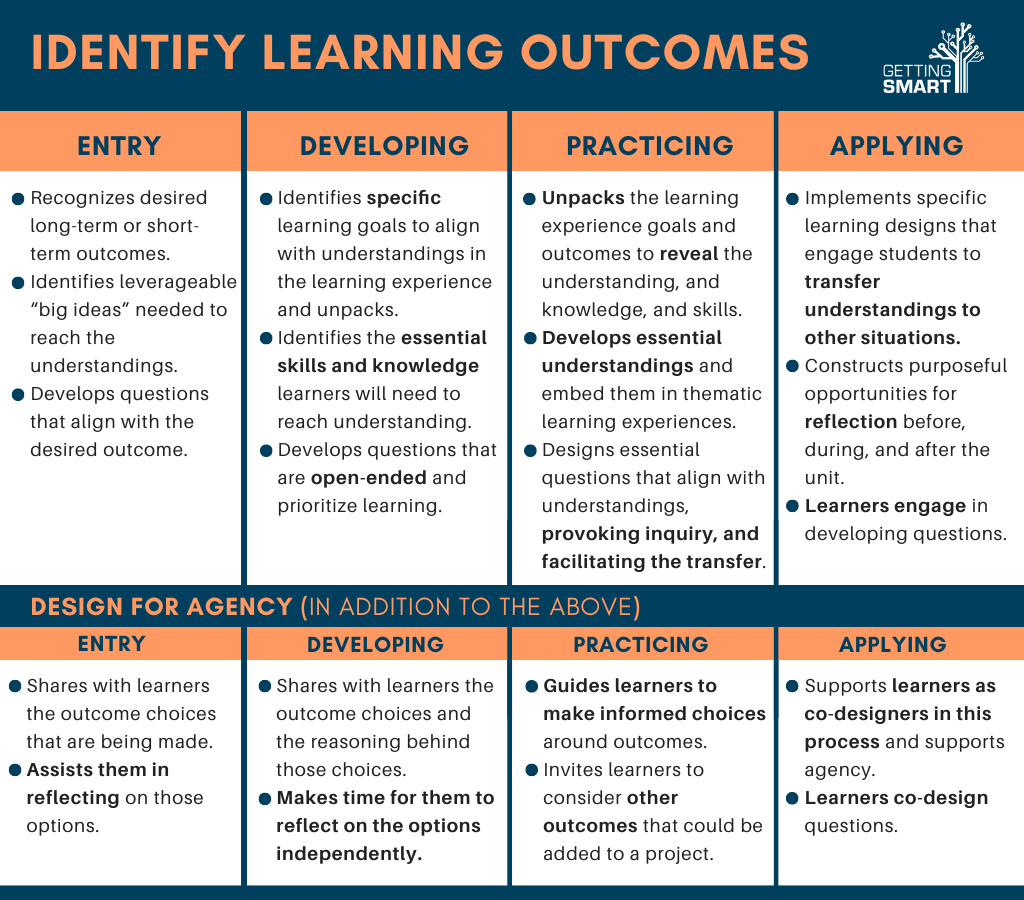
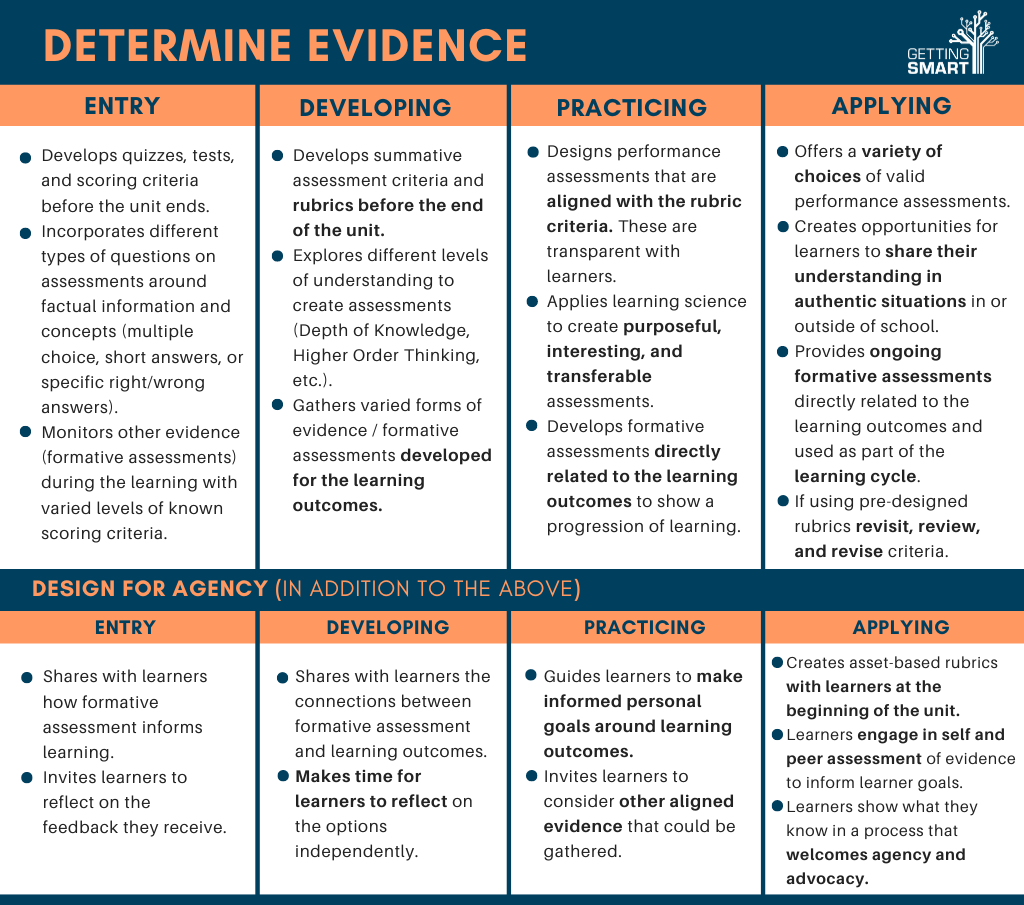
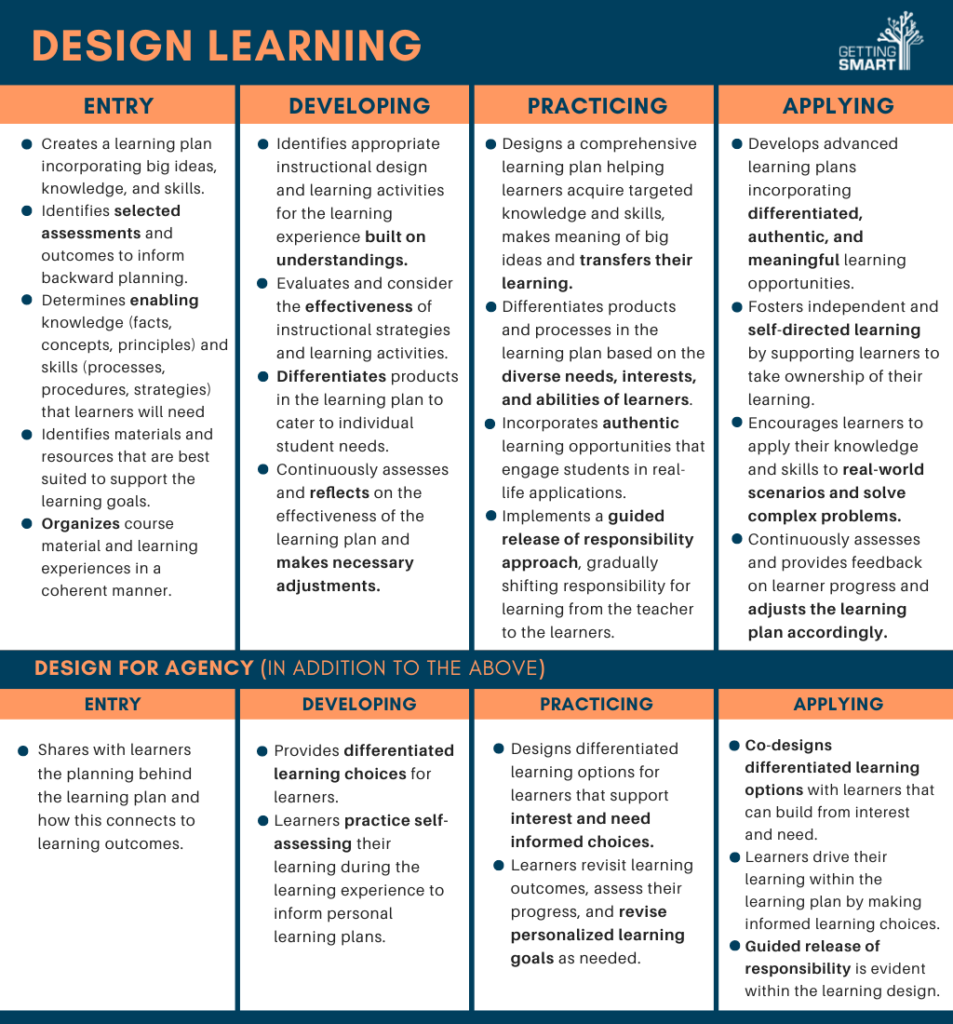
The continuum below is a guide for educators to revisit Backward Planning and foster a systemic approach in classrooms and learning systems. It originated in Colorado through a collaboration involving K-12 educators, leaders, and stakeholders in Mesa County Valley School District 51. While it has been refined over time, the core purpose has not changed. Educators optimize learning and refine instruction through co-design and deliberate feedback. These progressions can also be integrated as educator competencies or included in a comprehensive Portrait of an Educator.
Identify Learning Outcomes
Determine Acceptable Evidence
Design Learning
In personalized learning frameworks, learner agency and co-designing elements are essential, empowering learners to contribute to their educational journey. To support this, there is an additional row for learner agency, followed by a section that emphasizes aligned instructional strategies.
IDENTIFY LEARNING OUTCOMES PRACTICES
Learning outcomes can pull from competencies or standards. They may also be referred to as learning goals, Essential Understandings, Essential Questions, and Knowledge and Skills
Consider the learning outcomes. Questions to consider:
What are the essential concepts for students to understand?
What essential questions will students keep considering?
What knowledge and skills will students acquire?
What established outcomes are targeted?
Review the depth of knowledge identified to know the learning outcomes. Set clear, achievable, and measurable learning goals and share them with learners. Prioritize collaborative, learner-centered learning. Determine how the design of learning contributes to a learner’s success and how the assessment process will impact the final mark (reassessment opportunities).
DETERMINE ACCEPTABLE EVIDENCE PRACTICES
Assessment design incorporates assessment literacy and learning science principles to effectively utilize formative, summative, and performance assessments.
Consider the assessments and performance tasks learners will complete in order to demonstrate evidence of understanding and learning. How will I know if students have achieved the desired results? What will I accept as evidence of student understanding and proficiency?
Choose the types of assessments to gather evidence that will be used for designing. Considering Summative, the culminating assessment activity at the end of the unit or a version of a formative assessment, that measures learners’ understanding along the way, such as quizzes, reflections, peer feedback, conferring, performance tasks, or practice work.
Access Prior Knowledge & Gather Feedback. This can occur through a pre-assessment, a type of diagnostic assessment to check students’ existing knowledge (which may not be needed in learning systems where the data is not averaged or archived) and/or formative check-ins (most common: KWL organizers, pre-tests, skill checks, and interest surveys (start of year/course). Timely, specific, and descriptive feedback that invites and allows student improvement
Self & Peer Assessment. A key component of effective formative assessment is the involvement of learners in the process. This process Impacts the brain’s executive functions, ability to focus attention, monitor actions, and use feedback to make adjustments when necessary
Performance Assessment. The authentic application of learning, the ultimate transfer of learning. Learners show what they know – not just for their teachers, but for themselves.
DESIGN LEARNING PRACTICES
Backward Planning from selected assessments and outcomes should incorporate instructional strategies and activities. Instructional strategies and learning activities are evaluated and considered for learning design.
Questions to consider:
What enabling knowledge (facts, concepts, principles) and skills (processes, procedures, strategies) will learners need in order to achieve desired results?
What activities will equip students with the needed knowledge and skills?
What materials and resources are best suited to accomplish these goals?
How will course material and learning experiences be organized?
Instructional strategies are the teaching methods used to present new information. Methods can include teacher-centered approaches like demonstrations or lectures or student-centered approaches like peer discussion and inquiry-based learning. Instructional activities are the specific ways in which students interact with the course content. These activities run the gamut of watching educational videos, creating posters or presentations, completing a group project, or playing learning-based games
These implementation progressions serve as a reflective tool for educators and PLC teams to self-assess their understanding and application of the Backward Planning stages. These tools foster a culture of reflection and growth, leading to ongoing improvements in instructional practices and enhancing learner achievement.
When looking around the education innovation table – who is present? Are there leaders doing work for and with their local communities? Are there leaders doing work for and with students with disabilities and learning differences, specifically? What about leaders who are new to the space or are bringing new, innovative approaches to equity, education, and inclusion? The Educating All Learners Alliance created the New Champions Fund Initiative to identify such leaders and support their work.
The EALA New Champions Program
The Educating All Learners Alliance (EALA)’s New Champions Fund Program is an annual competitive subgrant created to provide unrestricted funding and a one-year mentorship to a leader doing exceptional work at the intersection of equity and students with disabilities or learning differences, including students who are also marginalized, come from underserved communities, or experience poverty. This competitive grant was created to elevate the work and profile of not-yet-recognized leaders who are doing exceptional work but who may struggle to gain recognition in traditional national fundraising and communication efforts. We believe this effort is not just about extending financial capital, but social and human capital.
In 2023, only the second year after the program’s launch, EALA received an unprecedented number of applications. Over 170 leaders from across the nation applied for the opportunity to be named 2023 New Champion to grow their work. For many applicants, this was their first grant application experience. Upon attending the New Champions office hours created to support early-stage grant applicants, applicants remarked on the impact this program was able to provide. For those who had applied to grants before, this was the first program they encountered that could provide feedback on applications not chosen and grow the capacity of the sector. The office hour sessions not only answered their questions on the grant, but also provided space for applicants to meet and hear from other leaders from across the country who are also centering equity and students with disabilities – a first for many in the room.
When looking around the education innovation table – who is present?
Treah Hutchings
Meet the 2023 New Champion: Kim Riley
In 2019, Kim Riley founded The Transition Academy (TTA) with a mission to make economic inclusion a reality for youth with disabilities, especially for young people of color who have been historically failed by systems. As the mom of a young adult son who was not adequately prepared to be successful after high school, she designed this organization as a solution to this problem impacting her family and others like hers. She gathered families, teachers, counselors, employers, colleges and universities, Social Security Benefits counselors, and others to form The Transition Academy (TTA), where mostly African American students with disabilities in the Kansas City, Missouri Public School system could participate in actively creating their paths forward beyond graduation and to close the opportunity gap that existed.
In 2022, Riley held the first-ever Greater Kansas City DiversAbility College and Career Fair, a free metro-wide event bringing representatives from universities and employers to help students plan their next steps. In 2023, TTA tripled the number of schools served, exceeding its original target of serving 100 students and their families, and the 2023 KC DiversAbility fair drew more than 400 attendees who met one-on-one with college professionals, job recruiters, social security benefits professionals, and others. TTA has exciting plans for their programming in 2023, including bus tours to colleges and universities and new in-class discovery and job training work. TTA is continually evolving to meet the needs of those being served, and plans to use funding from the EALA New Champions Grant to achieve its ambitious 2023 growth goals.
Students and families attending the 2023 KC DiversAbility College and Career Fair
In an introductory blog on The Transition Academy website, Kim states, “For far too long, parents of youth with disabilities have described life after high school as ‘falling off a cliff.’ These feelings of dread are because the preschool to high school process is easy to follow. But life after high school is a different story. And the systems (i.e. employment, benefits) are confusing. In fact, it seems like you need a secret knock and password to understand what employment and benefits opportunities are available and match you or your child’s interests. We, at The Transition Academy, believe every youth of every ability level deserves the right to live a happy and productive life.”
The Power of Representation
The Transition Academy is the only African American-led organization in the Greater Kansas City Area focusing on improving postsecondary outcomes for youth of color with disabilities.
This kind of representation in leadership matters. In her application, Kim shared how this representation helps strengthen communities and provides opportunities for underrepresented youth to see themselves in leadership roles, inspiring them to imagine bigger and bolder dreams for themselves.
After the print and television media coverage on the impact of the KC DiversAbility College and Career Fair this year, Kim said it was a comment from a 19-year-old African American youth with autism that stood out. According to his mom, he had never experienced people of color in disability leadership. When he saw TTA’s black and brown team, he smiled and pointed to his brown hand and said, “Look mom. They’re black like me.”
The EALA New Champions Program goes beyond individual recognition; it aims to build a community of changemakers who collectively transform education and drive lasting impact. The combined efforts of Kim Riley, Antoinette Banks, Nekia Wright, and past EALA New Champions represent a powerful force for equity, inclusion, and innovation in education. We cannot wait to see where the expanding network of New Champions leads.
Treah Hutchings is the Director of the Educating All Learners Alliance at InnovateEDU.
Two-thirds of current high schoolers and graduates say they would have benefited from more career exploration in middle or high school according to ASA research. We recently spotted two innovative approaches to addressing this guidance gap: EvolveMe, a direct-to-youth platform from ASA, and a middle grade course from Education Opens Doors.
“We’ve invested a lot of time and energy to learn what really works in terms of getting kids to play an active role in planning their future,” said ASA CEO Jean Eddy. “And one thing that consistently comes back is the reality that kids need to be engaged in their own spaces and on their own terms. Importantly, they need to have agency and be able to make informed choices,” she added.
The ASA team assembled a mobile-first free suite of products and resources to build durable skills and prepare young people for their career journey and life after high school. The EvolveMe platform encourages the exploration of possible futures and offers incentives for completed tasks along the way.
EvolveMe features 26 career experimentation and skills-building activities from 15 innovative partners that serve millions of teens. Partners include:
UStrive, which enables teens to sign up, find, and meet with a mentor,
Tyto/Immersed Games, which offers five games across in-demand issues where kids can build knowledge and skills and try on jobs,
Talk Hiring, which helps kids learn to interview with confidence by doing realistic yet automated mock interviews and getting instant feedback,
Create & Learn, which helps young people to learn Scratch and Python coding through online courses with real professionals, practice core coding concepts, and build an impressive project,
Work Simplr, a platform that breaks real-world deliverables down into projects for kids to complete and earn money,
Science Near Me, which allows youth to search for activities and experiences in science,
CareerVillage, an online platform democratizing access to career information and advice by providing a supportive community of real professionals ready to answer any question about any career,
Skillsline, a platform that teaches durable human skills, with the goal of giving every student the tools they need to navigate the complexities of the modern world — in school, at work, and in life,
ProjectSet, an online platform for virtual work-based learning opportunities that help kids and university students to develop workplace skills and become career ready,
Bloom Learning/Ender, which is on a mission to make kids employable before they graduate high school by building a competition platform where they win prizes by completing projects and gaining skills,
School of Thought, which is a nonprofit dedicated to teaching critical thinking and reasoning skills,
FitMoney, which provides a free certificate course that allows kids to build knowledge and confidence around financial literacy topics,
Aha Media, which connects teens and emerging talent to immersive virtual internships in animation production from the comfort of their own communities,
Cirkled In, a modern, engaging, Gen-Z-focused professional profile platform that empowers K-16 students to showcase their holistic achievements, strengths, and talents, connecting them to their best-fit educational and employment opportunities, from college and scholarships to jobs and internships.
For the last two months, ASA has been reaching out through social media inviting teens onto the platform. Tens of thousands of learners are engaging and earning rewards while developing
“We’re excited about this launch and about any initiative that promises to get kids feeling a sense of ownership over their education, work experience, and future,” said Eddy.
EvolveMe features 26 career experimentation and skills-building activities from 15 innovative partners that serve millions of teens.
Getting Smart Staff
New Class Boosts High School and Career Readiness
Education Opens Doors (EOD) provides a middle school course that builds skills and supports thoughtful high school choices. It is used by the 43 middle schools in Dallas ISD and gaining national attention.
“We partner with middle schools across the country, training teachers to equip their students with the college and career knowledge and skills they need for long-term success,” said EOD CEO Roscoe Compton-Kelly.
The two-part college and career readiness curriculum can be offered as a middle grade class or in units of study in an advisory period.
The first program includes six units designed to introduce students to key college information and soft skills. Topics covered include measures of success (GPA, class rank) types of high schools, resume and interviewing, reasons to attend college and financial aid.
The second program includes growth mindset, internships and jobs, mock interviews, choosing a major, financial literacy and applying to college.
In terms of outcomes, Roscoe sees high levels of student and teacher engagement, digital citizenship skills, a sense of belonging, and more informed high school choices.
Opportunities and experiences at all stages of students’ lives are integral in shaping the adults they become. For today’s students, though, the pandemic stole valuable time, resulting in steep academic and social-emotional declines that will impact them for years to come.
As COVID-related disruptions disappear into the rearview mirror, the educational community must take time to reflect on the purpose of education and reevaluate strategies currently in place to prepare our next generation for their future. Instead of focusing solely on passing state assessments, remediating to address gaps, or identifying students for advanced academic programming, schools must become a place where all children can develop their talents.
Nurturing Talent from the Start
Nurturing talent must be an ongoing process rather than a single event. Programs must be re-envisioned with a lens toward adulthood, rather than doing only what it takes for students to get the best score on tomorrow’s test. And these programs must help all students – even the youngest ones – develop the skills they need to succeed in their lives and careers beyond graduation.
Talent development research emphasizes that ability is malleable and domain-specific, rather than fixed and global in nature, and developed by specialized educational and training opportunities. The goal of talent development is to transform potential and recognized abilities into domain-specific competencies, expertise, and creative productivity or eminence.
Looking at education from this perspective, there are two components that foster the critical and creative thinking, as well as problem-solving, skills required for talent development:
Domain knowledge and skills – The ability, competence, expertise and detailed understanding of core topics.
Psycho-social skills – Mental skills and social-emotional learning (SEL), such as a student’s ability to engage with others, regulate emotions and see themselves as capable.
As schools reimagine their roles in the post-pandemic world, a high priority must be given to developing the talents of all students, not just a select group that may do well on achievement tests.
Susan Corwith and Anna Houseman
Addressing a Mismatch in Learning and Student Needs
While these programs are seeing success, in many schools, students are unable to effectively develop their talents because there is a mismatch between the learning environment and student needs. Since achievement only tells one chapter of a student’s story, schools also must consider student abilities and social-emotional competencies. To truly identify opportunities to personalize learning based on student needs, schools must triangulate ability, social-emotional skills and achievement measures.
By looking through different lenses and evaluating these multiple measures, schools can hone in on student’s individual talents and engage them in ways they learn best in the classroom. Many districts are interested in this strength-based approach to learning and have to reimagine what learning looks like by starting pilot programs at individual schools or with certain groups to refine processes and leverage lessons learned as they scale to a wider population.
Richardson ISD in North Texas believes that everyone deserves an enriching learning environment, regardless if they are gifted learners or struggling students. The district developed a robust accelerated learning program and a creative approach to using ability data in every classroom to address this goal. They use a center-based classroom to provide opportunities for an educator to adjust their practices, ensuring constant student engagement and monitoring, while providing immediate feedback as the students work with collaborative peer groups.
Reinvented Programs Deliver Results
To help all students achieve at the highest levels, many school systems are leveraging student strengths and focusing on teaching them to apply skills and experiences in ways that help them grow. This is the approach taken by talent development-based gifted education services, such as the one in Elgin, Illinois. Elgin U-46 is a large suburban K-12 district northwest of Chicago that serves a socioeconomically, racially, linguistically and culturally diverse population of 36,000 students.
Over the last several years, Elgin U-46 redesigned its programs to support equity and access to advanced learning services. The district implemented several evidence-based practices – including the use of multiple assessments for identifying students for advanced programming, providing early-grade enrichment, and using a combination of universal screening and local norms for placement – with demonstrated results. During this time the number of Hispanic students in the program has doubled, better reflecting the population of the district’s student body.
Another example of an innovative talent development program is Project OCCAMS, a partnership between the Center for Talent Development at Northwestern University, the Center for Gifted Education at the College of William and Mary, and the Columbus (Ohio) City Schools. The cutting-edge program helps prepare students from low-income backgrounds for advanced high school courses.
Project OCCAMS develops and delivers an accelerated online English language arts (ELA) curriculum that compacts ELA standards for grades 7-9 into a two-year course sequence in grades 7-8. This allows students to earn a high school credit in middle school and enter high school one year accelerated. Coursework is facilitated through the Center for Talent Development’s online platform and uses a “hybrid” delivery model combining elements of online and in-class learning. Pilot teachers are engaged as co-developers of the curriculum using a design-based research model. All project partners also participate in an active online community where feedback, coaching and technical support are provided in near real-time.
As schools reimagine their roles in the post-pandemic world, a high priority must be given to developing the talents of all students, not just a select group that may do well on achievement tests. Educators and administrators must use a combination of measures – ability, achievement and SEL – to better understand each individual student’s style of learning and how to best engage them in the classroom. Personalized instruction that enables students to self-direct their learning in creative ways will be imperative as we prepare students for success beyond graduation.



 Jeff Horton | Blog Site