Johanna Peetz, a psychology professor at Carleton University, talked to us about how to foster proactivity. Here are a few highlights:
We define proactivity as taking initiative. Why is proactivity so important?
It’s often harder to get started than to keep going on a task. And the closer you get to achieving a goal, the easier it gets. So you could argue that the hardest part of reaching a goal is getting started. Research shows that there are times when it’s easier to get started—for example, when you feel like it’s the beginning of a new era. “Today is the first day of the rest of your life”—that cliché is actually helpful. If you feel like today is the start of a new time period, you are more motivated to start working toward goals.
How can parents and teachers help kids get started on projects?
Saying “just do it” isn’t very useful when you feel overwhelmed. It helps to break things down into smaller steps and tell yourself consciously, “All I’m doing today is getting started on the first step, and I’m not going to worry about the rest. Today is a good day for getting started.” Once you’ve done the first small thing, the next small thing is easier to do. The next day, you can say to yourself, “Today is a good day to get started on step two.” Before you know it, you’ve completed the whole task.
Sometimes parents see a project due in a week and think their kid should be working on it, but the kid thinks there’s no rush. What’s a good way to talk about deadlines?
Everybody has the potential to be a champion for their ideas and get started on things and be inspiring to others.
Johanna Peetz
The two different viewpoints—feeling a sense of urgency when a task is due in a week or feeling like there’s still a lot of time left—are both totally valid. There’s only a problem if people clash in those views, when one person feels like, “Why are they not working on this? They should be doing things because they only have a week,” and the other person thinks, “It’s not due for a whole week. What’s the rush?” I think the best way to bridge the gap is to talk about the difference in perception and set deadlines you both agree on. You have to be very explicit about what the kid plans to do and when they plan to do it to avoid miscommunication.
How can parents and teachers help kids manage their time for long-term projects?
It’s possible to shift people’s perception of time—how close or far into the future something feels. If you show the deadline in a very large timeframe like the school year and the assignment is due in a month, it feels a lot closer than if the timeline only spans two months, so the deadline is right in the middle. With little visual tricks, you can shift people into feeling motivated to get working.
You can also break down the project into smaller steps and set intermediate deadlines. You can ask kids, “What will you do per week?” and establish weekly deadlines so they don’t leave everything to the end.
What’s one easy thing we can do to help kids be more proactive?
Help them practice thinking into the future. My own kids don’t often do that spontaneously, so I have to encourage it. I’ll ask them, “What do you want to happen a year from now? What do you want to do between now and then?” So they practice planning out tasks and steps to reach goals. I’ll also talk to them about fun things, like a trip we will take this summer, and what we have to do beforehand. Do we need to buy luggage? What will we pack? I think this kind of explicit planning is a skill that can transfer over to other areas, like academics.
What do you think people get wrong about proactivity?
People believe that some kids are proactive and others aren’t. But they might just see the proactive impulses of one kid more than another. Maybe the other kid is being proactive in ways that aren’t as obvious. Or maybe they just haven’t had the circumstances that push them to show those qualities.
Everybody can be proactive. Everybody has the potential to be a champion for their ideas and get started on things and be inspiring to others. Proactivity is a quality we all have—it’s just about giving space to it and showing it to the world. Originally published by Character Lab, a nonprofit advancing scientific insights that help kids thrive.
The single narrative education system is no longer working. Its main limitation is its inability to honor young people as the dynamic individuals that they are. New models of teaching and learning need to be designed to center on the student, not the teacher.
In Dr. Benjamin Freud’s article, The Metaverse will make schools places of becoming, Chapter I asks,“Why do I need to learn from you?”.
This question is an invitation to us as educational professionals to create systems that allow students to personalize their learning. Again from Dr. Freud, “Kids know that they can learn anything they’re curious about and that there is so much more out there than the curriculum they are fed.” Education 3.0 has an important role to address this directly.
Immersive technology via the metaverse can support students’ curiosity about topics that interest them. Blockchain technology can help document, certify, and facilitate these learning experiences in a trustless way. Token-based systems have the potential to provide students with access to resources that can help grow and regenerate these learning experiences.
Dr. Freud summarizes these points well by stating, “Learning is liberated when we are released from our physical constraints when the physical world subsumes the imaginary world and we can access anything, anyone, anytime.”
It’s our responsibility as educators to pay close attention to how these immersive worlds are designed and implemented as we transition out of the physical world and into a new one. If students lose agency in these immersive worlds there is the potential to continue the corporate-owned and data-driven models of identity extrapolation.
Immersive technology via the metaverse can support students’ curiosity about topics that interest them.
Dagan Bernstein
Learning benefits when it is personalized. Immersive technology creates personalization that goes beyond the surface level that is discussed in education circles.
Is it regenerative?
The concept of regeneration (and regenerate, regenerative, and regeneration) has been borrowed from biology and has begun to spread across a variety of well-known industries–from agriculture, energy, finance, and education. The definition changes slightly with context, but we can extract a generalized definition of regenerative to mean “to regrow or be renewed or restored.”
The sustainability of an immersive learning system depends on its ability to continuously grow itself anew. Educator Daniel C. Wall relates this concept to education in his Medium article titled Education and Regenerative Cultures (Version 0.0) the following way:
“Education for regenerative cultures is about the life-long process of enabling and building the capacity of everyone to express their unique potential to serve their community and the planet and in the process serve themselves.”
This circular relationship between building the capacity of the individual to serve the community, serving the planet, and then in return serving the individual must be a foundational principle of the metaverse. Without this grounding in regeneration, immersive learning becomes a novelty that replaces outdated learning models but doesn’t add any value.
The strong interest in virtual, augmented, and immersive technologies put us in a dangerous position. We are “cutting off one’s nose to spite one’s face” if we don’t lean into the innovative pedagogy that researcher Justin Reich described in his book. Essentially cutting off in-person learning to spite its monotony.
We can examine how regeneration can support innovative pedagogy in immersive learning environments by digging a little deeper. Author Carol Sanford developed “The Regenerative Paradigm for Education” which consists of 7 First Principles of Living Systems. These are described in a series of articles titled The Regenerative Education System and Practice.
There are characteristics found within these principles that contribute to regenerative learning:
Learners are agents of their learning
Learners are whole individuals made up of mind and body
Learners possess the ability to teach themselves
Learning happens through both participation and observation
Learning happens in small nodal communities
Educators can maximize the effectiveness of immersive technology by infusing these characteristics of regenerative learning into their instruction. The metaverse will be another technology that “fails to disrupt”) to borrow from the title of Reich’s book) if we don’t
Does it allow for learning to happen non-linearly, at any time and any place?
Decentralization has taken on a new meaning in the context of web3 and blockchain. The World Bank has identified different forms of decentralization to help communicate what it means in different industries.
For schools I’ll use the definition of decentralization coined by education innovator Mike Peck in his article Schools in an Era of Decentralized Learning Networks, “educational systems that operate both inside and outside of the traditional school structure, using a variety of methods, sources, and technologies to facilitate teaching and learning.”
Why is this traditional school structure that is limited by the physical space of the school building and the time of the school schedule no longer viable? There are two main reasons, one is the inequality of this structure, and the second is the changes in how our society is structured.
Let’s break down each of these two to understand them better.
A major reason for the inequality in our public school spaces stems from funding models in the United States that are based on income from property taxes. The type of educational experience and learning opportunities, as well as the facilities and resources that young people have access to, are impacted by where they live. There is an even greater disparity happening in countries with emerging economies and more dislocated school systems.
The structure of our school day and the school year is extremely limiting as well. The design of the school calendar is out of date and based on societal needs from centuries ago. In terms of the in-day schedule, this Atlantic article examines adjustments to disrupt the common 8 am-3 pm model.
It also is time to rethink the structure that limits learning between eight or nine in the morning to three or four in the afternoon from August/September through May/June. We need to move towards “just in time” learning models that allow learning to happen at any time and anywhere. If a student learns best during the summer months from 2 pm to 9 pm we should be able to offer learning that honors that. Same for a student who prefers 5 am to noon.
Immersive technologies have the ability to facilitate learning that is accessible across space and time. This will help create this future in which educational systems are operating as Dr. Peck says, “both inside and outside of the traditional school structure.” The metaverse will be a key technology as these systems are built.
Non-linear learning will help incorporate two learning strategies that have been proven to improve learning efficacy, the jigsaw method and self-efficacy. The jigsaw method empowers students to become content experts and disseminate this knowledge to their peers. And self-efficacy is defined by John Hattie as “The confidence or strength of belief that we have in ourselves that we can make our learning happen.”
Shifts in the architecture of our schools and effective pedagogy combined with immersive technology are the ingredients for how we can reimagine education for the next generation of learners.
Concluding Thoughts
Education is particularly ripe for change, but many transformative technologies have not been invited into our learning spaces. Legacy systems are resistant to embracing things that will make their structures and rules irrelevant.
Immersive technologies are one of these technologies. Instead of pushing them away, we need to invite them into our schools to help facilitate new learning opportunities. The “Ready Player One Test” is a framework that educators can use to guide their decision-making around immersive technology because not all implementations of this technology are beneficial.
When the opportunity arises to implement learning that uses immersive technology ask yourself if the learning you are designing passes the Ready Player One Test:
Does it allow learners to immerse themselves in environments that would be too expensive or dangerous to experience otherwise?
Can the learning be personalized by the student?
Is it regenerative?
Does it allow for learning to happen non-linearly, at any time and place?
Dagan Bernstein is an educator from Hawai’i who believes in empowering deep learning through relationships and joy. Follow him on Twitter at @DaganBernstein.
The genesis of Affirmative Action started in 1935 with the Wagner Act, an act that gave legal rights for labor unions to bargain collectively with their employers. It was not until 1961 when President John F. Kennedy issued Executive Order 10925, encouraging federal contractors to “take affirmative action to ensure that applicants are employed, and that employees are treated during employment without regard to race, creed, color, or national origin.” Over time, this executive order started to impact education. It was in 1968, alongside social unrest and the civil rights movement, when students implored universities to better represent America through the admission process. Four weeks after the assassination of Dr. Martin Luther King Jr., Harvard University announced a commitment to enroll a higher number of Black students. Because of the recent reversal of Affirmative Action, universities will have to make the same commitment Harvard made 55 years ago. Will our students feel invisible in today’s higher education institutions? Below is my proposal to ensure the majority that represents our public education ecosystem are not invisible to the university admission process under the auspice of the Disruptive Excellence Framework.
Feeling Invisible: The Implications of Eliminating Affirmative Action
Throughout American history, the scope, breadth, and meaning of Affirmative Action have taken on many definitions. On June 29, 2023, the Supreme Court reversed Affirmative Action by stating it might no longer be necessary for 25 years. The structural frames of higher education in the context of Affirmative Action acted as a lever so students of color would not feel invisible at their respective institutions. The ruling by the Supreme Court explicitly imposes a new practice in higher education. A mindset consisting of a superficial lens of race blindness in America. The influence of overturning Affirmative Action exacerbates the legacy of discrimination while promulgating a statistical metric that plagues higher education – inequities with admission practices. Discrimination and racism have carried a pernicious undertone where this decision has the proxies of Black and Brown students becoming invisible in higher education. Despite future implications with regard to the negative ramifications of civil equity and collective intellectual growth, there are practices rooted in the Disruptive Excellence Framework that would evade new segregationist policies because of the ruling. Through the lens of the Excellence Loop, there are opportunities to mitigate a decision that inevitability will bring the sullied past of America to the forefront. Let’s explore strategies through the elements of the Excellence Loop to ensure Black and Brown students are not invisible at our universities.
Intentionally, Boldly, and Unapologetically Challenging the Affirmative Action Reversal Decision
The legacy of racial exclusion and the continued effects of segregation still exist despite the myopic responses to overturn Affirmative Action. Through the Excellence Loop, we can intentionally, boldly, and unapologetically continue to strengthen the equity scope of admission policies where Black and Brown students are not invisible. We must act to ensure that representation mirrors the broader demographic in public education. You can start with the strategies below.
Expectations Gap: Universities must establish an expectation to ensure equitable percentages of racial diversity are rooted in the university’s student demographics. Also, race-based or legacy decisions at the university level must be eradicated. For example, a university could designate percentages from historically excluded student groups for admission in accordance with their equity policies. We see this practice implemented at the high school level where there is a guarantee for equitable representation in rigorous courses.
Preparation Gap: Colleges and universities should assess alternatives to root policies that eliminate discriminatory admission practices. Boards of Trustees and university officials should review alternatives on a quarterly basis that include the voices of professors, staff, and students representing the institution.
Performance Gap: Without Affirmative Action, it is believed that universities will accept students only on academic merit. To amend future discriminatory acts with admission procedures, moving beyond standardized metrics to a holistic model should be a mandate at ALL institutions.
Access Gap: Since the Supreme Court ruling, there are theoretical claims that the representation of Black and Latino students will decrease exponentially at universities over time. Moreover, a significant decrease is forecasted at elite schools. Within any thread of the education ecosystem, specifically at the higher education level, policies, and admission trends must be interrogated by boards of trustees with a lens of access and opportunity. The ruling by the Supreme Court has an insidious opportunity to create institutional marginalization. Thus, in collaboration with boards of trustees, university officials must reevaluate admission policies with vigor and vitality. Criteria that promote holistic qualities to concertize access beyond traditional academic measures.
The Supreme Court’s ruling regarding Affirmative Action reminds us of Brown v. Board of Education of Topeka of 1954. The outcomes of the 1954 ruling acknowledged the persistence of segregation in education. I am afraid the long-term implications have moved our country into the modern-era civil rights movement. However, to achieve excellence and equity for Generation Z and Generation Alpha, we cannot accept the predicted outcomes from the reversal of Affirmative Action. Our efforts will demonstrate progress.
In the words of Martin Luther King Jr., “We shall overcome.”
At first glance, you might not be able to locate the teacher in Greg Zapasek’s class at Notre Dame High School in Ottawa, Canada. Instead of stationing himself at the head of the classroom, Greg Zapasek is working alongside individual students, conferencing with a small group of students, or triaging between different student groups on projects related to environmental sustainability. Similarly, just over 5,000 miles away in Lagos, Nigeria, Caleb British International School teacher Victor Okosun takes on the role of facilitator and coach to his students who are developing an eco-friendly refrigerator to help local farmers extend the shelf life of their produce.
What connects both classrooms is Challenge Based Learning, a framework for learning while solving real-world challenges. This framework anchors the Ciena Solutions Challenge, a global design challenge run by Digital Promise and Ciena where students create solutions addressing the UN Sustainable Development Goals (SDGs) in their communities.The SDGs are a collection of 17 interlinked goals for all countries to end poverty, protect the planet, and ensure that by 2030 all people enjoy peace and prosperity. Through the three phases Engage, Investigate, and Act, Challenge Based Learning invites learners to identify big ideas, ask questions, identify and solve challenges, gain in-depth subject area knowledge, develop 21st-century skills, and share their learning.
Challenge Based Learning and the Sustainable Development Goals
While there are many frameworks for hands-on, project-based learning, Digital Promise embraces Challenge Based Learning for its ability to empower students and teachers to be co-learners. The framework encourages students to determine the questions that can lead them to solving their challenge and the steps to discovering what they need to learn. The process supports teachers to act as facilitators and mentors as they learn and problem-solve alongside students, and collaboratively develop a solution to address their challenge.
“My role as the educator felt more like that of a coach, collaborating with students and offering support as they participated in their challenges,” said Greg Zapasek.
Because Challenge Based Learning helps cultivate authentic, student-driven learning experiences, it serves as a great scaffold for taking action on the SDGs in ways that are relevant to students’ personal lives and local communities. This is demonstrated by over 2,200 students around the world and their teachers–like Greg and Victor–who participated in the Ciena Solutions Challenge. We profile two of these teams from India and Zimbabwe who received a Ciena Solutions Challenge Sustainability Award to sustain and scale their projects.
Taking Action on Good Health and Wellbeing in Purulia, India
Located in Purulia, West Bengal, India, a team of high schoolers and their teacher Susmita Roy Chowdhury at Santamayee Girls High School used the Challenge Based Learning framework to take action on hunger (Goal 2), good health and well-being (Goal 3), and decent work and economic growth (Goal 8).
The team says their community is facing challenges such as high rates of unemployment and child malnutrition. Starting with the big ideas of combating malnutrition and empowering women financially, their essential question asks “How can we solve the prevailing rate of hunger and malnutrition in our community?”
The team conducted surveys with adults and children in their community to learn more about their personal experiences accessing nutritious food. They consulted with nutritionists to learn about what constitutes a healthy diet, and along the way met a team of researchers and scientists at Sidho-Kanho-Birsha University who introduced them to pisciculture.
Students interview community members about nutrition.
With the help of scientists and researchers, they learned about the nutrients in small fish in their local waterways and discovered which types of fish are the most nutritious. After learning about ring pisciculture, they are working toward developing a fish farm on school grounds. The fish farms will be operated by senior students and women in the community who can earn income from cultivating the fish.
“Teaching the students in the classroom [in a didactic style] and guiding them on a Challenge Based Learning Project are two completely different experiences because in the classroom, the students mostly follow in the teacher’s lead but in this kind of project, it is their thinking and performance that directs the overall progress,” said Susmita Roy Chowdhury. “So, as a teacher, it provided me an opportunity to witness how my learners react when faced with challenges, how they think and work as a team and how they implement their ideas into working models and that helped me understand my students a lot better than teaching-learning in a [didactic] classroom environment can ever do.”
Taking Action on Quality Education in Bulawayo, Zimbabwe
In 2017, the Ministry of Primary and Secondary Education of Zimbabwe introduced a new competence-based curriculum incorporating the use of education technology. However, teacher Jobert Ngwenya and students at Eveline High School in Bulawayo, Zimbabwe, recognized that there were few quality learning resources meeting the new standards. The team used the Challenge Based Learning framework to take action on quality education (Goal 4) and sustainable cities and communities (Goal 11).
Starting with the big idea of 21st century learning, the team’s essential question asks “How can we provide free digital content for learning areas that are under-resourced?” Layered within this challenge were their desires to document, record and promote local history and culture, and encourage the use of mobile technology as a learning tool. They explored their essential question by researching readily available printed and online content in history, economic history, and heritage studies reflecting the new standards; comparing the average cost of textbooks with the average income of people in their region; and conducting a survey with students on their access to mobile devices and the internet.
Students at Eveline High School interview their peers at school.
Based on the results of their research, they created Ilifa Lethu, a podcast through which they share information from difficult-to-access textbooks, local museums, people in their community who hold historical and cultural knowledge, and others with expertise in Zimbabwean culture and history. Their podcast is designed to provide more educational content for students in their community and share important cultural and historical knowledge to their community at large. They plan to scale up production by hosting more educational interviews, visiting and recording information from Matopo World Heritage Site, and getting their podcast disseminated through local radio.
Reflecting on the experience, Jobert Ngwenya says, “The Challenge Based Learning framework is a useful tool for addressing the SDGs because it provides a multidisciplinary, structured approach to problem-solving that engages learners in real-world challenges and encourages them to develop practical, feasible, and sustainable solutions that can make a positive difference in the real world.”
Elyse Gainor is a Program Director at Digital Promise. Elyse works on initiatives supporting youth voice and innovation, including the Ciena Solutions Challenge, a global design challenge for middle and high school youth, and the YouthMADE Festival, a global celebration of youth creativity and innovation.
I’ve been in education for over 35 years now. I have almost seen it all having worked in over 100 districts, 500 schools, and with over 1,000 educators and ten state departments of education. I’ve been in Seattle, Hartford and Waterbury, Yonkers, New York City, Worcester and Fall River, etc., as well as state education departments up and down the Eastern seaboard. From this work, I have seen how the mindsets, expectations, paradigms and federal and state policies have handcuffed the opportunity to serve our youth better than we do now.
Recognizing that the current design of school – in how we divide the disciplines, cover content, and push students through an assembly line of class after class in groups of 20-30 – was not working, I began my quest to seek out new school designs that far better serve youth and their future. The first “aha” I had was in coming across the Big Picture schools, then just getting underway out of Providence RI. To think that this school design was not organized to shepherd youth through a game-board of compliance (think chutes and ladders) but with a focus on the interests of students and the opportunity for them to explore their interests through internships and projects blew my mind.
I left Seattle after three years to work at Brown University where from I worked with school districts throughout New England and beyond to assist them in the creation of smaller learning communities, only to find that most of these systems really only wanted the money and didn’t want to really change how they did school very much. Yes, some of them created SLCs and career academies, but these shifts were minor in relationship to what was truly needed to serve youth better. Then I ended up working with several state departments of education with colleagues on how they could better assist and support school and district improvement in their respective states. Unfortunately, the bottom line – as a result of NCLB and later the misguided federal Turnaround School efforts of the Obama administration – was raising the ELA and math proficiency levels in their lowest-performing schools.
Seeing that the current policy environment did little to truly incentivize and support the growth of innovative, learner-centered schools, and now grounded in the power of experiential learning – a focus of Northeastern University where I have been teaching since 2009 – I sought out to find other schools pushing the envelope in the design of school, designs that foregrounded student agency, relationships, and the possibilities of their future lives. While working in Seattle, I came to know Jon Ketler and his colleagues and how they created their SOTA, SAMI, and IDEA schools, which have been highlighted here and here in Getting Smart. One Stone, a tuition free private school in Boise ID, directed by students. The well-regarded High Tech High in San Diego. The quickly growing and awesome CAPS Network. The innovative Design 39. And Iowa BIG, amongst many others.
The problem as I see it and as I attempt to detail in A Revolution in Education, is that each of these endeavors were the result of creative educators who through serendipity were able to manifest their visions from idea to reality. These educators by way of serendipitous events, relationships, and access to resources were able to materialize their visions with the support of others and a fortuitous context that supported their taking root. This is incredible and wonderful, but this means that an educator with a vision has to have the courage, commitment, and savvy and be afforded a similar alignment of stakeholder interest and welcoming context to get their vision off the ground. But our current public school ecosystem – with its current policies and funding streams – is very much designed to support the current status quo and hence very good at sustaining school as we now know it.
It continues to be increasingly clear that our current designs and aims of schooling are doing a gross disservice to our youth, their families, our communities, and the world. Student apathy remains high. Outcomes remain low – for most. It is for all these reasons that I push for a revolution today. Our youth remain disengaged and are graduating without the skills desired by employers. And perhaps most important, students continue to vocalize the lack of personal relevance and development of agency and opportunity they want, left abysmally unsure of what they want to do upon graduating and how they can pursue a desired future.
To school and district leaders, classroom educators, policy actors, parents, and community members, the future of education is yours to pursue.
Chris Unger
While the stories of High Tech High, the Tacoma Schools, Iowa BIG, and numerous others in the book can inspire us to rethink what school could be, these origin stories foreground how the start-up of such schools relied on the courage, persistence, creativity, and serendipitous events, relationships, community advocacy, and resources that led to their taking root and growing over time. Educators should not have to hope for or fight for the same fortuitous circumstances as afforded the other schools named in this book. Our public school system should be proactively incentivizing and supporting district and school leaders, classroom educators, and community partners to break the mold and build new designs of learning that serve their youth better. When educators are empowered and supported in pursuing creative visions, transformative school models can grow.
So, the call to action is clear: To school and district leaders, classroom educators, policy actors, parents, and community members, the future of education is yours to pursue. We can use many of the stories presented in the book and as evident elsewhere to help us pursue new designs. The revolution has been and continues to be underway here and there, but we need it to grow everywhere. Not slowly, and in only some communities. Rather, we need the number to grow exponentially, and in all communities. To do this, district and state policy actors need to be brave and figure out ways to incentivize and support the significant growth of agency-oriented schools. We can’t keep hoping that a few will break the mold despite the circumstances. We need the system to actively incentivize and support the development and growth of new designs. Then we need school and district leaders to embrace the challenge, community members to advocate for the new designs, and then district and state policy actors to create the greenfield for such schools to take root and grow. Fast.
How many more generations of students should we lose to apathy, compliance, and the lack of skills and knowledge that can benefit them moving forward in their lives? How much longer can we wait not taking advantage of the creativity of our educators and the possibilities of what we can do for our youth, our communities, and the world? Let’s stop tinkering inside the current model – something our current schools are very good at – and re-vision the aims of our schools and how we can achieve those ends – toward agency and opportunity for all.
Learn more about A Revolution in Education: Scaling Agency and Opportunity for All.
Chris Unger is a Teaching Professor in the Graduate School of Education at Northeastern University and supports the Graduate School of Education’s Network for Experiential Teaching and Learning (NExT) with a number of his colleagues at the University.
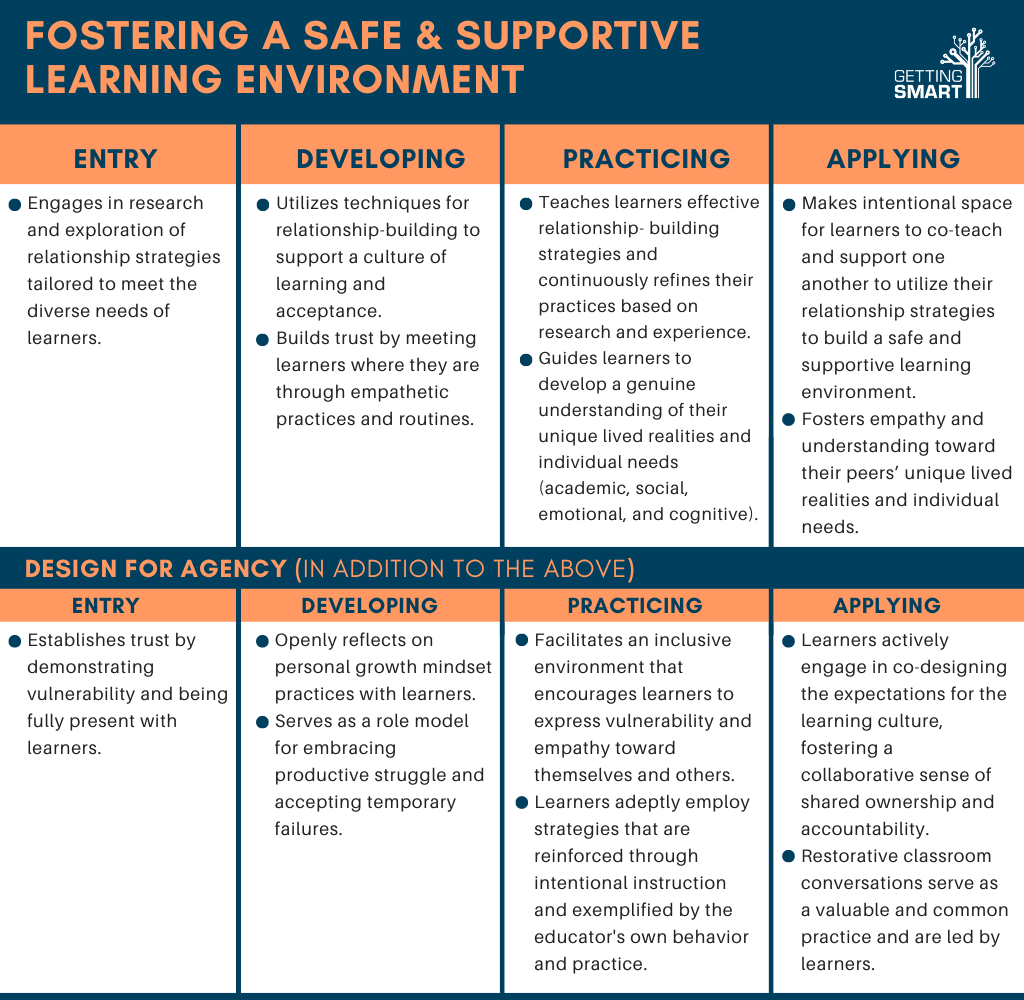
Fostering a growth mindset has become a powerful force, reaching beyond simple engagement and paving the way for lifelong learning driven by personal agency. Nurturing a true growth mindset culture demands more than just awareness; it necessitates establishing a safe and inclusive learning space that embraces the diversity of learners and their experiences.
This culture can then set the conditions for learners to understand that stress can be reframed as part of the learning process, an opportunity for growth, and a chance to push one’s boundaries. Embracing a growth mindset in the face of stress empowers individuals to approach challenges (and new learning) with resilience and adaptability, leading to enhanced learning outcomes and improved performance.
Equipping learners with a solid understanding of learning science empowers them to appreciate the importance of conditions, context, and thriving in their educational journey. Thoughtful feedback practices further enrich this transformative culture. By embracing these fundamental concepts, both educators and parents embark on a journey of transformation, redefining their view of productive struggle and embracing fresh learning experiences.
However, the real impact of growth mindset work comes to life when it seamlessly integrates into daily life, supported by systemic approaches that align with this vision. To genuinely cultivate a growth mindset culture, educators must avoid underestimating their learners’ potential and courageously address the harmful impact of systemic racial inequities in education. This unwavering belief in the capacity of historically underrepresented students to engage with challenging content is a cornerstone of fostering inclusivity.
Educators create a learning environment that empowers every student, regardless of their background by recognizing and confronting these inequities head-on. This means breaking down barriers, providing targeted support, and nurturing a truly inclusive atmosphere that amplifies the voices of underrepresented students. By applying the strategies and tools provided below, learners gain a sense of empowerment in their learning journey and their ability to shape their own growth.
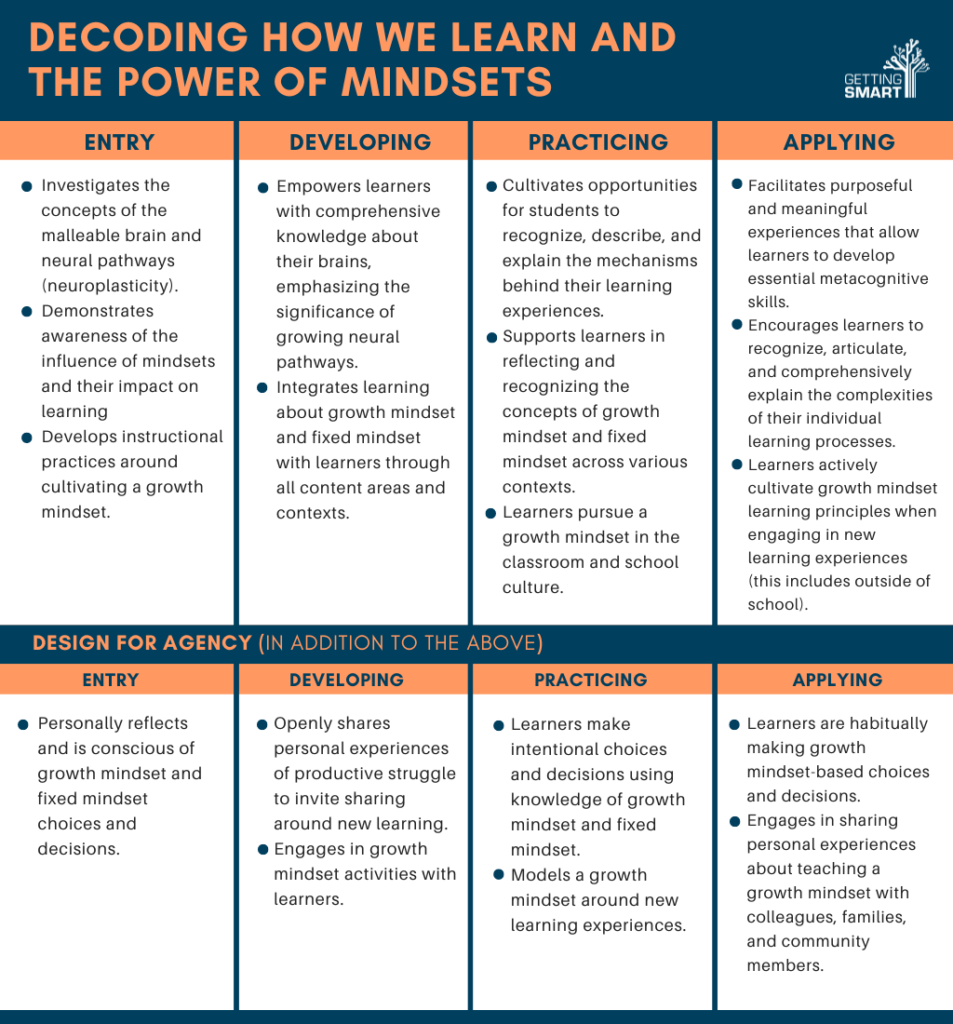
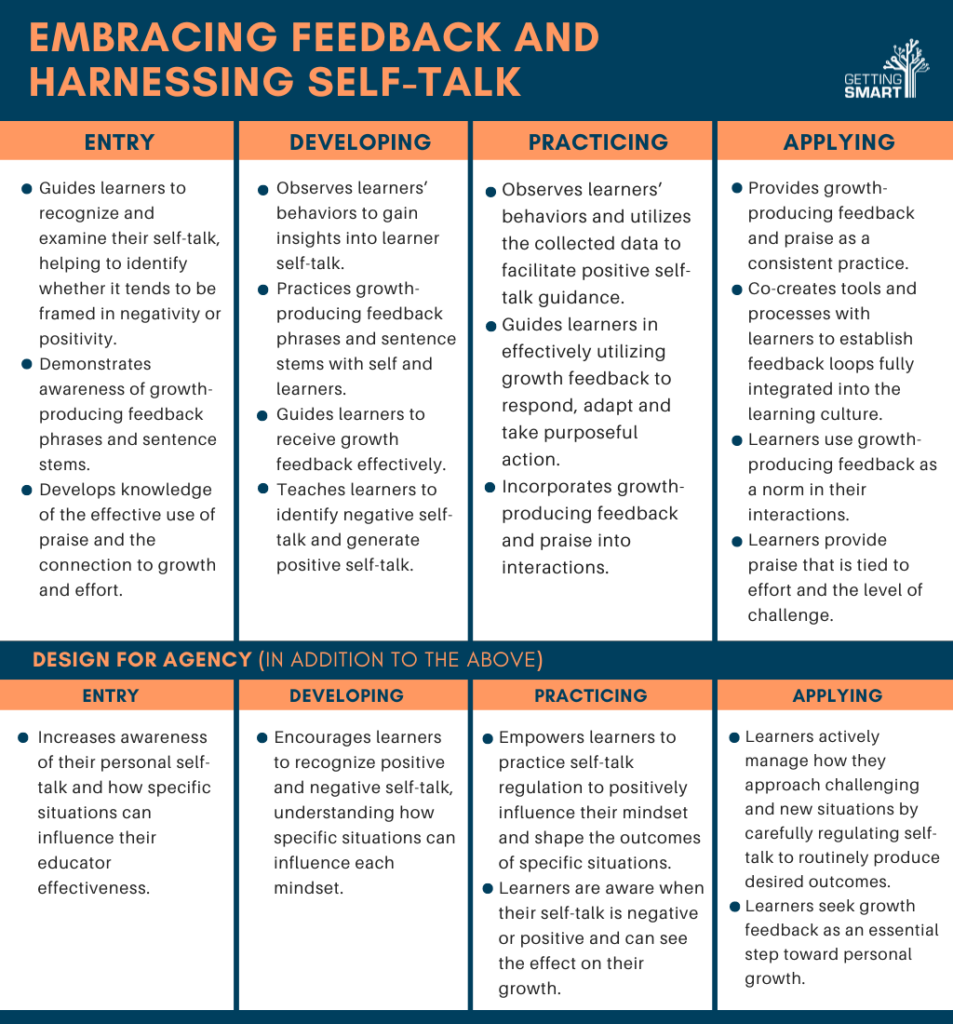
Implementation Progressions around a Growth Mindset Learning Culture:
Fostering a Safe & Supportive Learning Environment
Decoding How We Learn And the Power of Mindsets
Embracing Feedback And Harnessing Self-Talk
Educators optimize their professional learning best when they are part of the co-designing and refinement and provide deliberate feedback. These progressions can also be integrated as educator competencies or included in a comprehensive Portrait of an Educator. For more details on these stages and their origin, we invite you to explore these articles Five Steps to Embed Growth Mindset Practices and Growth Mindset is More than a Bulletin Board.
SAFE & SUPPORTIVE LEARNING ENVIRONMENT PRACTICES
Value and Acknowledge Learners: Prioritize recognizing and appreciating learners’ value when designing learning experiences. When learners feel valued and heard, it cultivates an environment that fosters recognition and enhances their readiness to learn. Validating and affirming their contributions is essential, as it acknowledges their unique perspectives and actively encourages their involvement in the learning process. Stephanie Malia Krause shares free resources from her latest book, Whole Child, Whole Life, 10 Ways to Help Kids Live, Learn, & Thrive. Tips for building connections and competencies.
Building Trust and a Safe Place: Establish an environment of trust by prioritizing relationship building. Begin by focusing on building relational trust through activities such as “Building Relational Trust” from Liberatory Design Implementation Cards, which feature design mindsets used at the Stanford d.school. NEA shared a recorded webinar titled “Building Trust in Indigenous Communities” and MDRC and The Education Trust have a helpful brief on “The Importance of Strong Relationships.” Design learning spaces for learners to take risks, ask questions, and freely share their thoughts, fostering an atmosphere where learning can flourish.
Cultivate Respect and Prioritize Learner Ideas: Create a learning environment that values and respects learner ideas. When learners feel that their thoughts and perspectives are respected and valued, they are more likely to share and express themselves without fear of judgment. This inclusive approach fosters psychological safety, enabling learners to engage in discussions and express their creativity confidently and without negative consequences.
HOW WE LEARN & MINDSETS PRACTICES
Reflect for Self-Awareness: Promote reflection to gain insights into learners’ feelings about themselves and their learning experiences. By providing opportunities for learners to reflect on moments of success and challenges throughout the day, educators bridge the gap between experiences and understanding of optimal learning methods. This reflective practice encourages metacognition, self-awareness, and a deeper comprehension of individual learning preferences.
Embrace Learning Science: Explicitly teach the dynamic nature of the brain, emphasizing that it evolves and grows throughout life. Adopt a phased approach to teach learning science, highlighting the concepts around neuroplasticity.
Supplement Curriculum: Engage learners by sharing and reviewing videos that illuminate the intricate workings of the brain. Consider integrating resources like the MindUP Curriculum, which offers K-8 materials, including videos tailored to specific grade levels (e.g., grades 3-5). Turnaround for Children, now the Center for Whole Child Education at ASU Teachers College, offers resources around brain development (Stress and the Brain) for teachers.
From Turnaround for Children, Stress and the Brain
Empower Parents & Families: Provide valuable resources for families and caregivers to enhance their understanding of brain development. MindsetWorks offers useful tools such as Brainology and Growing Early Mindsets (GEM). The Mindset Continuum chart helps identify mixed mindsets and offers insights into fostering growth.
Address Misconceptions. Stay abreast of recent articles that challenge common misconceptions about learning cultures. By staying informed and up-to-date on the latest research and insights educators can foster an environment that nurtures understanding and growth.
FEEDBACK AND SELF-TALK PRACTICES
Encourage Feedback: Recognize the significance of feedback as a powerful tool for growth and development. Emphasize the importance of delivering feedback constructively and thoughtfully to provide valuable insights into learners’ progress and areas for improvement.
Consider adopting a coaching approach when providing feedback, paying attention to tone and quality. Edutopia offers strategies in their article for enhancing the coaching approach.
Expand or create a feedback toolkit by exploring suggested sentence stems, such as the ones provided by Mindset Works. Review and adapt these phrases to suit your style and practice incorporating them into your feedback repertoire.
Nurturing Positive Self-Talk: Teach self-talk and self-awareness through modeling. As both a teacher and a learner, share your thoughts with students when receiving feedback, especially if it comes from them after a learning experience.
Co-generate a class list with learners by collecting examples of nonproductive self-talk and brainstorming alternative approaches. Classmates can then practice this with a trusted partner, or as trust and the culture grows this list can be posted for peers to support one another.
Develop mindful observations of learners akin to running records rather than quick assumptions. Refer to Kristine Mraz and Christine Hertz Hausman’s book, A Mindset for Learning,” which offers a chart of observable behaviors of learners and the examples of self-talk that may be occurring.
Engage in “think alouds” is a simple yet powerful technique that allows for exemplary modeling of self-talk practices.
To genuinely cultivate a growth mindset culture, avoid underestimating learners’ potential and bravely confront the harmful effects of systemic racial inequities in education. This unwavering belief in every student’s capacity to engage with challenging content is at the core of fostering inclusivity and empowerment. By embracing these principles, educators, and parents become powerful agents of change, enabling learners to thrive, succeed, and embrace a lifelong journey of learning and growth.
In today’s education landscape, “student voice” and “youth empowerment” are popular catchphrases. It’s understandable – there’s a growing recognition that giving young people more say and more ownership in their educational journey has profound, transformative benefits for learning. The ability for students to have a legitimate voice in things such as how they learn, what they learn, when they learn, and where they learn has tremendous potential for schools to adapt to the unique needs and gifts of every individual. However, there’s a glaring disconnect between the popularization of these terms and their actual implementation in many schools.
Over my career, I’ve worn many hats in education: classroom teacher, school founder, leadership coach, design consultant, and more. These experiences have given me the opportunity to really dig into HOW we can amplify youth voices and HOW we can empower young people; what I see is that many of the well-intentioned efforts schools are making to do this fall well short of what our students deserve. For instance, giving kids an hour of unstructured time once a week in a Genius Hour is progress, but it doesn’t address what happens in the other 39 hours. So, what does genuine empowerment actually look like? To put it simply, empowerment is a function of the level of freedom students have to navigate time and space in their everyday school experiences.
Through that lens, Eden Park Elementary School stands out as an exemplary model of genuine student empowerment. Here, 3rd-5th graders in the Learning Community have a tremendous amount of control to determine how they flow through the day.
That sense of freedom really comes out in this 3-minute short film.
During filming, students repeatedly told us the spaces they have access to are a big part of why they feel empowered. The proximity and transparency of the small group rooms to the classrooms make for a great breakout. The commons feel welcoming and comfortable, an agile place that allows students to spread out and find a quiet area when needed, or actively work on a project as a team. The variety of furniture students can arrange and rearrange encourages more movement, more active learning, and a greater sense of autonomy.
One of Eden Park’s students, Josephina, succinctly sums up the importance of such empowerment: “Freedom helps you learn; because without freedom, kids wouldn’t really want to go to school.” It’s through this profound understanding of the role of freedom in learning that Eden Park Elementary is raising the bar in fostering student empowerment.
This model serves as a powerful reminder of the significant impact a true commitment to youth voice can have on the education system, and how reimagining physical space an unlock genuine student empowerment.
The age of AI begs the question: what skills and knowledge are uniquely human? With massive search engine capacity and AI tools to scan, reorganize, and create new ways of interpreting information, where should learners be focusing their time and attention? In a VUCA world, Durable and transferable skills are essential and are backed by both educators and industry leaders. Unfortunately, they can be difficult to assess. Still, all of these skills combined don’t inherently result in a better world.
For the last few years, we’ve been making the case that purpose and contribution are the core outputs of a society. Because of that, there are skills and habits that young people need to strengthen and flex with regularity in a learning setting. This will result in generations of difference makers and solutionaries, people who spot problems (inherited or otherwise) and respond rapidly and systematically toward a future that works better for all. We must not continue to perpetuate a world where our long-term outcomes are purely economic or academic.
Powerful technology like AI increases the complexity given the challenge of bias in AI models, the susceptibility of humans towards influence, and the propensity for false narratives and information generated from AI sources. These challenges add a layer of increased urgency to the work of embedding purpose and imagination in our communities and schools.
In a recent interview on the People I (Mostly) Admire Podcast, guest Kevin Kelly shares “Part of my critique about the A.I. folks who are concerned about the end of the world is that they overestimate the value of intelligence. There are a lot of intelligent guys who think intelligence trumps everything, but most of the great things in the world are happening not by the smartest people in the room. They’re happening with people who have enthusiasm, who have imagination. Smartness and intelligence is one component, but if you put a man and a lion in a cage, it’s not the smartest one that’s going to win. It’s only one part of what we need to make things happen in the world. And the key thing of that is imagination. Imagining what could be, what we’d want, an alternative way of doing things. And that’s not just I.Q.”
As we continue to think about the role that AI will play in society, we must also consider what the core variables are that must be kept alongside exponential information to better drive decision-making and lead to a better world. For now, we will call the dream of a better world ‘purpose’. In an equation where information is merely one variable in a combination of factors toward a better world, what are the other variables? How might we preserve, promote and proliferate those variables while also using smart tools? To some, this may be viewed as “What makes us human?” To others, this may be viewed as “What constitutes a community?” And to others, “How does an ecosystem function, sustain and grow?”
A Proposed Formula
With purpose as an extended goal, supported by meaningful income and access to information, we propose a clear formula as a North Star for living and learning in an AI-influenced world.
(Skills + Reported Knowledge + Observed Phenomena) x Purpose = A Better World
Skills. Durable or transferable skills are a critical element and will be at a premium for those emerging into the workplace. Creating the systems and opportunities for learners to practice and show proficiency in these skills will move the needle toward a purpose-driven future. Fundamental building blocks tools such as those in the core skill set (literacy in language and mathematics) and technical skill set (relevant technical skills that change over time) support the application of durable skills. For now, AI is capable of many mental skills, however, without the aid of robotics and other technological advancements, it does not yet possess the ability to fully occupy and affect the physical world.
Reported Knowledge. Reported knowledge is the accumulated set of digital information (seeing as most information has been digitized or originated digitally). This reported knowledge can be loose in validity but due to insufficient truth systems and exponential dissemination technologies, it propagates as fact quickly. With AI scraping and building from this reported knowledge, information will continue to be useful, but only under close scrutiny. The “hallucinations” of early AI tools such as ChatGPT indicate occasional unpredictable results and very confident false results. AI tools are not thinking tools, but intelligence augmentation tools.
Observed Phenomena. With the proliferation of reported knowledge, we, as a species, will rapidly become distant from first-hand accounts of actual phenomena. These superpowers, the ability to observe the world, communicate directly with other humans and verify proclaimed data will be increasingly difficult and must be explicitly taught in education systems. Place-based approaches can support these efforts.
Purpose. We multiply the sum of all by ‘purpose’ which is a key multiplier towards a better world. A purpose-less pursuit regularly results in growth for growth-sake and while purpose can be variable, when we say it we mean that it is aligned to “the benefit of all life” and is at least reflective of the United Nations Sustainable Development Goals. While shared values may be harder to come by in an increasingly complex world, some, like empathy, safety, kindness and mutuality (working together towards common goals) may transcend divisiveness and increase belonging.
What happens if we ignore a variable in our educational systems? What happens if the multiplier (purpose) is not accounted for?
Skills
Reported Knowledge
Observable phenomena
Purpose
An inequitable or uninhabitable world. Without uniquely human skills such as those that amplify problem-spotting, imagination, deliberation, listening/empathy and creativity, we struggle to build, grow and exist.
No
Yes
Yes
Yes
Delayed purpose. Without accessing reported knowledge and enhancing it with AI tools, we miss the acceleration and iterative design of thinking, creativity, and information access that increases impact and scope.
Yes
No
Yes
Yes
Influenced purpose. With lack of verification, we may have a vision for a better world, but it will be bent toward the bias of AI or maligned operators with biased intentions.
Yes
Yes
No
Yes
Misguided. It becomes more challenging to ensure a collective movement towards a future that benefits all life.
Yes
Yes
Yes
No
As stated in a recent article by Tom Vander Ark, “This change won’t be easy but this new era means young people can do more than ever–more than we dreamed possible even a few months ago. It’s time to invite them, especially learners furthest from opportunity, into a future of possibility, into work that matters. Their potential just got bigger and better.”
In many cases, AI is a boon to the variables above rather than a threat, however, without a carefully calibrated purpose, the end result gets a whole lot murkier. Augmenting a design of the future with AI can certainly amplify purposeful futures for young people, but without careful evaluation of each element of the equation, future generations may end up falling into the trap of a highly developed AI world that misses the mark, or worse.
Imagine training to fight a forest fire, running a deep sea water rescue, or operating heavy machinery like a forklift and receiving the industry credentials needed to obtain employment once training is completed – all while in high school. These are the fully immersed learning opportunities readily available to roughly 400 Tacoma Public Schools (TPS) learners this summer.
Since September of 2022 and in partnership with over 50 local and regional industry leaders including the City of Tacoma, Metro Parks Tacoma, the Asia Pacific Cultural Center, Tacoma Housing Authority, and more, TPS has delivered over 1,200 learner experiences leading to industry-recognized certifications, job opportunities, and post-school support to help students transition into the workforce. Each student participant also earns a stipend and receives credit towards high school graduation.
In its 11th year, Jobs 253 work-based learning and credentialed opportunities aim to bridge the gap for students who may not have supportive pathways or resources after graduation. By providing certifications, knowledge, experience, and connections, the summer programming aims to set students up for success in the adult world and help them secure livable wages and high-demand careers in industries that have immediate openings and lack a solid workforce.
From Environmental Services to Merchant Mariners to the Wildland Fire program, learners gain hands-on experiences in high-demand industries. Within Jobs 253, participants also earn their Financial Literacy Credential through a partnership with Everfi.
“We are creating more diverse opportunities” shares Christopher Chase, CTE Innovative Coordinator at TPS. “We want to make sure that we’re not only looking at in-demand, high skill, livable wage career paths but [opportunities] even outside of skilled and technical skills trades.”
TPS not only provides its high school learners with pathways to productive citizenship, high-wage employment and economic mobility, and a purpose-driven life, it drives collaboration, social capital, and a sense of belonging with their peers.
“We have a beautifully diverse community of learners, with a wide variety of backgrounds from 11 high schools,” said Jeff Klancke, CTE Instructional Facilitator at TPS. “We’re getting kids from all over the district coming together. They don’t know each other. They’re all quiet on day one. Quickly the experience is established and the camaraderie begins.”
Student Reflection
For Jordan B., a high school senior, the Drones program will help him get a foot in the door in the ever-growing industry of media.
“I was initially drawn to the drone certification program due to my interest in photography and video work in the field of journalism,” shared Jordan. “I really enjoyed the class and took a lot of interest in the map reading portions of the program. Not only were we learning some highly in-depth information made for professionals but I was having a blast doing it.”
By the end of the program, Jordan passed the FAA certification test. “With this certification, I now have an additional asset to put on my resume but also understand the law of airspace and how to stay safe.”
The Path Forward
Through continued partnerships with the city and local businesses, Tacoma Public Schools plans to continue diversifying its offerings to provide even more exposure, experiences, and industry visits for their current and post-high school learners.
“We’re invested in keeping youth safe and we’re investing in keeping youth engaged,” said Chase. “We do this because it gives students outlets and a way that they can grow, gain credentials, and learn something new with a place of being.”
Learn more about the Tacoma Public Schools Summer Programming and how it’s impacting its learners here.
Summer is in session but that doesn’t mean that learning needs to stop. The opportunities are everywhere and there are many tools and resources that students in all grade levels can continue to explore this summer.
Here are seven that are great to get started with:
AIClub: An online platform that offers a K-12 curriculum covering AI, but it also has a range of AI-related resources and activities for students. There are interactive lessons, coding challenges, and AI project ideas. Middle school students and younger learners can explore the AI Club Gym and try some activities to develop an understanding of AI and how it works.
via AI Club Gym resources
AI World School: Offers AI modules for learners as young as 7 and has courses available for older students to learn about virtual driverless cars and ethics. There are fun activities for students to explore that gives them a chance to understand how AI works and the potential benefits and concerns.
Examples of resources via AI World School
Code.org: Provides many resources for coding and STEM and now has videos and resources for teachers to bring AI to all classrooms for grades K-12.
Google Quick Draw: An AI-powered game that challenges students to draw objects while the AI attempts to guess what they are drawing. Students are given a set of 6 words to draw within 20 seconds. They learn about how the neural network begins to eliminate objects, based on what the student is drawing. A fun way to explore AI for everyone!
ISTE Hands-On Guide: Available for different grade bands, teachers can find lessons specific to a content area that are ready to run. Each lesson includes key definitions, lesson objectives, standards and detailed plans for implementing each lesson in the classroom.
Scribble Diffusion: Students can turn a sketch into an AI-generated image by adding in text with descriptive words. The AI then generates a new image. A fun activity to try with all students and can be helpful for boosting creativity!
Semantris: A word association game powered by AI. Students can play solo or collaboratively, challenging their vocabulary and critical thinking skills as they try to come up with words that are related to terms provided on their screen. As they play, they develop an understanding of how quickly the information and data are sorted to come up with an answer.
As with all new technologies, it is important that we provide opportunities to explore new tools. Don’t be afraid to explore these tools so we can guide students to better understand the technologies that may become a big part of their future.





 Jeff Horton | Blog Site