Using Schoolwide Design Sprints to Seed Student-Centered Culture

By: Gloria Painter and Adam Haigler

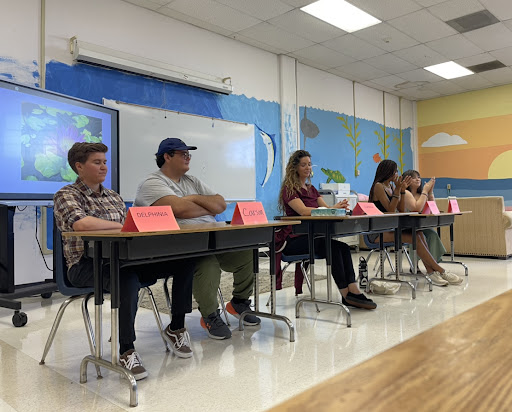
“I am so proud of what you students have been able to accomplish with this work and look forward to seeing how you use these projects to make an impact in our community.” This was what Jim Breedlove, the Board Chairman of Macon County Schools (NC) had to say after he and a group of local community members were panelists to hear a set of “pitches” from students at Macon Early College. The students were tasked with using the design process to develop project prototypes for real-world issues that could then translate into project ideas that the school would launch in the 2023/24 school year. This is the story of how that came together.

Schools around the world are increasingly interested in empowering student voices and including them in decision-making around governance, discipline, and curricular direction. There are myriad reasons for this shift, which shows promise in improving engagement, cultural responsiveness, academic, and socioemotional outcomes, especially for traditionally underserved students. Though the interest in these practices continues to grow, many schools overlook the school culture shifts that must occur to create sustained innovation in the mindsets and practices foundational to this philosophy.

Meanwhile, many forward-thinking schools are seeing excellent results from involving their students in the Design Process (for instance, Design 39 and One Stone), a continuous improvement framework that has been used to design countless products and services that are based in deep empathy for the user.  In the 2022-23 school year, Macon Early College (MEC), a small high school in Southern Appalachia, began using the design process as a way to plant the seeds for a more student-centered culture. Though the process has not been without setbacks, the overall impact has been remarkable, as there has been a palpable shift in student willingness to engage in solving problems within and beyond the school. It has also led to a new, shared language of design thinking and an authentic feeling by the students that they can indeed have a positive impact in their community.

MEC is located in the heart of the Blue Ridge Mountains in North Carolina, and was established in 2006 as a part of the New Schools Network, primarily funded by the Bill and Melinda Gates Foundation. Emerging from the isolation of COVID-19,  MEC felt a strong need to reconnect with its local community and culture. So, during a faculty meeting at the end of the  2021-2022 school year, the school planned to dig into our area’s rich history by centering its 2022-23 school year focus on Cherokee culture – the tribal nation on whose traditional territory the school resides. This was done by arranging student groups around the Seven Cherokee Clans and empowering students to design meaningful activities around this cultural focus. At the same time, the school wanted to find a way to shift towards hands-on, experiential learning, including Project Based Learning (PBL). The focus on the region’s Cherokee heritage was an obvious choice for a  schoolwide theme that would help students delve into local history and contemporary topics. However, as the school year began, the project was plagued with issues that led to a lack of buy-in from students and teachers alike.

Pivoting to Address School Culture

A positive school culture doesn’t just happen in a vacuum. It is designed, built, and maintained by students, faculty, and the community. It is a part of the educational experience that breathes and lives within and outside the school building. MEC’s initial approach with the Cherokee project involved radical student leadership – essentially asking them to guide their groups on how the project would look from the earliest stages. Though some groups were able to thrive in this loose framework, most of the students expressed frustration with the lack of direction and leadership. After a semester of such frustration, the students and staff decided that they would shift their attention to planting the seeds of student leadership throughout the student body so that they might become more capable of supporting such a project in the future.  By partnering with Open Way Learning (OWL), the entire school participated in several Design Sprints that have had an intriguing impact, which could be instructive for other schools considering similar aims. 

Student voices being heard is significant for them to have ownership in what they need and want, which is critical for building a student-centered culture. Design Sprints gave students the ability to have a safe place to voice concerns about their school and the changes they wanted to make. The student body gathered to dig into the problems they were facing at school before designing solutions. The platform in which OWL provided MEC students grew their confidence and started to build a culture within MEC that students and their voices mattered. The identifiable issues students voiced concerns about were communication, student voice, and clan leadership. Cameron Ramsey, an MEC student commented that, “For me, incorporating design sprints into the educational framework not only amplifies student voices and decision-making, but it also cultivates a sense of ownership, fostering a truly student-centered learning environment where our perspectives and preferences were valued and integrated. That is not the norm right now in most cases, so this experience gave me some hope for a better future in learning and being a student at Macon Early College.”

The lack of timely and clear communication was a significant theme throughout the first session. This was also discussed in School Improvement Team meetings because communication was a goal MEC staff identified needing to work on. For instance, newsletters in previous years were designed, maintained, and sent by the data manager, but this had become overly burdensome for her already full plate. Meanwhile, families and students also expressed interest in the previous school year’s newsletter and asked why they weren’t being issued.  Interestingly, a solution for having a student group take charge of the newsletter had emerged during an SIT meeting, but had yet to surface. Other communication issues that surfaced were the student body not feeling prepared for upcoming events such as clan and service days and the lack of general information concerning school happenings. Indeed, the communication between leadership, clan leaders, and their clans was poorly planned or lacked follow-through. Overall, students felt that information concerning service opportunities and general information concerning daily updates or changes in the schedule weren’t being communicated effectively, which was leading to mounting frustration.

As a faculty member, it is hard to hear the things your students are not pleased with. However, as educators, we know that our students are the drivers and their needs matter. MEC had to be open and honest about what our students were voicing. We had to encourage ourselves to give up control and allow our students to guide this change. Our belief is that this will build a school culture that is solid and purposeful. 

Promising Results

Since these initial sprints, communication between students and faculty has increased – admittedly with setbacks, but also some key victories. Now, thanks to a group of intrepid students, a weekly flier is sent out with some consistency to the student body, which contains next week’s events and a preview of future events. The students also wanted in-person announcements face to face, which was initially accomplished via Google Meet, then a recorded video. Currently, it has evolved to become face-to-face in our shared space first thing Monday morning. This gives the entire staff time to make personal announcements, add or provide clarification while also allowing the students to ask questions or add comments. Another new emphasis, which was recommended by students, has been the TV screens in the shared space, which continuously present announcements and other important school information. Overall, since our first design sprint meeting, students feel like they have a partnership with their school.

A clear indicator of this has been watching clan leaders starting to meet independently to take ownership of clan days. Clan leaders actually schedule meetings after school to collaborate and plan the assigned clan days, something that never happened previous to the design sprints! To take it one step further, they are now designing Google Forms to give the student body voice and choice in what activities to participate in on Clan days, then communicating with teachers about their plans. The collaboration among leaders is dramatically more effective than it was beforehand. Jackson Kelley, a junior MEC stated, “OWL helped bring out the initiative in many of my fellow classmates. This jumpstarted them into thinking of new ways to alleviate the strain on student events and the miscommunication that came with it. We started having professional meetings and strategically planning on how we wanted the school events to perform. Once we had done this, we all had struck gold. It is among my highest wishes that future MEC students can look back on the work we did and use our strategies to fix their own problems.”

Setting the Stage for Next Year

We ended this school year with another Design Sprint that had students choose problems they were interested in solving from the United Nations Sustainable Development Goals, Grand Engineering Challenges, and 100 People Project. The students independently investigated and selected problems of interest, then formed groups based on those interests, developed a problem statement, brainstormed potential solutions, and then prototyped one that they presented at a schoolwide pitch day in front of peers, MEC faculty, and community members. MEC has now gauged student interest in a variety of topics that will be used to create schoolwide projects next year, thus increasing the likelihood of student engagement and buy-in.

Bringing The Process To Your Context

These Design Sprints have centered MEC’s focus and developed a school culture that is already fostering and supporting more powerful Project-Based and student-centered learning. Along the way, MEC’s learning community has discovered that (1) student voice creates a strong school culture, (2) every student can be included, and (3) school faculty and leaders must be open to what students suggest. 

It has been inspiring to see how effective it can be to partner with students in creating a school culture. Giving them a framework to not only voice their opinions but develop detailed prototypes of potential solutions, led to highly constructive feedback that has been quickly operationalized by MEC’s team. A pleasant surprise was how the students took ownership of their part of the problems they voiced and subsequently assumed responsibility for the solutions they devised. 

Most efforts to embolden student voices involve only a select group of students, like the student council, which almost invariably represents only the most successful and motivated among the student body. This leads to predictable equity issues that could be avoided by involving all students in a Design Sprint process so that all voices can truly be heard in the process. 

Finally, without a willing and open staff, none of this would have been possible. We must be cognizant of how deflating it can be to ask students for their ideas, and then disregard them right afterward. Any school that commits to a process like this must also commit to implementing the most promising solutions that emerge. Being transparent about what constitutes a “promising solution” is essential along the way to avoid undermining the fragile trust that is being co-created – an essential element to a student-centered culture. 

MEC’s team has learned so much along the way and encourages others to undertake a similar process! It has now become clear that, with a little help from a solid process and supportive staff, students can develop the confidence needed to take these skills to be critical thinkers and help solve real-world problems.

Gloria Painter is an education leader at Macon County Schools, NC, and Adam Haigler is the Co-Founder and chief Operations Officer of Open Way Learning.

The post Using Schoolwide Design Sprints to Seed Student-Centered Culture appeared first on Getting Smart.

from Getting Smart https://www.gettingsmart.com/2023/09/04/using-schoolwide-design-sprints-to-seed-student-centered-culture/
Big Push for Small Schools Grants

Microschools are as old as America, originating as one-room schoolhouses across the country. As institutional education consolidated into larger buildings and larger systems, microschools persisted as homeschool cooperatives. Beginning three decades ago, virtual schools (both public and private) created new platforms for hybrid schools and learner cooperatives. However, nationally there is still a lack of understanding about what quality small school options are available for families in each state, how these schools can partner and network to share resources and operate sustainably, and how to launch efficient new models. Most small schools need support with economic vitality, measuring and sharing impact, and awareness as a high quality option for all learners. 

As we look toward the horizon of innovation and the subsequent rise in diverse school models, we are excited to announce the Learning Innovation Fund and our first grant program A Big Push for Small Schools, an initiative that taps into the rich legacy of microschools and reimagines them as the pillars of modern-day learning. These small school communities are redefining the way students learn.

The Vision Behind the Fund

At the heart of the Learning Innovation Fund lies a shared vision – to unlock the true potential of education by creating a place for all learners. This initiative envisions a future where every learner’s unique journey is nurtured, and where innovative, impactful education is accessible to all. The fund’s mission is to amplify the impact of innovative models, that are diverse and sustainable and empower learners for life.

With a rich history of leading educational advocacy strategy and fostering innovation, our team at Getting Smart stands uniquely prepared to spearhead this transformative initiative. Our wide range of experience and deep understanding of education dynamics, combined with a network of thought leaders and visionaries, allows us to curate an environment where innovation flourishes. We’ve witnessed the power and success of many different microschool models and believe in their potential to revolutionize education. Over the next few years, the Learning Innovation Fund will feature many more grantmaking partnerships all focused on creating new equitable opportunities for all learners. 

A Collaborative Endeavor

The Learning Innovation Fund is not just an initiative; it’s a testament to the power of collaboration. The funding for this first grant program is led by the Walton Family Foundation. As we continue to expand our impact, we enthusiastically welcome and are actively seeking additional funding partners who share our vision and want to join us in propelling education into a brighter future. We are also seeking evaluation partners, technical assistance providers and leaders interested in joining a small-school community of practice. 

Grant Opportunity

Imagine the potential when vision meets resources. The Learning Innovation Fund presents a golden opportunity for educators, innovators, and administrators of small schools to bring their innovative dreams to life. With up to 20 grants ranging from $75,000 to $250,000, this initiative aims to accelerate the impact and scalability of microschool models, igniting a ripple effect of positive change. 

Grantees will benefit from a comprehensive ecosystem of support. Collaborate with evaluators, work alongside technical assistance and coaching providers, and join a grantee network that nurtures innovation. This fund isn’t just about financial support; it’s about cultivating a community of change-makers. Beyond grants, this initiative will also include a platform for storytelling, case studies, and community conversations. By amplifying awareness of small school potential, we’re not just shaping education; we’re changing perceptions and inspiring new paths of learning.

Who Should Apply

We welcome innovative small-school leaders with transformative ideas, poised to make waves. 

We’re looking for diverse national models across the K-12 spectrum that utilize various funding methods, be it private, public, or ESA-funded models. Our selection criteria emphasize geographic diversity, ensuring that urban, suburban, and rural areas are all represented. We are interested in high-engagement learning models ready to scale or replicate. Above all, our priority is to support models that cater to historically underserved communities. If this aligns with your expertise or that of someone you know, find more details and the application process here.

A Call to Action

Join us in this transformative journey of education. If you know passionate small school leaders who could benefit from this grant, we urge you to share this exciting opportunity with them. Let’s collectively amplify the reach and impact of small schools, ensuring that every learner gets the education they truly deserve. Sometimes, the smallest shifts lead to the most significant transformations. Let’s make a big push, together!

The post Big Push for Small Schools Grants appeared first on Getting Smart.

from Getting Smart https://www.gettingsmart.com/2023/08/31/big-push-for-small-schools-grants/

Not Your Typical Back-to-School Days at Learner-Centered Sites

By: Jason Krobatsch

As we think about kids heading back to school, our minds are often filled with images of brown bag lunches tucked into oversized backpacks, individual desks neatly arranged in rows, and teachers setting the tone for how they’ll keep order in a room full of 25 (or more) kids. But in learner-centered sites across the country, back-to-school is a time filled with adventure and exploration—from neighborhood scavenger hunts and NBA-style introductions to overnight cabin trips and campus-wide cookouts. In these environments, self-discovery, trust-building and interest exploration are the starting points of learning.

Learner-centered leaders recognize the need to help young people lean into their personal development as a critical part of their learning and do so in community with the peers and adults in their environments. By design, this approach helps foster fulfilled human beings with the skills needed for life and career. While each site approaches learning in a way that works for their young people and community, Education Reimagined has identified five elements that can be found at sites that demonstrate the full breadth of learner-centered education. These elements are learner-agency; socially embedded; personalized, relevant and contextualized; open-walled; and competency-based. As sites welcome learners, many choose to make these quantities evident from day one. Here, interests are explored and curiosity abounds.

Lab51

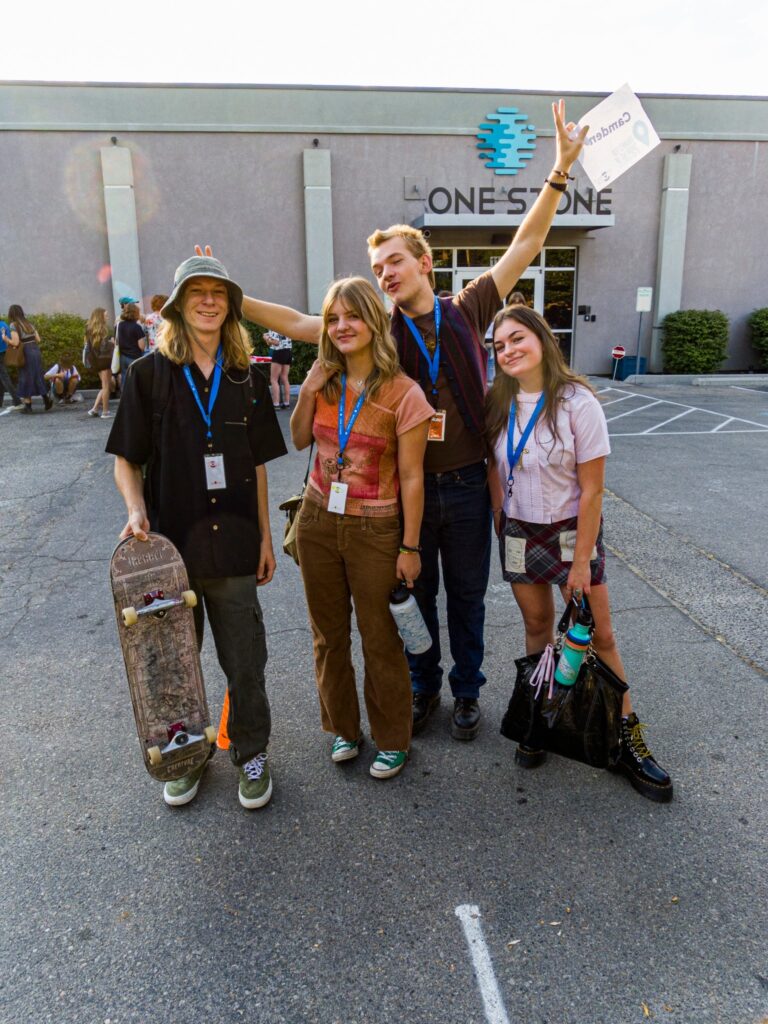
If you’ve ever thought about starting your school year with the cheers and applause of an NBA-style announcement welcome, look no further than One Stone’s Lab51 school. Located in Boise, ID, Lab51 is an independent high school focused on growth, not grades. Coaches—their term for educators—guide learners through their various programs to discover themes that are of interest to them. Learners can choose the duration of time they spend on a particular area, ranging from week-long “deep dives” to 12-week “immersions” to choose-your-own-adventure day-long “cannonballs.” Young people can explore topics from skateboard design and mechanics to agriculture and environmental science.

Learners who are new to Lab51 are welcomed back early for a Reboot Week. They’re paired with returning “trail guides” who engage in four days of team and culture-building activities. The autonomy young people experience in a learner-centered environment is often a big (but empowering) shift from their conventional schools, so this time is important to help them rediscover their voice and identify what sparks their interest.  

Once all of the learners have returned, the group engages in two weeks of welcome activities. The focus is on establishing strong foundations of personal understanding, vulnerability, and curiosity so that coaches and learners can build on these relationships as they move throughout the year. These welcome activities include experiential service projects in the community, the sharing of one-minute life stories, an introduction to Lab51’s Bold Learning Objectives, a community read discussion, and short and long-term goal setting. The group even takes an overnight cabin trip to Payette Lake in McCall, ID. Talk about building relationships and community from day one!

Embark Education

For learners at Embark Education, a micro-middle school in Denver, CO, learning happens in and around their peaceful yet vibrant neighborhood. With a strong emphasis on building community and radical trust, Embark learners start the year with a whole-school scavenger hunt where learners lead themselves through the neighborhood to better orient themselves with the places and people that matter to their learning. They’re also given cash to explore local lunch spots or other businesses. (Given their extensive candy selection, Ace Hardware is a popular choice.) Not only does this help learners build bonds with each other and explore their community, but primarily, it is an exercise in trust and responsibility. For many learners who are new to Embark, nothing says “learner autonomy“ quite like an unsupervised group trip around the neighborhood with money at their disposal.

In the following days, learners will meet with staff at Pinwheel Coffee and Framework Cycles, local businesses that are core to Embark’s education model. Staff at these shops, who are educators within the Embark community, will work with the young people throughout the year to learn a variety of skills including marketing, mechanics, business management, and yes, even coffee-making.These young people have opportunities to learn from each member of their community and build mentorship opportunities along the way. And speaking of community, to start the school year, the learners collaborate on a team project. At Embark, learners are always empowered to choose from multiple learning experiences that are sparked by authentic needs. This year, learners chose between rehabilitating one of their outdoor learning spaces or designing the first-ever Embark swag.

The SD Met

The SD Met, located on the San Diego Mesa College campus, is a high school that follows the Big Picture Learning model. While each Big Picture school has its own unique qualities, each follows a philosophy of student-led, adult-supported learning. The year begins with a New Family Mixer, a one-hour meet-and-greet for learners and families to get acquainted with fellow learners, advisors, and facilities on campus. At The Met, advisories are cohorts of about 16 learners and one advisor who remain together for all four years of high school.

Because relationships are an important part of learning at the Met, the first few days have a heavy emphasis on building community and connection. Freshmen are also introduced to personalized learning plans, a keystone feature that will help drive each young person’s learning journey and make meaning out of each experience. These plans are developed between each learner and their advisor to address competencies including knowing how to learn, personal qualities, quantitative reasoning, empirical reasoning, social reasoning, and communication. Through off-campus internships, classes at the community college, and instruction within advisories, learners will create goals and map them against their learning plans. To top off a week of introductions and relationship building, the entire Met community comes together for a campus-wide luncheon where learners are encouraged to sit with new people, share their experiences, and explore the campus.

While many teachers in conventional schools are doing the hard work of prepping their classrooms for students and designing a curriculum to meet state requirements, remember that back-to-school doesn’t look the same everywhere. In learner-centered environments, they continue on with learning, because learning can and does take place all around us. Returning to a learning environment can be a time of exploration, connection, understanding, and growth when it’s centered around the needs of each learner.

 Jason Krobatsch is the Communications Manager at Education Reimagined, an organization focused on advancing learner-centered education at a national level.

The post Not Your Typical Back-to-School Days at Learner-Centered Sites appeared first on Getting Smart.

from Getting Smart https://www.gettingsmart.com/2023/08/30/not-your-typical-back-to-school-days-at-learner-centered-sites/

Why 20 Missouri School Districts Are Seeking New ‘Innovation Waivers’ to Rethink the Way They Test Students

By: Lauren Wagner

Updated: The Missouri State Board of Education voted unanimously Aug. 15 to approve ‘innovation waivers’ for the 20-school Success-Ready Students Network.

A network of 20 Missouri school districts is asking the state to implement a more responsive assessment system in order to personalize student learning.

The state Board of Education is considering the districts’ proposal to change testing at its Aug. 15 meeting. If approved, it would be the inception of a shift in Missouri’s education system that will “resurrect student engagement,” district leaders say.

The group of schools, part of the Success-Ready Students Network, wants to move away from the state’s annual standardized testing to assessments that would be administered multiple times a year. The coalition consists of public school districts and one St. Louis charter school, and includes a mix of rural and urban campuses with a wide range of student performance scores and poverty rates, according to state demographic and assessment data

During a June state board meeting, district leaders argued that the current system doesn’t provide results in time to be effectively used in the classroom. 

The schools want to instead take advantage of a new pilot waiver program created last year that offers exemptions for districts to bypass specific education laws for up to three years. These “innovation waivers” are intended to boost student performance and benefit educators by giving schools the room to implement unique strategies, said Lisa Sireno, assistant commissioner with the Missouri Department of Elementary and Secondary Education. 

“The state legislature enacted a statute that allowed the school innovation waivers in 2022 and so we’ve been working on what that process might look like,” Sireno told The 74. “The group with our very first innovation waiver request — the Success-Ready Students Network — kind of grew out of a (state) work group that was looking at competency-based education.”

While 20 school districts in the Success-Ready Students Network have agreed to launch new assessments if approved, other schools will join in the future, said Mike Fulton, one of the network’s facilitators. The plan is for a new cohort of districts to use the innovation waivers each school year until the entire state is involved.

Mike Fulton

If approved, districts will be able to administer multiple interim tests, but will still have to give the normal annual standardized test until a federal waiver is approved to get rid of it. Fulton said the Success-Ready Students Network will be working on a federal waiver later this year.

Fulton said the state’s innovation waivers are key to competency-based learning, which allows students to move through education at their own pace as they demonstrate a full understanding of the material.

“The whole proposal is designed to support the participating districts in using personalized, competency-based approaches in their learning design,” Fulton told The 74. “The assessment system was designed to provide feedback to both students, teachers, parents and every stakeholder, on how individual students are progressing, how classrooms and schools are doing and how districts are doing as a whole.”

Jenny Ulrich, superintendent of the Lonedell School District, part of the Success-Ready Students Network, said her teachers are always asking for feedback on what they are doing in the classroom, but assessment results are returned too late to make an effective change for individual students.

Jenny Ulrich

“We are alone out there trying to figure out how we get real-world learning to our kids,” Ulrich told the state board in June. “This work supports educators. It gives them a platform, an opportunity and the data they need to make good instructional design and decisions for their kids.”

Besides lagging results, standardized tests have been criticized around the U.S. for sucking up too much time, being culturally biased and doing little to improve students’ academic outcomes.

Ulrich said instead of the one-time tests, schools will administer tests several times a year and keep results updated online on a district dashboard for teachers to use in real time. The dashboards, which will go live in November, will show a student’s progress in becoming “high school ready” or “college, career and workforce ready.”

“By the end of the 2025-26 school year, it is our aim — our lofty goal — that 100% of our graduates would have an individualized plan,” Ulrich said. “As we reach these goals, all students will be able to declare, ‘I am truly college, career and workplace ready.’”

Fulton said districts will be transitioning to competency-based learning even if the state innovation waivers aren’t approved. Students will progress on evidence of mastery of skills based on state standards, meaning they might move through the K-12 education system faster or slower than their peers.

“That scares people a bit and I understand that,” Fulton said. “That’s a big shift.”

Sireno, the assistant state education commissioner, said the desire to switch Missouri schools to competency-based learning emerged from the learning loss caused by the pandemic. Earlier this year, more than a 100 Missouri districts experienced a drop in their student assessment scores to levels that would typically threaten their state accreditation.

“This will allow students to move at the appropriate pace. So, if some students finish mastery of the content a little bit quicker, if some students take a little bit longer, that’s OK,” Sireno said. “It’s a heavy lift, but it’s important work, and (districts) realize that it can have a real positive impact on student learning.”

Other schools around the nation have been tackling competency-based education as a way to help students recover ground in learning. Idaho, South Carolina, Kansas and Utah are among those that have successfully created competency-based learning systems, according to a 2021 state education department report.

Some states haven’t done as well implementing competency-based education. In 2018, Maine’s Department of Education had to scrap its competency-based learning model several years after it went into effect. The system lacked specifics in things like proficiency and grading, which also sparked parent backlash.

This is a common failure in putting the approach into practice, according to the Missouri Education Department’s 2021 report. 

“Researchers attribute negative outcomes to schools that implemented (competency-based learning) without clear definitions and expectations, as well as uneven implementation,” the report says. 

When Missouri’s innovation waiver plan was unveiled in June, the entire State Board of Education voiced support for it.

“It is a gift to the students, the parents and families in Missouri, and I would say nationwide,” said Charles Shields, board president. “Others will learn from us nationwide.”

Vice President Carol Hallquist said she believed it will “change the face of education” in Missouri.

Fulton, of the Success-Ready Students Network, said he hasn’t heard from any stakeholders warning against the use of innovation waivers or the switch to competency-based learning, but there is some wariness from the state department about using a model that hasn’t been tested. 

“I think we’re all going at this cautiously. Research is going to sit at the core of this,” he said. “But you have to be willing to be entrepreneurial and innovative and that’s what I think these districts are being asked to do. We need more of that in public education.”

Lauren Wagner covers education for the Omaha World-Herald and is a contributor to The 74.

This story first appeared at The 74, a nonprofit news site covering education. Sign up for free newsletters from The 74 to get more like this in your inbox.

The post Why 20 Missouri School Districts Are Seeking New ‘Innovation Waivers’ to Rethink the Way They Test Students appeared first on Getting Smart.

from Getting Smart https://www.gettingsmart.com/2023/08/29/why-20-missouri-school-districts-are-seeking-new-innovation-waivers-to-rethink-the-way-they-test-students/

Real World Experience with NAF Advisory Boards

NAF academies are designed to be small, concentrated learning communities that fit within and strengthen high school systems. This allows NAF to become an integral element of a low-cost plan for higher achievement. NAF encourages open enrollment at its academies so that any student who is interested has the opportunity to participate. The adaptable structure promotes cross-subject collaboration and personalization to match the needs and goals of students, schools, districts, and states. NAF is a network of over 600 college preparatory, career-themed academies in 35 states, plus DC, Puerto Rico, and the US Virgin Islands, educating around 112,000 students.

NAF offers challenging, career-focused programs incorporating current industry standards and practices, project-based learning, and performance-based assessment. Through relationships with industry leaders and the business community, NAF empowers instructors to broaden classroom limits by introducing students to real-world issues in high-growth industries. Students gain important workplace skills and 21st-century competencies to be college and career-ready.

The advisory boards serve as a vital link between the classroom and business. They offer full, continuing support to NAF academy personnel and students by acting as ambassadors in their networks and communities, assisting in creating exciting new work-based learning and internship possibilities. Business professionals and community leaders serve on local advisory committees to help shape talent in high school. Members of the advisory board engage with educators to inform curricula and coordinate job-based learning activities. Advisory boards help students to form ties with mentors and learn from successful adults at an early age.

NAF supports high school students’ ambitions by providing fair possibilities for a prosperous future and contributing to a creative, highly skilled, diverse workforce.

Antonio Boyd

Darrell Kain, NAF’s Director of Advisory Board Activation, spoke with me about work-based learning, NAF advisory boards, and their role in the NAF process.

How did your journey at NAF begin?

My passion for real world learning stems from having exciting internships at a young age. In high school I interned at a telecommunications company that focused on EMS technical systems and in college I held internships at the U.S. Army Personnel Command where I focused on information systems. I continued my professional growth by completing my bachelor’s degree in engineering management from the U.S. Military Academy at West Point and then spent five years as an Army officer where I led tactical and technical training activities. After the military, I worked in management positions in corporate America where I partnered with telecommunications and supply chain professionals and delivered professional development. My most recent career experiences have focused on building business-education partnerships at leading organizations like PLTW and NC State University and I was a volunteer on a NAF business advisory board at the Apex High School, Academy of Information Technology. I joined NAF in January 2023 as they were enhancing their services for business advisory boards and desired to better equip volunteers throughout the network. I was referred to NAF by a former NAF employee whom I had partnered with on another education-business project. 

How do NAF advisory boards work, and how many do you have nationwide?

NAF supports and partners with over 600 academies within high schools across the country and U.S. territories. We provide best practice recommendations, resources, and support for board development though each academy has the autonomy to decide the board structure that works best in their geography and local economy. There are more than 300 advisory boards at the academy, school, or district levels. At the academy level, a group of 10-12 professionals are board members each with a chairperson who leads the team’s goal-setting and planning to maximize student impact in the NAF academies. In a few major metro areas, there are career theme-based boards that focus on a specific area such as STEM, hospitality, or health science; these boards are larger and utilize a sub-committee structure to activate their work plans. Regardless of the size or structure, the board works with the academy leaders and teachers to provide students with work-based learning experiences, internships, and classroom support. The advisory board usually meets monthly or bi-monthly and implements yearly strategic plans to support the academy. 

What makes a good advisory board member?

The main quality that is important for an engaged board member is a passion for helping students prepare for their future careers. In most cases, a board member is an industry professional who has experienced success in his or her career and has the heart to volunteer their time and talent. Board members come with a variety of talents and resources, and they can either directly provide support or connect the academy with their network or their employer. The most successful boards listen to the needs and desires of the academies’ teachers and leadership and provide work-based learning opportunities that are relatable and meaningful for students. A great example of a passionate board member is Carlos Vazquez in Miami who oversees a district-wide advisory board that is focused on STEM fields. Carlos and his colleagues run an annual student conference that brings speakers and internship opportunities to over 1,800 students. 

How does the advisory board help high school students get real-world experience?

Advisory Board members work with educators to map out work-based learning opportunities each year through a strategic planning process. These activities include short experiences such as a series of informational interviews. This is where students interview industry professionals about their career paths or longer activities such as mentored industry projects or internships where students are working on authentic job-related tasks under the supervision of an employer supervisor or mentor. These activities help inform students’ career possibilities, provide opportunities for students to build their technical and future-ready skills, and make the connections they need to help them navigate their path forward. 

What have students been sharing with you about NAF?

One student shared, “Personally, getting exposed to mock interviews really opened my eyes to how the real world is. Before having a mock interview, I believed that when someone applied for a job, they immediately got it. I was completely wrong, applying is not simply just submitting a form and getting accepted right away. It is about showing who you are and what you can bring to the “table” as some would say. “

Another said, “We toured Twitter and that is where I learned more about marketing, and it intrigued me. And I already loved sports, so it became clear. Combining my budding interest in marketing with my love for sports – like soccer, hockey, and basketball – would be a great career path for myself. Because of the classes, activities, and connections to the Advisory Board, today, I am confident. I am a leader. “

A former student attended a NAF academy at Woodlawn High School in Birmingham. They shared that “NAF provided me with opportunities that allowed me to take part in the farm at Woodlawn High School and introduced me to my current employer, Jones Valley Teaching Farm. Today, as a farm & apprenticeship manager, I get to play the role that others in the NAF community played for me, helping students ignite their passion for learning.” 

NAF supports high school students’ ambitions by providing fair possibilities for a prosperous future and contributing to a creative, highly skilled, diverse workforce.

If you’re interested in learning more about NAF or joining an advisory board in your area, reach out to Darrell Kain at dkain@naf.org.

The post Real World Experience with NAF Advisory Boards appeared first on Getting Smart.

from Getting Smart https://www.gettingsmart.com/2023/08/28/real-world-experience-with-naf-advisory-boards/

Deeper Learning Requires Deeper Relationships?

By: Scott McLeod

As I visit innovative elementary and middle schools across the country, I have noticed that these schools devote significant amounts of time for students and educators to simply be together in community. These time blocks are not academic. This community time is for small groups within the school to check in, share out, bond together, identify who might need support, wrestle with interesting ideas, and so on.

At Highline Big Picture Middle School in Burien, Washington, this time takes the form of a morning circle. I joined a sixth-grade class when I visited and was welcomed warmly by the students and teacher. We discussed things that were happening in our lives and answered some interesting questions, I witnessed two students resolve a lingering conflict and apologize to each other, and we learned about what each individual was thinking and feeling as we started the school day. Students initiated most of the conversations. When a small family of 18 students and a teacher talk together about non-academic matters every day for three years in middle school, those interactions morph over time into meaningful connection and interdependence, just like the small, additive conversations that we may have with our neighbors over the back fence.

Morning time looks a little different at Down to Earth Forest School in West Linn, Oregon. The nature-immersed independent school doesn’t have a building. Instead, students and educators meet each day at the city park and they start with a ‘soft open.’ Students trickle in over the first half hour of the school day, often accompanied by parents who use the time to touch base with a teacher, ask a question about their child, or see how they can help with upcoming events. Some students read a book or catch up on homework, while others play a game or work on an interesting puzzle. A few students might be playing in the woods and getting some energy out, while others sit and listen to an adult who is playing the ukulele and singing. The experience was incredibly relaxing compared to the typical start of a more traditional school day, and I found myself wishing that more schools had this type of peaceful beginning.

I have noticed that these schools devote significant amounts of time for students and educators to simply be together in community.

Scott McLeod

Morning circle time isn’t a new structure for many schools, but often the emphasis in more traditional schools is to get students settled and ready to receive instruction. Those purposes exist for the schools that I visited too, but the time felt less hectic and more oriented toward togetherness rather than simply preparing for a day’s worth of teacher-led academic experiences. 

This time existing in the community can take other forms. For example, educators and students might spend the last 15 to 20 minutes of school checking in to see how the day went, decompressing, and identifying who needs support as they walk out the door and transition toward home. Rod Buenviaje, the principal of High Tech Middle Chula Vista in California, told me that teachers there might spend an entire week or two at the beginning of the school year doing community-building work before they dive into academics. Rod noted,

[Teachers are] trying to create a space where students feel safe to engage in the type of work that they’re going to be diving into. In our Humanities classes, they do a lot of work on identity. We’re trying to create a strong sense of self in our students, and it’s hard to do that if you don’t create the space that will allow for honest conversations and honest work to happen. So community building is really, really big.

The emphasis during all of these community time blocks is on relationships, well-being, and connection, which are valued for their own sake, not just as a means to some academic end. 

If you ask the educators in these deeper learning schools why they devote so much time toward community, they reply that it’s about ‘relationships.’ Of course, educators in more traditional schools also claim that relationships with students are important to them, but most don’t expend nearly as much time or energy toward community-building. There seem to be both quantitative and qualitative differences in how deeper learning schools think about relationships and the time and effort spent on them. As I work to unpack those differences, I’m currently landing on the idea that the learning model of traditional schools may not actually require deep relationships with or between most students.

The typical interaction dynamic for a student in a traditional classroom often is between them, the teacher, and the academic content. Direct instruction; teacher-led discussions; call-and-response checks for understanding; tests, quizzes, essays, and digital worksheets; self-paced learning software; regurgitation of material from a textbook, website, or video… none of these require a student to interact much with anyone except the instructor or the content. Occasionally a student might do a think-pair-share with the child next to them, complete a short jigsaw activity with a few classmates, or engage in ill-structured (and thus dreaded) ‘group work’ for a couple of days. Teacher-student and student-student dynamics usually are focused on academics first, not community.

In contrast, students in deeper learning schools typically are diving into robust projects and challenges that require them to work in small teams to accomplish much deeper, more complex tasks. That collectively-owned work may take many weeks or months to complete together. Accordingly, students have to understand and be positively interdependent with each other to a much greater depth. Challenges always arise during these longer, more complex activities, and it’s imperative that students both know and trust each other as they work through the inevitable speed bumps and roadblocks. Students in deeper learning schools may spend significant time doing personality inventories, leadership profiles, strengths assessments, and other exercises that strengthen mutual understanding, relationships, and appreciation of others’ skills and talents.

Nearly all school systems say that they are trying to improve the social-emotional learning skills of students, foster better relationships, and enhance feelings of belonging. Many of them are investing tens of thousands of dollars in vendor-provided curricula to help with this work. These purchased activities then get shoehorned into existing homeroom or advisory periods, and often are perceived as inauthentic or ineffective by both students and educators. The learning model and relationship-building activities of deeper learning schools may show us a different path, one that both allows and requires students to do more than simply co-inhabit the instructional space with their fellow classmates. 

Scott McLeod, J.D., Ph.D., is a Professor of Educational Leadership at the University of Colorado Denver. He is also a Senior Fellow at Getting Smart, investigating innovative elementary and middle schools that help prepare students for new pathways in high school.

The post Deeper Learning Requires Deeper Relationships? appeared first on Getting Smart.

from Getting Smart https://www.gettingsmart.com/2023/08/25/deeper-learning-requires-deeper-relationships/

Balancing Design Thinking with Equity

By: Hassan Hassan

Over much of the last decade, the education innovation community has worked to incorporate a greater focus on diversity, equity, and inclusion, including a talent base that is more representative of the children that our schools serve and increasing philanthropic funding to combat systemic racism and support learners of color. At 4.0, we have also worked to evolve our approach to better meet our mission over the last several years. After we were founded in 2010 as 4.0 Schools, our early approach was heavily informed by the user-focused principles of “design thinking,” which focuses on building and testing prototypes and which dominated commercial product design, school reform, and social entrepreneurship at the time. 

However, just as others have reckoned with the ways in which their approach to teaching and schooling was insufficient to combat systemic racism and educational inequity, we too began to notice that our model’s focus on individual stakeholders and building out solutions wasn’t doing much to address the inequitable systems and outcomes that burdened communities. Ultimately, what 4.0 wants to bring about is education reimagined and run by communities, rather than education that’s done to and imposed upon communities using antiquated systems and structures.

Source: Matt Candler, 2018

To that end, 4.0 has modified our approach to put greater power in the hands of communities facing the inequity challenges, to focus not on isolated problems and solutions in education but on understanding the complexity of the inequitable systems that produce the problems in education, and to conduct measurement and evaluation in partnership with members of the communities that founders are designing alongside.

“Widening gaps between races, classes and communities are pushing us away from one another, and I believe schooling has a better shot at uniting us and drawing us back across these boundaries than any other tool on our belt,” reflected 4.0 founder Matt Candler in 2016. “That means making our equity work about both fairness/justice and about those in power creating and sharing ownership.”

First, a history lesson: What is design thinking?

The “design thinking” process rose to prominence in the 1990s thanks to the design firm IDEO, which was formed from the merger of two companies – one that designed the first laptop computer and the other the first Apple Computer mouse. The innovation of design thinking was far more human-centric, and its products more responsive to real users’ needs. Compared to engineers and marketers sitting in an office spitballing ideas, design thinking relies on “our ability to be intuitive, to recognize patterns, to construct ideas that have emotional meaning as well as being functional, and to express ourselves in media other than words or symbols,” wrote IDEO’s Tim Brown and Jocelyn Wyatt in Stanford Social Innovation Review in 2011.

As Brown and Wyatt explain it, design thinking includes three overlapping steps:

  • Inspiration: the problem or opportunity that motivates people to search for solutions, including a “brief” of constraints that give the project team objectives and benchmarks to work toward, as well as observations of people’s actual needs through interviews and shadowing;
  • Ideation: distilling what the diverse interdisciplinary design team sees and hears from users into insights that can lead to solutions or opportunities for change, through a structured brainstorming process; and
  • Implementation: the best ideas generated during ideation are turned into a concrete, fully conceived action plan, including prototyping to turn ideas into actual products and services that are then tested, iterated, and refined.

Ultimately, this approach was appealing to 4.0 because it put people at the center of product and systems design work. “With the user experience at the center of design, the design-thinking process helps the designer understand pain points, motivations, expectations, and direct and peripheral experiences,” observes educator and school design innovator Caroline Hill. “It provides a framework for complex, iterative, and targeted solutions. It emphasizes the need to define the problem well and build sooner to get better feedback.”

Although this human-centered design process was a critical innovation that led to some incremental innovations, it was limited in improving outcomes for communities most impacted by equity challenges. To overcome the immense disparities faced by communities historically pushed to the margins, educational change would need to look less like product development and more like complex systems change.

Today’s mandate: Infusing equity into design thinking

Fortunately for 4.0, other educators and community leaders recognized the need for an approach that could blend the human-centric methods of design thinking with the consciousness-raising of equity work. A group of these leaders came together to develop the “equityXdesign” framework, which has guided 4.0’s work to improve our approaches in designing for equity. They write:

“Design thinking provides a framework for complex, iterative, and targeted solutions: It emphasizes the need to define the problem well and build sooner to get better feedback, and it has fundamentally changed the relationship between designers and those they are designing for. If we believe design thinking is the right tool to use to redesign products, systems, and institutions to be more equitable, then we must redesign the design thinking process, mindsets and tools themselves to ensure they mitigate for the causes of inequity — the prejudices of the human designers in the process, both their explicit and implicit personal biases, and the power of mostly invisible status quo systems of oppression.”

Inspired by this framework, 4.0 has been working to infuse equity into its work so that the needs of communities are recognized, understood, and addressed, and that solutions take into account – and strive to overcome – both individual biases and flawed systems.

How 4.0 layers equity onto design thinking
Design Thinking + Equity Design Thinking + Equity
Purpose: Products and experiences + Dismantle barriers for communities that have been marginalized Transformative solutions that address systemic problems
Inspiration: Design briefandhomestays and shadowing users + Investigating identity+ Empathy interviews Understand deeply the equity challenges and the impacted communities’ ideas for dismantling them
Ideation: Diverse teams synthesize findings into lots of ideas + Craft a pilot that addresses the equity challenge and that is designed to test demand / gather feedback Working with impacted communities to develop and evaluate potential solutions
Implementation: Prototype of part or all of the idea, which may be expensive, and gather feedback + Try something small and low-cost+ Gather feedback that assesses demand / impact Gather feedback on pilot and share back impact with the community

A study conducted by the Center for Research in Education and Social Policy (CRESP) at the University of Delaware, which surveyed hundreds of alumni of 4.0 programs to learn more about the 4.0 fellowship process, illustrates how this equity work affects founders in three key ways: by selecting founders who hail from the impacted community, by consulting them in the design of programs that serve them, and by rethinking the very systems they work within.

Rooting education change in communities by selecting founders from those communities

First and foremost, 4.0 exists not to create new products or companies for the sake of novelty, nor in the pursuit of slight improvements or benefits for advantaged populations; rather, we exist in order to dismantle barriers to access and success for communities historically marginalized. We believe that passionate people are already working toward a more equitable future of education, and our role is to support those people.

So 4.0 designs programming that centers and prioritizes those voices by selecting founders from those communities and leveraging alumni to strengthen and refine the program. Increasingly, the founders chosen for these programs hail from the communities they seek to serve: more than 75% of participants are people of color and more than 75% are women or non-binary. Several years ago, a small group of 4.0 alumni worked together to improve the recruitment and selection process so it yielded a more equitable representation of founders. “We revamped the application process to include more events where 4.0 alumni could share their experiences and hosted office hours where candidates could get support with application,” says 4.0 alumnus Marvin Pierre, “We also revamped the selection rubric so it was more holistic and structured.”

Harnessing alumni insights to develop programming

Founder recruitment and selection is now led by eight alumni community chairs, who also facilitate connections and support among different identity-based groups across the country throughout the programs. These groups include founders that identify as Black, Asian American and Pacific Islander (AAPI), and Latinx founders. Additional groups include founders who identify as Queer, Trans, and/or Gender Nonconforming (QTGNC), founders focused on schools or early childhood, founders who are parents and/or caregivers, founders with chronic illness or disabilities or those who care for them, and founders from underrepresented geographic regions. In addition, alumni “app coaches” help interested participants put their applications together. Another set of alumni work with the 4.0 staff to interview applicants and select participants to join the Fellowship programs.

These alumni join other 4.0 alumni contractors who serve as curriculum developers, integrating survey feedback gathered from their peers. “When I came into the program, the majority of participants were people of color, but the pedagogical approach was from a very cis white hetero male perspective,” says Kynita Stringer-Stanback, a founder who has participated in several 4.0 fellowships. We shared this constructive criticism with 4.0 staff and alumni working on revising the program curriculum. “The way we started was not the way we ended,” we reflect. “I have seen the indigenous, black, queer and feminist pedagogies that have been more integrated. This year’s folks have a completely different experience than when I entered last year.”

Over the last several years, 4.0 has also shifted away from staff coaches and external “expert” coaches, instead training and preparing 4.0 alumni to serve as coaches to subsequent cohorts of founders and guide them through their fellowship program year. Where possible, founders are paired with alumni coaches whose philosophies, areas of expertise, and geographical locations align with their own. At 4.0, the alumni experience is integral to the coaching experience. When coaches have familiarity with our fellowships, they can build more meaningful coaching relationships with founders, a longer and more intentional pipeline of support, and more leadership development.

At 4.0, the goal is for our programming to be completely alumni-led and alumni-driven. For this reason, we invest in the continuous development of our alumni community. Hence, our participants become leaders who, in turn, identify the next generation of participants and what success looks like in a field that continues to evolve. “4.0 is not just telling us to design with our community, they are designing with their community,” agrees stringer-stanback. “We know what we want, we know what we need, we just need someone to ask us.”

Rethinking inequitable systems and how we define success

Moreover, the founders that 4.0 works with focus not on isolated problems and solutions but on considering solutions within the context of oppressive systems – such as white-dominant culture, racism, classism, ageism, sexism, homophobia, and ableism – that manifest in traditional schooling.

4.0 founders investigate these systems as part of their individual and collective work to abolish and rebuild new worlds with other changemakers. “The connections I made through the fellowship were valuable and those relationships are built through the work that 4.0 had us do,” says Danielle Stewart, who participated in several 4.0 fellowship programs. “The information gathered through empathy interviews encourages you to dive deep into what you’re trying to create, and that is what forms the connections with others who are trying to build things and change systems.”

As we move away from definitions of success rooted in traditional, predominantly white institutions and driven by philanthropic wealth – such as test scores and scope of influence – 4.0 and its participants are exploring new ways of measuring and evaluating our impact. “Countless research surveys mine communities for the raw material of lived experiences, without yielding much for the community—or worse,” writes impact investor Chicago Beyond in its groundbreaking guidebook “Why Am I Always Being Researched?” “Without shared ownership, the process of research can take from, rather than build up, the community, and the inputs and answers are incomplete.”

To remedy this dynamic, 4.0 listens to the individuals we work with to learn what is working and what we must adapt. Our funders and our founders have asked 4.0 for greater clarity about the data we ask for and the outcomes we seek. We took initial steps toward this consistency by launching a Measurement & Evaluation Collaborative alongside our New Normal Fellowships that focused on responses to the Covid-19 pandemic, connecting founders with a network of researchers who helped them craft logic models and metrics that fit their approach. We also partnered with CRESP at the University of Delaware to design surveys that evaluated the impact of founders’ pilot projects on participants’ social and emotional learning (SEL) skills.

In addition, 4.0 emphasizes not only whether these are the right questions, but whether they’ve been developed alongside the community. We also encourage founders to bring those answers back to that community. “Some people were driven by the numbers versus driven by outcomes,” recalls Stewart of her experiences with 4.0 fellowship programs several years ago. Today, Stewart continues to run a for-profit diversity, equity, and inclusion consulting practice, iChange Collaborative, which guides clients through strategic planning and execution to create more inclusive workplaces – including the gathering and sharing of meaningful data. “What is most important is how you create a relationship with your community to use those results,” she says.

Conclusion

Today, 4.0 is creating a space for members of communities to become founders, harnessing the experiences of 4.0 alumni to refine our programming, and redefining success alongside the communities those founders serve. This work is our contribution to moving the center of gravity away from isolated designs that privilege the perspective of entrepreneurs and closer to community-led educational designs imagined by families and children.

We also invite and applaud others in the field who are stepping forward to advance equity by sharing power with affected communities. “Strategies to rebuild a stronger and more equitable society not only need to focus on including the voices from the community, but to do so in ways that truly shift agency, capital, and power,” note Nate Wong and Andrea McGrath of the Beeck Center for Social Impact + Innovation at Georgetown University. “This work requires real changes to the structures, organizations, cultures, and norms within which so many of us operate.”

Hassan Hassan is the Chief Executive Officer at 4.0.

The post Balancing Design Thinking with Equity appeared first on Getting Smart.

from Getting Smart https://www.gettingsmart.com/2023/08/24/balancing-design-thinking-with-equity/

Let’s Use ChatGPT to ‘Think Different’ About K-12 Schools

By: Kara Stern, Ph.D.

When Horace Mann dreamed up the idea that eventually became the US public school system, the world was a different place.

Fast forward to 1940. By then, the one-room schoolhouse had morphed into something we’d recognize today. And then things got…a little stuck. For example, I went to the same high school as my mother. When I was in 10th grade, I read the same exact books in English class she’d read 23 years before. My baby sister, 20 years younger than I am, read the same ones, too. Since their founding, the job of K-12 schools has been to open up access and opportunity to all children, to prepare today’s youth for tomorrow’s adulthood, citizenship, and employment. But we’ve basically done that by sticking to what we’ve always done in the past. 

The recent hew and cry about ChatGPT in schools is a perfect example. If you google ‘ChatGPT and schools,’ almost every single link on the first page of Google includes the word “ban.” Search Facebook and you find posts like: “We’re blocking it for all faculty and staff,” “I’ll let you guys work out the kinks first,” and “If we just ignore it maybe it will go away?” But it’s not going away. 

The public school industrial complex cannot operate out of fear of the future as we prepare students to live and lead in the world that’s to come. As economist and author Daniel Pink has pointed out when speaking to an educator audience, “We need to prepare kids for their future, not our past.”

Schools may be stuck in the past, but teachers are early adopters of cool technology.

So it’s not surprising that alongside the calls to ban ChatGPT, we quickly started seeing teachers’ posts, and even books, about how to use it to plan lessons, assess student work, and compose messages to parents. New York State Master Teacher Mary Howard, author of Streamlining Your Teacher Life with AI, says, “As an educator, one thing that I can assert with respect to this new wave of artificial intelligence tools is that we need to adopt and accept the risk inherent in being early adopters.  AI tools will not go away. The internal combustion engine replaced the horse and the calculator replaced the abacus.” Each new technological advance makes space for new ways of teaching, and new ways of learning, solving, creating, and inventing. 

As school administrators start to individually embrace ChatGPT for its capability as an unpaid 24/7 personal assistant, the go-to spot for ideas is social media. Facebook chat groups show diversity and creativity of usage. For example:

  • Creating a section on academic integrity and AI for the student handbook, written by ChatGPT
  • Having ChatGPT analyze an annual school survey for trends and use that to develop goals for the year
  • Using ChatGPT to generate an A/B block schedule

On X (Twitter), you can find Rebecca Bultsma, a school communications professional in Canada, tweeting ChatGPT prompts like: “I want you to act as a crisis communication specialist, crafting a checklist for handling a potential incident that could harm our school’s reputation. Detail your immediate response, key messages, and the process for updating stakeholders.” These prompts show that administrators (like teachers) are using ChatGPT to do their jobs more efficiently and effectively. 

They are thinking from the mindset of the role they occupy. 

But what if we used ChatGPT to “think differently”?

Apple’s focus on the user experience revolutionized how we use computers. This is something we don’t really think about in schools. For my Master’s program, I was assigned to shadow a 10th-grade student for a day. It was one of the most boring days of my life. Seriously. I barely made it through each class awake. If that’s what school feels like for students, we need to rethink the user experience (UX). That’s where ChatGPT can help.

The fear (and focus) when it comes to ChatGPT and students are cheating. We need to flip the lens on that. Graphing calculators helped usher in a new approach to problem-solving. Could ChatGPT usher in a new approach to teaching and learning? If we know that ChatGPT could write any number of essays on The Great Gatsby, or the causes of the Civil War, maybe those assignments aren’t actually encouraging students to be critical or original thinkers. If we have an advanced tool that can craft capable responses for students, it doesn’t mean we should shut it down quickly. It means we should change our methodology. 

What’s a prompt a teacher could give ChatGPT for this example? How about: “Write 5 sample classroom-based activities about The Great Gatsby that are culturally relevant, meet the needs of different kinds of learners, and don’t have Google-able responses.” That’s one way a teacher could use ChatGPT to:

  • Do the job more efficiently
  • Prevent students from cheating
  • Address the needs of a wider diversity of students

But that only improves the UX partway.

ChatGPT can help us think from the POV of our students and parents.

We live to the limits of our own understanding, imagination, and experience. But ChatGPT is built with a lot more information than any of us could hold in our brains. So, in addition to asking ChatGPT to think like a school communications professional, a principal, or a teacher, what if we asked ChatGPT to think like the populations we’re serving, as a way of improving the education (or UX) we’re delivering? ChatGPT is a neural network that works very much like the human brain, which means we can use it to think like folks who are different from us. Who are not planning and leading in districts, buildings, and classrooms? Who may be new to the country, or the English language? Who may be chronically absent or have an IEP or be in the foster system? 

Here are prompts I could imagine asking:

  1. As if you were a teenager, create the ideal school schedule for what my brain and body need. 
  2. As if you were a struggling math student, write a lesson plan on factoring algebraic equations that would be easy to understand but that includes activities so kids who get it don’t get bored. 
  3. Review this unit/communications plan/newsletter/classroom update/lesson plan/college counseling document/student handbook/welcome letter and show me how it could be improved for diversity, equity, and inclusion.
  4. Write a culturally inclusive 8th Grade science curriculum that adheres to NGSS Standards.
  5. As if you were a new immigrant parent in a public school, list the communications you need to see in your home language.
  6. As if you were a chronically absent 10th-grade student, suggest what the school could do to help you feel like you want to be there.

In this way, ChatGPT becomes an equity tool to help educators reach and connect with more students and families. It gives insight into how to achieve a more inclusive school system. We can use it to foster school connectedness and trust, turning chronic absenteeism on its head. 

It’s time to let go of the rear-view mirror approach to schooling. The way to overcome the current challenges dominating k-12 is to think out of the box, from the mindset of our ‘users.’ And the way to overcome the challenges in our future is to model for our students how to embrace the new and unfamiliar with curiosity and confidence.

We can only do that by looking forwards.

Kara Stern, Ph.D. is an educational leader committed to equitable and inclusive k12 education & am a staunch advocate for the importance of home-school communications in building trust, reducing absenteeism, and creating more inclusive school communities.

The post Let’s Use ChatGPT to ‘Think Different’ About K-12 Schools appeared first on Getting Smart.

from Getting Smart https://www.gettingsmart.com/2023/08/22/lets-use-chatgpt-to-think-different-about-k-12-schools/

Paving the Way for Pathways: Connecting Local Schools and Businesses in Tacoma, WA

The journey towards a brighter, more equitable future for every learner is taking center stage at Getting Smart’s first regional New Pathways Convening “Paving the Way for Pathways: Connecting Local Schools and Businesses” on October 19th and 20th at the Greater Tacoma Convention Center in Tacoma, WA. In collaboration with American Student Assistance (ASA), Tacoma Public Schools, and Puget Sound Educational Services District (PSESD), this convening will create space and connection to design a way for Washington schools to cultivate engaged citizens, blending high wage employment and economic mobility with a purpose-driven life.

In an era quickly being defined by technological advances and hyperconnectivity, the traditional educational landscape is transforming. Creating a learning ecosystem where K-12, higher ed, industry, and community collaborate to provide students with the tools they need to thrive is essential. How might we design a road map for Washington schools, where every learner, regardless of zip code, is on a pathway to productive citizenship? It starts with curating, connecting and catalyzing the development of New Pathways and all of us have a part to play.

By showcasing the inspiring work already underway in Washington State, the convening seeks to inspire attendees and catalyze a movement that amplifies the impact of innovative educational practices.

Getting Smart Staff

The New Pathways Convening can guide us toward a future where education is not confined to a classroom but is a dynamic and continuous journey. It calls upon the entire community to shape an educational landscape, with equity at the center. All students need to be given the access and opportunity to explore their full potential.

Why Washington State? By showcasing the inspiring work already underway in Washington State, the convening seeks to inspire attendees and catalyze a movement that amplifies the impact of innovative educational practices. By bringing attention to local success stories and national exemplars, the conference aims to inspire education leaders, policymakers, community programs and stakeholders across the region to embrace and implement New Pathways.

As the convening unfolds, attendees will have the opportunity to engage with thought-provoking panels, tour exemplar pathway programs, participate in facilitated design sessions and network with stakeholders. By curating, connecting, and catalyzing the development of New Pathways, this convening is setting the stage for a brighter tomorrow. Let’s come together, learn from each other, and pave the way for a purpose-driven learning ecosystem that empowers every student to thrive!

We can’t wait to gather and design with you. To register your team’s key stakeholders for the October 19-20 New Pathways Convening in Tacoma, WA, visit the registration page here. Have questions about the event? Send them to marissa@gettingsmart.com.

The post Paving the Way for Pathways: Connecting Local Schools and Businesses in Tacoma, WA appeared first on Getting Smart.

from Getting Smart https://www.gettingsmart.com/2023/08/21/paving-the-way-for-pathways-connecting-local-schools-and-businesses-in-tacoma-wa/

School Resilience and Educator Efficacy: The Power of Flexible Learning Environments

By: Mike Posthumus

In the evolving landscape of education, professional learning stands as a powerful catalyst to foster teacher or system resilience, effectiveness, and job satisfaction. But how can we make the profession more rewarding and impactful? Schools around the world are realizing that their flexible learning environments are improving conditions for educators’ well-being, helping build stronger teams, improving culture, and benefiting students as a result.

Flexible learning environments are not just for students. These spaces serve as hubs for professional development, nurturing a collaborative culture and fostering professional learning communities (PLCs). The PLC model offers a collaborative approach to professional development, allowing educators to share expertise, exchange ideas, and learn from each other in a real-time, practical setting. A study by Waldron and McLeskey found that schools that implemented the PLC model in a flexible learning environment experienced increased teacher effectiveness, improved student achievement, and a more positive school culture.

In these flexible spaces, teachers become students, learning and seeing new teaching methodologies, integrating technology effectively, and understanding diverse student needs alongside their peer educators without the siloed classroom that has traditionally contained educators for the spirit of collaboration that is so widely discussed in education circles. The interactive nature of these environments creates a network of professional educators collaborating in real-time, offering feedback, peer observation, and co-teaching, enhancing the quality of professional learning and implementation of high-quality practices that help kids.

Beyond enriching teaching methods and enhancing student engagement, flexible learning environments also serve a more pragmatic function in bolstering the resilience of staffing structures.

Mike Posthumus

Beyond enriching teaching methods and enhancing student engagement, flexible learning environments also serve a more pragmatic function in bolstering the resilience of staffing structures. The inherent adaptability of these environments allows for seamless adjustment in cases of unforeseen adult absences, ensuring continuity in student learning. Instead of traditional isolated classrooms that depend heavily on the presence of a single teacher, the fluid structure of flexible learning spaces fosters a sense of shared responsibility among educators, promoting cross-functional teamwork.

The malleability of these spaces supports unanticipated shifts in a school’s day-to-day operations, effectively accommodating spur-of-the-moment events or sudden changes in school routines. For example, a flexible learning space can swiftly transition from a collaborative group work setup to a lecture-style arrangement for a surprise guest speaker or can be rearranged to host an impromptu school assembly or event.

But the power of flexibility extends beyond physical space and into the teaching strategies employed. It empowers teachers to pivot their instructional methods as needed, honing practices in real-time based on student feedback and peer input. This dynamic, responsive approach builds a more resilient teaching community that can adapt swiftly to changing educational circumstances or challenges. Flexible learning environments are not just about providing versatile spaces; they’re about nurturing an adaptable, resilient, and collaborative educational community that can thrive in the face of both routine and unexpected challenges.

So, if you’re an educator or school administrator looking to invigorate professional learning and practices while making your system more resilient, it’s time to embrace the type of flexibility demonstrated at Eden Park. By transforming a block of classrooms into dynamic, collaborative spaces that are collectively shared and understood as environments to help all students learn, we can catalyze professional growth, foster resilience, and ultimately, enhance the quality of education we deliver to our students. As always, email me to talk more about the specific challenges you are facing in your buildings and the models we could explore to meet your specific programming needs.

Mike Posthumus, a leader in education innovation since 2009, excels at transforming complex challenges into successful strategies, utilizing a human-centered design thinking approach. As Vice President of Learning and Engagement at the Grand Rapids Public Museum, he co-established the XQ Super School award-winning Grand Rapids Public Museum School, reflecting his commitment to place-based and experiential learning. He holds a Master’s in Education Administration and now serves as the Learning Design Principal for Fielding International where he collaborates with an interdisciplinary team in designing the ideal conditions for learners to thrive.

The post School Resilience and Educator Efficacy: The Power of Flexible Learning Environments appeared first on Getting Smart.

from Getting Smart https://www.gettingsmart.com/2023/08/17/school-resilience-and-educator-efficacy-the-power-of-flexible-learning-environments/

Design a site like this with WordPress.com
Get started