School systems across the nation face a common problem – how to use the vast amount of data available to them from various edtech tools to make informed decisions and equip educators with that data promptly. According to a recent LearnPlatform report, school districts accessed an average of 2,591 district edtech tools last year and about 1,379 edtech tools each month. However, much of this data is siloed, making it difficult for educators to use it to drive decision-making.
The solution to this challenge is data interoperability – the seamless, secure, and controlled exchange of data between applications. Data interoperability makes it easy to exchange data between systems and combine it to be easily analyzed and made available through data visualizations and reports. This makes it easier for educators to get a holistic picture of each student and can help drive better instructional decisions.
Implementing data interoperability can be a challenging, multi-year process for school systems and edtech service providers. For many districts, the journey continues while moving to more sophisticated interoperability systems and leading educators through professional development in online learning and data-informed decision-making.
Every year, Project Unicorn administers the School System Data Survey to help the education sector better understand current K-12 school system capabilities and infrastructure for leveraging education data. Questions are grouped into six domains: Leadership and Vision, Governance, Technology and Infrastructure Landscape, Procurement, Implementation Fidelity, and Impact on Educational Environment. Project Unicorn then analyzes the data and publishes the results in the State of the Sector Report.
The 2023 report evaluated the responses from school systems across the United States, providing valuable insights into the state of K-12 data interoperability and suggested action steps to move the work forward.
Consistent with all three years, governance was identified as the most significant challenge for school systems among the six survey domains.
Consistent with findings from last year, school systems that reported having data teams scored significantly higher across all domains, and the size of a district’s IT team did not have a significant relationship with the size of a district’s data team.
Many school system leaders still need to familiarize themselves with education data standards and/or how they might be used to benefit students. Although knowledge in this area is slowly increasing year after year, the buy-in for interoperability is high.
Larger and more urban school systems tended to score higher on the survey than smaller and more rural ones. This is likely because larger systems have more resources to invest in infrastructure, which ultimately leads to better outcomes.
School systems continue to indicate prioritization of data-driven decision-making but need more capacity for robust implementation and face obstacles.
Funding continues to be a challenge for implementing data system modernization, including interoperability and privacy, even with increased federal dollars.
The State of the Sector Report indicates that school systems need funding and support to leverage data interoperability and use their data best. Despite the abundance of edtech tools, school systems need more infrastructure and human capacity to leverage this data at scale.
Fortunately, Project Unicorn provides support and guidance to school systems that want to use their data better. By signing the Project Unicorn School Network Pledge, school systems receive complimentary technical assistance from Project Unicorn interoperability experts to help them move forward. No matter where school systems are on their interoperability journey, Project Unicorn and our partners can help them move this important work forward to benefit students, educators, administrators, and parents.
Chloe Sanducci is the Project Director for Project Unicorn, an initiative of the non-profit InnovateEDU. This initiative is a coalition of 17 external organizations focused on advancing and implementing data interoperability in K-12 schools. Project Unicorn helps school technology leaders and edtech solution providers integrate data interoperability standards into their data ecosystems by providing free resources, webinars, scholarships for professional development, interoperability certifications, and reports. Additional 1:1 technical assistance is available for signatories of the Project Unicorn School Network Pledge and the Project Unicorn Edtech Vendor Pledge to help them move forward on their data interoperability journey.Project Unicorn has released its 2023 State of the Sector Report, featuring insights from the field into the status of data interoperability in K-12 schools nationwide.
Recently, I keynoted at the California City School Superintendents (CCSS) Fall Conference about the future of learning with AI. Even before I got there, these capable leaders were learning about AI from several axes and diverse stakeholders. They were using their previous experiences with social media to forecast what might happen with AI. They were carefully balancing the politics between their communities, their boards, their local government agencies, their parents, their staff, and their students. They were crafting policies and implementation plans.
Often, they were doing this work with little cognitive and emotional support.
Dr. Carmen Garcia, president of CCSS, Superintendent of Morgan Hill Unified School District and an incredibly thoughtful and kind leader, welcomed the group with one sentiment; “being a superintendent is lonely.” No matter how big your team is, the high-pressure, highly-public, and highly responsible role of superintendent has little room for mistakes.
In the education world, we’ve seen the ways educators can use AI to produce lesson plans, quizzes, and report cards. But I would argue the most important potential of AI isn’t to enhance human productivity. It’s to enhance and support human thinking.
So at CCSS, I chose to prepare our Superintendents to use AI as the thought partner they’ve always wanted, in a world where leading is a lonely job.
This 2-part article is about AI’s cognitive abilities as a thought partner.
The first part differentiates the competencies of AI from humans. It identifies what humans can double down on as their unique advantage, while also identifying a new standard for quality of thought using AI.
The second part (coming next week) provides ideas for how leaders can train an AI thought partner to represent whoever they want – a critic, a twin, a mentor, a philosopher, or a guide.
The Cognitive Dance of AI
In the last year, we’ve seen a rapid improvement in the abilities of generative AI. It can take millions of pieces of data and reconfigure them into billions of pieces of content. However, shortcomings with data validity, misinformation, and algorithmic bias have deterred some educators from considering it a reliable tool.
When writing my keynote, I wondered if understanding AI’s cognitive abilities could help advocate for its utility. A familiar framework came to mind: Bloom’s Taxonomy.
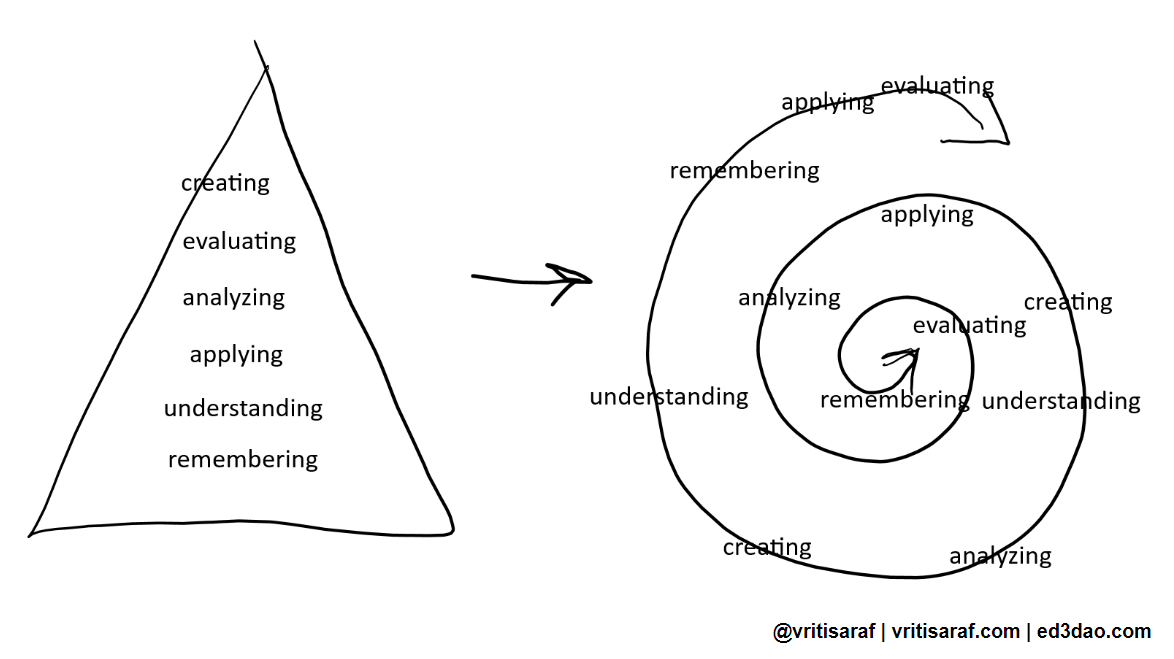
When I was a teacher, Bloom’s played an important role in lesson planning and assessing the competencies of my learners. Recent critics have appropriately recognized that these cognitive levels shouldn’t be stacked linearly, but should be more of a spiral that volleys between levels as learning is happening. Either way, it’s been the most accessible representation of learning in the last 70 years.
I thought that mapping AI’s abilities to Bloom’s Taxonomy would group at the top, bottom, or even perhaps swallow all of Bloom’s. In reality, it was much more spotty and varied, revealing a keen representation of human and robot capabilities.
Mapping AI to Bloom’s
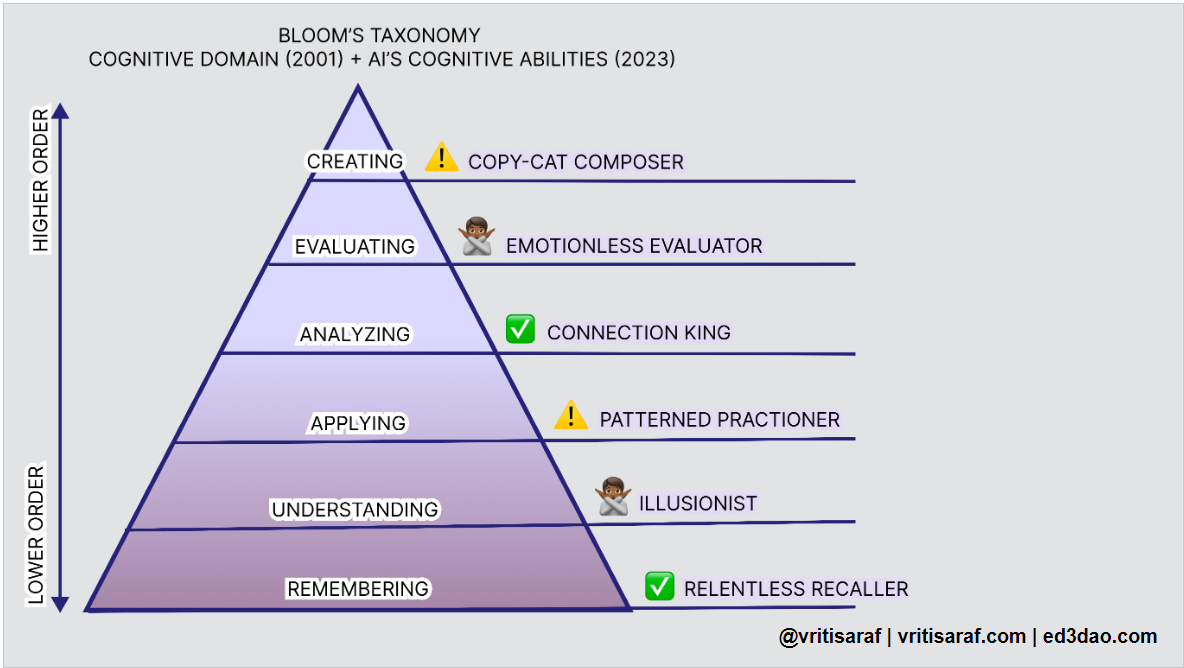
Here’s my evaluation. Remember that the purpose was to set our superintendents up for understanding when and how AI is most powerful. As you read this, keep in mind how you’ve been thinking about AI.
Remembering:The Relentless Recaller
Bloom’s Level: Remembering
AI’s abilities: Highly competent.
Key actions: Retrieving information such as facts, dates, definitions, or answers.
How well does AI recall data or information?
This first one is obvious. AI can simultaneously access millions of pieces of information across large databases. It will always be able to retrieve data more quickly, accurately, and with more abundance, than humans ever will.
Understanding: The Illusionist
Bloom’s Level: Understanding
AI’s abilities: Not competent.
Key actions: Recognizing, discussing, or explaining the meaning behind information.
How well does AI make meaning of information?
When I evaluated this level, I didn’t expect AI to fail so soon on Bloom’s. AI can recognize patterns, categorize data, and extract pattern-based meaning from large datasets, but it doesn’t truly “understand” in the human sense. Its comprehension is based on patterns and data, not on consciousness or intuition.
During my keynote at CCSS, the very thoughtful leader Dr. Tom McCoy, Superintendent at Oxnard Union HS District, chimed in with an incredible example. He explained how his son, when completing a homework assignment that asked him to write a goodbye letter to racism, used ChatGPT for ideas. ChatGPT replied with an opening line to the letter: “Dear Racism, We’ve had such great times in the past…”. AI used pattern recognition to identify how great letters hook the reader but didn’t make meaning of the purpose of the letter and the weight of racism. AI did not understand the assignment.
AI possesses an uncanny ability to generate responses that, at face value, seem informed and profound. This is because it excels in pattern-matching, recognizing and mimicking structures, sequences, and commonalities within data. But it’s not making meaning.
Applying: The Patterned Practitioner
Bloom’s Level: Applying
AI’s abilities: Somewhat competent.
Key actions: Using information in new contexts to predict, interpret, solve for, execute, or implement.
How well does AI use information in new situations?
AI, especially machine learning models, excels in applying learned patterns to new data. At the heart of AI’s application skills is a concept called “transfer learning”, which enables an AI model trained on one task to be repurposed for a second related task without starting from scratch. This is akin to a human leveraging their knowledge of cycling to quickly learn motorcycle riding.
However, humans possess an innate ability to make intuitive leaps. If faced with an unfamiliar problem, we draw from our varied experiences, even if they seem unrelated, to find solutions. AI, on the other hand, relies heavily on patterns it has seen. It struggles in scenarios where data is sparse or where intuitive, out-of-the-box thinking is required.
So the effectiveness of AI at this bloom’s level is somewhat competent and really depends on the data it has along with the complexity of the problem.
Analyzing:The Connection King
Bloom’s Level: Analyzing
AI’s abilities:Highly competent.
Key actions: Identifying trends, differentiating, comparing, relating, and questioning.
How well does AI draw connections among ideas?
Traditionally, Bloom’s illustrates that if a student isn’t able to remember, understand or apply, they probably won’t be able to move up on the taxonomy. But seeing AI fail at the lower levels and excel at this one further helps to make the case for Bloom’s Taxonomy as a spiral construct, not a linear progression.
AI can analyze vast and multidimensional datasets with superhuman speed, identifying subtle patterns and relationships. For instance, in genetics, AI tools can sift through enormous genomic data to spot potential markers or mutations linked to diseases. AI can predict potential future patterns based on historical data, which makes it highly competent at this level.
Evaluating: The Emotionless Evaluator
Bloom’s Level: Evaluating
AI’s abilities: Minimally competent
Key actions: Making a judgment, critiquing, depending, or providing an informed opinion.
How well does AI make judgments?
The act of evaluation is not merely about decision-making based on data; it is a complex cognitive process that often demands judgment, ethics, and contextual understanding. AI falls apart at this level. It does not operate with ethical judgment, it does not have cultural nuance, and it certainly does not have emotions. It over-relies on quantifiable metrics and although this perspective is important and can be used to evaluate our own blindspots, it is not the full picture.
We know that the instinct-based decisions leaders need to make in difficult situations are sometimes the best decisions. Steve Jobs is famously known for using his instinct to launch the iPad when tablets were failing in the market.
This level is where humans can shine and have a serious advantage over the machine. I gave this one a “minimally competent” because although AI cannot make judgments, it can provide us with the right information and recommendations so we can make judgments.
AI can create new content by merging patterns it has observed, but it isn’t original. It doesn’t have original thoughts, emotions, or consciousness. Even when AI creates music, artwork, or narratives, it does so by identifying and combining patterns in its training data. The result may sound or look unique to our ears or eyes, especially when the AI blends seemingly disparate styles. But at its core, AI is not inventing; it’s remixing.
And because of this, AI’s creative capacity is tethered to data. It cannot make the cognitive leaps across variable experiences even if the sheer vastness of combinations it generates seems groundbreaking. The permutations are just regurgitations in many forms.
Human creativity often springs from emotions, personal experiences, cultural contexts, and epiphanies. It’s organic, nuanced, risky, and sometimes serendipitous and unintuitive. These elements are currently beyond AI’s grasp. So although AI is highly competent at creating remixed content, it is not competent at creating original content.
An overview of AI’s cognitive abilities mapped on Bloom’s Taxonomy
How Learning Blooms
Mapping AI on Bloom’s taxonomy opened several cognitive and presentation pathways for me.
It helped me explain the human advantage over AI
It depicted AI as a cognitive partner
It identified the ways learners might use AI and be duped by AI
It allowed me to narrate how AI will elevate our standards in education for the production of content, ideas, and discourse
This last point is particularly important. One of the superintendents mentioned that using AI feels like cheating. She didn’t want people to think her thoughts and her work were not her own. That made perfect sense to me and it was difficult to justify AI’s IP leaching algorithm.
Instead, I shared that the calculator gave us the shortcuts we needed for quick and generic mathematics, but what we put in the calculator — how we used and contextualized the answer, and how we reasoned through the validity of the response — is what made the output our own. The use of the calculator also enabled educators to level up their expectations for students. Getting an answer was no longer the sole outcome. Now, students had to show their work and reason through more difficult questions.
Although a simplistic analogy, AI will similarly create new standards of productivity for us. The more ubiquitous AI is, the more we will use it to produce higher-quality content. When everyone is using it, we’ll think of new ways to assess student competencies.
The next article in this two-part series will dive into how AI can be a cognitive partner to leaders.
Young people keep telling us that school is boring and irrelevant to their lives and careers, yet schooling has not radically changed for over a century. The pandemic underscored the need to refresh education amidst today’s pace of change and to redesign what, why, how, where and with whom students learn.
But any transformation relies on big systems making space for innovators — and on innovators having faith in the ability of big systems to change. When people with a bent towards innovation consistently hit walls within inflexible institutions and are drawn to launch other ventures, the places where our kids are learning stay outdated. On top of the often-touted entrepreneurs, education needs intrapreneurs, people transforming systems from the inside.
In 2019, I partnered with our CEO, Elisa Villanueva Beard, to launch the Reinvention Lab at Teach For America (TFA) to catalyze the next chapter of TFA’s impact for young people. Since then, the Reinvention Lab’s charge has been “transforming ourselves to radically transform learning,” a concept inspired by Grace Lee Boggs. We ask where the future of learning needs to go, how the system of education needs to evolve and, ultimately, how we put TFA’s assets to work on behalf of creating that future. In collaboration with colleagues across the organization, we help lead TFA’s evolution from the inside to make sure it doesn’t get calcified in its thirty-year approach and design new learning environments with and for young people. One transformation can’t happen without the other.
Even though TFA is serious about doing things differently, the journey has been imperfect and sometimes difficult. From experiences working in public school districts, government agencies, academia, philanthropy and large nonprofits, my teammates and I have compassion for the ways that systems can get stuck.
In the spirit of humility and knowledge sharing with those working to transform our education systems and institutions, here are 4 principles about changing from within that we’ve learned and continue to refine.
Principle 1: Innovate on your core model and build towards the future of learning
TFA’s two-year corps member program is its largest offering. Since 1990, it has attracted young people to teach in low-income communities for at least two years, where they’re employed by local schools and become lifelong leaders in the fight for educational excellence and equity. Like any model created thirty years ago, it requires modernization for the needs of today’s rising generation. This critical work lives alongside nascent projects out of the Reinvention Lab that create new models to address students’ emerging needs. Two current projects for example: designing a summer school experience for students to develop greater agency in exploring post-secondary interests and creating an AI literacy course that college students deliver virtually.
TFA works to simultaneously improve its core model and build towards the future. An in-house innovation team allows a separate and distinct group to focus on new offerings without diluting an organization’s core business. For us, this model allows The Reinvention Lab to experiment in ways that do not put TFA or its existing work at risk.
But we still need to align with the organization’s overall priorities and mission. The Reinvention Lab leaders regularly coordinate with others across the organization even as Lab team members work independently. TFA senior leaders reiterate that all innovative work across the organization matters and is valued, and that the relationship between an in-house innovation team and the rest of the institution is a mutually reciprocal one. Without this, competition over resources or confusion about roles can fester, even among people with shared values and strong professional relationships.
We made missteps around this principle when creating The Reinvention Lab. We took too long to communicate intra-organizationally what was going on behind the scenes, creating anxiety about diffusing organizational focus. We worried about The Reinvention Lab getting scrutinized before we had time to learn deeply from those already working at the intersection of equity and innovation and because it took time to determine how TFA could add unique value to the field. Our concerns meant we didn’t clearly explain how the new team would contribute to TFA’s shared mission. Elliott Witney at ECHO Learning reflected on this same tension from his time running an innovation wing in a Texas school district. He described the ideal as creating a fishbowl around an innovation team to allow collective understanding and transparency without requiring collective input at every step of the way. In hindsight, we should have created this type of transparency and cohesion and done so sooner.
Principle 2: Create a culture of testing and composting
Historically, Teach For America staff feel most successful if they create something quickly, make it big and get it right the first time. I grew up professionally in TFA and in many ways helped create our organizational culture around scale, speed and results. This approach is an asset when it encourages us to be bold and reach as many kids as possible, but it can also result in a culture of perfectionism or risk avoidance.
The Reinvention Lab models dreaming big while starting small. We come up with ideas, test our assumptions through prototypes, refine and iterate. If a project is impactful, we pass it along to our friends in other areas of the organization who are better poised to take the idea to scale. If the data shows we’re on the wrong track, the time was not wasted because we didn’t invest in an expensive program that wouldn’t have made a significant impact.
Moreover, we capture what we’ve learned to inform future projects. We call this process composting, an intentionally organic metaphor. Composting is a way to invest projects we’ve decided not to pursue back into a nutrient-rich soil that can grow into related or different ideas. For example, we observed that a number of our urban and rural district partners began moving to a 4-day school week after the pandemic, partly because of a growing teacher shortage. At the Reinvention Lab, we asked ourselves: If this trend continues, could TFA build an offering for the 5th day? Exploratory research showed that such a program, while promising for young people, would not have been financially viable. Starting small paid off and kept us from building out an entire new initiative that we could not sustain. We composted this idea, and it has influenced our work around reinventing summer school, another potential way to bring innovative models to young people during less regulated learning time.
In a culture of perfectionism, no one wants to “fail.” But if low-stakes prototypes prove assumptions wrong, failing is a win. It’s a responsible way to ensure high-quality experiences for participants and steward an organization’s resources before making huge investments. Adults need space to practice nimbleness and flexibility, skills that young people need too.
The practice of composting is slowly spreading across TFA and helping the organization focus on the places where real breakthroughs and transformations are possible. Our ultimate hope is that we successfully build new offerings that advance the future of learning and become part of TFA’s fabric.
Principle 3: Resist fixed work plans and staffing structures
The culture of testing from Principle 3 requires a new pace of work and a different staffing model. Instead of starting with a predetermined outcome and operating on fixed annual planning cycles, The Reinvention Lab functions in trimester cycles. We set four-month goals, sort ourselves into project teams, plan ahead two weeks at a time and use emerging data to influence what we do next. In between trimesters, we reorganize teams and projects as needed.
More traditional backward planning makes sense in other parts of the organization. When refining an existing program or increasing efficiency, a more linear, annual approach is preferable. The outcome and capacity required are largely known. When you’re trying to create something that does not yet exist, it’s impossible to predict what you’ll need and when.
This style of working runs counter to the common approach in education. School principals and teachers are year-long fixed roles. The plan is linear: students need to master math or English Language Arts content by the end of the school year. Education organizations tend to mirror that linear approach: annual goals, fixed teams, fixed staffing.
Despite our best intentions, The Reinvention Lab found ourselves slipping back into static positions. We continually remind ourselves that our jobs can and often do change, even when that ambiguity is hard to hold. We view the regular evolution of our jobs as an asset and an opportunity to grow. Staffing flexibility also means we can bring in outside people for a broader range of expertise. A number of contractors join our small full-time team to work on specific projects, bringing technical expertise that would be too expensive to hire full time.
In doing so, we’ve brought new vantage points to the work. Because we believe the future of learning needs to expand beyond current school buildings, we value expertise from the edtech sector and from museum, after-school and homeschool settings. We’re betting on the benefit of diversity and different world views, even if doing so means we may bump up against differences in values, working styles, and assumptions. Harnessing a combination of perspectives feels critical to getting something different while making sure it is relevant at TFA.
Principle 4: Get serious about authentic youth participation
There is no effective path forward in education without the earnest involvement of young people. Organizations need to move beyond box-checking surveys and focus groups to thoughtfully engage and uplift the leadership of young people. At The Reinvention Lab, we’ve learned that this is more difficult than anticipated, but essential — having young people at the table has in fact changed the outcome in healthy and unexpected ways.
When we created the Enduring Ideas Fellowship after the pandemic hit, we included youth fellows on the Enduring Ideas Award grantmaking process. Young people comprised 50% of the decision-making body and joined adults to distribute $1.5m to community-based efforts. Time and time again, the group funded efforts that adults alone wouldn’t have funded, a testament to what can happen through participatory decision-making.
Under Malliron Hodge’s leadership, we moved from listening and sharing decision-making to actually co-building. We’ve done this in several different ways, including embedding youth as part-time staff on all projects. Even with our commitment to youth-adult co-creation, putting these values into action has been harder than we expected. Much like the importance of affinity groups, young people need and deserve their own space in addition to time with adult colleagues. Yet students have full school schedules during traditional business hours. If they miss a project team meeting for The Reinvention Lab, it can be difficult to disrupt traditional power dynamics that default to adult decision-making. We’re still figuring out how to maximize the unique assets and participation of young staff by defining what we do as a full team and what we can take on in smaller groups.
Young people are the most impacted yet least engaged stakeholders in education. If the education field doesn’t start sharing power with young people, a small set of largely white adults will continue to make decisions that impact young people and communities of color.
TFA envisions a world in which young people participate in joy-filled, affirming and relevant learning experiences and are prepared to thrive in and shape the future. This world won’t create itself. To unlock and shift our education systems, adults need opportunities to be creative, agile and work in new ways, ways that mirror the responsive learning environments young people have long been demanding. The work of transforming and re-structuring institutions from the inside is never easy and never finished. The transformation of The Reinvention Lab, Teach For America and the nation’s public school system are all works in progress. But each is necessary, interconnected, urgent and possible.
More than 50 percent of teachers said their edtech professional development training was a one-time event with little follow-up coaching or mentoring. Behind the data is a pattern that many superintendents and principals should recognize. Often a leader hears powerful claims about a new tool, gets educators excited about how the technology can unleash teacher capacity, implements the tool and then turns their attention to the next big tech trend. Teachers are left swimming alone in the deep end, trying to figure out how to effectively use the new technology.
Leaders can break this cycle by easing the edtech learning curve for teachers with professional development experiences that focus on teacher-centered mentorship, practicing and modeling patience and setting realistic expectations. It’s a philosophy that Concord Community Schools in Concord, Michigan recently took to heart.
Redesign Training as Teacher-Centered Mentorship
Many traditional professional development and training models are built on the same “sit and get” approach that leaders are trying to move away from in classrooms. In contrast, a teacher-centered mentorship model enables teachers to learn in ways that supports diverse learning levels, provides ongoing support and becomes self-sustaining so new teachers can easily adopt technology.
At Concord Community Schools the transition in professional development began as the district explored the power of the Modern Classrooms Project (MCP) framework as an instructional shift in classrooms. The model centers on blended instruction, self-paced learning and mastery-based grading, as opposed to a traditional lecture-based model. Using the model, teachers leverage technology to engage students with a broad diversity of learning levels and social-emotional needs through bite-sized teacher-created videos, and one-to-one and small-group classroom learning. The MCP framework also enables parents, guardians, or other people in a student’s life to get involved, because they can access the content just like a student would and support the student’s learning.
As part of adopting the model, school leaders and an initial cohort of teachers, completed a modern classrooms mentorship program. The district experienced how mentorship could help teachers learn new instructional skills, inspiring them to think about how it could be used in other forms of professional development.
Along with in-person training, the district converted professional development sessions into self-paced virtual units so educators could rewatch the material as needed. Educators at Concord Community Schools also continue to receive ongoing coaching to maximize their impact in the classroom and even guide their fellow educators in developing new skills in everything from technology use to instructional models. One educator described the experience as, “It’s a challenge, but worth it. What worked 10-20 years ago, just isn’t as effective anymore! This is the method all schools need to be introduced to, in order to be relevant in this time of teaching kids.”
Practice Patience with Yourself and Your Team
In a world of instant gratification, it’s easy to stop innovating when challenges arise. However, learning to use new technology, especially if it impacts how teachers teach, takes time, dedicated and intentional work and a resilient attitude. When scaling innovation, a leader must practice patience and not cut the process short because someone is struggling or stakeholders are questioning a district’s progress.
Practicing patience starts with understanding not all teachers will be ready to change. Leaders will be best served by starting small and focusing on a coalition of the willing.
When it comes to actually showing teachers how to use new technology or implement a new approach, leaders have to be the number one risk taker and model self-compassion because inevitably there will be frustrations and failures. Afterall, educators, just like students, learn at different paces and in different ways. Dedicating time to nurture teachers through their struggles, help them identify their strengths and develop a solution together, will soften feelings of fear and self-doubt and help guide teachers from initially learning a new model or technology to competency and mastery and then to advocacy.
Reaching the advocacy stage is essential to easing the learning curve for teachers who may initially be hesitant about new technology. Amplifying the voices of teachers who successfully adopted a new tool can help those still going through the process see what is possible. It takes patience and a willingness from administrative leaders to create space for teachers to get there.
Set Realistic Expectations
During the pandemic, districts were focused on helping students continue to learn so there was minimal time to thoroughly vet edtech solutions, provide sufficient professional development and communicate changes to families.
Today, however, districts have the capacity to be more intentional when implementing educational solutions. In addition to easing teachers into using these solutions, district leaders must be transparent with all stakeholders on the progress of the implementation so any issues can be worked out before a new program launches. For example, families who may have concerns about the implementation of a new instructional model can be invited into a conversation to better understand the impact on their students. When introducing new technology or models into the classroom, some educators at Concord Community Schools have created demonstrations for parents and guardians during parent-teacher conferences. Teachers walk parents through the new approach or tool or even create mock assignments where family members pretend they are students. It’s a meaningful step that helps the larger community fully understand the goal of changes in the classroom.
Bonus considerations for leaders. Reimagining professional development is a journey. The above practices will make the biggest difference, but leaders can also consider:
Learning alongside educators – joining educators in the process of learning a new tool or model creates a shared experience and demonstrates leaders are invested in the change.
Centering “why” – communications about new technology should focus on why it is important and the benefits it brings to teachers and students. Leaders should also connect it to a school’s greater mission or strategic plans.
Create a continuation plan – learning often doesn’t stop after a single workshop or a few weeks of training. Intentionally creating a plan for ongoing training, follow-ups, and ad hoc questions provides teachers the continued support they need.
As district leaders, we have the opportunity to reimagine how we support educators with professional development through mentorship, patience and setting realistic expectations, preparing them for what’s next in K-12 education and ultimately creating equitable learning environments for our students.
Becky Hutchinson is the Superintendent of Concord Community Schools in Concord, Michigan. Kareem Farah is the CEO and Co-Founder of The Modern Classrooms Project, a nonprofit dedicated to empowering educators to build classrooms that respond to every student’s needs
“…we have entered a new age of AI that will fundamentally transform productivity for every individual, organization, and industry on earth, and help us address some of our most pressing challenges.” –Satya Nadella
We are a year into the new age of human-computer interaction and things are moving fast. Generative AI gets better every month at producing text, code, images, and even video.
In an Impromptu dialog with GPT-4, LinkedIn founder Reid Hoffman suggested we should now think of ourselves as a new species, homo techne, “tool-makers and tool users, augmented and amplified beings capable of more than we ever thought possible.”
Two breakthroughs define this new age of human-computer interaction, explained Satya Nadella in his annual letter, natural language as the interface (after generations of keyboards, mice, and touch screens) and powerful reasoning engines. “This generation of AI helps us interact with data in powerful new ways—from completing or summarizing text to detecting anomalies and recognizing images—to help us identify patterns and surface insights faster than ever.”
Hoffman’s AI startup Inflection offers Pi, a “personal intelligence” willing to serve as “coach, confidante, creative partner, sounding board and assistant.” The 2013 sci-fi movie Her is playing out with dozens of AI companions in app stores.
A year ago, the script was “Focus on human skills because AI will never be creative or empathetic.” This fall AI apps promote idea generation, collaboration and creative content.
AI apps are empathetic confidants, coaches, and pathway advisors. AI capabilities are moving fast causing a reconsideration of what young people can do and should know.
At an AI demo at EdTech Week in NYC last month, there was a mixture of Hoffman’s optimism and a dose of concern. Some pragmatic optimists are busy automating 20th-century pedagogy–making it easier to produce worksheets and robo-tutoring hand calculations in math.
Creative optimists are inviting learners into value creation. Warton professor Ethan Mollick invites students to view AI as a co-founder and creativity engine in entrepreneurship. Learners in DaVinci Schools in Los Angeles use Project Leo to construct community-connected projects.
Educators use Playlab to construct project tools and chatbots. Reinvention Lab used Playlab to create FutureShock, a summer impact sprint.
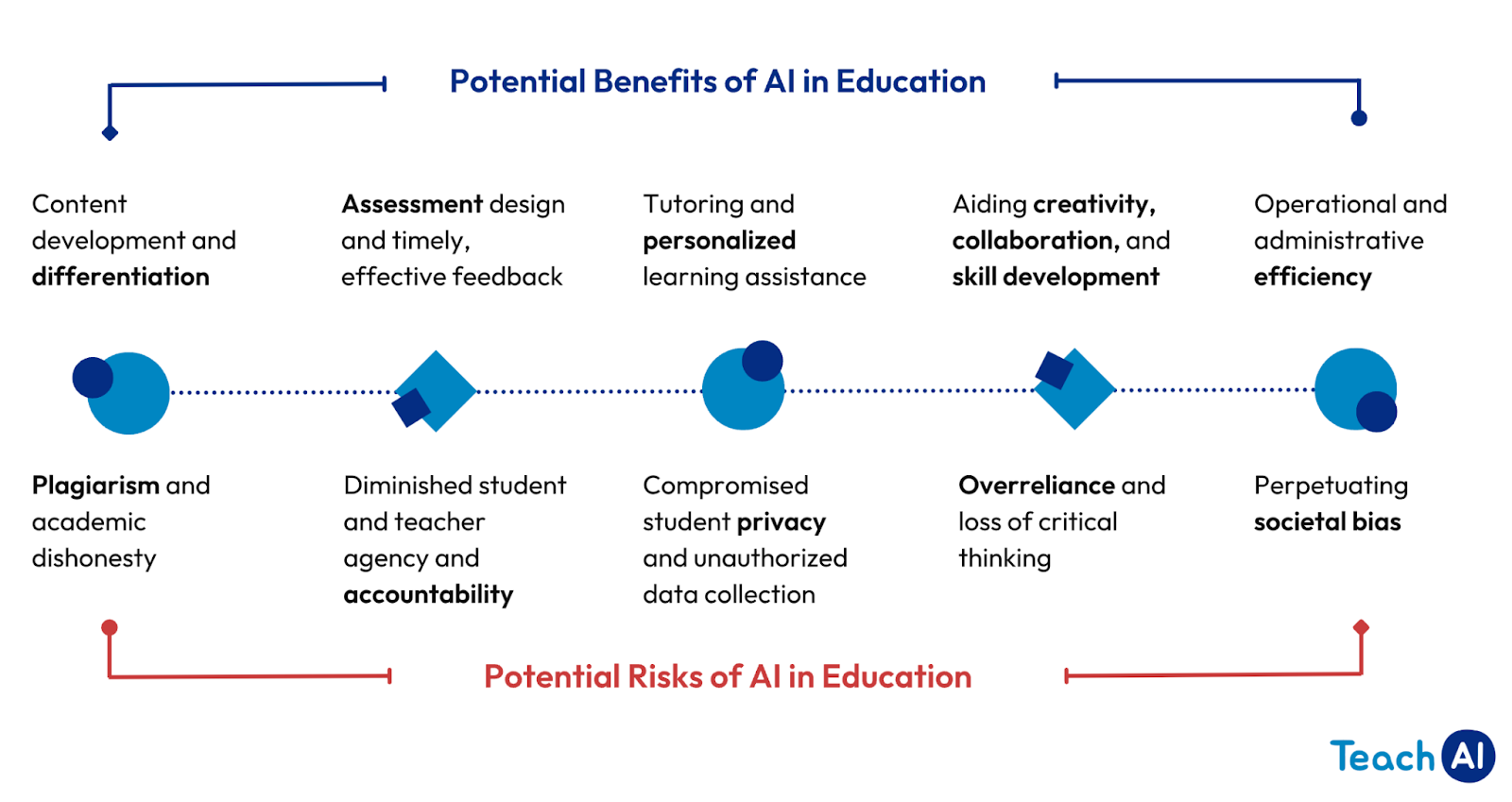
A new report from TeachAI summarizes the potential benefits of AI in education (below) leading with content development and (4th on the list) creative project-based work. To the personalized learning category, add smart career exploration and path guidance (see SchoolJoy for example).
The most widespread concern is (what is currently considered) cheating and plagiarism–or the unauthorized and undisclosed use of gen AI in completing assignments. Use guidelines are important but there is also the opportunity to move to what Professor Sarah Elaine Eaton calls “the post-plagiarismage of hybrid writing” with higher expectations for quality while valuing attribution.
The automation of bad pedagogy, as TeachAI notes, could lead to less agency and loss of critical thinking. The opposite is the goal– inviting learners into more challenging work yielding public products not previously possible.
Getting Started With AI
School visits this fall suggest that most schools are waiting for guidance. And, that direction is beginning to emerge. AI for Education offers useful guidance on laying a foundation, developing staff, and engaging students.
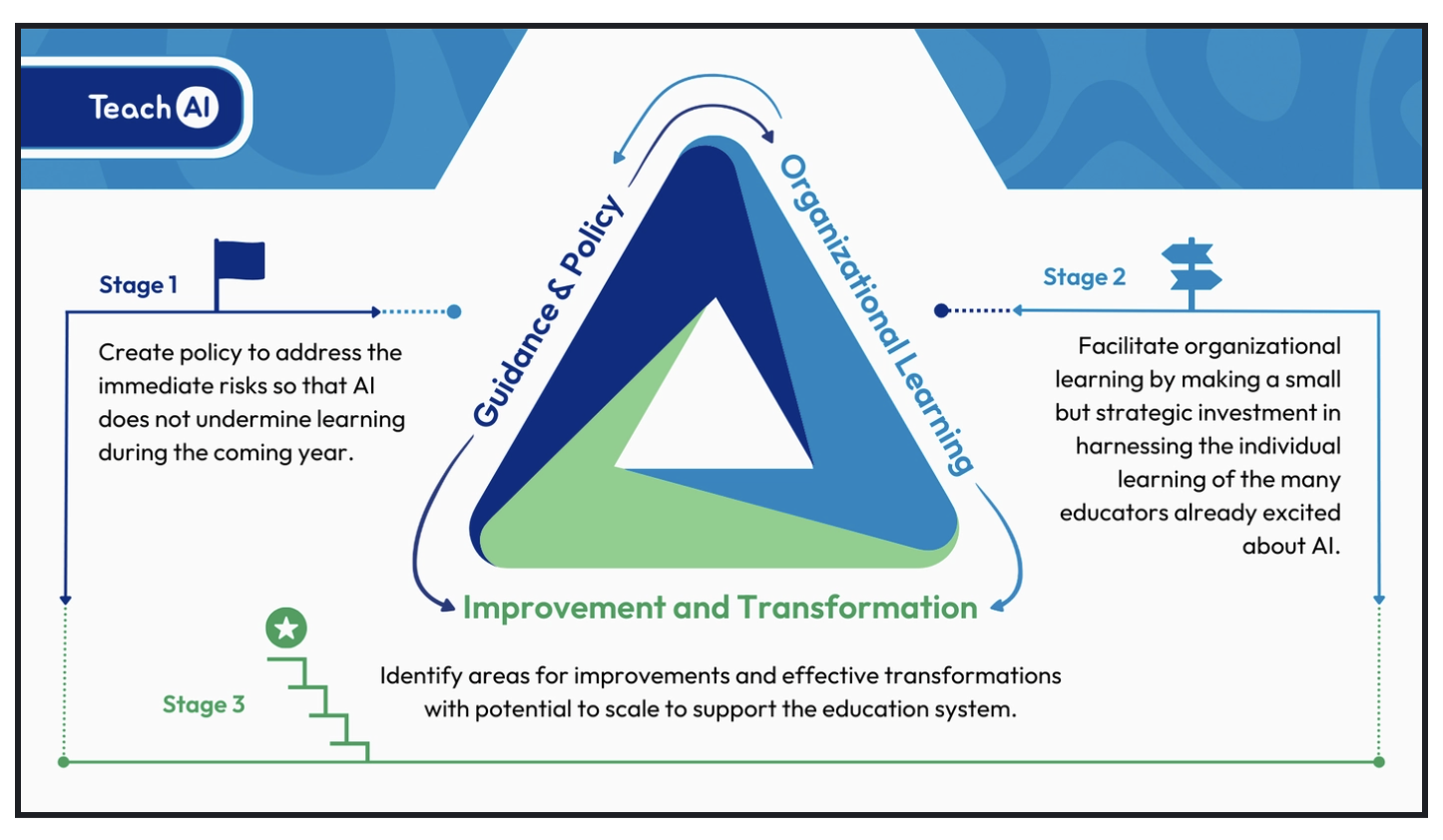
Similarly, the new guidance from TeachAI suggests a three-step process of 1) creating/updating a use policy, 2) facilitating staff development, and 3) identifying areas for improvement and transformation.
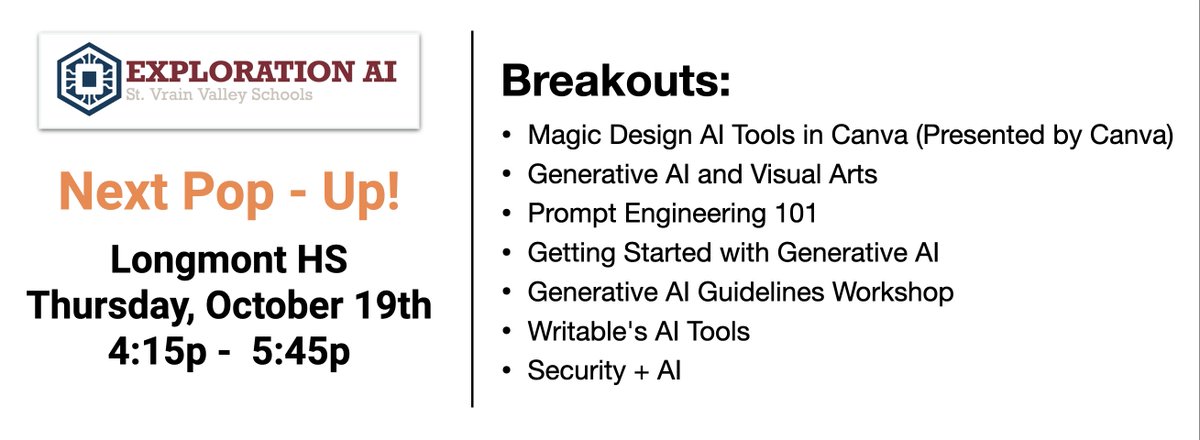
A few school districts are well down this path. St Vrain Valley Schools in Longmont Colorado has invited staff to explore AI with a bingo card of 25 learning experiences. Drop-in coaching sessions are hosted at the Innovation Center and weekly pop-up events at schools invite exploration (example below). AI Champions at each school support ongoing development and real-time exploration.
The Peninsula School District in Gig Harbor, Washington developed Artificial Intelligence Principles and Beliefs rooted in Universal Design for Learning. It concluded, “AI is a potent tool that can dramatically improve education by offering personalized, inclusive, and compelling learning experiences when used responsibly and ethically.” Teachers in an AI Action Research project developed Resources and FAQS.
Stretch AI from ISTE, a chatbot that is trained on their libraries of vetted content.
Communities Alive With Possibility
There are good reasons to be concerned about the proliferation of AI in work and learning. But if collective response is limited to risk mitigation, communities will miss the greatest impact opportunity in history. Gen Z (or as Reid Hoffman suggests, Generation AI) has the opportunity to do more than ever thought possible–to create, express, invent, heal, and teach.
What I most appreciate about visiting St Vrain Valley Schools is the sense of possibility. They lean into opportunity, they turn it into an R&D agenda, they invite teachers and learners to explore new possibilities, and then they scale innovation for equity.
With Colorado Education Initiative, St Vrain hosts the National Innovation and Leadership Institute where they share the formula for building a strong foundation and adding an innovation agenda. Assistant Superintendent for Innovation Joe McBreen challenged the last cohort,
“Your district’s greatness in 2030 will be directly proportionate to how innovatively you dare to lead.” (And, he said it in three languages using an AI translation app.)It’s time for a community conversation about what’s possible, about lifting collective expectations of the kind of work young people can do. Like KEEN engineering schools, it’s time to invite learners to spot opportunity, design solutions, and deliver impact. Like Real World Learning schools in Kansas City, it’s time to invite learners into community-connected and entrepreneurial projects. Ethan Mollick said, “Given the inevitability of change, we need to figure out how to mitigate the negative, but also how to channel the change for good as much as possible.”
AI in Education
For the past decade, we’ve been covering advances in artificial intelligence and machine learning, sounding the alarm that it’s not if it’s when and it’s not when… it’s now. Over the last few years, the news cycle appears to be in full agreement with us. This publication highlights trends and developments in artificial intelligence that are shaping teaching and learning.
Picture this: a second-year university student from Ghana wants to transfer to the University of Leeds and receive credit for courses completed in their home country. Similarly, an individual has completed a law degree in Malaysia and now wants to practice in Italy. Both of these learners hit the same snag, the immense challenge of converting credentials and experiences (e.g. converting UK Key Stage 4 to US early High School). Those responsible for this critical work exist but are rarely talked about.
At the 10th Annual The Association for Credential Evaluation Professionals (TAICEP) Conference, nearly 250 delegates from 24 countries gathered to focus on topics like the varying national educational systems, issues with refugees and war-torn countries, spotting fraudulent transcripts and diplomas, and evaluating non-traditional pathways like micro-credentials and work experience for credit.
TAICEP shines a light on the whole world of benevolent behind-the-scenes operators who manage the fate of thousands of applicants to universities, trade schools, and visa offices who don’t quite fit the definition of normal. Determining eligibility and the next steps require a massive amount of knowledge about national systems, languages, and deciphering what is meant by items like “paraprofessional level one training.” Through sessions and conversations, a few big-picture questions emerged.
Who is governing?
The world is getting more complex. Different countries are adapting their educational and professional certification programs and there is a proliferation of fraudulent credentials, which will likely get worse before it gets better as we enter an increasingly AI-infused world. To combat this, some attendees proposed global governance on items like verifying credits awarded for MOOCs, Micro-credentials, competency-based programs, and industry certifications.
Even within this reimagined governance model, there was no consensus on effective strategies to assess the value of non-traditional, non-credit-bearing learning experiences. Anneta Stroud, AACRAO (Registrars and Admissions Officers), was very clear that universities need to get on board, like yesterday. At one of the later sessions, a team from South Africa presented on their attempts to bring micro-credentials (AKA short skills programs or part qualifications) under their National Qualifications Framework (NQF). The presenter noted that Malaysia has also had success with defining and evaluating micro-credentials and that UNESCO, the EU, and the OECD have all drafted blueprints or policy recommendations on micro-credentials, but to date, there is no common agreement on definitions, rigor, or assessments.
Who certifies the certifiers?
The recognition of this global community of credential evaluators organized by TAICEP is only ten years old. However, TAICEP itself is just a membership organization for anyone involved in the specialized field of international credential evaluation. Delegates represent “higher education institutions, independent evaluation agencies, ENIC/NARIC offices, government ministries, licensing authorities, examination boards, awarding bodies, and other organizations.” It is not a global governing body. Therefore, there remains a need for a certification program and industry standards for the credential evaluation profession. TAICEP has proposed its own set of rigorous mini-certifications on various aspects of the profession, but ironically those micro-credentials suffer from the same lack of authority that puzzles the credentialing community on other forms of micro-credentialing.
How do we deal with the non-traditional?
This profession is full of completely out-of-the-box situations. One panel discussion which included university and industry representatives shared stories about candidates presenting credentials that had never been seen before and the rabbit holes they have to go down to figure out equivalencies or to validate that person’s education or training as acceptable. The panel and audience members shared the view that they should act as an accessory rather than an obstacle and how much joy it brings them when they can tell someone that their credential has been accepted as valid. Three different sessions addressed the issue of dealing with credentials from war-torn regions like Syria or Ukraine where there was longer a university or trade school to validate. In one panel, one of the better-known agencies, World Educational Services, had teamed up with the national certification board in South Africa in a pilot project to validate the credentials of over 6,000 refugees.
As the world continues to evolve its understanding of what an education is, professional credential evaluators are an important component of that cycle, whether behind the scenes or sitting directly in front of that candidate clutching a piece of paper they worked very hard to achieve and hoping it will be accepted as valid evidence of learning.
James Mattiace is an assessment reform advocate. Previously, he was a principal and an IB teacher,
Microschools are not a new phenomenon that emerged during COVID-19. Their prevalence rose during the pandemic due to their agility and ability to prioritize relevancy and agency in every learning experience. Microschools provide an alternative option where pedagogy is grounded in problem-centric exploration, project-based activities, and co-creation of experiences. Despite the continuation of static operational and instructional systems, several states have adopted policies to pioneer small learning environments as the preferred model of the future.
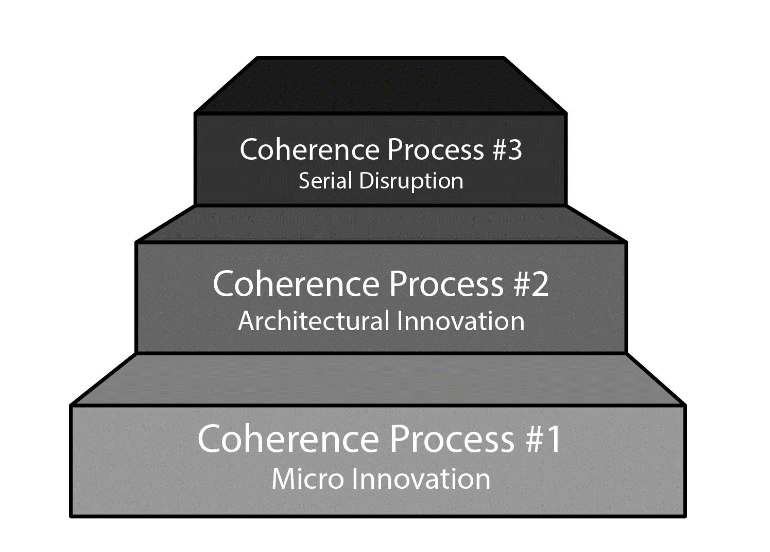
Traditional functions of the industrial model in education are optimized by tightly-coupled structures. Microschools are non-linear. loosely-coupled structures where classrooms are multi-age and multi-dimensional. Classrooms in this model are focused on developing the voice of students where learning is facilitated through a co-authorship facilitation. Agility in the context of an adaptive curriculum elicits a consensus design where communities, families, and students are the core components of making learning meaningful. Below, I have applied the Creative Staircase model to take a look at the conceptual frames of microschools.
Coherence Process #1 (Micro Innovation): To achieve a serial disruptive model within a comprehensive design such as the Jeffersonian Model, there must be a combination of incremental changes that are intentional by design. These micro innovations are the initial shifts for macro-level transformations. In the context of new design or redesign within a traditional learning organization, start with curriculum modifications to root experimentation, agency, and authentic experiences through problem-based activities. An example of Coherence Process #1 of the Creative Staircase can be found at The Met School in Providence, Rhode Island. A variety of micro-innovations are noted at this Microschool. Work place learning coupled with internships and advisory are a part of this conglomerate embedded in the elements of the Microschool design.
Coherence Process #2 (Architectural Innovation): Because of the systems change through the influences of multiple micro innovations, traditional classroom structures will need to be eliminated to cohere with the flexibility of microschools. With regard to architectural innovations in alignment to the microschool design, environments are studio-based with pathways that are customized for students. The flexibility of microschools elicits lab features and innovation hubs for hands-on discovery. Microschools are innovative learning models where environmental space is flipped for agency, exploration, and personalization.
A best in class, specifically in alignment with architectural disruption, is NuVu Studio in Cambridge, Massachusetts. Underpinning Coherence Process #2 in the Creative Staircase (i.e., architectural innovation), NuVu’s structure is antithetical to the Jeffersonian model design because legacy classrooms, linear pedagogy that is content-driven, age cohorts, and letter-based grading systems are absent within the design. Multi-disciplinary projects, open structures, and experiential learning activities in conjunction with competency-based portfolios are rooted structures to elicit teaching that facilitates authentic learning experiences.
Coherence Process #3 (Serial Disruption): For serial disruption purposes in alignment to Delta 2030, microschool elements feature entrepreneurial pathways, adaptive schedules for hybrid opportunities beyond the confines of traditional school, certificate programs based on economic demands, blended experiences with artificial intelligence tools, and pedagogy that is guided by the engineer-design process. Serial disruption is integrated and multi-dimensional which is level-set in microschools.
One Stone, a non-profit organization that leverages design thinking into their Microschool model, features a studio-based program where learning experiences are personalized by industry experts. To deepen the serial disruptive frame, makerspace labs, electorics labs, and a progressive after-school program with coding experiences are normalized in the academic day. Teachers and students act as co-constructors of the learning experience which is measured through a growth framework and transcript of each student to be future and workforce ready.
It is known in various research studies that Generation Z and Generation Alpha demands are fundamentally different from any other in the history of humankind. Technology and artificial intelligence are contributing factors, but societal trends have reimagined the urgency for transformation. The ecosystem is experiencing creative tension because of the incongruence with current economic patterns and model articulation in education. Microschools provide innovation and creativity to develop new competencies for 2030 and beyond. Individualized pathways, multi-disciplinary projects, blended programs with flexibility, and studio-driven learning environments can be deemed as the future of schools.
Michael Conner, Ed.D., is the CEO/Founder of Agile Evolutionary Group, Corp., Senior Fellow for Getting Smart, and former Superintendent of Schools. He is the creator of the Disruptive Excellence Framework and author of Intentional, Bold, and Unapologetic: A Guide in Transforming Schools in the AC-Stage of Education.
Low literacy rates continue to persist, especially in low socioeconomic communities. Recent data indicates that approximately 40% of K-12 students in the United States are not reading at basic levels and almost 70% of low income 4th grade students are below basic levels. We know that struggling readers often exhibit behavioral challenges in the short term and the long-term adverse consequences are well-established. Three of four people on welfare can’t read and three out of five in prison lack basic literacy skills. As summarized in a New York Times article entitled “It’s ‘Alarming’: Children Are Severely Behind in Reading,” we are reminded that poor readers are more likely to drop out of high school, earn less money as adults, and become involved in the criminal justice system.
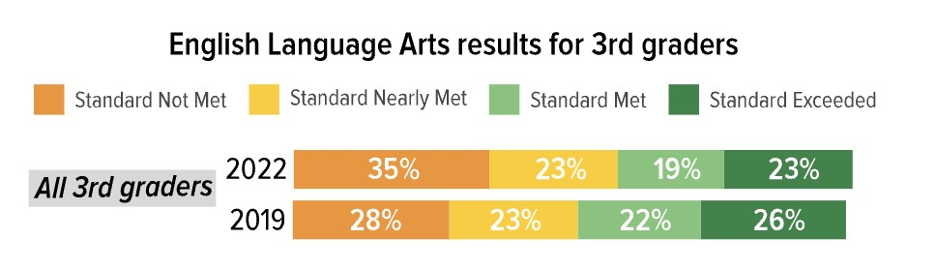
Literacy challenges have intensified through the pandemic, demonstrated in states like California where 3rd grade English Language results were lower in 2022 than they were in 2019, leading to the following statement regarding our current reality: “The scores may be brutal … but they’re far from shocking. Some experts view this uproar over falling test scores as a distraction from the sobering fact that these challenges persisted long before the pandemic, in terms of teaching kids to read.”
Our legacy approach hasn’t been effective in meeting the needs of all learners. Now is the time for us to rethink the ways in which we organize our efforts to improve the impact for the benefit of learners, communities, and society as a whole.
From Grade Levels Classrooms to Literacy Launchpad
Imagine if we could break away from these rigid one-classroom, one-teacher school structures and instead organize our elementary students into microschools with a dedicated focus on ensuring each and every child is literate by 2nd grade.
As an example, a neighborhood elementary school that currently houses 600 students organized into grade levels could be organized into 4 microschools of 150 students each on the same campus. The microschools could be multi-aged, incorporating looping and team teaching to develop strong relationships, and held accountable to locally-developed outcomes as well as family choice among the microschools.
We also can envision that the aggregation of microschools can help us address one of the most pressing challenges of our time to dramatically improve early literacy rates that we know are foundational for future success. An early-literacy focused microschool with clear competencies could be the initial placement for all students until they demonstrate mastery of those competencies at which point they would matriculate out into one of the other site-based microschools. This early-literacy microschool could be deliberately resourced with extensive expertise, personnel, and programming to ensure that ALL learners have a strong and stable language and literacy base to set the stage for lifelong learning.
Targeted teaching and learning that includes phonemic awareness, phonics, vocabulary building, fluency practice, comprehension strategies, structured reading time, and culturally-responsive methods would be delivered by teams of educators in a literacy-rich environment who work closely with families to ensure that every learner makes significant progress.
What Sets the Literacy Launchpad Apart?
The Literacy Launchpad represents a departure from traditional primary age classes in several key ways:
● Focus on Literacy Proficiency: The primary and most significant difference is the explicit focus on literacy proficiency. In a traditional primary classroom, literacy skills are one component of a broader curriculum. In contrast, the Launchpad places literacy at the forefront of its educational mission.
● Specialized Expertise: The Launchpad is staffed with highly specialized educators who are experts in literacy development. These educators have extensive training in evidence-based literacy strategies and have a deep understanding of how to support students in mastering foundational reading and writing skills.
● Competency-Based Assessment-Driven Instruction: The Launchpad utilizes frequent and thorough competency-based assessments to identify each student’s literacy strengths and weaknesses. This data guides the development of personalized, assessment-driven learning plans for every learner.
● Intensive Intervention: For students who require additional support, the Launchpad offers intensive, evidence-based interventions. These embedded interventions are designed to target specific skill deficits and help struggling learners catch up to their peers.
● Small Learning Communities: The Launchpad is organized into smaller learning communities, creating a more intimate and personalized learning environment. This improved adult-student ratio allows for greater individualized attention and fosters stronger relationships between students and educators.
● Multi-Age Grouping: Unlike traditional grade-level classrooms, the Launchpad may incorporate multi-age grouping. This approach allows students to learn alongside peers at different developmental levels, promoting collaboration and peer mentoring.
● Flexibility in Progression: Students progress through the Literacy Launchpad at their own pace, based on their mastery of literacy skills. There is no rigid grade-level progression. Instead, students move forward when they have achieved proficiency in reading and writing.
● Individualized Learning Plans: Every student has an individualized learning plan that outlines their unique literacy goals and the strategies and resources required to achieve them. These plans are continuously updated based on ongoing assessments.
● Community Engagement: The Launchpad actively engages parents and the local community in supporting literacy development. It recognizes that literacy proficiency is a shared responsibility and involves all stakeholders in the learning process.
● Inclusive and Equitable: The Launchpad is committed to inclusive and equitable education. It ensures that all students, regardless of their starting point, have the opportunity to reach literacy proficiency. Special education services are seamlessly integrated for those with diverse learning needs.
Overall, the Literacy Launchpad represents a paradigm shift in primary education, where literacy development is the central pillar of the curriculum, and personalized, evidence-based approaches ensure that every student becomes proficient in reading and writing. This innovative model seeks to address literacy challenges comprehensively and set students on a path to lifelong learning success.
A Bright Future Awaits
The evolution of elementary education from grade levels to literacy-focused microschools is not just a vision; it’s a tangible possibility. The Literacy Launchpad could be a game-changer for our young learners, setting them on a path to success in all subjects and success in and out of school.
As we move forward, let’s embrace our responsibility to co-create a brighter future for teaching and learning. The time is now, and the way forward is together. Let’s configure schools that unlock the full potential of education for all learners by ensuring that every learner has a strong language and literacy foundation for lifelong learning.
What sort of problems did you want to solve when you were younger?
When I was younger, I didn’t entirely know what I wanted to do. I often spent time playing school because I really enjoyed learning. I also loved animals and thought that maybe I might choose a career that involved working with animals. Helping others is something that I learned from my parents and I always sought opportunities where I could help others in any way that I could.
What led you to the world of education and how long have you been in it?
I recall as a junior at Penn State having an interesting conversation with my guidance counselor. I was a student in the School of Liberal Arts and had taken the required courses and many focused on the French language and culture because that was one of my strong areas. I recall the conversation when my guidance counselor told me it was time to declare a major. I did not have a clue about what I wanted to do. They suggested going into education, because of my interest in helping others. I also have several members in my family who are involved in education and so I dove in without realizing that I might make it a long-term career for myself. I have been teaching since the last century, which is something I like to tell my students and other educators.
What are you hoping your students to “feel” when they walk into your classroom?
I want my students to feel welcome and safe in our learning space and to know that I am there to support them for whatever it is that they need. I want them to be excited about learning and know that I really do care about them and want to do the best for them during the year and beyond. With the way that I design my classroom, I want all students to know that they can come in anytime and that I am there to listen, guide, support and be a mentor for them as they navigate all of the challenges that can come with learning.
What strategies do you recommend for creating a positive and inclusive classroom environment for your students?
In hindsight, the key lies in building relationships. From day one, invest in getting to know your students, their interests, and needs. Engage in meaningful conversations and allow them to get to know you better. Fostering mutual understanding enables the creation of a positive and inclusive space. It’s essential to strike a balance between learning and enjoyment, shared challenges, and celebrate the big and small accomplishments. To achieve this, it is a priority to provide a comfortable learning environment. It’s okay to have fun, laugh together, experience challenges and learn together.
As the rise of new technology continues to play a significant role in education, how do you strike a balance between digital tools and traditional teaching methods in your classroom?
I always think about what I’m trying to do. What is my purpose for using a specific method or a digital tool in my classroom? Sometimes with the content covered in my class, I know that students need additional examples beyond the ones that I’m providing for them. They need activities that are interactive or provide different ways for them to engage with the content. To do this, I often rely on some digital tools that are very versatile and that provide me with access to information about where students are in the learning process. I also want to use the time that I save by leveraging some of the tools, to spend with students working with them one-on-one, in small groups or as a whole class.
In today’s rapidly changing world, what skills do you believe are most essential for students to develop in order to thrive beyond the classroom, and how do you incorporate these skills into your teaching approach?
I started to realize a couple of years ago that even though I want students to love learning Spanish and maybe even become Spanish teachers or explore careers where they need these skills, I also need to take advantage of opportunities to help prepare them for whatever it is they decide to do in the future. When looking at social-emotional learning (SEL) skills or reviewing the Job Skills Outlook from the World Economic Forum, I look for ways to help students to build these skills in my classroom. I try to provide a variety of opportunities for students to collaborate, communicate, to work through challenges in learning, to connect with others and to leverage some of the different technologies that are available. I have to help prepare them for the different ways they may be engaging in work in the future. I am always about embracing new ideas and diving into risks in my classroom. I think it’s important to talk with our students about why we are choosing a certain method or a tool and how we think it will impact them. It’s also important to make time to gather feedback from them to understand the impact. Was it positive, or negative and how can we improve from there?
Parents play a crucial role in a student’s education. What strategies do you suggest for fostering a strong teacher-parent partnership throughout the school year?
It is important from the beginning of the year to set up a way for parents to communicate with you. I always recommend using a survey to ask parents what their preferences are when it comes to communication. Do they prefer email, phone calls or a messaging tool for example? Do we have our class materials available on a class website so families can access it? Also, be consistent with providing information to families so they know about the learning that is happening in your classroom. Are there any events or projects coming up, and how can they become more involved in the learning experience of their children? Keeping communication open is essential because we know that the more the families are involved and engaged in learning, it helps to promote student academic achievement.
What’s one message you have for fellow school leaders? My advice is to not be afraid to take some risks with new ideas or new tools. There are so many choices out there that can really help to enhance the learning experience of students but also to keep us learning ourselves. We want our students to not be afraid of challenges in learning and what better way than to show that we are also risk-takers. Dive into learning with them, show them that we are not afraid of making mistakes and how we learn from those mistakes. So if there is a topic that you’ve been interested in but I’ve been hesitant to try, I say this is the perfect time to do it. Involve your students in the process and learn with and from them and enjoy the school year. I am all about getting teachers to dive into AI and not worry about being an expert, we just need enough to get started!
What is your one hope for the future of education?
My hope for the future of education is that educators will be receptive to evolving ideas and technologies. We are in the best position to guide our students into whatever the future brings. I hope that we all realize that we are constantly learning and must keep on learning, making mistakes and pushing ourselves so that we can provide the best for our students.
Schools, as integral components of the social tapestry within any given community, possess the potential for a more profound role. They hold the potential to be dynamic centers of community engagement and enrichment, creating learning experiences that touch every demographic of the community. Too many schools are shuttered at the end of the day, or after the last student practice or club has adjourned. When schools start viewing themselves as resources in the lives of the entire community, not just its children, it creates opportunities to actively involve the community, creating a reciprocal relationship that benefits both the students and the surrounding neighborhood. This collaborative approach transforms schools into vibrant hubs that enhance not only student learning but also the well-being of the entire community.
At the heart of this idea lies the recognition that the community itself is a valuable repository of knowledge, skills, and experiences.
By developing shared resources, or making minor updates to make them shareable, a school can open its doors and invite community members into the school environment. Educators can tap into this rich resource to enhance student learning while providing additional benefits to the community by bringing the outside in. Community members can gain the benefits of educational athletic and recreational facilities, theatrical and multipurpose facilities, and beyond, which also an opportunity to put money back into the schools through renting these facilities. Applications and websites, such as facilitron, already exist to match community groups and users with public facilities, including schools. However, these are applications for people to request access to school facilities, not those schools actively inviting the community to contribute to education. To do that, districts must be proactive.
One effective way to create dynamic community participation is through the inclusion and utilization of flexible maker spaces or tinker labs. These spaces can be the perfect environment to invite guest professionals, artists, entrepreneurs, and experts from various fields to share their insights and experiences with students. These guest speakers can provide real-world context to classroom learning, bridging the gap between theory and practice. Students gain a deeper understanding of how their studies translate to the world outside, which can ignite their passion for learning and open their minds to new possibilities.
Moreover, community members can serve as mentors, guiding students in areas of their expertise. This mentorship goes beyond traditional education, offering personalized support and guidance that helps students develop crucial life skills, set goals, and make informed decisions about their futures. The mentor-student relationship also instills a sense of belonging and builds self-confidence, as students receive validation and encouragement from role models within their community.
In recent years, to provide more value to the community, many schools have built administrative community resource space in the form of wellness and family centers for adult instruction, legal and housing assistance, health resources and services, and English as a second language instruction. These types of community health and wellness resources can be excellent vehicles for career education training in health careers or in second language learning where adult and adolescent students teach one another under supervision from trained instructors.
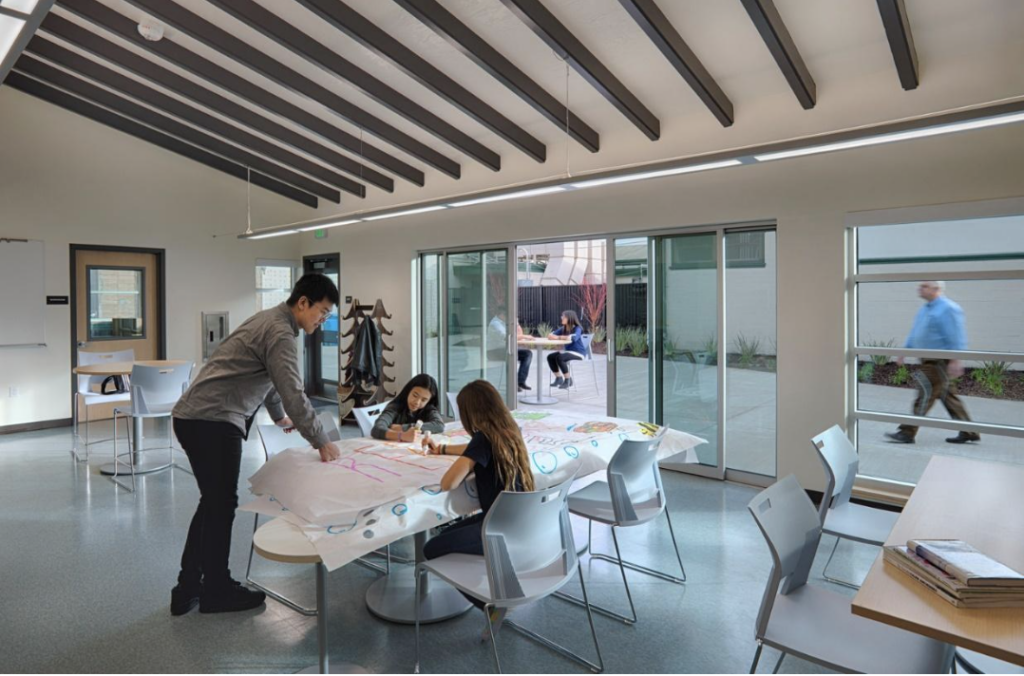
Figure 2 – This multi-purpose administrative space at Kennedy Middle School is adjacent to the school’s Family Center and is part of an addition of secured entry facilities, making it useable in the evening for community instruction and available during the day for student use. Image courtesy of HED
Collaborative projects between schools and community organizations are another powerful way to enrich both student learning and the community. Local businesses, nonprofit organizations, and civic groups can partner with schools to create hands-on projects that address real community needs. This not only teaches students about social responsibility but also equips them with practical skills while making a tangible impact on the community. For instance, students could work on environmental initiatives, urban planning projects, or community service initiatives, fostering a sense of civic engagement and empowerment in shared research space such as the library, large meeting spaces, or even the campus quad.
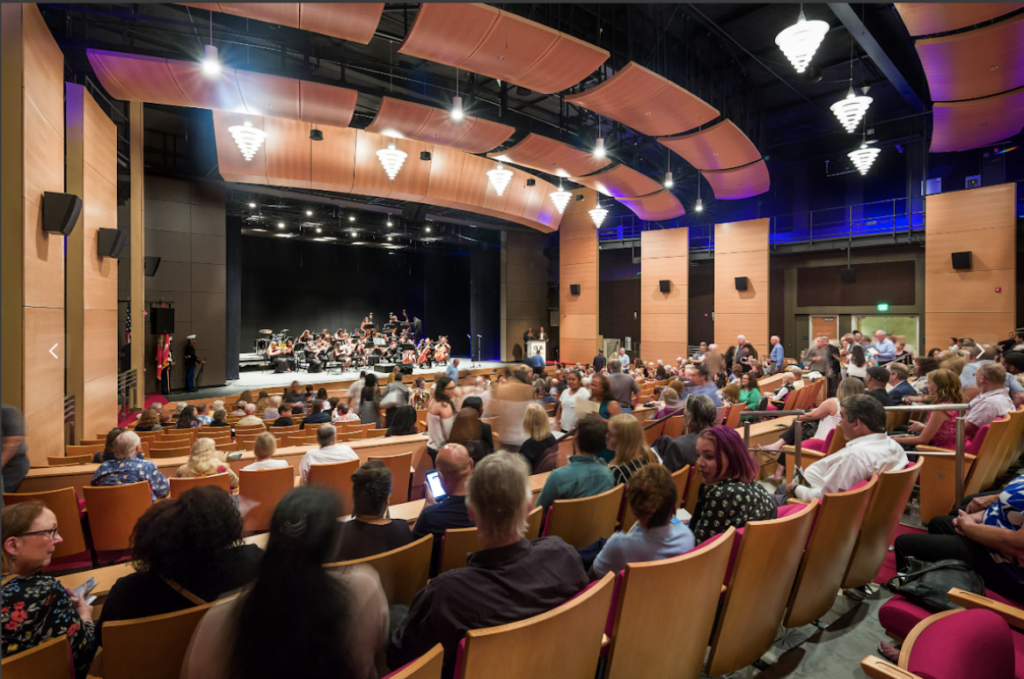
Figure 3 – The Oceanside High School Performing Arts Center can be used by the community both for student-programmed events and to bring the community in to mentor or use the facility resources. Image courtesy of HED
Cultural and artistic engagement is equally vital. Schools can collaborate with local artists, musicians, dancers, and performers to offer workshops, exhibitions, and performances. This not only encourages creativity and self-expression among students but also introduces the community to a diverse range of artistic experiences. Cultural events hosted at schools provide a platform for community members to interact, share their cultural heritage, and celebrate diversity. These events not only enrich the community’s cultural fabric but also provide students with an opportunity to learn about different traditions and perspectives.
Collaborations like these not only maximize the use of available resources but also fosters a sense of ownership among community members. Schools become a shared space where people of all ages can gather, interact, and learn from each other. In many communities across the country, schools are engaging in facilities upgrades to create secured and monitored entries for just such joint-se activities. Most school facilities are already equipped with spaces that could be utilized in numerous ways beyond the examples above to benefit the broader community and students in flexible after-hours special projects, education, or hobbyist activities and skill sharing.
Community involvement fosters a positive reputation for the school, strengthening its ties to the neighborhood and garnering support for its programs. Additionally, involving the community can often provide financial support through grants, donations, and volunteer efforts, enabling schools to enhance their resources and offerings. When developing new facilities or modernizing existing ones, we encourage our district clients to consider how their campus can open itself to the community and provide additional value that engages the whole community.
One of the most important steps to ensuring success that we have seen is writing community engagement goals into Strategic and Capital Improvement Plans for the District. By outlining community engagement as a discrete facility project goal at the Request for Proposal (RFP) stage, we as the design firm were able to be informed of the key project goal from the very beginning. This shaped how we approached the project and informed the design possibilities we brought to the table when working with each District. We as designers can come to the table with concrete facilities suggestions on each project to make the facility more porous and adaptive to community need. In the case of all the project examples here, community engagement was a goal written into the outset of the project, and our team was able to design around that goal and propose use cases and examples for the District and community stakeholders to discuss and vet in meetings and charettes.
The collaboration between schools and communities holds immense potential to enrich student learning while benefiting the community at large. By opening their doors and inviting community programs, guest speakers, fostering mentorship relationships, engaging in collaborative projects, and promoting cultural exchange, schools become vibrant centers of knowledge, growth, and interaction. This approach nurtures well-rounded, socially responsible students while also strengthening the bonds within the community, creating a cycle of continuous enrichment for both students and the neighborhoods they inhabit.
 Jeff Horton | Blog Site