More Real World Learning in Kansas City

In the lower level of Grandview High, away from the crush of a busy passing period, a manufacturing lab hosts students working on a client project. These Grandview students are joined by peers from Center School District and Hickman Mills School District and are often accompanied by retired Honeywell engineers. The three southern Kansas City suburban districts, which serve about 13,000 diverse students, share a portfolio of real world learning pathways with transported access for students. 

Grandview superintendent Dr. Kenny Rodrigez (Missouri Superintendent of the Year) explains how the four career academies — health and engineering (both PLTW pathways), business and the arts — are adding client projects and dual enrollment courses. Grandview hosted the first PLTW engineering program in the area and their leadership encouraged regional growth to now over 95,000 students. Grandview Assistant Superintendent Patty LeMoy said Grandview elementary schools are adding more real world learning.

On recent visits to metro Kansas City high schools, we spotted evidence of more real world learning including more client-connected projects in core and elective courses, more internships and entrepreneurial experiences during and after school, and more dual credit courses and industry-recognized credentials.   

Summit Technology Academy (STA) is a next-gen career center in Lee’s Summit that opened in 2017 with the University of Central Missouri. It offers half-day experiences in five pathways: engineering, computer science, health, human services and natural resources (which is offered at a new location this year). Each pathway offers a career capstone project assessed for agency, authenticity, and articulation (i.e., how well students tell their story). Lucy, a senior, is completing an engineering capstone project to reduce contaminations from electronic waste. Lilli is taking on a challenging digital media project for a client and learning to use constructive feedback. JC appreciates time in the flight simulator (which he helped build over the summer). Blake will graduate in the spring with extensive work experience, 60 hours of college credit and will be on track to finish a finance degree in two years at KU. Instead of sports trophies, the results of PLTW biomedical research projects are proudly displayed at STA. 

North of Kansas City, Kearney High teachers are adding client projects to core and elective courses. Botony teacher Kaitlyn LaFrenz lined up garden projects with civic organizations and a church. Culinary teacher Kassidy Robertson helped students organize a catering event. Students in Angie Carmack’s Graphic Arts class served community clients with campaign collateral. Dustin McKinney turned choir into a client project with community deliverables while teaching quality, service, and entrepreneurship.  

Kearney Principal Dr. Andrew Gustafson showed off the professional broadcast studio where students produce news and sports programming. Several dozen Kearney students are engaged in an education internship where they teach an elementary class for an hour each afternoon. 

Shawnee Mission high schools (in southwest Kansas City) are adding client projects in core and non-CTE courses. Tenth grade English at Shawnee Mission Eash High includes a project for a school district client; students problem-solve real issues in school operations and deliver a written report with solutions.   
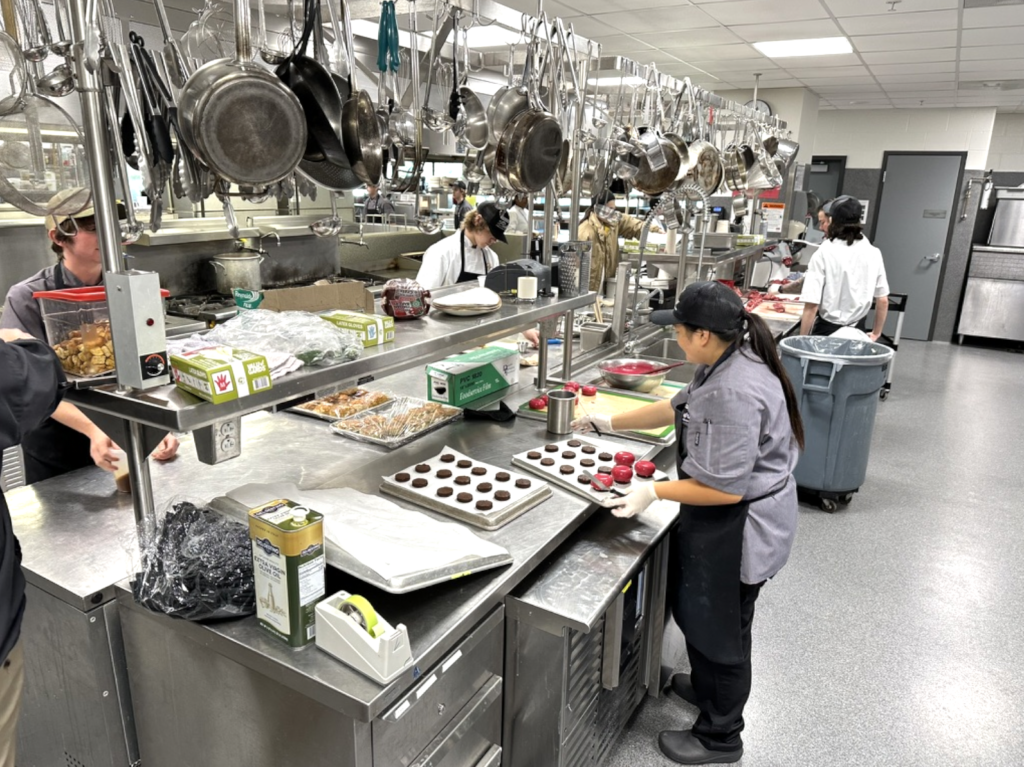
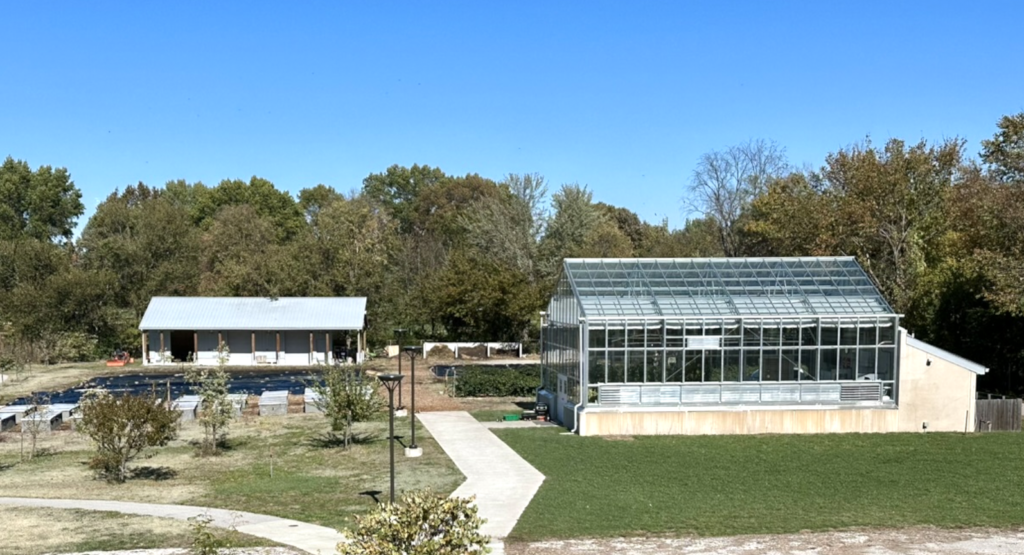
Like Summit Tech, the Shawnee Mission Center for Academic Achievement opened in 2017. The next-gen career center hosts a world-class culinary program (above) and restaurant, the Broadmoor Bistro, which serves more than 150 guests per day (and is booked out through Valentine’s Day). It is supplied (in part) by a horticulture program that includes a greenhouse and garden (below). 
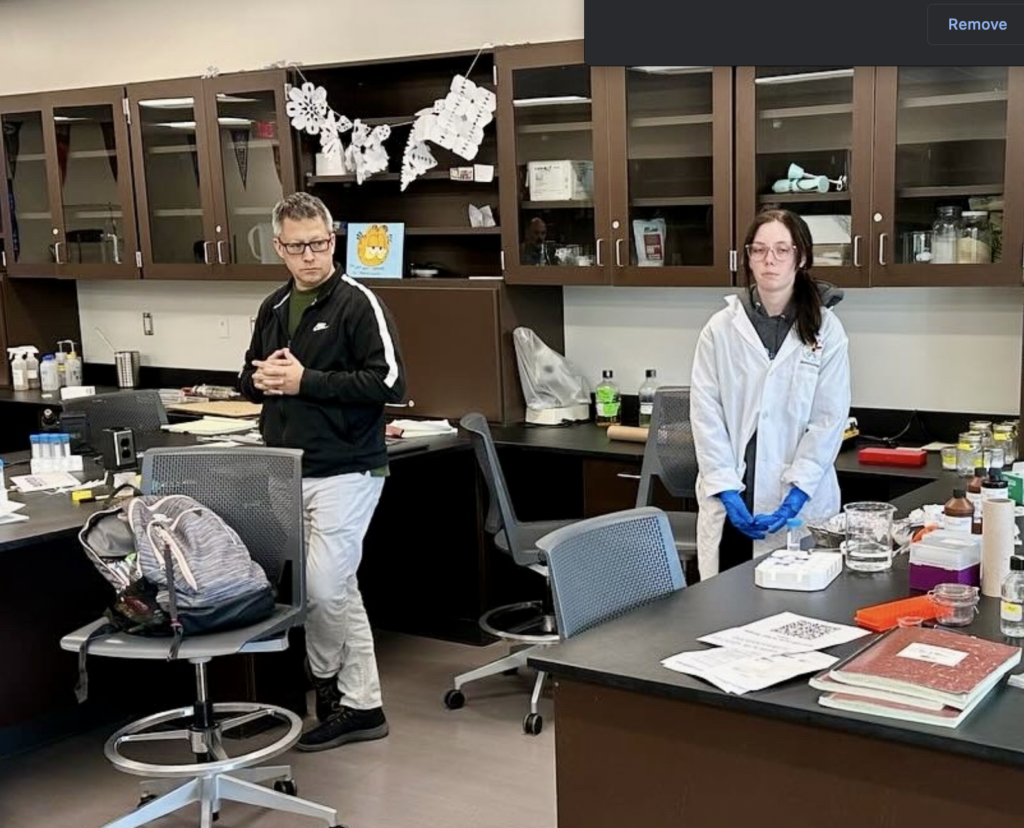
Above the restaurant are labs where seniors are doing capstone biomedical research with a molecular biologist, Dr Kenneth Lee (below). Research topics include microbes that degrade plastic, mycelial networks, micro-building blocks, and treatments for diabetes.  
Shawnee Mission elementary schools have added career exploration experiences. There is a middle school career fair and a high school internship fair. Secondary students use YouScience to identify strengths and interests and match them to possible futures.   

Bringing Real World Learning to Scale in Kansas City

The first cohort of 15 school systems received planning grants four years ago. It now includes 35 systems and 80 high schools in three Missouri counties and three Kansas counties. 

The goal is that all students will graduate with at least one valuable experience (called Market Value Assets) including internships, client projects, college credit (9 hours) and industry-recognized credentials. 

Many of the participating school systems have improved the number of students graduating with valuable experiences from a baseline of one-fifth to almost half. A few systems had more than 70% of graduates earn MVA, with many earning two or three. 

The Kansas state board has recommended that students should graduate with at least two valuable experiences (with a slightly broader definition). 

Principals from 49 of the regional high schools are participating in a fellowship program learning from each other how to add more real world learning. (The school visit observations in this blog resulted from accompanying principals as they visited other real world learning schools.)

Adding more real world learning experiences is boosting student engagement and job-ready skills, it’s developing learner agency and social capital, it’s connecting youth to possible futures and inviting them to experience success in what’s next. As more graduates leave school with valuable experiences, it’s likely to boost entrepreneurship and economic mobility and make Kansas City even more equitable and vibrant.

The post More Real World Learning in Kansas City appeared first on Getting Smart.

from Getting Smart https://www.gettingsmart.com/2023/11/24/more-real-world-learning-in-kansas-city/

How The Principles of Experimentation Can Support Postsecondary Decision-Making

By: Jared Schwartz

“The College Lab is the single most valuable project I’ve ever completed.” 

As a high school AP Chemistry teacher, it’s a powerful statement to hear from a student. It might also seem like an odd project name for a science class. But I discovered years ago that all good chemistry lessons include student exploration and problem-solving–and that isn’t so different from the skills required to create a plan for life after high school.  

My classroom has about 90 sophomores, juniors, and seniors who take the class for a variety of reasons. It’s one of many classes they will take at Walter L. Sickles High School, putting them one step closer to the end of the year and graduation. It also means that when a student steps into my classroom, AP Chemistry is just one of many things on their mind. 

The reality is that many high school students are feeling unprepared for what comes next. They’re eager for more guidance. It’s why I’m never surprised to hear students look at class curriculums and ask themselves “How will this even help me?”  

I wanted to better answer that question so several years ago, I applied the scientific principles and practices of chemistry that I’m familiar with to an equally important topic: Planning for the future.  

Bringing College and Career Discovery into the Classroom 

The College Lab is a two-week project I lead that invites college and career conversations into the classroom. 

The need is urgent. A Morning Consult survey of 1,200 high school students for College Board looked at students’ attitudes about the future, and while it was encouraging to see that 46% felt motivated about exploring a career, 48% also said they felt anxious. My goal is to spark my students’ interest in these discussions so they feel confident making smart choices about a future career, college planning, and finances. 

The project is structured around five scientific principles:

  • Conduct Research. Students research 15 diverse schools or majors they might be interested in. Using College Search on BigFuture, students can access profiles for more than 4,000 institutions – spanning certificate, 2-year, and four-year programs. 
  • Make a Claim. As they research, students form a hypothesis as to which college they believe will be a good fit for them.
  • Experiment. Students are given independent time to gather information about each institution according to the criteria that they chose to explore. The free planning site offers career exploration and financial planning resources so during this process, students might discover how a major connects to a potential career path or how they might afford postsecondary education.
  • Draw a Conclusion. Based on all of the information gathered, students draw a conclusion as to what school they believe will be the best fit based on the data collected.
  • Commentary. Students are given time to discuss the implications of their data and conclusion, including any sources of error, bias, or unexpected results.

As students explore, there is time for peer discussions. This can elevate lines of inquiry that they may not have thought of and spark further dialogue as students begin to discover similarities in their research. Many of my students claim that being able to discuss the project allows them to home in on the most important aspects including majors, campus life and financial aid.  

Haley, a former student of mine shared, “I [now] feel like I can make a decision about college that actually makes sense.”  

3 Tips for Your Classroom 

Students accomplish a lot in the two weeks but dedicating that amount of time isn’t always possible. If teachers are looking for meaningful ways to have a conversation on the future with their students, they can: 

  • Start Small: Have students start with the college or career quiz on College Board’s BigFuture. The questionnaire can help students connect to key information on the site.  
  • Give It a Try: Offer a small-scale assignment for students to explore some prospective colleges and universities. Ask for a smaller list or see what they can learn in a shorter amount of time. 
  • Be a Resource: While we don’t have all of the answers, we can provide our students with support. That may be sharing our own college experience, connections to guidance counselors, and knowledge of free resources that can aid students. 

Not every student in my class walks away from the project knowing exactly what they’re going to do or where they’re going to go next. My hope is that 100 percent of my students will finish with a better understanding of their options and what it might take to get there. Regardless of the path they choose, I hope that the decision that they make is one that is informed and puts them in the best position to find success. Jared Schwartz is an AP Chemistry teacher at Walter L. Sickles High School in Tampa, Florida which serves a diverse population of students. Jared teaches 10th through 12th graders. This is his 11th year teaching, and he couldn’t imagine doing anything else. His goal is to not only provide students with an enjoyable and rigorous learning experience, but also instill values to develop citizens of the world. When he’s not teaching, Jared enjoys running, golfing, reading, and spending quality time with his wife and newborn son, Teddy.

The post How The Principles of Experimentation Can Support Postsecondary Decision-Making appeared first on Getting Smart.

from Getting Smart https://www.gettingsmart.com/2023/11/21/how-the-principles-of-experimentation-can-support-postsecondary-decision-making/

The Content Every High School Student Should Learn (But Doesn’t)

The United States is one of the few countries in the world that does not have a nationalized curriculum. The combination of local and state control allows for extraordinary leverage on outcome decisions and content alignment. Our country’s preservation of state’s rights empowers schools and states to contextualize both policy and implementation. Federal oversight comes, typically, with leveraged grants to encourage participation. The policies articulated in the No Child Left Behind Act and Every Student Succeeds Act fall into this category. 

In many high schools in the nation, the traditional course sequence and graduation requirements remain static: four years of English, three years of math, three years of science, etc. Both mathematical and language literacies still hold major importance for every graduate. And, as the world becomes more complex and unpredictable, new consideration should be given to the required core content. 

We talk a lot about the most innovative learner-centered schools that combine personalized, competency-based and project-based learning co-designed around real-world experiences. Here, content emerges from student interest in high-purpose topics while also linking to standards or competencies. These learning environments are challenging the Carnegie status quo and sit on the horizon of education. While important signals for the future of learning, they remain the minority.

Updating content areas would accelerate learning around three core types of skills expected by schools: core skills (typically the skills of writing, reading, mathematics, history, arts found in state standards), technological skills (industry skills earned through CTE programs, work-based learning, apprenticeships, career pathways, etc.), and transferable skills (durable skills, XQ). Weaving in the content below will create engaging and future forward ways to nurture the core, technological and durable skills while preparing young people to govern, contribute and thrive as adults.

Next-Gen Economics

Every learner should engage in learning about entrepreneurship. Releasing a generation of empowered problem-solvers equipped with the tools to contribute to ventures that have both financial and/or social impact, helps future generations find their sense of purpose and ownership. UnchartED, the National Foundation for Teaching Entrepreneurship (NFTE), and KnoPro from NAF all provide resources to embed entrepreneurial experiences and content.

Additionally, with both our country and many individuals experiencing significant debt, financial literacy remains low for graduates. Yet, it can have the most profound outcome on financial stability. Budgeting, credit, borrowing, and investing increase the long-term probability of financial stability for graduates. Both entrepreneurship and personal finance are well-represented in those who choose the CTE Finance or CTE Business and Administration career clusters, but this is not universally available. Many free or low-cost resources exist (see list here).

Artificial Intelligence

While school leaders and educators still are in the early stages of understanding the impact of AI, there is no doubt that it will rapidly become immersed in the education sector (likely in hyper-personalized learning of core skills and support for learning design and assessment). However, every graduate should understand the core principles of AI functionality and how to use it to augment intelligence and performance. These skills will be requisite in almost every future professional career. TeachAI.org recently released a guide for AI implementation while some districts, like Gwinnett County Public Schools, offer an AI CTE program pathway.

Civics and Citizenship

While often found in civics classrooms, the content remains less about good citizenship and more about the structures and function of government. While the structures and function are important, every student should understand their role in a democracy through political processes, how to move an idea to action, and community organizing for change. For example, the United States, with less than 50% of eligible 18-29 year old voters participating in elections, is in dire need of core education in civics. Organizations such as iCivics and Citizens and Scholars offer innovative and engaging approaches to civic education.

Media Literacy

Few other influential forces impact the current (and future) generations like digital media. The power of disinformation, misinformation, bias, etc. propagated through heavily financed algorithms will only increase. High school graduates need the tools and filters to process and evaluate everything they see online to better understand ways to get to the truth. Advances in AI around image, audio and video generation will make discernment of fact even more difficult. Resources such as Civic Online Reasoning at the core of every high school curriculum will have a significant positive change for future generations.

Healthy Living

Data shows the declining mental and physical health of adolescents. A generation struggling with mental and physical health increases the emotional and financial costs of a nation. While physical education programs have changed significantly over the years (like less dodgeball and rope climbing and more yoga and personal fitness), students still disengage from physical education. Accelerating, personalizing and customizing healthy living as part of core learning will increase the odds of healthy adults. Healthy food programs such as Food Corps and innovative physical education programs that focus on personal fitness can be integrated into the school day.

Place and Sustainability

Too many learners graduate high school with little to no knowledge about their local context and the long-term social, economic and ecological factors that drive the success or demise of a community. Every learner should graduate not only with a deep understanding of their own place, but should also know how to understand and impact future communities. Finding local purpose to inspire students through the creation of high-impact projects (Teton Science Schools’ Place-based Education, High Tech High) and building content around sustainability standards (Cloud Institute) can increase the long-term vitality of local and regional communities.

Neuroscience

One of the last frontiers in understanding the human body (along with the microbiome) is the brain. Every day, students are bombarded with outside stimuli that impact their brains from substances (alcohol, vaping, drug use, etc.) to technology (media, phones) – all while going through one of the more significant changes in the human brain – adolescence. Teaching relevant neuroscience could improve choice-making, mental health and learning in general (Global Online Academy, University of Wisconsin Neuroscience Training Program). By graduation all students should be able to describe the conditions and processes for how they learn and how they manage stress.

Data Science

Data science has surfaced over the last decade as critically important in many higher ed institutions and professions. Too many young people graduate high school never having had to create a spreadsheet, let alone organize, analyze and synthesize large amounts of data. Given the continued acceleration (again hyper-charged via AI) of data creation, every graduate needs to understand how to find, interpret, organize and analyze data in every form (YouCubed). 

Current Events 

While traditional history has expansive coverage in schools, most learners experience fact immersion rather than relevance and understanding. Every high school learner should experience history through a modern-day lens to both understand the throughline (see Throughline podcast) and the repeated themes of history — war, peace, power, oppression, freedom, religion, etc. — to find hope and skills to imagine a more peaceful future. Facing History provides a Current Events toolkit for those ready to jump in.

Systems and Futures

Understanding both systems thinking (the complex interactivity of multiple elements) and futures thinking (aptitudes for transformative vision-seeking over short-term solutions) is critical in a complex and uncertain world. By explicitly creating content and experiences around these concepts, young people are better equipped to anticipate and address current and future challenges.

To be clear, literacy remains paramount and a core pillar of society. While as a nation we still greatly struggle with literacy rates, we cannot wait to adapt our current content base toward possibility, opportunity and contribution. If a high school does not have the support or resources to complete redesign, rethinking the core curriculum may be an alternative first step when state or local policy allows. Replacing or merging the typical core content with the ten content areas above better supports the current generation of students to tackle an unpredictable and uncertain world.

The post The Content Every High School Student Should Learn (But Doesn’t) appeared first on Getting Smart.

from Getting Smart https://www.gettingsmart.com/2023/11/20/the-content-every-high-school-student-should-learn-but-doesnt/

Igniting North Carolina’s Future: SparkNC’s Innovative Approach to Education

By: Senator Michael V. Lee and Dr. Lynn Moody

In the next five years, almost every area of our lives will be fundamentally changed by advances in artificial intelligence and other cutting-edge technologies.

As a North Carolina legislator and a former North Carolina school district superintendent, we believe we need to think differently about preparing students for this reality. We care deeply about education, economic development, and the future of our state. If schools can’t keep pace with the rapid evolution of technology, our children will be left behind.

This is why we are excited about SparkNC, a nonprofit organization rethinking education to give North Carolina students a competitive edge in an uncertain future.

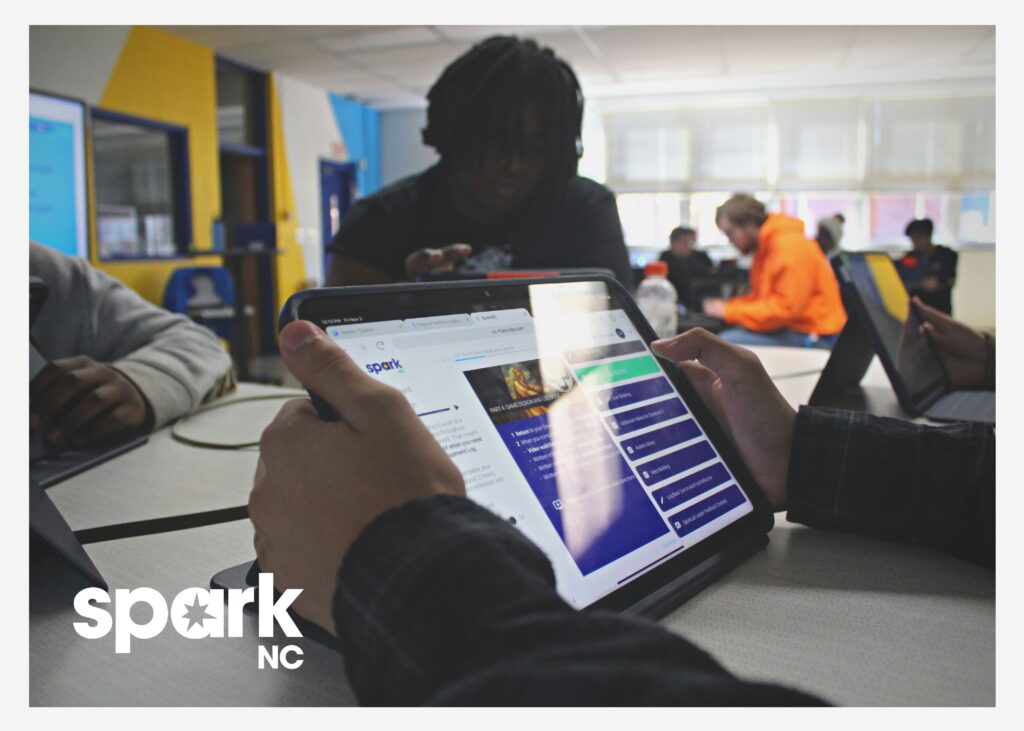
SparkNC is different because students have the freedom and flexibility to pursue what interests them. Unlike traditional classrooms, SparkNC isn’t built around a rigid calendar and classes where students all move at the same pace. Instead, students choose their own paths, selecting learning experiences in fields like cybersecurity, computer systems engineering, and data analytics.

Learning is not confined to textbooks and classrooms. SparkNC collaborates with industry partners, helping students learn about tech careers firsthand. Through interactions with experts, students grow their networks and gain insights about tech jobs. Real-world experiences help students develop skills in teamwork, communication, leadership, critical thinking, and problem solving. All of this opens doors to career opportunities.

Every student in SparkNC develops a portfolio of learning where they collect tangible evidence of their accomplishments. It’s not just about what they’ve learned. It’s about what they’ve experienced and how they’ve prepared for their futures. This portfolio becomes a powerful asset as they take their next steps, to higher education or the workforce.

Sixteen school districts are currently partnering with SparkNC and opened high-tech “SparkLabs” this fall. These facilities serve as hubs of innovation where students can learn individually and in groups. All SparkLabs are connected through state-of-the-art systems that enable students in different spaces to meet, collaborate, and learn together with teachers and industry professionals.

SparkLab Leaders in each district facilitate learning. They are a new kind of educator, blending the roles of teacher, mentor, coach, entrepreneur, innovator, and connector. They guide and inspire students, helping them navigate their educational journeys and develop the skills and insights needed to succeed in a tech-driven world.

This year’s state budget continues funding for SparkNC’s innovative approach. This is an investment in the future of North Carolina. It’s an investment in our students, who will emerge from SparkNC with a competitive edge in the job market. And it’s an investment in our state’s economic development, as a tech-savvy workforce attracts businesses and drives growth.

We are each proud to stand behind SparkNC and its mission to rethink education in North Carolina. By offering students flexibility, choice, and a curriculum tailored to the demands of the tech industry, SparkNC is paving the way for a brighter and more prosperous future for our state.

Sen. Michael V. Lee represents New Hanover County in the North Carolina Senate. Dr. Lynn Moody is the former superintendent of Rowan-Salisbury Schools and the current Senior Director of Partnerships at SparkNC.

The post Igniting North Carolina’s Future: SparkNC’s Innovative Approach to Education appeared first on Getting Smart.

from Getting Smart https://www.gettingsmart.com/2023/11/16/igniting-north-carolinas-future-sparkncs-innovative-approach-to-education/

Microschool in a Box: Programs Enabling the Microschool Movement

Small learning environments have always been the foundation of formal learning systems. Indigenous groups around the world, early one-room schoolhouses propped up by local communities, and eventually the modern home-school movement have all been demonstrations of effectiveness. While the microschool movement feels new in the media, its foundations are a tale as old as learning itself. One-room schoolhouses (such as Cooke City, MT), small private schools, home schools, or academies within public schools all existed before the microschool explosion. Driven by learners, families and teachers, these schools want to better serve the students in their communities with more personalized, more connected and more relevant experiences. With district mergers, rural egress, and legal hoops, these small schools became anomalies in a system dominated by large schools. 

In 2020, however, the pandemic enabled families to see (and often engage in) their children’s school experience. This window into school made transparent the quality, types of learning and community that made up the lived experience of their children. For some, low satisfaction fueled renewed interest in microschooling led by parents, political support and philanthropic dollars.

The last two years of microschool growth (estimated enrollment by the National Microschooling Center at 1-2 million current students), heavily subsidized by the philanthropic sector, demonstrated that the demand exists. Alongside this resurgence, key questions arise: Are microschools sustainable? What outcomes should they measure (if any)? Are they compatible within the public sector? Can they scale? 

Below, we briefly hit upon the first three questions and then dive into the question of scaling.

Sustainability

Most microschools operate in the private sector, sustained by public funds (via Education Savings Account structures) or private tuition. Both of these funding sources supply individual students with far less than can be found in the public sector, making the business models and staffing (1-2 educators and a handful of students without the support of larger operations systems) challenging over time. Organizations like Microschool Revolution (investment model) and Prenda (service and support model) have emerged to address this issue.

Outcomes

In the public sector, there is a heavy focus on narrow slices of accountability which challenges  many families. Although microschools have far fewer accountability expectations outside of the public sector, they do have a responsibility to ensure that every child finds success. As a sector, we remain in the early stages of alternative, efficient, adaptive and flexible forms of measurement addressing both academic and whole child development.

Public Sector

With increasingly diminished enrollment in many districts (3% post-pandemic), the public sector needs to imagine the power of microschools within their existing communities. More specialized approaches, autonomy for teachers and small communities that benefit from larger districts will better serve all students. High school academy models such as CAPS and NAF have scaled around professional pathways to provide more opportunities for high school students.

Scale

Roughly 1-2 million students are enrolled in some form of a microschool, just 2% of all students enrolled in K-12 schools (estimates are difficult as many microschools are not required to report enrollment numbers). If demand is high for microschools – and demonstrated success continues, then scaling support is needed. ASU Prep in Phoenix, Arizona built a Microschool Entrepreneur Fellowship Program program to help facilitate this scaling. Based on the success of their microschool options — powered by ASU Prep Digital and partnered with ASU Prep school or ASU higher education campus — ASU Prep wants to support others in this journey. 

The size of microschools may provide the sense that they are easy to start and run. Yet, anecdotes from the field indicate challenges with sustainability and operations. Partner organizations and programs, like ASU Prep’s Microschool in a Box fill a needed space in the ecosystem to help these programs thrive and scale.

The ASU Prep Microschool Entrepreneur Program provides training and support for microschools. The fellowship spans one year with coaching calls starting for those accepted as early as October. A 3-day in-person Fellowship gathering in February in Tempe, Arizona kicks off the formal programming which leads to an online community of practice designed to build community amongst fellows. They then round out the year with frequent resources and ongoing mentorship and support. The program will support the launch of several new microschools in the Fall of 2024 to serve diverse learners across the country leveraging the assets of ASU Prep. The fellowship covers a range of topics including:

  1. Policy and funding. Policy, rules and regulations, and funding models are the lifeblood of the microschool. Adhering to local and state regulations and securing appropriate funding is a key priority that ASU Prep will support.
  2. Operations. Hiring, space design, leadership training, and general operations (schedules, transportation, facilities, etc.) can be overwhelming for microschools with 1-2 teachers and no administrators. Using established templates and resources, ASU Prep guides the construction of the operations of the microschool.
  3. Pedagogy. While most microschools founders have some ideas of the approach for a school, ASU Prep’s robust resource base from a variety of approaches allows for more rapid development in this area. ASU Prep’s experience with professional learning and growth supports microschool leaders as they maintain relevance in the education landscape.

Funding is often a barrier for entrepreneur support programs like this but the Stand Together Trust has funded this program enabling up to 20 full grants for fellows. Similar programs from the Learning Innovation Fund at Getting Smart Collective and Community Partner Grant Program have also funded microschool models.

Microschools are meeting strong market demand for more personalized, more contextualized and more relevant learning for every student. Programs like ASU Prep’s Microschool in a Box make it possible for more learners to become future-ready with access to affordable, relational microschool learning.

The post Microschool in a Box: Programs Enabling the Microschool Movement appeared first on Getting Smart.

from Getting Smart https://www.gettingsmart.com/2023/11/14/microschool-in-a-box-programs-enabling-the-microschool-movement/

Why Entrepreneurship Might Save Our Kids—and the Rest of Us.

By: Katie Kimbrell

One of my favorite mom friends asks her young school-aged kids every day, “What did you make today?”

I love how subtly subversive this question is. Not, “How was school today?” “Were you good today?” or, “How’s [insert school subject] going?” But, “How did you put your ideas out into the world today?” 

That simple question understands this fundamental truth: to be human is to create, to employ our imaginations and partake in forming the world we want to live in. Our institutions have forgotten this basic truth, though—schools, especially. 

My oldest daughter Maeve is in first grade. I’m not sure what your impression or memory of first grade is, but I’m experiencing it like an academic boot camp for six-year-olds. You must immediately learn to: read, write, add, subtract, tie your shoes, memorize your facts, memorize your patriotic songs, and organize your things, and you need to do it all now. No time to waste. Maeve starts and ends most days with a sort of glaze over her eyes that I most certainly project as my own reaction to her extremely rigid daily schedule of keeping up with the skill/drill. 

Last week, I finally saw the lately-rare spark in her eyes when I picked her up from after-school art class. She had created glittered ceramic donuts, along with a wooden donut stand, and had designed a donut menu. I immediately was solicited by the tiny CEO, who informed me her donuts ranged from $100-$800 and I would need to pay her. 

Ceramic Donuts, photo credit Katie Kimbrell
Young entrepreneur holding their creation: photo credit Katie Kimbrell

To be human is to create, to put your ideas out into the world. Think of the last thing you were deeply invested in, and tell me it was not related to your own idea or problem you were passionate about. To solve problems and work on our own ideas is generally what, at the most basic level, makes any of us really give a damn at the end of the day, young and old alike. It’s the spark in all of our eyes, a sense of purpose and inspiration we could all use a hefty dose more of—kids in schools, especially. 

In my role and in my circles, I often partake in big-picture, philosophical discussions about education. Different flavors of the same conversation: our schools and communities are in crisis, educators are overwhelmed and in shortage, children/youth are ‘failing’, they’re unmotivated and struggling with mental health, and/or they’re so disconnected from the real world and inadequately prepared for the future—and what are we going to do about it all? 

I don’t have simple answers for public education, but here is what I do know. My years as a high school teacher taught me this very unlikely lesson for a traditional English teacher: to be human is to be entrepreneurial. Students crave opportunities to be active participants, creators, and solutionaries in real-world problems, and the essence of these opportunities is the essence of entrepreneurship. 

To Be Human is to Be Entrepreneurial

I learned this lesson most clearly from my own students, who by the time they were in high school, were exhausted from playing the game of school. Many who struggled to get through, but who came out of the woodwork and shined when the work and task of school shifted—when they were asked to launch real solutions to real problems they experienced every day. Students who I discovered were running successful businesses with their parents outside of school and who thrived when we no longer focused only on their deficits and skills gaps. Students who, in spite of – not because of – school, have gone on to open flower shops, body shops, cosmetic product companies. Students who have built new roles or departments within companies. And like the students we work with at Startland, who have launched viable, sustainable solutions to the community’s greatest needs that affect them—on topics they’re passionate about like immigration, environmental protection, racial equity, and women’s rights—many while still in high school.

To be human is to be entrepreneurial because to be entrepreneurial is to put your ideas and solutions into the world. To be entrepreneurial is to discover purpose, passion, and identity in this life. To be entrepreneurial is to be a shapeshifter with the fast-changing world, ready to meet the demands and challenges we can’t currently imagine. To be entrepreneurial is to build on your life experiences and bring innate value into situations, not deficits—which means being entrepreneurial is a path toward equity. Being entrepreneurial means you take on the world’s problems with confidence, curiosity, and persistence. It means you create opportunity for yourself and others, including economic opportunity and generational wealth. It means you negotiate your ideas with others, manage audacious goals with others, and gain empathy for others. Being entrepreneurial means becoming a leader.

Read that again and tell me it’s not what our children—and world—need now more than ever. And let me be clear— all kids, not just those deemed ready, capable, on grade level, or gifted. 

To be human is to be entrepreneurial, and when we leave entrepreneurship out of schools, or gatekeep these experiences for the elite few inside schools, we leave authentic learning and human development out of schools. Full stop. 

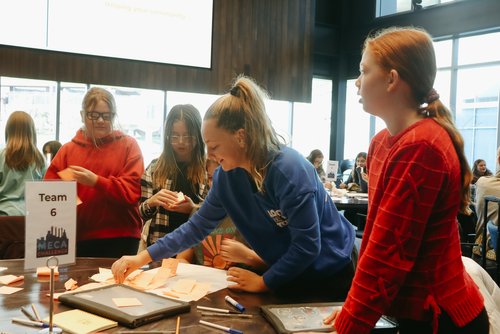
Students at MECA Challenge

It’s hard to get behind entrepreneurship as educators and as a community. It’s high-risk and often misunderstood. If implemented, entrepreneurship is usually pigeon-holed in business classes or extracurricular clubs rather than scaled across the curriculum for all kids. It’s uncomfortable, to say the least, for most educators, who’ve themselves generally emerged from traditional teacher preparation programs. Philanthropists and policymakers haven’t figured out how to prioritize and invest in K-12 entrepreneurial experiences in a meaningful way. The ROI is not quick. It’s generational. 

At the same time, the role of entrepreneurship in personal and community economic development is well-researched. If you want to create and compound opportunity in communities, you invest in entrepreneurship. 

Entrepreneurship is Misunderstood and Misapplied 

The disconnect I’ve observed is who is having those conversations (economic development professionals) and whom they are having those conversations about (small business owners and startup founders). This trend is shortsighted and siloed. We need to have these discussions about our community’s schools and children, and we need to be having them at every level, as parents, educators, policymakers, funders, and economic development experts—and with the same seriousness and intensity that we discuss and measure reading, writing, and math. 

We can invest in closing critical gaps in literacy and math, but if we aren’t also investing in closing gaps in entrepreneurial opportunity for children at every level, we are widening well-researched opportunity gaps and removing the spark from the eyes of children at every level. 

To be human is to be entrepreneurial, and this innate entrepreneurialism should begin to be nurtured at the same time kids are learning to read, tie their shoes, and sell $800 make-believe ceramic donuts. These are the generations whose huge hearts and imaginations will be soon tasked—in a more complex and conflict-ridden world than ever before—with creating opportunity for themselves, their communities, and leading us all.

Katie Kimbrell is the Director of Startland Education, a program of Startland, a 501(c)3 nonprofit. At Startland Education, our mission is to bring human-centered design thinking to classrooms in order to create communities that value our youth and inspire them as future change leaders and entrepreneurs. To learn how Startland Education can equip and empower educators in design thinking at your school, visit startlandedu.org.

The post Why Entrepreneurship Might Save Our Kids—and the Rest of Us. appeared first on Getting Smart.

from Getting Smart https://www.gettingsmart.com/2023/11/13/why-entrepreneurship-might-save-our-kids-and-the-rest-of-us/

AI is the Cognitive Friend We’ve Always Wanted

In my last piece of this series, I mapped AI’s capabilities to Bloom’s taxonomy.

We learned that AI’s splotchy cognitive competencies can help us: 

  • explain the human advantage over AI 
  • depict AI as a cognitive partner
  • identify ways learners might use AI and be duped by AI
  • narrate how AI will elevate our standards in education for the production of content, ideas, and discourse

Now, we’ll identify how leaders can finally have the thought partner they’ve always wanted. 

Leaders are often faced with complex decision-making. It isn’t easy to expect others in their ecosystem to be able to provide a full evaluation of the situation or the final decision, because the leader often has more information. Collaborative decision making is always an excellent strategy to involve more stakeholders, but that can also fail if the stakeholders are uninformed or the decision needs to be made quickly. 

So in the moments when a leader needs to make a decision, help her collaborators make a decision, or evaluate a decision she made, who does she turn to?

Imagine if every leader had a personal coach who was critical when she needed feedback, a twin when she needed efficiency, and a philosopher when she needed inspiration. Imagine that this guide knew everything about the leader, her ecosystem, her stakeholders, and her problems.

During my keynote at CCSS, the thoughtful Dr. César Morales, Ventura County Superintendent, said he had a lightbulb moment at this point. Although he didn’t feel comfortable producing content on ChatGPT, he realized he could have it critique his work. And that completely changed his perspective on AI. 

Breaking Down Complex Decision Making

So how do we do this? There are ways to literally create a digital twin using AI. In fact, my friend Bodo built two with his kids using my friend Dima’s AI platform. But let’s consider ChatGPT as our main tool.

Let’s start by breaking down complex decision making. 

To make a difficult decision (or write a letter to the board, advocate for a staff member, produce a business report, etc. etc.), leaders have to gather and analyze the appropriate information from various sources first. We can equate this to the “empathy” stage of design thinking. Without analyzing information from all sides, it’s impossible to conceive a wise decision or prioritize the components of the decision. 

As leaders brainstorm a solution to their problem, they should explore alternative perspectives and generate scenarios that assess the risk, trade-offs, and predict the response. If leaders are not considering what could happen if this decision were made, they may run into bigger problems. 

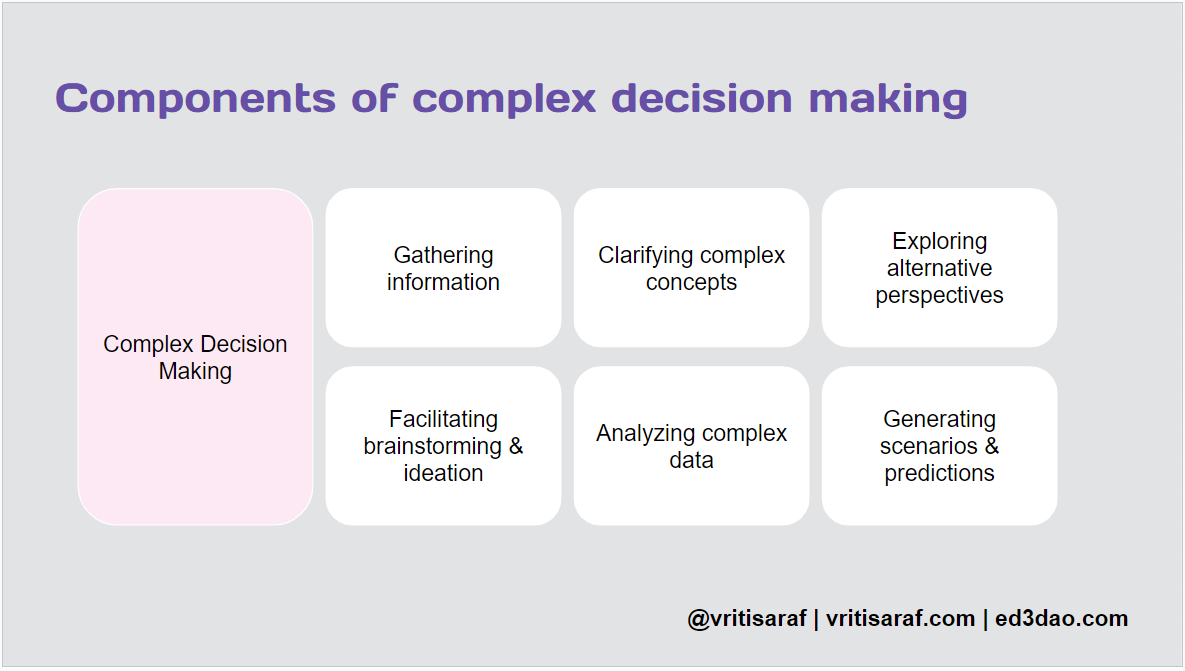
These components work much like Bloom’s in that they’re more of a spiral that volley back and forth between each other. In sum, complex decision making is made up of gathering information, clarifying complex concepts, exploring alternative perspectives, facilitating brainstorming, analyzing data, and generating scenarios and predictions.

But the reality is that leaders don’t always have time or the skill to make these levels of assessments before they execute.

Enter, AI. 

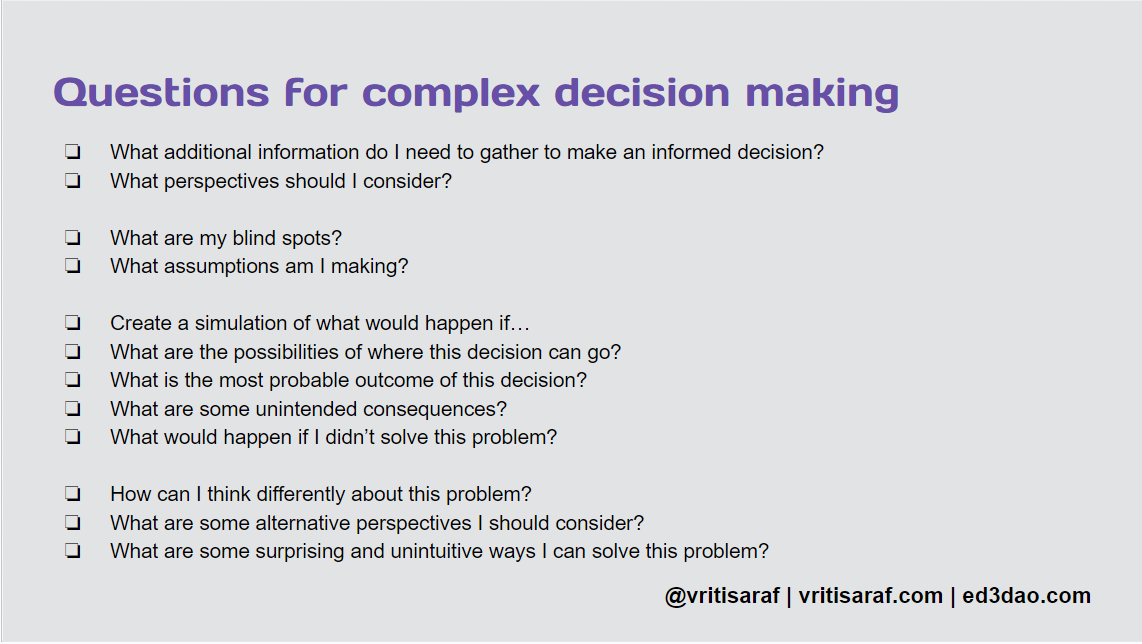
In addition to asking AI to brainstorm the decision for us, we can ask AI to analyze the decision we may want to make. Remember that AI cannot make meaning so humans must always make their own judgments. Here are my go-to questions for complex decisions.

These questions allow teams to quickly iterate and adapt their decisions before executing. They allow us to simulate outcomes and consider alternatives we may never have thought of. And most importantly, they equip us with strategies to improve our thinking that we can potentially learn from for future decisions. 

This, of course, is my main thesis across these articles: AI can help us become better thinkers.

Context Setting 

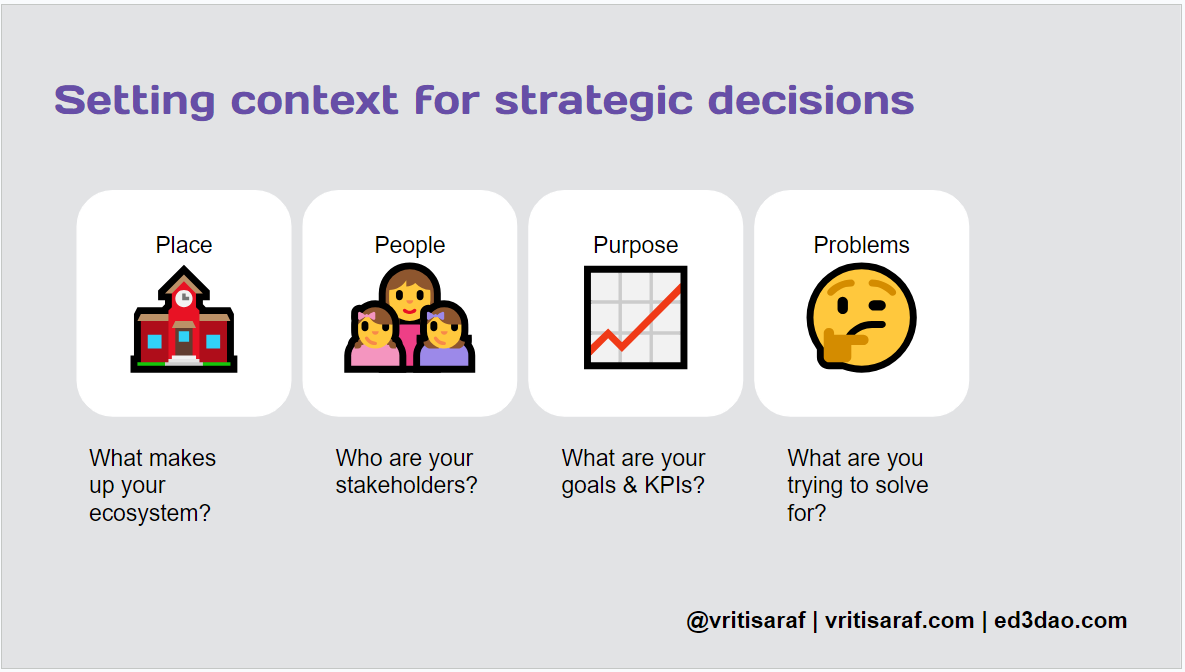
To set up a cognitive friend on ChatGPT, we first need to set clear context for our ecosystem using the four Ps, before you even ask my go-to questions. 

Place: Tell AI what makes up your ecosystem from the size of the organization to the history it’s had. 

People: Describe who your stakeholders are and be as detailed as possible. Try introducing a few personas that your decision impacts.

Purpose: Identify the goals and objectives of your organization, your own professional goals in your leadership role, and any KPIs that might be relevant to the short or long term.

Problems: Explain the obstacles your organization has had over the last few years. Explain what your team has been struggling with. 

By asking ChatGPT to remember these things, every new piece of information will build upon the last. 

To set up a critic, add the prompt: “You are an expert in complex systems thinking, conflict-resolution, and design thinking. You are also my critical yet supportive thought partner who helps me see beyond my blindspots.” 

To set up a philosopher: “You are an expert in philosophy, regenerative ecosystems, and moral theory. You are also my critical yet supportive thought partner who helps me see beyond my blindspots.” 

…you get the idea. Following this, present your draft solution to AI and then ask the aforementioned go-to questions.

There are oodles of prompt engineering resources out there that will show you how to increase the reliability of responses. Our Ed3 DAO community member Brian Piper recently identified prompts he’s used. Please choose your own adventure.

The main goal with setting up a cognitive thought partner is to improve your thinking, not just the production of content. If used correctly, leaders having a thought partner who knows them can be game changing. 

Grasping our Self-Governance

Technology will outpace our ability to keep up with it. Expanding datasets and neural links will likely help AI get “smarter”. But if we want to stand a chance against the machine, we must retain our self-governance, AKA our ability to own our decisions and data. We need to continually evolve our cognitive abilities and explicitly recognize the nuances only humans know, from politics to pedagogy.

I’m grateful to the folks at CCSS for inviting me to share my ideas with them and commend their continued leadership across their school districts, despite how lonely leading can be.

Check out my newsletter for more thoughts on AI + Web3 and my website, www.vritisaraf.com. Join our community at Ed3 DAO to continue the conversation and to access AI courses for educators. 

The post AI is the Cognitive Friend We’ve Always Wanted appeared first on Getting Smart.

from Getting Smart https://www.gettingsmart.com/2023/11/09/ai-is-the-cognitive-friend-weve-always-wanted/

An Overlooked Pathway: Law and Civic Engagement

For as much as we talk about the three branches of government, the judiciary branch is often overlooked or, when taught, it’s described hierarchically. Rules and laws exist and citizens are meant to follow them. What if we did more to help students understand that we can shape those rules and laws to design a better world?

Rules and laws guide how we live and work, and act as a powerful tool to catalyze change. When we help students understand this link they can explore how they might employ legal pathways to shape rules and policy to better engender the various types of systems they want to create. This can help students uncover opportunities to advocate for themselves, their communities, and their world.

Youth activism is already demonstrating the power of law to support the concerns of our youth. A recent ruling in Montana ruled in favor of sixteen young people advocating for their right to a clean and healthy environment, which claimed the state of Montana was violating this right by allowing continued fossil fuel development without taking into account the impacts of climate change. Rulings such as these prove the power of legal pathways and pave the way for young people working towards climate action — a topic on the forefront of the agenda for many of today’s youths. 

In some states, students can join the school board to help inform decisions and shape school policy. Other states are working to ensure students can vote within school committees.  In states like Oregon, students are working together to draft legislation to push for climate change education. As students discover the opportunities they have to draft legislation one can’t help but wonder if this guidance has come from their formal education or is purely driven by passionate youth working to ensure their voice is heard. 

As educators, we have ample opportunity to demonstrate how law can act as a pathway toward civic engagement. Whether it’s going to a local courthouse to watch a trial, attending a town hall meeting, getting involved in school council, or attending an HOA meeting – providing students with ideas on how they can get involved in decision-making (therefore rules and/or laws) can help them understand pathways so they might have the know-how to shape where they work or live throughout their lives. 

Civic Pathways

What does law look like at the high school level?

A few organizations are working to make law a more common part of the high school experience. The Youth Justice Alliance helps students understand the power of law, how it shapes their lives, how they can use the law in their favor, and how it presents an exciting career opportunity. With a focus on underrepresented populations and Title I Schools this organization works to “democratize the law by redistributing legal knowledge and legal power.” It demonstrates the power of law as a pathway towards creating more equitable communities. 

Armin Salek, an Ashoka Fellow, noticed that the legal landscape was hard for many to navigate and that many people didn’t have any sort of legal literacy. For this reason, he has been working to bring more legal education courses into high school and even established the first-ever high school-led legal clinic. Students get real-world exposure to applied law while simultaneously supporting those in their communities with free legal counsel. 

Local partnerships are always making it easier for students to explore law as a legal pathway. The Kansas City Metropolitan Bar Foundation was able to partner with a local education organization to create the Student Law Academy (SLA) for students within Kansas City’s school districts. Programs like this ensure more students can access a legal career pathway. 

In addition, many students are mobilizing and finding movements to join. From the Sunrise Movement’s Green New Deal for Schools pushing for sweeping reforms in climate and jobs to local activism, students understand the power of law and policy.  As schools and school leaders, it’s time we look more holistically at all the pathways available for our students to step up, be heard, and get involved. 

The post An Overlooked Pathway: Law and Civic Engagement appeared first on Getting Smart.

from Getting Smart https://www.gettingsmart.com/2023/11/07/an-overlooked-pathway-law-and-civic-engagement/

The Future of Teaching Apprenticeships: Empowering Educators and Transforming Education

By: Sabrina Baptiste

Apprenticeships provide an innovative way for educators to experience real-life challenges and hone their professional skills. Allowing aspiring educators to gain hands-on experience, mentorship, and practice in actual classrooms positively impacts the development of their competency levels and the quality of education they can provide throughout their careers. Simultaneously, apprenticeships address the educator shortages many districts and schools are experiencing while creating a durable pathway into the teaching profession. It is essential to recognize that as the education field evolves, apprenticeships hold tremendous potential for the growth and advancement of educators while providing an opportunity for aspiring teachers to earn income while they learn.

One of the critical advantages of educator apprenticeships is the emphasis on practical experience. Traditional education preparation programs have focused on theoretical knowledge, leaving many new educators unprepared for real-world classroom challenges. Apprenticeships offer an immersive learning experience where aspiring educators can actively participate in the teaching process under the guidance of experienced mentor teachers. 

Educator apprenticeships strongly emphasize mentorship, pairing novices with experienced educators who serve as their guides throughout the program. This mentor-mentee relationship allows apprentices to benefit from the wisdom and expertise of seasoned professionals while also receiving ongoing support, constructive feedback, and opportunities to reflect on teaching practices. The mentor model is not new and is cited as a best practice, according to the Educator Prep Lab at the Learning Policy Institute, and is backed by a rich evidence base that prioritizes educator retention in the profession and other similar factors championed by teacher residency programs. 

Through this mentorship model, teaching apprenticeships foster a culture of continuous professional growth and core competency development. Novice educators receive personalized guidance tailored to individual needs that enables them to develop their strengths while addressing areas that need improvement. 

Another critical component of apprenticeships is the ability to earn while you learn. By offering a stipend or salary during their training, teaching apprenticeships become financially accessible for individuals considering a career change or for those with financial constraints who are passionate about teaching. Moreover, by providing an opportunity for aspiring teachers to work alongside experienced educators, apprenticeships offer a compelling and supportive environment for individuals to transition into education.

As America grapples with a persistent teacher shortage, apprenticeships offer a light at the end of the tunnel. As of October 2022, 4% of all public school teaching positions were vacant. Eighteen percent of public schools had one teaching vacancy, and 27% had multiple teaching vacancies. Teaching apprenticeships can address the deficit by attracting more individuals to the profession. 

Currently, apprenticeship programs are recognized by the U.S. Department of Labor in 16 states, with several more states presently applying for state or federal approval. The Pathways Alliance Apprenticeship Working Group, alongside other Pathways organizations and national partners, created the recently released National Guidelines for Standards for Educator Apprenticeships (NGS). The NGS outlines the requirements and responsibilities an apprenticeship program must be held accountable for and essential guidance about competencies that educators must demonstrate to be considered a successful apprentice.

Under the NGS, the term of the apprenticeship is at least one full school year of paid on-the-job learning (OJL)/clinical practice working alongside a mentor teacher who is the teacher of record for the classroom. The apprentice must demonstrate the competencies described in the Work Process Schedule throughout at least one K-12 academic year. Total time spent in the apprenticeship program, including during the school day, in professional learning opportunities, and preparation for classroom work, must be at least 2,000 hours. Exposure to constant feedback while operating amid real-life situations offers passionate individuals the opportunity to hone the emotional intelligence and capacity for adaptation needed in a capable teacher. 

This comprehensive framework outlines an apprentice’s professional and pedagogical skills alongside wage guidance and clinical hour requirements and offers standards for environments with and without collective bargaining. All guidelines are underpinned by an evidence-based approach to educator development and training from the Biden-Harris Administration’s call to provide high-quality apprenticeship programs and more for current and future educators. 

Looking ahead, it’s essential to keep in mind that teaching apprenticeships have the potential to transform educator preparation and deserve our attention and enthusiasm. The Pathways Alliance is contributing to that momentum by releasing a series of webinars focusing on apprenticeships and resources to help districts, states, IHEs, and other stakeholders understand this vital opportunity. 

In the first in the series released this August, Pathways Alliance collaborated with Dallas College and Deans For Impact to discuss how Dallas College has developed its apprenticeship model. The next exciting apprenticeship-focused webinar was a collaboration with AACTE (The American Association of Colleges for Teacher Education) and AIR (American Institute for Research), which focused heavily on the role of EPPs.

The Pathways Alliance aims to build a national coalition focused on supporting and implementing diverse and inclusive educator preparation pipelines. By continuing to explore how apprenticeships and teacher residency programs can be continuously adapted to meet the challenges of the ever-changing education sector, Pathways Alliance and its partners have the potential to play a significant role in accelerating innovation toward an equitable, inclusive, and radically different future for all learners. 

Sabrina Baptiste leads InnovateEDU’s LAB Corps Fellowship program, which provides training and professional development to novice educators providing small group instruction and mentorship to middle school students.

The post The Future of Teaching Apprenticeships: Empowering Educators and Transforming Education appeared first on Getting Smart.

from Getting Smart https://www.gettingsmart.com/2023/11/06/the-future-of-teaching-apprenticeships-empowering-educators-and-transforming-education/

One State’s Approach to AI Integration and Rapid Reskilling

Michigan Virtual, has been working hard to provide a path to the future for students and educators since 1998. As a part of this commitment, they have unveiled recent AI Guidance and implementation suggestions that highlight the vast number of challenges and opportunities facing school leaders when handling technology. 

AI Integration Framework

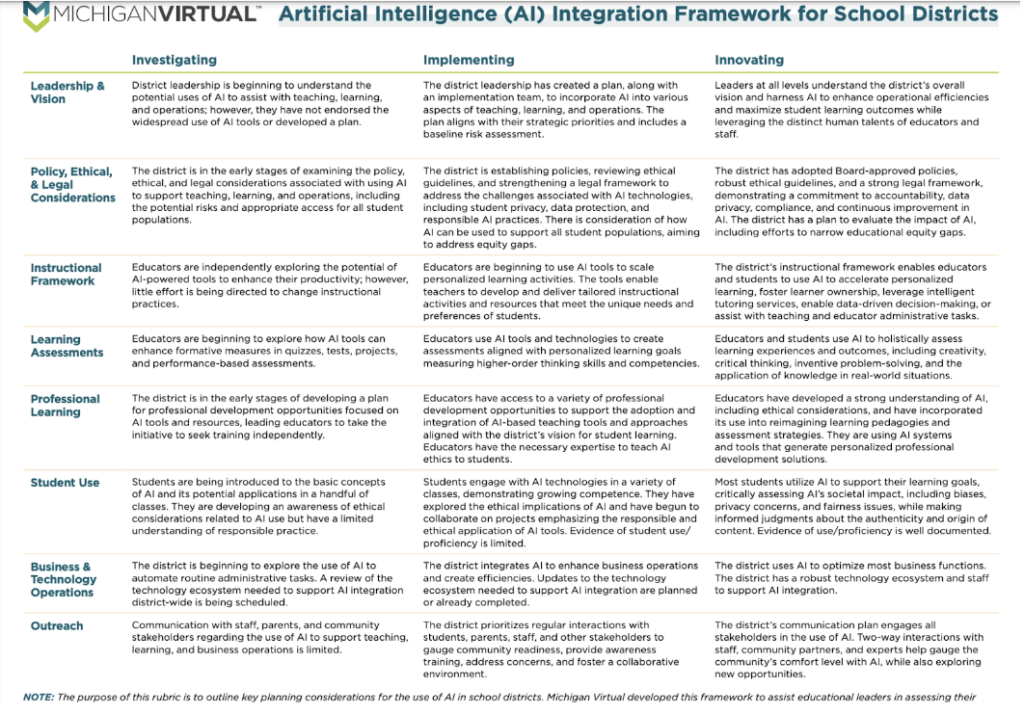
Their AI Integration Framework breaks the progression of adoption into three distinct stages, investigating, implementing and innovation. 

Progression Stages:

  • Investigating involves initial exploration and understanding, with limited AI applications.
  • Implementing sees schools actively integrating AI, with a focus on ethical considerations, targeted learning activities, and foundational AI infrastructure.
  • Innovating signifies a mature AI adoption, with advanced applications, comprehensive policies, and holistic assessments using AI. The innovating column also emphasizes how AI can support bolstering student ownership.

The framework then applies these stages across a variety of fields: Leadership & Vision, Policy Considerations, Instructional Framework, Learning Assessments, Professional Learning, Student Use of AI, Business & Technology Operations, and Outreach. Each is a great opportunity for innovating in new ways. 

Planning Guide for AI

Supplementing the framework, they have released a planning guide for AI which starts off with four distinct directives for school leaders to responsibly engage with AI: engage in planning, make it local, dedicate a team and address potential concerns. Throughout, they make the case for using AI as an augmentation tool, not a replacement tool, and suggest that it can support “uniquely human tasks,” “promoting student agency” and developing “new learning models.” We also appreciate the call for helping students to both understand and utilize the technology. Each section is then followed by a suite of potential risks of adoption and integration, which seeks to anticipate some of the potential pitfalls and roadblocks of the coming transition. 

Additionally, the team has announced a series of workshops, courses and trainings to support school leaders in their adoption, their understanding and their ability to form their own strategies for embracing the new learning landscape.

All of these contributions add to the great information emerging from orgs like TeachAI and AI for Education.

A Statewide Culture of Innovation

This is not the first time Michigan Virtual has led the charge toward innovation. For 25 years, the statewide virtual school has partnered with school districts. They sponsored The Future of Learning Council (FLC), a cohort of 40 unique school districts and learning organizations.

“The Council members are thought leaders who represent a powerful ‘coalition of the willing’ who embrace change and recognize the value of flexible, personalized, and competency-based learning systems that are high-touch and high-tech. We are excited to provide the administrative backbone and meeting facilities to support the Council’s functions,” said Jamey Fitzpatrick, President of Michigan Virtual.

For more on the transformational change happening in Michigan:

The post One State’s Approach to AI Integration and Rapid Reskilling appeared first on Getting Smart.

from Getting Smart https://www.gettingsmart.com/2023/11/03/one-states-approach-to-ai-integration-and-rapid-reskilling/

Design a site like this with WordPress.com
Get started