Honoring A Legacy of Leaders: The Jeanes Fellowship

In the Jim Crow era of the American South, Jeanes Teachers, otherwise known as Jeanes Supervisors, were women of color who functioned as superintendents for black schools. These teachers were dedicated to community benefits such as improving public health, living conditions, and teacher training. Over time, these Jeanes teachers became recognized by the informal motto of do “the next needed thing.”

At the time, Jeanes Teachers were funded through the Negro Rural School Fund, established by the Anna T. Jeanes Foundation in 1907 with an endowment of $1 million and recruiting Booker T. Washington to be the chairman of the Trustees. By 1909 -1910, there were 129 Jeanes Teachers operating in thirteen southern states. Soon, North Carolina took the lead with 36 Jeanes teachers by 1915.

To build on this legacy, in 2022 North Carolina created the Jeanes Fellowship. The Jeanes Fellows Program is a partnership between The Innovation Project (TIP) and the Dudley Flood Center designed to provide consistent and intentional infrastructure to support community-school relationships using an equity lens. 

The revitalized program builds upon and operationalizes needed action from 3 foundational documents

  • The Leandro Action Plan: Sound Basic Education for All: An Action Plan for North Carolina can be found here. A few key recommendations called for a qualified and well-prepared teacher in every classroom and finance and resource allocation. 
  • DRIVE Task Force Final Report and Recommendations: a report with 10 key recommendations to increase teacher diversity. Recommendations include affordable postsecondary access, diversity goals for schools and districts, and support networks for educators of color.
  • NC State Board of Education Statewide Strategic Plan: a plan grounded in the guiding principles of equity and the whole child with goals to eliminate opportunity gaps, improve school and district performance, and increase educator preparedness to meet the needs of every student, all to be fulfilled by 2025.

This first cohort of fellows is working hard to advance equity, diversity and cultural responsiveness in districts across North Carolina. From EdPrep partnerships with community colleges to micro-credentials through the diversity office, these educators and district-level leaders are making a huge difference in North Carolina. 

A New Approach to Advocacy Curriculum

One Jeanes Fellow, Saletta Ureña, is laser-focused on advancing racial and culturally responsive curriculum across Guilford County Schools in a new district role focused on supports and leaning into her fellowship position. As a veteran classroom teacher (Spanish and Language Arts), it is important to her not to get too far removed from “what kids are doing in the classroom.” 

Her new district-level position allows her to find a unique space within schools and systems change. “Some people told me to try for principal, but I’ve never wanted that role,” said Saletta. In her current role, she reports directly to the Chief of Staff and is grateful for the ways that the district has supported her growth and recent training in access mapping and liberatory design. “[Guillford has] all the bells and whistles,” she says.

In her classroom days, Saletta began to recognize that she heavily focused on building a decolonized curriculum. This became the unifying thread that tied each of her roles together. She began to notice that students were not participating in spaces that encouraged good civic behavior: discourse, tolerance and advocacy. “Student councils are a great practice ground for some of the core mechanisms of civics, but they’re not diverse, and their goals aren’t diverse.” With the Jeanes Fellowship, Saletta was able to start changing that narrative. 

Using her curriculum background, Saletta focused on creating a no-prep lesson for social studies teachers with a focus on advocacy. Much of this curriculum hinged on a children’s book that was perfect for second graders. Unfortunately, that book was flagged by some recent legal challenges, and Saletta had to do a quick pivot. At a time in which the political landscape is uniquely fraught, particularly around what’s being taught, Saletta adds, “This work is not about indoctrination, it’s about systems recognition.”

Saletta was able to use the unveiling of a recent newcomer school named after the de-segregationist Sylvia Mendez to build and announce a curriculum around her book Separate is Never Equal. Currently, the curriculum is best suited for 5th-8th graders. She already has one school on board and ample funding for many more students to participate, so she begins the courting process to make the lesson a whole grade requirement or, perhaps even, a whole course. 

“North Carolina is one of the states that is constitutionally bound to provide an ‘adequate education’ to all learners,” said Saletta. “If we’re not graduating children with core literacies, character and understanding of the systems they are in and how to participate we are quite literally breaking the law.” 

An Iterative Journey

During the planning phase of the project, the Jeanes Fellows began working with Open Way Learning (OWL) to hone their liberatory design skills. In one half-day design sprint, Fellows analyzed historical Jeanes supervisors’ case studies along with current data from their home districts. This analysis helped to ground their projects in empathy data of their place and people, including the district’s learners, their families, communities, and educators. With this foundation, they then built empathy maps around each stakeholder’s point of view, uncovering common problems hindering their learning, health, and opportunities in school, home, and the community.  

This session engaged Saletta and gave her the materials she needed to communicate an emerging project idea to her leadership teams. She later explained, “Liberatory Design is EYE OPENING. My immediate takeaway from the initial session was that this was a more in-depth way of looking at and including stakeholder groups.”
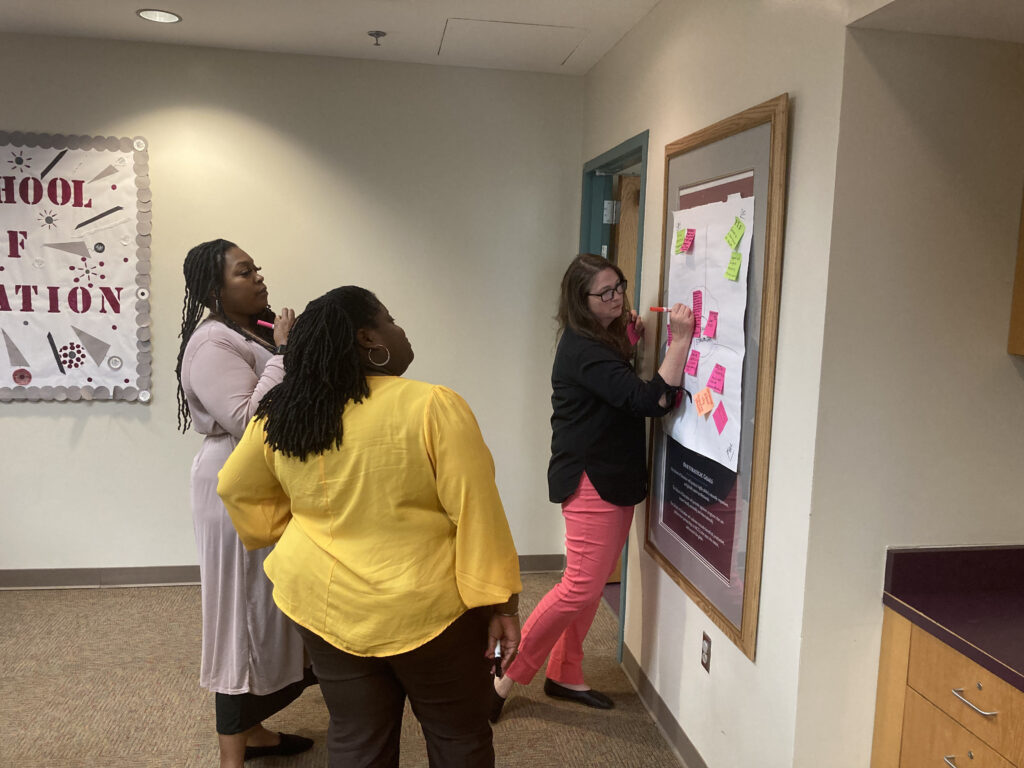
Jeanes Fellows collaborate on iterative design.

In another example, Jessica Parker in Edgecombe County Schools led community co-design sessions in order to build trust between communities and support this shifting population of learners (and their conflicted families). Her experience using design thinking in prior school team collaborations, also to great effect for her learners and educators, gave her a valuable foundation for picking up and shaping liberatory design tools to engage and connect the goals of her district leadership, affected communities, and their learners and families.

In a second half-day sprint as the school year started their projects, Fellows reconvened to iterate on their original ideas with agile prototyping tools, starting with a revised problem definition based on the power of story and NOISE strategic planning. In this meeting, they were encouraged to see their role as developing and engaging with their district’s equity “coalition of the willing” by identifying the innovators and early adopters they could build relationships and partnerships with as they piloted their Fellowship efforts.

Saletta believes that this experience has given her a name for something that she has always had, a “Jeanes Fellowship Mindset,” and she hopes to spread that message at educator gatherings in the years to come. This mindset can help her and other Fellows ensure that their projects’ outcomes translate into equitable change in their districts based on a foundation of trust, collaboration, and innovation.

“You can make changes from wherever you are.”

The post Honoring A Legacy of Leaders: The Jeanes Fellowship appeared first on Getting Smart.

from Getting Smart https://www.gettingsmart.com/2024/02/12/honoring-a-legacy-of-leaders-the-jeanes-fellowship/
Passion Projects and Peer Feedback: A Recipe for Work That Matters

Last year, we reflected on the first year of Khan World School (KWS) and their innovative approach to rethinking school. In that post, we highlighted the six core areas where the dedicated KWS team was most focused on progressing: onboarding, scale, purpose, student profile, artificial intelligence and accelerated college. A new semester is underway and, along with radically expanded graded bands, is evolving rapidly in multiple of these selected areas. 

6th  7th 8th 9th 10th 11th 12th
22 25 24 27 43 12 2

Student Experience

True to their stated goals of focusing on purpose and student profiles, KWS students are gaining a variety of skills outside of core content areas to grow into both thriving students and humans. Through Seminar, students engage in real-world discussions that develop their critical thinking skills. The students may be presented with a question like: Is college worth it? Is climate change a bad thing? Are U.S. elections fair? Will people live to be 150 years old or more? Should we pause AI development? They will then work together to reason and address challenges, develop solutions and better articulate their ideas on the subject. 

Along their learning journey, students focus on specific passion projects, developing their research and creativity skills. “We encourage choice and voice as much as possible. For example, in all humanities courses (and many STEM) students can self-design projects to demonstrate mastery,” said Jessica Jaeger, Khan World School Guide Manager and Humanities Guide at ASU Preparatory Academy. KWS allows students to exemplify their skills and knowledge in any way they choose, but are still expected to reason through their thinking when answering questions, they are assessed on their processing as well as their accuracy. 

Jaeger continued, “The parents are noticing that through projects and Seminar, students are building transferable skills. Employers can teach job-specific skills, but [at KWS] we’re helping equip them with some of the more durable skills.” 

At KWS, particularly at the high school level, oftentimes the feedback cycle is peer-to-peer rather than facilitator-to-student. This helps form a close cohort of students while also getting them comfortable with content and expertise, editing and much more. One 6th grade student reflected on the agenctic model by sharing “We DEFINITELY have a choice in what we dive deeper into here! For example: book talks. We can read any book we like as long as it’s not a baby book. ANY BOOK! Do you know how many books there are in the whole world?”

Student Projects

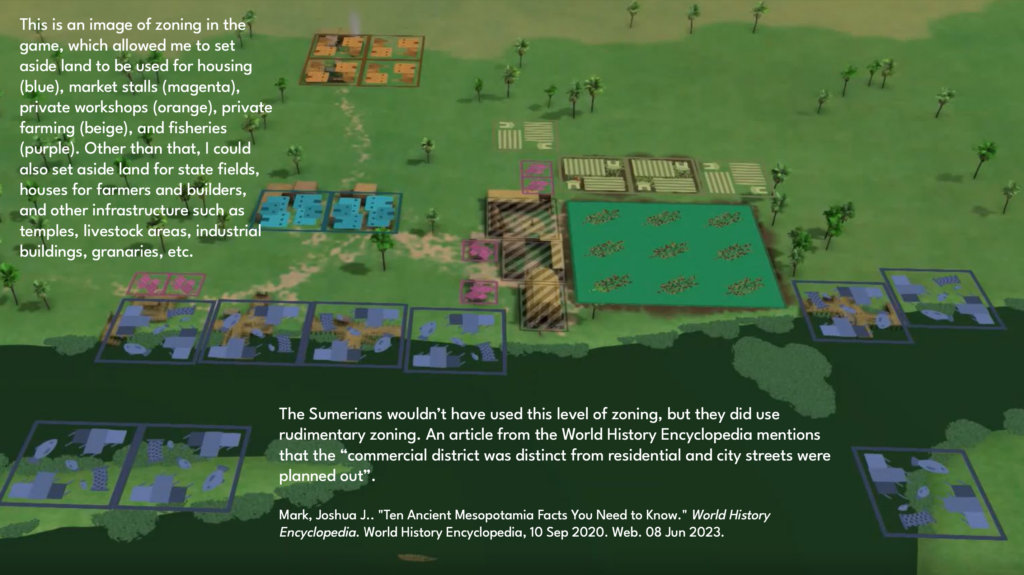
These passion projects have yielded impressive results. One student shared “I really like the mastery projects because you can do ANY IDEA YOU CAN IMAGINE!” Through co-authorship and intentional rubrics, the students are given just enough information to get started and just enough flexibility to follow their curiosities wherever they may take them. For example, one student leveraged their love of video games to explore Ancient Mesopotamia through the game Sumerians. Their critical question revolved around the historical accuracy of the game. Unprompted by the facilitating staff, this student sent an email to Dr. Irving Finkle, a scholar at the British Museum and asked questions about the game and how it compared to research on Mesopotamia. In another history project, this one at the middle school level, a 6th grader completed a humanities inquiry project that centered on the building techniques of Roman Aqueducts. They then used this lens to investigate the water system of their city. 

Image of a slide from the Sumerian project presentation.

This work is not limited to History class, however. It also applies to Science. Some labs are structured, but when they aren’t, students are encouraged to “Design Your Own Science Lab.” This has resulted in some of the following questions and corresponding projects: 

High School

  • What is the effectiveness of a linearly progressed strength training program?
  • What is the effectiveness of special moves in chess?
  • What was the effectiveness of COVID-19 protocols on public health outcomes (using an ASU simulation)?
  • What is the correlation between the mass of an organism and the size of its genome?
  • Do PEMF frequencies affect plant growth?
  • What is the effectiveness of UV phone sanitizers?
  • What is the effect of exercise on sleep quality?
  • How efficient are different rowing strokes?

Middle School

  • Does a PCle 4.0 slot actually make a huge difference over a PCle 3.0 slot when compared to desktop and gaming functionality?
  • Which sports drink actually contains the most electrolytes when measured by a multimeter?
  • Is a pneumatic system or a hydraulic system more efficient?
  • Which colored light will cause the least amount of bacterial growth in an agar plate
  • Does the density of a liquid change how fast something sinks?
  • In randomized samples would people prefer photos that have an increased amount of saturation?

Additionally, a high school student in Art Independent Study has been experimenting with a variety of mediums and painting techniques.

Student Art Project

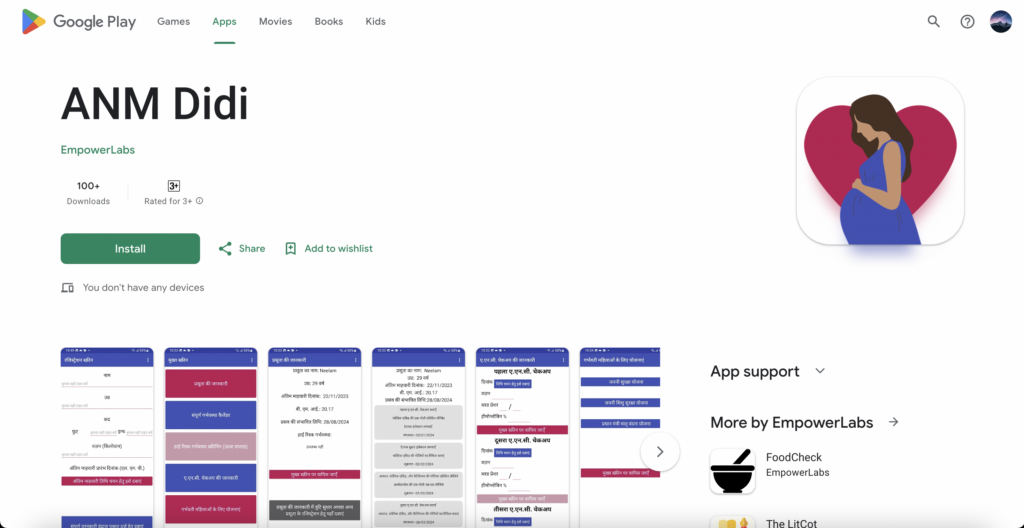
In addition to core content projects and assignments, the KWS model provides learners with the flexibility to pursue additional passion projects outside of school. Some examples include competitive gymnastics, world champion chess, national robotics competitions, theater and a student who worked on developing an app for pregnant women in rural India that would help them track their pregnancy including when they should be visiting a doctor.

Image of the pregnancy app in the app store.

What’s Next

Khan World School is now enrolling for the 24-25 school year.  Interested applicants should submit their application online and select their interest in the Khan World School program. Applicants can expect to submit the following materials:

  • Current transcript
  • Most recent standardized test scores in math and ELA
  • Letter of reference
  • Student interest video essay

Interested in learning more? Check out this conversation with Sal Khan and Amy McGrath on the Khan World School.

The post Passion Projects and Peer Feedback: A Recipe for Work That Matters appeared first on Getting Smart.

from Getting Smart https://www.gettingsmart.com/2024/02/08/passion-projects-and-peer-feedback-a-recipe-for-work-that-matters/

Values-Driven Learning in Hawai’i Helps Learners Find What They Are SEEQing

By: Billy Nicely and Josh Reppun

If you were allowed to reimagine what education could be through the creation of a completely new school, what would it look like? What would be its overarching purpose? How would students engage and what student outcomes would you insist on? These are enormous questions that not many are willing to think seriously about, much less put into action. But, in 2012, Buffy Cushman-Patz did just that. What she and other trusted advisors landed on was SEEQS: the School for Examining Essential Questions of Sustainability, located in Honolulu, Hawaiʻi.

Cushman-Patz and her four co-collaborators, including Josh Reppun (host of the What School Could Be Podcast), were once fellow teachers in a traditional independent school, frustrated by the structures that limited their ability to teach in a more innovative way, one that would allow more freedom in how required learning standards could be achieved. They began to imagine how they could design and co-teach courses that were interdisciplinary, integrating both science and history and helping students recognize the similarities between scientific thinking and historical thinking.

Years later, long after they went their separate ways, Josh got a call from Cushman-Patz. She had a request: help design an innovative charter school. After a year spent interviewing education thought leaders, they collaborated with Mark Hines, Carole Ota, and Raleigh Werberger to develop a progressive school model deeply rooted in an interdisciplinary, project-based approach centered on examining Essential Questions of Sustainability (EQS). 

The Power of Essential Questions

Each SEEQS course circles an essential question cleverly aligned to state-mandated course content standards. Students navigate these questions as a class while exercising agency in the process. Essential questions are seemingly short and simple, yet in reality, they are large, broad, and complex questions with no readily apparent answer. It is for this reason that they are ideal for the kind of student inquiry that leads to deep learning. By framing learning through essential questions, the learning experiences can be co-authored while enabling teachers to scaffold learning standards around them.

On our recent student ambassador-led tour of SEEQS (a middle school whose charter includes the eventual development of a high school), a high degree of student agency was evident from our student ambassadors: 8th-grade student, Sophia, and 7th-grade student, Avyay. Sophia explained that her class’s EQS for the semester was: How can service lead to change? In the process of exploring the impact of service, students engaged in a variety of service opportunities. Sophia described to us the experiences she had both investigating with her class what service is all about and what it was like to engage in community service projects. When asked how participating in service activities for the benefit of others changed who she is as a person, she shared that she could more easily empathize with others, and, without provocation, she said she would continue engaging in service work for the rest of her life. 

Throughout our hour-long tour, we asked a hundred questions of Sophia and Avyay. Both fielded them as if they were veteran shortstops for the Kansas City Royals, something we talked about in the parking lot after the tour. They fully understand the DNA of their school.

Avyay’s class was investigating the EQS: How can we develop a reliance on clean energy? Avyay and a classmate broke from the rest of the class to research and prototype the feasibility of electric-powered flights for transporting goods. Doing this is a great example of how SEEQS’s teachers allow for flexibility in learning to fit students’ particular interests. The first few days of each semester when new EQS are introduced, students participate in a project-based learning launch event known as EQS Camp where they spend time researching their topic and visiting important off-site locations learning from experts and engaging in field work. 

This year’s semester-long Essential Questions explored by students are listed below. As you read through them, take note how each question topic aligns well with things residents of the Hawaiian islands are thinking about and issues they are grappling with.

  • EQS Cultural Preservation: How can preserving Hawaiian culture benefit society? 
  • EQS Kai (the sea): How can restoration solutions help mitigate the impacts of invasive species?
  • EQS Waste and Consumerism: How do humans impact the waste cycle? 
  • EQS Forests: What are the dynamics of the forest system and how do humans fit in?
  • EQS Responsible Tourism: How can tourism sustain Hawai’i’s land, people, and culture?
  • EQS Clean Energy: How can clean energy be used in responsible ways?

Values and Sustainability

Regardless of the question investigated by students, each has been created to result in students also developing Essential Skills. These Essential Skills are all covered under the SEEQS Core Value of “Living Sustainably.” For this reason, they are known as Sustainability Skills but are associated with every aspect of learning and life. 

  • Reasoning Analytically
  • Managing Effectively
  • Communicating Powerfully
  • Collaborating Productively
  • Thinking Systemically

Cushman-Patz is known for talking about the following: “How you spend your time is how you enact your values” and the labeling of these skills as “sustainability skills” certainly lives into the values of SEEQS. She also notes that students leaving SEEQS most often head to a traditional high school and have a different set of challenges.  

While these core skills make for lifelong real-world learners, we would be remiss if we didn’t ask about state standardized test scores. After all, charter schools like SEEQS are not exempt from this measure of student performance. In data as recent as 2022 (as the COVID crisis receded), SEEQS’s students met proficiency in percentage far above the state average; 24% above the average in English Language Arts: 15% above the average in Math and 26% above the average in Science.  

When viewing the school’s weekly schedule, the afternoon EQS project-based courses are taught collaboratively by three teachers (two content teachers and one student support teacher). In this way, teachers become adept at subject-area content integration and therefore unafraid to collaborate across the rest of the schedule. This kind of instruction must be planned deliberately for it to be systemic. 

The law, passed by Hawaii’s legislature in 1994, that established a system of charter schools said that they should act as “demonstration schools.” Hawaii’s charter schools now account for 37 of the state’s nearly 300 public schools. They operate with more autonomy than district schools. As demonstration schools, it is explicit and implicit that each of these schools explore education innovation, creativity, and imagination. They are, under the law, directed to explore what school could be. SEEQS, under Cushman-Patz’s guidance, has done this to a remarkable extent. So much so that when folks both in Hawai’i and outside the islands ask to see great examples of student-focused innovation in education, SEEQS is most often the school of choice.

Bill Nicely is an educator-in-residence for the Ewing Marion Kauffman Foundation, where he works on activities related primarily to the high school design portfolio within the Real World Learning initiative.

Josh Reppun is the host of the What School Could Be Podcast and co-founder of SEEQS.

The post Values-Driven Learning in Hawai’i Helps Learners Find What They Are SEEQing appeared first on Getting Smart.

from Getting Smart https://www.gettingsmart.com/2024/02/06/values-driven-learning-in-hawaii-helps-learners-find-what-they-are-seeqing/

Building An Authentic Learning Culture Starts With Imperfection and Vulnerability

By: Mike Yates and Aaron Schorn

I once shared Cy Twombly’s painting, “A blackboard covered in white scribbles” with a group of 6th graders. I asked them for their immediate thoughts on the work. 

“Ummm I could do that right now!” 

“Looks like a messy” 

“Looks like I’m going to be famous!”

“This looks like a kid did it.”

“A whole mess!” 

The word “mess” kept being hurled into the air in the direction of this painting. Then I told them how much it sold for. $70.5 million. 

“Your mess can be worth millions,” I told them. This conversation fundamentally altered the culture of my classroom. “Cy Time” became a period of class where students would try new things because of the example that this conversation set for them. 

In direct contrast to this line of thinking is something that rots at the root of our current model of education. We call it many names so that it can hide in plain sight. Some might call it rigor or standards, high achievement, rubrics, grading scales, behavior charts or even classroom management. None of these are bad things on their own, however, you will often find that the core of any of these is perfectionism

Perfectionism often sounds like: “Raise your hand to speak”, “don’t talk out of turn”, “the bell doesn’t dismiss you, I dismiss you”, “get on the all A’s honor roll”, “don’t miss class”, “balance your sports with your academics”, and on and on and on. This litany of demands becomes a dangerous culture that can crush a student under its weight, creating a lack of trust and belonging in schools and classrooms and punishing students for courageously seeking classes/experiences that may challenge and expand them.

In this blog, we’ll highlight pedagogy that allows for imperfect work to be shared and we’ll share how you can create a culture of sharing invisible learning so that there isn’t just one teacher in your classroom but a room full of teachers. 

How to Ditch a Culture of Perfectionism

It’s hard to buck the system, but we’ve got you. To start, focus on your own personal classroom culture and create concrete tools and strategies you can use in your classroom tomorrow… after you’ve read this and shared it with everyone you know.

Building a Classroom Culture Without Perfectionism

The bulk of culture building comes from both the words of a leader and the actions that follow those words. This is to say that as the person typically facilitating learning you have to be willing to think differently about what you say, why you say it, and what it means to follow through.

  • Start with identity to get to a place where we know each other and feel comfortable sharing imperfect work. A great starting place is understanding which aspects of your identity make you powerful, and a great resource is a talk Mike gave on how he’s used the work of Lisa Delpit and Peggy McIntosh to do this when he was in the classroom.
  • If you’re not ready to get rid of traditional grades yet, create some set of assignments, projects or time when students are producing something that should be evaluated but for which there is no final “grade.” Create a Capstone program that book-ends high school, middle school, elementary, or all three. 
  • Think about who does the evaluating, and ask yourself if the stakes are higher when you, the teacher, evaluate work or when their peers do. Here is a good hub for peer-to-peer learning but for a great one remix this and make it your own.
  • Don’t just model the learning, be in it with your students. Doing this will let you demonstrate what sharing early (even imperfect work) and often looks like, and It gives you a chance to be the tide that rises the boats of your classroom. Here is a great guide on how
  • Teach the lesson that we move forward together. This means in your planning you’re thinking intentionally about designing experiences where students need to lean on their peers and the collective to complete the assignment. 
  • Create a lower threshold for failure. Treat failure as a part of the learning process by teaching students how to pivot. This might mean you don’t grade every assignment or that you evaluate their ability to make a meaningful pivot instead of the work.

Assignments and Pedagogy That Allow Imperfect Work to be Shared

  • Make student growth visible with process documentation and then give your learners the ability and time to look at each other’s evidence and reflections. This is learner-led documentation
  • Make your classroom transparent when working on big projects and don’t be the gatekeeper. It’s vital that the whole class has an understanding of where each learner is the life cycle of a project. This can be done through micro check-ins that are shared and celebrated. 
  • Create a system of visible learning. A great tactic for this is to pull from agile project management and have student-led scrums in class once a week. 
  • Build into your schedule multiple celebrations of learning presentations, these can be in person or virtually
  • Student led teach-ins can be a great option; this is when you create an opportunity for students to teach content to each other and get feedback from one other. Break students into groups, have roles like teacher, learner and coach where students take turns fulfilling each role.
  • When you create a culture of sharing invisible learning, there isn’t one teacher. The room becomes the teacher and the classroom becomes the collective. Have your students become SMEs for each other. 
  • Ditch the archaic (and most likely GenAI written) giant research paper and replace with portfolios that highlight both product and process.

Two Experiences of Perfectionism

“How’d you do?”

I’ll never forget the day I was dumbfounded by someone else’s grade on a math test. My 9th grade Algebra teacher always handed tests back folded hot dog style. She thought she was slick. She didn’t want anyone to know how they did based on how she returned their test. We’d just taken what she heralded as her most difficult Algebra II test, and were about to see how we stacked up. I looked over to my table partner who was covered in sweat, I remained unphased. 

The teacher slid my test across the table, then placed my neighbor’s test face down. We both glanced at each other and flipped our tests over at the same time. “Boom!” I got an 89 on the “hardest test of the year.” In my excitement, I looked over and saw my classmate in tears. “Grace, you alright? How’d you do?” 

“I got a 92.” She said, through tears. 

I was confused beyond my 9th-grade understanding. Crying like your dog just died over a 92? She then begged the teacher to let her retake the test so she could make above a 96 because of some requirement for the National Honor Society. 

The funny thing is, years later, I saw those same tears from students of mine over the difference between a 98 and a 100. See, my table partner and my future students were not in tears over how well they’d done on difficult assignments. They were in tears because they’d swung for the strawman of perfection and missed.

Perfectionism in school harms learners who are getting a 96 and those getting a 65. Fundamentally, it harms authentic relationships to learning and each other. – Mike

Between You and the Rubric

The grade is the carrot and the stick. It is the motivation, the reason for hard work and grit. All of my work in education has been to challenge this power structure and to help learners to understand their own power through meaningful and personal products and artifacts. Although well-intentioned, I was met with an unexpected response: “Why are you giving me choice, time, and space in this one class when I have little in almost every other class I take? Tell me what to do, tell me what my project should be like.” For them this was whiplash. Perfectionism had colonized them to be passive in their learning. They had selected classes that they knew they would ace and created projects where there was little uncertainty or real challenge. 

One student, Ry Bleckel, helped me to create a program that fought against perfectionism. Ry’s senior capstone project was about creating, and teaching people how to create an album. His project was about empowering youth to understand both the software and the “heartware” of making music. He’d never performed in front of people in a formal setting but we pushed him to perform during his mid-year presentation. He was afraid to do it, but the night before he decided to pivot and show the unfinished, imperfect version of his performance and album. Though we instructed students to use Google Slides and pull from Slide Carnival templates he did it from keynote and in his own brilliant and minimalist style. It took him longer and more work than the others. Through this, you saw who he was, his aesthetic and his identity. This was especially apparent in the gaps between his product and the rubric. – Aaron

In Conclusion

The Classroom becomes a Collective. When the goal isn’t the grade, the process of learning becomes more important than the destination. When students (and teachers) understand that all work can be seen as a step along the journey of growth, it becomes much easier for them to cheer each other on, pick each other up when they fall and be in flow together toward growth. 

Students become familiar with the pivot. Failure can feel like a brick wall or it can feel like a turn in the road. When learning means you have to be perfect, every failure hurts because you run full speed into a brick wall that demands you go back and start running again until you break through the wall. When learning isn’t about being perfect students learn how to pivot early and often — what was once a wall is now a fork.

Then you get a real portfolio of work. You know you’re on the right track regarding your classroom culture when you find your students having a larger and larger portfolio of real work to show for being in your classroom. Your idea of what a portfolio is will change as you seek to ditch the perfectionism in your classroom culture. Imagine a student being able to document the 4 attempts or methods they used that didn’t work to show how they arrived at the attempt or method that finally did work. 


Dr. Betina Love states, “Who cares if we graduate students with 4.7 GPA’s if they’ve come out of school traumatized and with little confidence.” Perfectionism creates a culture in schools that is deeply individualistic and lonely. It creates structures that ensure that learners are passive, where school is done to them. It kills the soul of learning and creates inauthentic relationships rooted in power and punishment. We urge you to fight this ethos of perfectionism tooth and nail, with culture and pedagogy. Whether you’re an administrator, teacher, parent, or student: to prepare for the real world; do real and imperfect work, and document the hell out of it.

The post Building An Authentic Learning Culture Starts With Imperfection and Vulnerability appeared first on Getting Smart.

from Getting Smart https://www.gettingsmart.com/2024/02/05/building-an-authentic-learning-culture-starts-with-imperfection-and-vulnerability/

Transforming Learning, Deciding Where to Start: Practical Steps for Educational Leaders

Navigating the landscape of educational transformation requires leaders to cultivate a reflective process and practice strategic decision-making. More than two decades ago, my involvement in a groundbreaking learning initiative in Alaska paved the way for a transformative approach to education, aligning with many of Deming’s quality management principles. We were working to create systemic approaches for personalized learning that would not be time-bound or driven by course requirements. This redesign prioritized equitable access for learners from very small and remote systems and created pathways to honor cultural differences and varied community values. This work predated Common Core and was in the early stages of what would become competency-based learning. Further details about this journey are detailed in the book Delivering on the Promise.

During these early years, we received training and support as we transformed schools and districts. I decided to reverse-engineer one of the tools from this training, creating a process that has been indispensable in my leadership journey. Although I made some tweaks, I often refer to it as the Interrelationship Diagram, its original name, because it is about causal relationships. The original intent was to provide a visual way to unravel complex problems by illustrating connections between factors. I still use this as a valuable way to dig into challenges related to adult collegiality and cultivating a learning culture. For additional information on the Interrelationship Diagram, organizations like ASQ (American Society for Quality) and David Langford’s Tool Time, have offered comprehensive insights and step-by-step guides for decades. HTH Graduate School of Education and Mind Tools does as well.

In my work with school leaders, we often need to assess organizational strengths and starting points. A modified Interrelationship Diagram solved this challenge. This visual aid, now known as the Focused Impact Tool (FIT), has become instrumental in efficiently directing organizational energy. Used as a collaborative process, it has proven to be an effective way to direct action in redesigning learning models, improving school cultures, and addressing learning transformation with school leaders.

The Focused Impact Tool is not just a diagram but a structured approach to unraveling the intricate web of relationships within educational systems. The process facilitates prioritizing issues, analyzing causal connections and offers a pathway for informed decision-making. Combined with effective facilitation, this tool harnesses rich dialogue among staff members, creating a conducive environment for collaboration and reflection.

Discussions within this context are crucial and necessitate sufficient time for collaboration. The duration, ranging from 15 to nearly 60 minutes, adapts to the tension around the topic and the team’s familiarity with the process. Acknowledging the challenges in managing these aspects, an external facilitator can prove beneficial. From my facilitation experience, instances where principals or district leaders actively participated reinforced the process for other staff. This approach also allowed them to distance themselves from topics of personal significance and engage as participants rather than leaders.

The ‘secret sauce’ of this process lies in valuable reflection and analysis through meaningful dialogue within a team. Effective and meaningful dialogue requires revisiting established group norms. For certain topics, specific protocols may be necessary to ensure all voices are heard and conflicts are navigated, especially if not explicitly addressed within the group norms.

The Focused Impact Tool Process

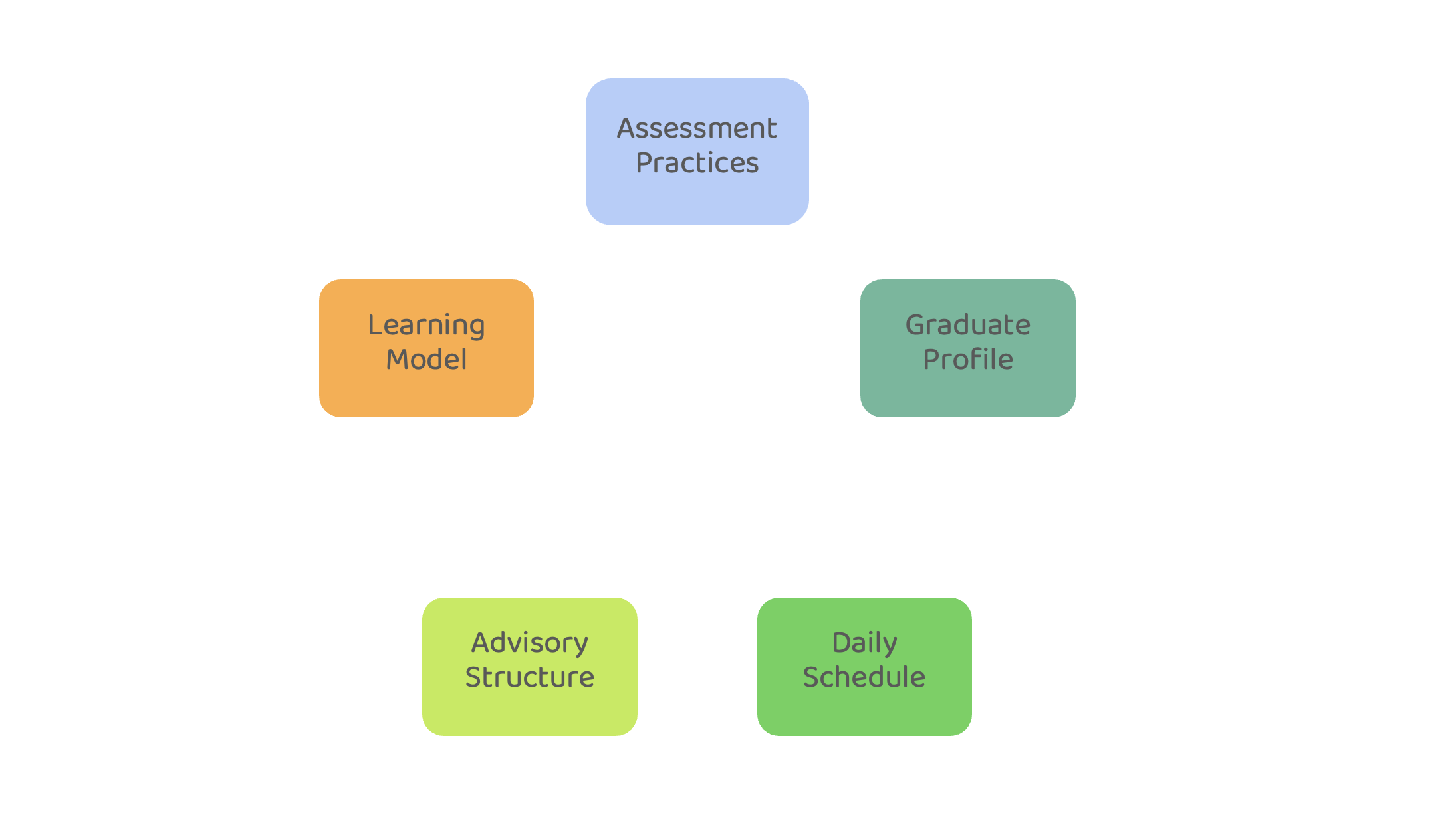
Step One: Identify Key Actions

Actions can be programs, protocols, or identified processes for an approach to help transform a learning organization.

Define the purpose. Some examples might be: 

  • Align the Learning Model to the Graduate Profile
  • Activate personalized learning in a K12 system

Group Norms are established for collaboration.

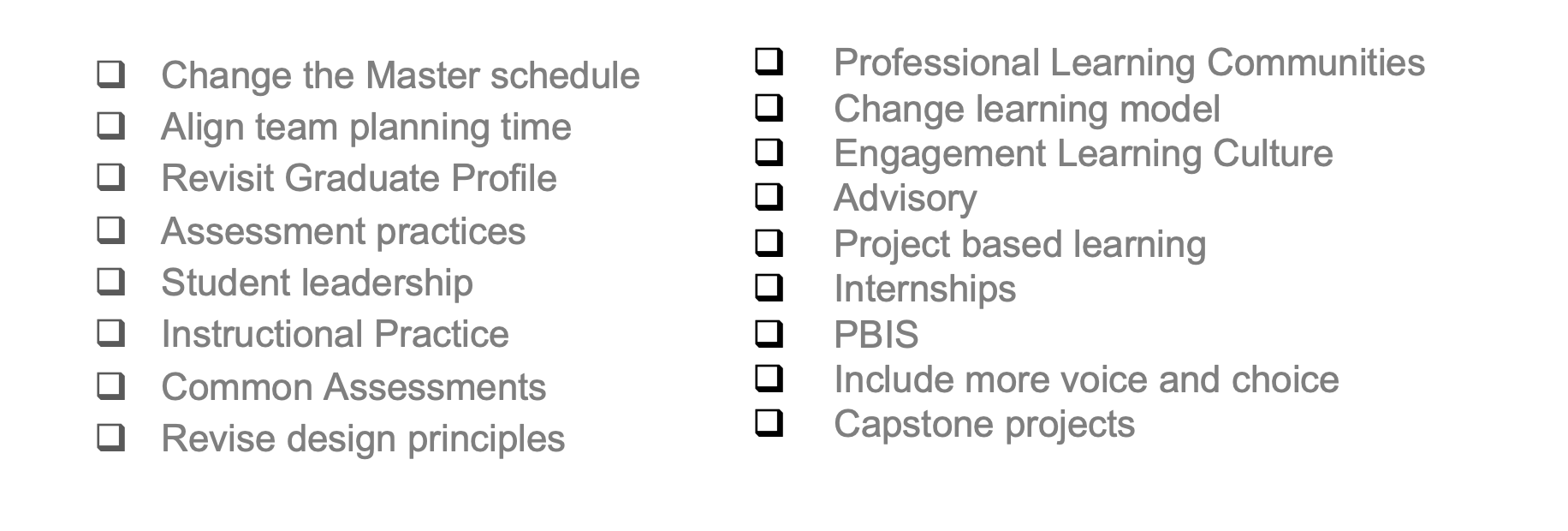
Generate a list of the key areas/actions to meet the identified outcome. This list can be a result of brainstorming and mapping tools, or it may be a current list of actions already in place. If this topic is relatively new to the group, you may wish to consider brainstorming techniques. A mapping tool, such as an affinity diagram is a great way to solicit responses.

An example list: 

Step Two: Select Areas of Focus

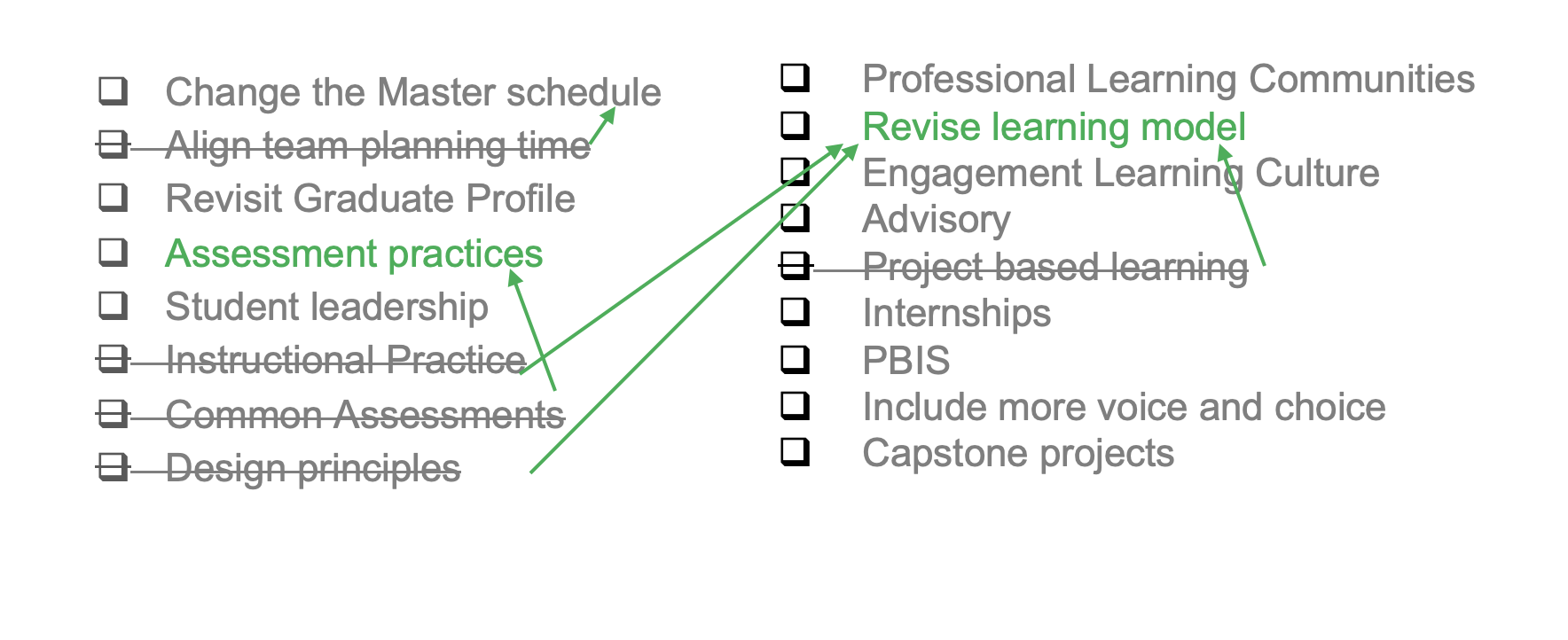
The following steps can happen in reverse order if the group is struggling to consolidate or to agree on consolidation. The voting can then be used to assist with consolidation. 

Consolidate similarities from the brainstormed list.

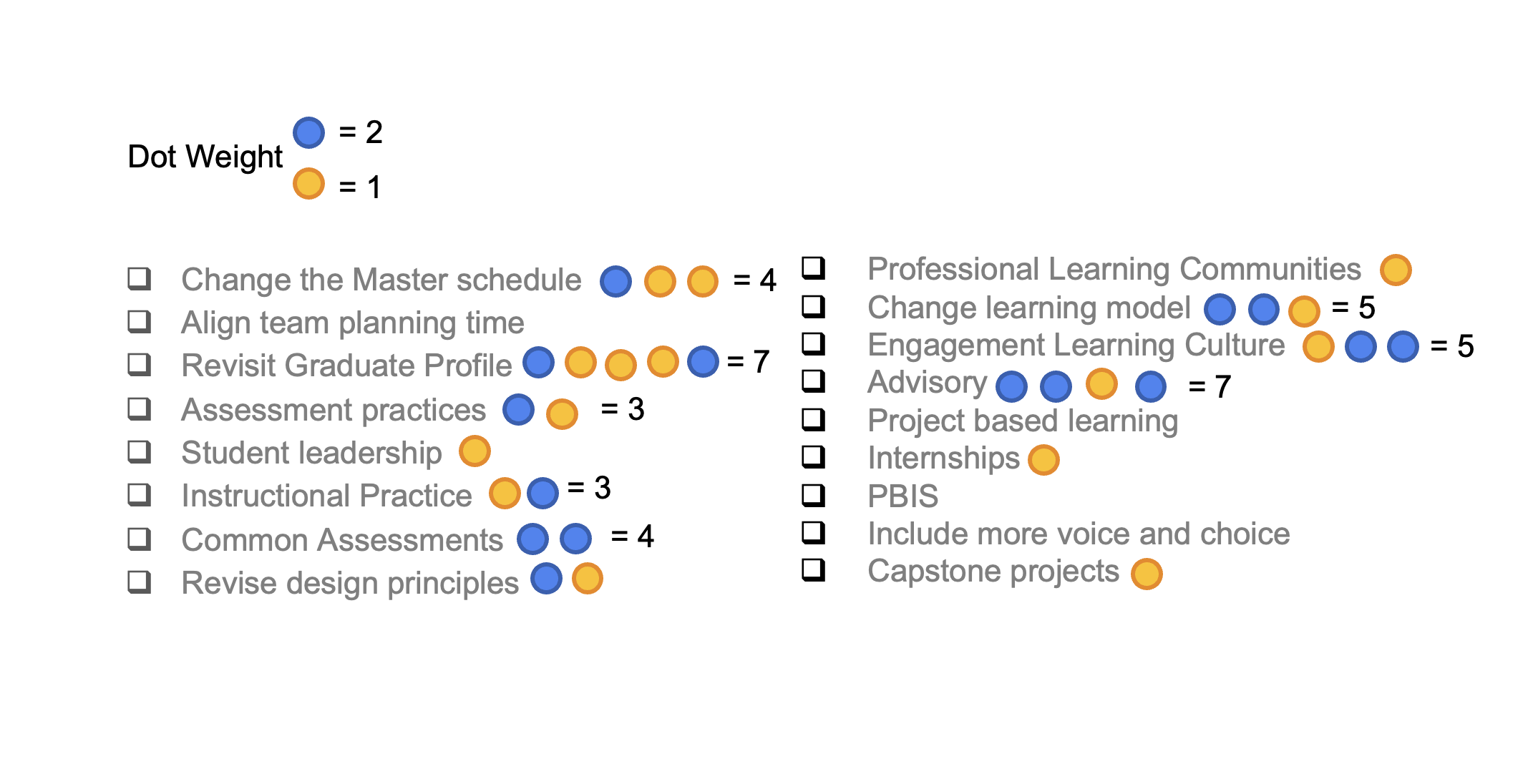
Prioritize. Select a power voting protocol. Options: Dot Voting, Nominal Group Technique (NGT)

Example:

Step Three: Define Relational Impact

It is critical to revisit established group norms to ensure all voices are heard. 

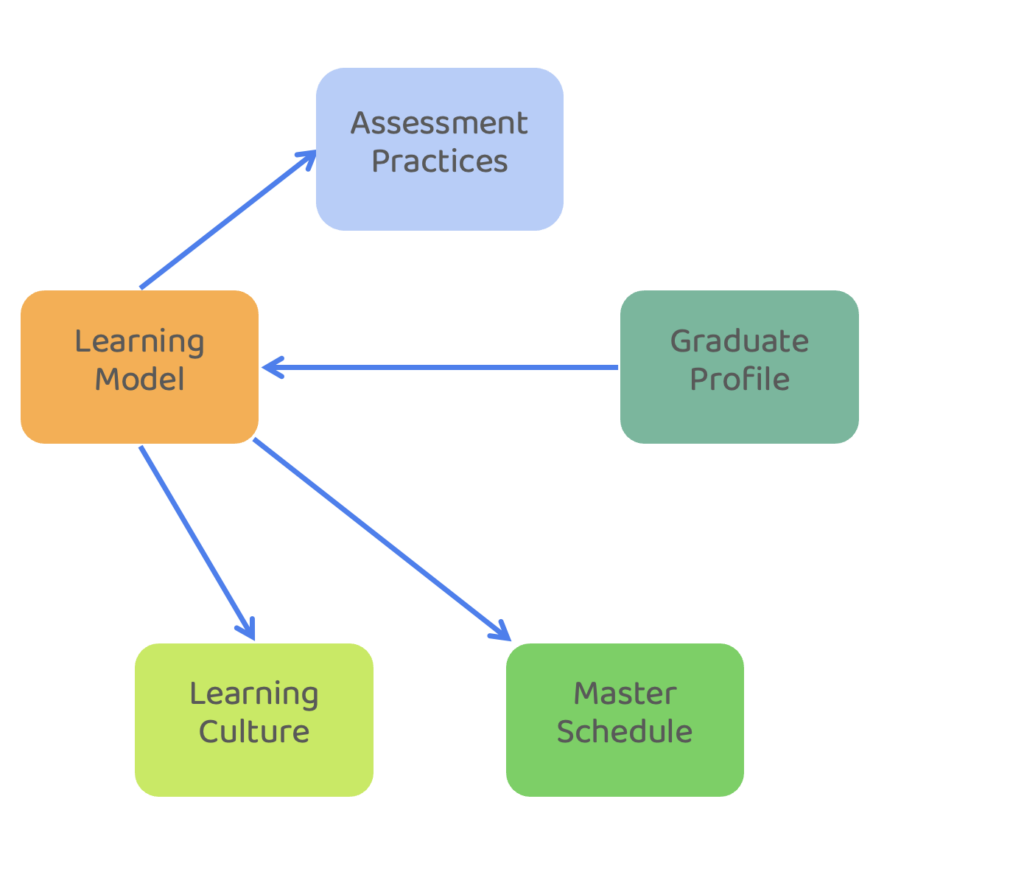
Draw the Diagram. Create a circular diagram with each key area represented as a category. 

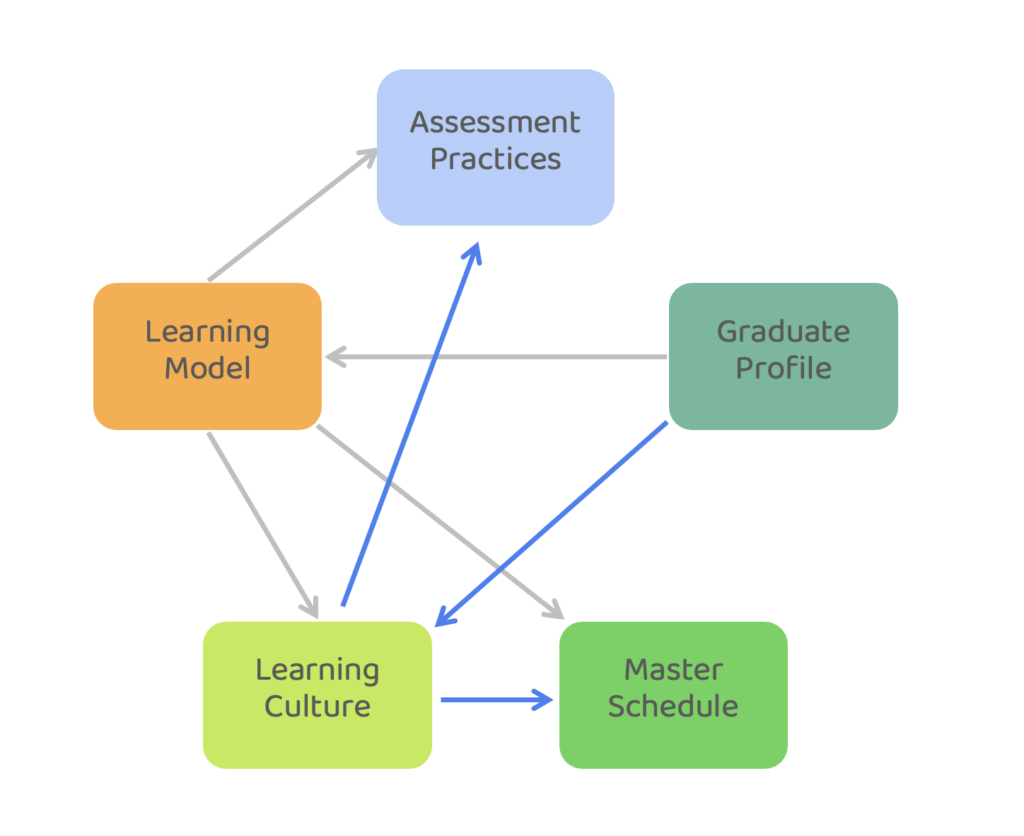
Determine the Impact of the Relationship. Use arrows to connect categories, visually representing the relationship between key areas to indicate directional impact. For each connected pair; determine which action, if performed first, would have the most significant impact on the other and then draw the arrow facing that direction. 

For example, consider the scenario of revising a learning model and altering assessment practices. Which one would exert a greater impact on the other? While it might appear that the learning model would directly influence assessment, the reality is that learning organizations exhibit diverse levels of readiness for change and have strengths in various areas.

Step Four: Define Relational Impact

Teams or individuals strongly associated with an action that may not initially have the highest impact will understand that initiating work in this first area will eventually influence their primary focus. Additionally, other action items will become the subsequent goal for concentrated efforts sequentially.

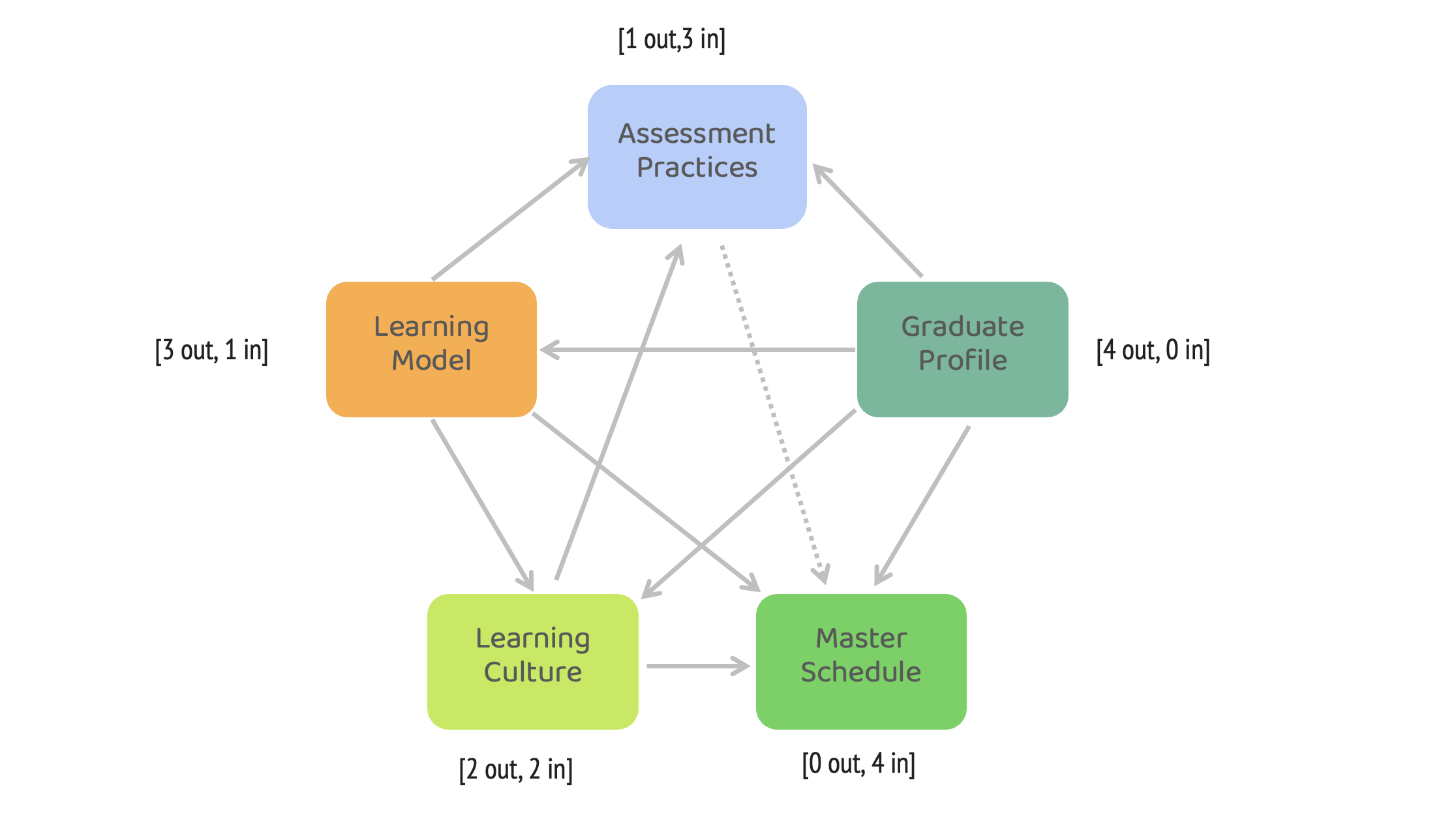
Quantify Relationships: Count the number of arrows going into and out of each key area. This quantification helps in identifying which areas have the most significant impact on others.

Identify and Prioritize the Action: Look for the category with the most arrows going out of it. This action has the most impact on the overall system. 

Quantifying causal connections and prioritizing actions based on outcomes are essential parts of strategic planning. The Focused Impact Tool process, outlined in these stages, navigates key actions, and selection processes, and defines relational impacts. Informed by the analysis and results obtained through the process, a learning organization can strategically prioritize actions to maximize impact. 

The post Transforming Learning, Deciding Where to Start: Practical Steps for Educational Leaders appeared first on Getting Smart.

from Getting Smart https://www.gettingsmart.com/2024/02/01/transforming-learning-deciding-where-to-start-practical-steps-for-educational-leaders/

Portland Youth Exercise Power through Participatory Budgeting

By: Rebecca Jacobson

Lillyanne Pham ’20 and Jim Labbe ’95 were part of Oregon’s first-ever experiment in giving community members direct say over how to spend public dollars.

Participatory budgeting, a democratic process in which ordinary people decide how to spend part of a public budget, isn’t a new phenomenon. It was first tried in 1989 in Porto Alegre, Brazil, and has since spread widely; researchers count more than 11,000 initiatives worldwide. But until recently, it had never been implemented in Portland (or anywhere else in Oregon).

Jim, whose career was for many years focused on natural resource conservation, has been engaged in PB efforts in Portland since 2016, and in 2018 helped found a nonprofit called Participatory Budgeting Oregon. In 2022, that organization launched Youth Voice Youth Vote, a program that aimed to enact Oregon’s first-ever PB process. The goal was to engage at least 2,000 youth in Portland’s east metro area to decide how to spend $500,000 allocated by the American Rescue Plan Act.

Why begin with youth? In part, Jim says, it’s precedent: other American cities, including Seattle, Boston, and Phoenix, have carried out successful youth-led PB processes. But it’s also to build a constituency that will be invested in PB over time. “We’re in it for the long haul, which is why we started with a youth-based process,” Jim says. He emphasizes, too, that youth in Portland’s east metro area are a high-need group who represent the racial and ethnic diversity of the region’s future population. 

The first step was to hire a paid, all-youth steering committee to design the process and write the rulebook, which is when Lillyanne, an artist and organizer with a focus on place-based and racial equity work, came on board. In addition to being drawn to how PB gives community members a direct say in how public money is spent, Lillyanne was excited by the way this particular program gave the decision-making power to youth (defined here as 13- to 25-year-olds). “I hadn’t known PB could be done totally by youth,” she says. “To have a whole process by youth is crazy cool.”

Process design took place over the summer of 2022, as Lillyanne and 11 other steering commitee members worked to produce a robust plan and timeline. Step two: idea collection, with youth in the project area brainstorming both online and at in-person assemblies about what they wanted to see in their communities. Next, upwards of 100 budget delegates worked in committees alongside community-based organizations to vet and refine ideas into feasible, youth-centered projects. 

And last summer, nearly 800 youth took part in a binding vote to determine which projects would receive $100,000 apiece in funding. Voting took place both in person and online, and the winning projects—a job resource fair, a paid two-week program for youth artists, paid internships for youth, expansion of access to menstrual and hygiene products, and improved connections to rental and housing assistance—are entering the implementation phase. Simply put, this means that projects developed by and for young people, and directed at their own communities, are currently being supported by federal dollars.

“The cool thing about PB is that it has different levels of participation,” Jim says. “The steering committee is a deep, deliberative process. With idea collection, anyone can show up and throw out an idea. Budget development again goes deep, and then the voting phase opens up. Unlike a lot of other participatory democracy innovations, PB has both the deep and the broad.”

For Lillyanne, a highlight of the process was witnessing what happens when youth across an age range come together. “It was interesting to see what cross-generational youth collaboration looks like,” she says. As an older youth, Lillyanne felt it important to step back in order to empower her younger peers to trust what they already know and, as she says, to “follow their gut.”

Though efforts to secure funding for a second round of PB have thus far been unsuccessful, Jim remains committed and optimistic. A recent poll found that 72 percent of Portland voters support implementing PB in the city, and 51 percent expressed some or significant interest in participating in a PB process. ​​In a small win, Portland’s recently passed climate investment plan authorizes up to $150,000 per school district for participatory budgeting purposes. While districts aren’t required to implement PB, it’s at least a nod to the process, and comes in part thanks to Youth Voice Youth Vote leaders who pushed to include PB in the plan.

“Part of our goal was to build our capacity and knowledge to do PB, and [to build] the young people’s capacity,” he says. “If PB is going to last, it’s going to have to be from the ground up in a significant way. We’re making youth the experts in a new way of governance.”

This post was originally published in Reed Magazine.

The post Portland Youth Exercise Power through Participatory Budgeting appeared first on Getting Smart.

from Getting Smart https://www.gettingsmart.com/2024/01/29/portland-youth-exercise-power-through-participatory-budgeting/

Community Collaboration: The Success Story of Tacoma Public Schools’ Summer Late Nights Program

In the spring of 2022, Tacoma Public Schools (TPS) faced a heart-wrenching crisis. The district, which serves 28,000 students, was reeling from the loss of ten students to gun violence. With summer approaching, safety was top of mind and a non-negotiable. 

As the summer neared, TPS Superintendent Dr. Josh Garcia addressed the City of Tacoma Joint Municipal Action Committee (JMAC), an assembly of officials from various governmental organizations, with a challenge to not let the tragedy of the last year go unnoticed. The community needed to act. 

The response to Dr. Garcia’s challenge was the establishment of the Summer Late Nights in Tacoma. This initiative was an incredible demonstration of what rapid and effective community collaboration can look like. Metro Parks Tacoma spearheaded marketing and grant writing, while nonprofits like the YMCA and Boys & Girls Clubs provided staffing and programming. Their combined efforts raised over $1.4 million from both public and private funders. The result was 12 safe spaces across the city, which, throughout the summer, hosted over 12,000 participants. There were no gun violence-related injuries or deaths among students that summer.

The Beginnings of JMAC

Understanding the roots of JMAC is crucial to appreciating this success. Initially formed in the 1970s to bring the Head Start program to Tacoma, JMAC evolved significantly over the years. The COVID-19 pandemic marked a turning point, transforming JMAC from a social meeting group into an action-oriented body. Under the leadership of Chair Elizabeth Bonbright and Vice Chair Kristina Walker, JMAC focused on Justice, Equity, Diversity, Inclusion (J.E.D.I), Health and Security, and Community Wealth Building. The redefined vision and commitment to action laid the groundwork for future collaborative successes like the Summer Late Nights program.

During this period of reinvigorating the action committee, the team hosted a summit of 60 and invited community partners (including business, non-profit, and faith leaders) to share JMAC’s new united direction and ask for ways to engage with them so that their collective work would be aligned. Even after the urgency of COVID had begun to wane, a group of 75-100 attendees—mostly comprised of interested staff from participating organizations and community partners—continued to move their collaborative work forward. 

In December 2022, they held another Summit and were proud of the significant impact they achieved by shifting away from agency-siloed thinking in favor of aligned policies and funding.  

Leveraging Relationships

TPS already had a collaboration framework in place, having worked with Metro Parks Tacoma and Greentrike on the Beyond the Bell and Club Beyond programs. These programs provided after-school care to meet the post-COVID child care void and were quickly adapted for the summer initiative. The district offers TPS families free or low-cost (pay as you can) extended learning opportunities after school between the hours of 3 – 6 p.m. every weekday during the school year. The community vendors provide a wide range of engaging activities including STEAM programs, tutoring, sports, art, music, theater, and leadership opportunities. Metro Parks coordinates and Greentrike manages the vendors by recruiting vendors, performing background checks and paying for their services. By leveraging the existing infrastructure and partnerships, the community was able to quickly deploy the Summer Late Nights program.

In late April/early May of 2023, Dr. Garcia challenged JMAC members to commit dollars to stand up a program for Middle School and High School students during the summer every weekday from 5 – 10 p.m. for the 10 weeks of summer.  “We adapted the Beyond the Bell/Club B model with similar staffing but a less structured environment. And we provided hot nutritious dinners to all participants at all 12 sites.”

Throughout the program, TPS maintained a strong leadership role. Dr. Garcia’s involvement was pivotal in rallying community support and ensuring the program’s alignment with the “Whole Child, Whole Educator” approach. Half of the 12 sites were housed at a TPS Middle School and the district provided janitorial services and other in-kind supports for our 6 sites.  In addition, TPS staff often dropped in on the 12 sites throughout the summer to speak with students and Late Night staff to learn more about the impact and any suggestions for improvement and canvassing to ensure the community knew about the great opportunity.

One of the key components of Beyond the Bell, Club B and Summer Late Nights is that all staff working with TPS Students are trained in and must use their “warm welcome” and  “zones of regulation”. 

“Warm welcomes” and “zones of regulation” are components of the Tacoma Public Schools Whole Child approach to education. A “warm welcome” involves greeting each student by name and asking each student about their “zones of regulation” (how they are feeling at that moment: GREEN = Good/Happy or YELLOW = anxious/nervous/worried or BLUE = sad/depressed or RED = angry/highly emotional). These basic self-disclosed bits of the real-time emotional status of each student provide TPS teachers and afterschool providers with critical information to help them best operate a successful environment for all the students in their classrooms/activity space.

The story of the Summer Late Nights program in Tacoma is a shining example of how community collaboration can address and mitigate pressing social issues. By pooling resources, expertise, and commitment, TPS and the Tacoma community created a safe, engaging summer environment for their youth. 

The post Community Collaboration: The Success Story of Tacoma Public Schools’ Summer Late Nights Program appeared first on Getting Smart.

from Getting Smart https://www.gettingsmart.com/2024/01/25/community-collaboration-the-success-story-of-tacoma-public-schools-summer-late-nights-program/

TRETC 2024: Revolutionizing Technology and Work

By: Norton Gusky

At this year’s TRETC Conference AI was on everyone’s mind. According to Bard, the AI tool from Google: 

The Three Rivers Educational Technology Conference (TRETC) 2024, held in Pittsburgh on January 15th, was a transformative day for educators, administrators, and industry experts in Southwestern Pennsylvania. The theme, “Students are the future of our workforce,” resonated through sessions and workshops focused on harnessing EdTech to prepare students for careers in a rapidly evolving world.

Keynote speakers like Ed Hidalgo inspired attendees with innovative approaches to career development, while educators shared best practices for integrating technology into the classroom. The conference culminated in the Evening Innovation in Education Awards, celebrating outstanding advancements in educational technology. Overall, TRETC 2024 provided a valuable platform for collaboration, inspiration, and the exploration of transformative EdTech for a brighter future.

This summary is a good example of the strength and weakness of AI. For example: The conference did not “culminate” with the Innovation in Education Awards; the conference kicked off with the awards. However, Bard did a fine job providing a one paragraph summary. 

My colleague, Rich Platt, decided to see how ChatGPT 4.0 with Bing access would summarize the event. ChatGPT 4 with Bing access performed a little better.

The Three Rivers Educational Technology Conference (TRETC) 2024, held at South Fayette High School on January 15, centered around the theme “Transformative EdTech”. This event offered a dynamic professional development opportunity for teachers, K-12 administrators, industry experts, and higher education decision-makers in South Western PA. It aimed to advance the integration of educational technology, fostering pathways for students to engage with “what is next” while in the classroom, thereby laying a strong foundation for their future careers.

Key highlights of the conference included:

1. Keynote Speaker: Ed Hidalgo, an expert in integrating career readiness into school culture and an advisor for various educational and non-profit organizations, shared insights based on his extensive experience in corporate HR, higher education, and K-12 public schools.

2. Featured Speakers:

   – Joseph T. Yun, an AI architect and research professor, discussed AI/ML technologies and user-centric analytics systems.

   – Amil Cook, a Hip-Hop Technologist & Strategic Partnership Consultant, spoke on empowering Black youth through technology, language, and cultural identity.

   – Rachelle Dené Poth, an edtech consultant and teacher, shared her extensive knowledge in Spanish and STEAM education.

   – Janet T. Phan, the founder of Thriving Elements, discussed empowering underrepresented girls in STEM through mentorship.

3. Additional Sessions and Events:

   – Dr. Gary Stager presented on “Coding in the Age of AI”.

   – An Early Innovation in Education Award & Networking Event was held prior to the conference, providing a platform for networking and recognizing innovative educational approaches.

   – Optional two-day Teacher Training by World of Work Pittsburgh was available, focusing on practical training and classroom site visits.

Here’s a more complete summary using postings on X and LinkedIn from participants at TRETC plus my own observations as a key planner and workshop leader for the event. The variety of voices shows a key difference from AI which is flat and lacks a point of view. 

On January 14 and 15th over 530 educators from more than 200 different entities sampled workshops, presentations, an eSports competition, panel discussions, featured speakers, an author’s fireside chat, award ceremonies, and a visit to a local Robotics factory. The Pittsburgh Technology Council sponsored the event that has become for more than 25 years the premier educational technology gathering for educators and educational leaders in the Pittsburgh region. 

According to Matt Friedman, the Superintendent of the Quakertown School District outside of Philadelphia, “So amazing to have @EdHidalgoSD kicking off #TRETC2024 talking #RIASEC and thinking about student voice, student interest and common language to build a connection within your schools, district and community.” 

“Unsurprisingly, AI took center stage in our discussions. Joseph T. Yun, Ph.D, one of the featured speakers,  reminded us that AI is not just here; it’s here to stay and progressing faster than we might anticipate. His call to action resonated deeply — how can we empower students to be leaders in a world entwined with AI? Human leaders in a world with AI,” Katherine Rettura, the Director of Technology and Innovation for Teamology commented. 

Marie Pelloni, the Coordinator of TRETC, invited onto the stage a team of K-2 students from South Fayette Primary School led by their STEAM teacher, Melissa Ungar. According to Marie, “This was one of my most favorite parts of the day. They gathered over 300 pieces of data coming out of the keynote. And … so fitting, and speak about their results. It was AWESOME.”

Like Katherine, I found everyone talking about AI. With my colleagues, Rich Platt, the Director of Technology for the Allegheny Intermediate Unit, and Ed McKaveney, the Director of Technology for the Hampton School District, we facilitated an Edtech Forum for Education Leaders. We shaped our session around CoSN’s Driving K-12 Innovation project for 2024, especially the Tech Enablers. When we divided the group into three working groups, AI became the common theme. Steve Ritter from Carnegie Learning joined me for a look at Adaptive Technologies and Analytics. Each group that joined us talked about AI in some fashion. We discussed some of the pros and cons, especially how AI can provide a tool to adapt to individual learners and provide opportunities for student agency. One group talked about using AI as a way to assess student prior knowledge. According to the group’s note-taker, “In addition to prior knowledge, learning is mediated by a host of other factors—motivation, engagement, teacher efficacy, contextual factors outside of school, etc. Meaningful learning occurs in the active integration of to-be-learned material with existing knowledge and experience. In other words, learning that is meaningful—worthwhile—is an active process (which assumes engagement, motivation, requisite prior knowledge and skills, and proper scaffolding).”

Tom Lauwers, the founder and CEO of Birdbrain Technologies, and Zee Poerio, the Technology and Latin teacher at St. Louise de Marillac School, shared in a session how the Finch Robot can be used to introduce students to AI. According to Tom, it’s critical that students understand the underlying principles behind AI or Machine Learning. Zee shared her experiences running the Finch activity in her classroom, as well as her students’ reactions to the activity.  In the learning activity, students learn how to use image recognition software to program the Finch robot to respond to a prompt. Key to the project is Teachable Machine, a tool developed by Google a number of years ago. A modified version of the activity for Hour Code allows teachers to test it out even if they don’t have a Finch Robot.  

Phil Martell, the superintendent for the River Valley School District and the winner of the 2024 TRETC Leadership Award, moderated a panel discussion on Cybersecurity with experts that included a teacher – Ms. Melissa Milanak, superintendent – Dr. David McDonald, higher education instructor – Michael Pry, and director of technology – Dr. Ed McKaveney. According to one of the participants, The Panel for the Leaders in Cybersecurity Education Inside of K-12 Classrooms was excellent. At the end of the day, the goals are simple: Safety and Security.”

TRETC had a special track on the World of Work coordinated by Ashli Detweiler, the Regional  Coordinator for a special project in the Pittsburgh region funded by the Grable Foundation. Pittsburgh – World of Work started as a cohort of four partnering school districts that include Avonworth, Duquesne City, Elizabeth Forward, and South Fayette Township.  These four districts partnered together during the 22-23 school year where the focus for implementation fell in the grade bands of second through fifth grade.  A common language around RIASEC was introduced and included in daily conversations and instructional delivery.  Once students had an understanding of RIASEC and were able to make personal connections to each of the RIASEC themes, students were exposed to six careers in each grade level.  As the cohort shifted into the second year of the pilot, all teachers in grades second through fifth grade were implementing what was created from the previous year.  The work has grown from 11 classroom teachers in Year One to over 150 teachers in Year Two.  As Pittsburgh – World of Work continues to grow, so do the partnering districts who want to be onboarded and supported.  

TRETC was the kick-off for a two-day professional development with teachers, counselors, principals, Directors of Curriculum, and Superintendents.  Participants were engaged from the start of the two-day learning experience as Ed Hidalgo led the session by showcasing how RIASEC can be introduced and incorporated into conversations with students.  Unpacking the overview and resources of World of Work was shared with all participants as each person started to think about how this would look in their respective school districts.  Team work time was offered as Detweiler, William Battistone (Avonworth Principal), Tom Kaminski (South Fayette Township Principal) and Kristen Johnson (South Fayette Township Assistant Principal) facilitated the work sessions and helped to guide the participants in a roll-out that made sense to each of them.  The following day allowed the participants from TRETC to come to see World of Work in action in the Avonworth School District.  Battistone utilized his building, staff and passion to continue to guide districts as they develop what World of Work can look like for each of them.  

Liz Peek joined the WOW track to share her experiences with the Beable software. Liz related that a new career has been added to the @onet_center for Instructional Coaches, an SEC career, and accessed via Beable. According to Ed Hidalgo: “I think the benefit of Beable is personalized lessons, nonfiction, that connect student interests and  RIASEC/reading at the students’ lexile level. Exploration is unlimited. And can be used in different approaches/integrations.”

Another session for the WOW track was led by a team from the River Valley School District. According to an observer of the session,  “Creating Career Interest and Exploration K-5 was well attended by a diverse group of educators and Tech Ed participants. Brian Higginbotham, Principal at Blairsville Elementary School, joined by River Valley elementary teachers Jessica Scardina and Stephanie Stroup, delivered strategies for integrating and embedding RIASEC language through a proven, methodical approach. Audience members gained a unique perspective on how to effectively harness student strengths, interests and values to develop career pathways as early as Kindergarten.” 

TRETC had several opportunities for students to showcase their talents. Dr. Janeen Peretin, the Director of Communication, Innovation, and Advancement for the Baldwin-Whitehall School District, led a session with her student team around their award-winning Drone project. According to Janeen, “Feeling incredibly proud of our FLAG team as they soared at #TRETC24 today! These bright young minds are not just representing our program but also embody our vision for future-focused programs in our schools. Our Fly Like a Girl drone academy presentations were met with great enthusiasm, highlighting the growing interest in aviation in our region. We are incredibly grateful for the unwavering support from our partner districts and Remake Learning as it is only through a Moonshot Grant that we are able to take these bold steps toward a new future for learning. Looking ahead, we are excited to announce that applications for schools to join our second cohort are now open and can be accessed here: https://forms.gle/G8FimnW2RmnirYAXA.

For the first time, TRETC included an eSports competition. This year 5 high school teams joined the competition. The winners were from Trinity Area SD and the second-place team represented South Fayette SD. 

In addition to educators and students, TRETC this year had a great number of corporate and non-profit partners demonstrating their technologies as part of a vendor exhibit and an Innovation Zone. 

Kashif Henderson, the Executive Director for the Neighborhood Learning Alliance in Pittsburgh, shared his thoughts about the impact of the conference, “The TRETC 2024 Conference was a great opportunity to highlight the innovative workforce development opportunities happening in the Pittsburgh region. The most rewarding aspect of the conference was being in a collaborative space with industry, out-of-school-time, and school leaders to brainstorm how we can work together as a collective to further this work beyond the conference. “

Katherine Rettura shared her reflections about the conference and the importance of connecting both in the classroom and in a conference like TRETC at the South Fayette Township School District: 

“…I had the privilege to connect and reconnect with dedicated educators passionate about embracing technology and the dynamic innovations unfolding in education.

“Contemplating the prospect of students assuming leadership roles in a world with AI, the theme of connection emerges as a necessity. In a world where AI is ubiquitous, Ed Hidalgo emphasized the vital role of human connection. Connecting with students, and understanding their interests, values, and beliefs. Educators can amplify student learning by forging connections on a personal level, empowering them to recognize the value in their unique strengths and interests. Every RIASEC personality type, he highlighted, has a meaningful contribution to make.

“Recalling my classroom experiences, the magic unfolded when students connected, collaborated, and utilized their unique strengths to create, innovate, and learn together.” 

Norton Gusky is an educational technology broker and uses technology to empower kids, educators and communities. You can find him on X at @ngusky.

The post TRETC 2024: Revolutionizing Technology and Work appeared first on Getting Smart.

from Getting Smart https://www.gettingsmart.com/2024/01/23/tretc-2024-revolutionizing-technology-and-work/

Students Are Still Telling the Stories

By Chris Wilmoth

Osda Shunale Niagada! O-shi-no-tsi-gv-go-wa-ta!

This familiar refrain meaning, “good morning everyone” and “good to see you”, routinely plays throughout the halls of Cherokee High School in Cherokee, North Carolina. Here, mornings are busy. Before the lesson begins, students must record the announcements, create their news backgrounds and videos, upload them into the iMovie roll and distribute them across the campus. Although I supervise this process, this project is one of many that the students are in full control of. In this Broadcast Journalism class, it is far more than just daily announcements. Rather, the class centers on the development of student responsibility, student creativity, student leadership, and Cherokee culture.

 Cherokee students interview a film crew member on what it’s like to work in video production.

Crafting the Story

In this class, students are learning about the process of news broadcasting. Freshman, Chaz states, “This class I’m taking, it’s not an ordinary class. It involves a lot of moving parts, like setting up equipment, making green screens and backgrounds for those green screens.” Like professional journalists, these students know they are responsible for daily deadlines and for getting the news out in a way that is appealing and resonant. They learn how to turn information into news that their classmates care about. 

Chaz continues, “ We have learned subjects such as news vocabulary, like “proximity” which are newsworthy events going on close to you, or “impact” which is when the news is impactful to the viewer.” But more than that, these students are learning the authentic purpose of sharing and receiving stories. Student Noqwisi states, “ I had to take responsibility for what I was given to handle like, making sure the audio is at the correct level, producing the green screen video and making sure we looked realistic and the video was uploaded to the right file. We have been responsible for the whole process from beginning to end even if the teacher has to be out for some reason.” 

The class has also given students an opportunity to develop their personalities through news broadcasting. Noqwisi continues, “It helps if someone is shy or isn’t loud or doesn’t talk much, it helps people open up because then they get used to talking more and speaking up and getting used to being on camera.” These skills transfer over to other classes that Noqwisi engages in, as evidenced in her stage acting in the school’s theater department. Noqwisi reflects on this complementary effect, “ I was a very shy person when I first came in, but being in this class helped me, because I had to get in front of a camera and speak with a loud and clear voice, and I have a very soft voice, but after a while, I’ve gotten used to it and now I don’t feel nervous about doing all of that now”

Real-world Opportunities in the Classroom

Students have participated in real-life reporting and on-camera experiences that included creating commercials for a local business, supporting supply procurement for building a recording stage and interviewing school faculty members students need to know more about. Furthermore, they have created video packages for special events such as the Real Life Financial Expo, Career Fairs, and STEM events. To deepen their real-world understanding and connection between the class and the journalism profession, students have also visited local broadcasting studios, hosted a visit from a local weatherman and news journalist, and even interviewed a film crew from the Atlanta Braves professional baseball team, who, at the time, were working on a video package in Cherokee to highlight the partnership between the tribe and the team.

Students have also developed their own leadership by creating tutorials for future classes so that they can learn the news lessons and how to utilize classroom tools such as Do Ink, Google Slides, iMovie and more to create their video packages. They have also been involved in hands-on experiences of learning how to set up and produce interviews, utilize appropriate camera angles for filming, and edit their video packages with software. 

Integrating the Cherokee Language and Culture of Storytelling

Most importantly, students are using the class and the acquired broadcasting skills to teach the Cherokee language and continue the cultural tradition of Cherokee storytelling (ka-no-he-tlv-s-gi). Chaz elaborates, “We incorporate our native language into the class. For example, when we are announcing lunch we begin with “the Cherokee word for “I am hungry’ is ‘A-gi-yo-shi-ha’ and we always share the Cherokee word for weather, which is “Do-gal-sdi do-yi-di-tsv-hi?” which means “What is happening outside” and then we give the weather in both Cherokee and English.

The above are just some of the many examples of how students in Broadcast Journalism carry on the timeless craft of the Cherokee in storytelling as well. Cherokee storytellers such as Freeman Owle, who works in the elementary school, and community member John John Toineeta, who share stories at the yearly school pow-wow, continue to proudly tell the legends and myths the Cherokee people have shared for thousands of years. It is a part of the tribe’s identity and the students have heard the stories throughout their childhood. Like these storytellers, these students must know their audience for the video packages they create, and the essential elements of any story worth sharing. What is it that makes this story news and why is it important for the school to hear it? 

Students are encouraged to choose stories that are important to them as long as they demonstrate the news with relevance to Cherokee, the tribe, or their concerns. For some, it’s a favorite individual who has influenced their life. Other students have chosen concepts that are important to them such as what it means to be Cherokee or the responsibility of protecting the environment. As mentioned previously, the most recent story the students created was a video package on what goes into making a video project with a freelance film crew hired by the Atlanta Braves to show the ties between the Eastern Band of Cherokee Indians and the major league baseball team. The video package told the story of how the crew got their start in the video production industry and how students interested in video production can begin developing their skills on a smaller scale. 
Who are your storytellers? Are you looking for an opportunity to give your students leadership roles in technology? Your students can have the opportunity to tell their own stories and your school’s important news through learning about creating news video packages in Broadcast Journalism. They will learn not just what makes news and why but, more importantly, how they can be a leader in creating and telling the story from start to finish. Osd-ga-she-sti-go-i-ga! (Have a nice day)

The post Students Are Still Telling the Stories appeared first on Getting Smart.

from Getting Smart https://www.gettingsmart.com/2024/01/22/students-are-still-telling-the-stories/

Rigor or Vigor? What do we want for our children?

For nearly two decades educational reformers have been touting the need to create rigorous curriculum, standards, and learning for our students. The result of all these reforms are tepid at best and has damaged children and teachers at its worst.

It’s time to ditch the idea of “rigor” and the damage it has caused, as it is the opposite direction we want to be traveling in. Like my friend, Eliot Washer, Co-Founder of the Big Picture Learning Schools, once told me, “We don’t need rigorous learning, we need vigorous learning!” As educators, we must embrace the idea of creating vigor and vigorous learning and growth. 

First, let’s explore the definitions of both rigor and vigor. The Merriam-Webster Dictionary defines “rigor” as follows:

  • Stiffness, to be stiff (e.g. rigor mortis)
  • The quality of being extremely thorough, exhaustive, or accurate
  • Demanding, difficult, or extreme conditions
  • Harsh inflexibility in opinion, temper or judgement
  • The quality of being unyielding or inflexible
  • A condition that makes life difficult, challenging, or uncomfortable
  • Strict precision

Now, lets take a look at Merriam-Webster and Dictionary.com’s definitions of “vigor”:

  • Active bodily or mental strength or force
  • Active, healthy, well-balanced growth
  • Intensity of action or effect
  • Strong, healthy, full of energy
  • Healthy physical or mental energy or power
  • Energetic activity, force of healthy growth

When reading these definitions the stark difference between these two words and their meanings is striking. The words we use shape our behaviors and actions. Is a learning experience that is inflexible, severe, harsh, strict, and unyielding actually the learning experience and environment we want for our kids? Or, do we want them to experience a VIGOROUS school and curricular experience? A learning experience that is active, healthy, well-balanced and filled with physical and mental energetic activity? The answer seems obvious. One approach makes things more difficult, hard to bear, and something to try to live through. The other is about being active, healthy, engaged and becoming powerful. 

You can either stand with the student against the standards or with the standards against the student.

Trace Pickering

The old refrain is “rigor, relevance, and relationships.” Unfortunately, since “rigor” was most compatible with the existing order of traditional American education, it received the most attention and work. To be more rigorous, we systematically created an unachievable amount of standards in order to graduate, tougher tests, pacing guides, and tougher curriculum. We carried out the very definition of rigor — demanding, difficult, harsh, making life more difficult for everyone in the system. 

Rigor shows up in all the efforts to create a “guaranteed and viable curriculum” which assumes a mechanical orientation to improvement, believing that a consistent and same set of inputs will produce the same outputs. Want to show you have a “good” school? Show them how damn hard and unrelenting your curriculum and pacing guides are. Then simply give lip service to relevance and relationships. Relevance goes out the door with the idea that a single “guaranteed and viable” curriculum can meet all student needs and personal interests and desires. Rigor has no room for exceptions. Relationships are the cost of true “rigor.” You can either stand with the student against the standards or with the standards against the student. Rigorous approaches choose the later, further dehumanizing the entire system.

The result of rigor is that we’re creating rigor mortis in our kids, teachers, and schools. The constant drone of sameness, of drilling and killing teachers and curriculum directors chasing the illusion that a “guaranteed and viable curriculum” (inputs) will produce consistent, high-level outcomes. Teachers are burnt out and frustrated, feeling that much of their ability to adapt to individual students and contexts has been taken away. Students, particularly in the wake of the pandemic, see and feel the inhumanity of school with its focus on an unrelenting curriculum largely asking them to learn things in decontextualized ways. Rigor also assumes a deficit mindset, dictating all the learning and approach to learning rather than growth-minded and strength-focused like vigor implies

What if American education turned away from rigor and towards vigor? What if we became an education system focused on creating a life-affirming, well-balanced, energetic growth trajectory for our students, teachers and schools? What are some things we could do to move towards a vigorous learning system and approach? 

First, we need an honest conversation about the standards. I’m all for clear standards that create a meaningful baseline that all learners need to reach. Currently, however, the ~300 standards we expect all high school graduates to know and demonstrate are all about proving one’s “rigor.” A vigorous set of standards would include standards from all aspects of life and that every reasonable American adult should know and be able to do. I believe it’s pretty hard to argue that every American needs to know and solve Algebra II formulas and pretty easy to argue that all Americans must have a grasp on basic mathematics, including statistics and probability. Our standards should reflect this more reasonable approach.

Second, to have a vigorous approach to learning, students must have a much stronger voice in what and how they learn. They have to see how what they are learning helps them now and makes them stronger and smarter. They need to be able to explore things that interest them and have teachers around them who can help them see that knowing some science, math, English, history, technology, etc., etc. helps them in their interest areas and improves their life in general.

Third, a vigorous learning environment makes relationships and relevance absolute necessities. Healthy physical and mental energy is dependent upon strong relationships with caring adults helping them engage in relevant and worthwhile learning. The same thing needs to be provided all the adults in the system as well.

Let’s strive for vigorous learning for everyone in the system. Let’s be strength-based, not deficit-based. Let’s be human-centered, not curriculum-centered. Let’s drive learning through vigorous approaches characterized by strong relationships, relevant experiences, and truly deep learning.

The post Rigor or Vigor? What do we want for our children? appeared first on Getting Smart.

from Getting Smart https://www.gettingsmart.com/2024/01/18/rigor-or-vigor-what-do-we-want-for-our-children/

Design a site like this with WordPress.com
Get started