How to Design a School for Belonging

By: Danish Kurani

Here’s an alarming statistic: in a 2019 survey of 47,000 high school students, just 40% of students said they felt like “a real part of this school.” That means 60% of students show up to school each day feeling, to some degree, like outsiders. Given the intense isolation many students have felt during and after the COVID-19 pandemic, it’s hard to imagine this lack of belonging has gotten any better. In fact, it’s likely gotten worse.

So, what happens to those kids? Research shows that a lack of belonging at school causes students to disengage. Their performance suffers. And they come to believe that certain futures aren’t available to them. 

We’ve seen cultural movements around diversity, equity, and inclusion that are meant to help people feel included. But, is merely being included enough for a child, or does she need to feel like she belongs and is a valued member of her community? 

Just about every school experience improves when students feel like they belong. According to one 2022 review, students become more confident, motivated, and engaged overall. That means they’ll speak up more confidently in class, ask more questions, work better with their classmates, and perform better academically. Ultimately, if you can model a place of belonging for children as they’re growing up, they’re more likely to become adults who create this kind of world for others—and isn’t that the highest goal education can achieve?

Most school leaders probably think they already do things to make students feel like they belong. But, this isn’t the case. Painting your walls blue and yellow just because those are your school colors won’t make students feel like they belong. Chances are, it will just give them headaches. To create a school of belonging, an institution’s leaders need to consider what really gets people of any age to feel connection: ownership, representation, and community.

Exceed Student Expectations

Not long ago, I designed a tech lab in Oakland, California for students to use after school and on the weekends. It’s called Code Next. On a typical Friday afternoon, Code Next is relatively quiet. There’s the low humming of a laser cutter as a student etches a piece of wood, and a few 3D printers whirring in the makerspace. Pretty soon, a handful more students filter in. Without hesitation, they grab a laptop and a pair of headphones. Then they grab a few other essentials: a bottle of Vitamin Water, a pack of Oreos, and a piece of Swiss chocolate. They get down to work. 

At Code Next, kids don’t have to ask permission. The space is theirs. 
Credit: designed by architect Danish Kurani

The work that gets done at Code Next is permissionless. Students don’t need to ask anyone if they can work on certain projects or use whatever materials and tools they need. They just do it because they feel comfortable in that space. When the Code Next team at Google asked me to design a learning lab where students would feel a sense of belonging, I knew that meant students had to feel like the space was theirs. 

I designed the entire lab to feel accessible, where all of the supplies and fancy equipment were in reach, not hidden or locked up in cabinets. Students have front-door access and show up whenever they please. Furniture is movable and modular, so kids can create the workspaces that make sense for them. The space is theirs, and it’s in that sense of ownership where we most feel like we belong. 

When supplies are out in the open, students feel ownership and this helps them feel like they belong. 
Credit: designed by architect Danish Kurani

Within weeks of Code Next’s opening, a student told me, “The design of the lab really makes it feel like a workspace for engineers. You really feel that engineering feeling going through your body. It really helped me understand what I want to pursue in the future.”

A staff member shared, “The space is so cool, and open and fun. It kind of feels like a playground but in an educational way. And that’s kind of the best part — it motivates you to say ‘What can I learn?!’  We have students come on their lunch breaks or after school even when there’s no programming.”

Ask Students for Input So They Can Make it Their Own

It’s also crucial that school leaders consult the students themselves about the kind of school they want to attend. If students have a say, they’re more likely to feel like the space belongs to them and that they belong there. 

An example of this came from the City Neighbors High School in Baltimore, Maryland. When it opened in 2010, the school did something fascinating. They let students design the cafeteria. In fact, they asked students, “If you could have the all-time coolest cafeteria for your high school, what would it look like?” The kids came up with a long wish list: black leather couches, a stage with a piano, pub-sized tables, and booths. And the school gave it to them! 

Students at City Neighbors High School got to design the cafeteria so it felt like theirs. 
Credit: Bobbi Macdonald

This act alone, of involving students in the design process, makes students feel like it’s partly their space. This leads to feelings of belonging, in the same way a child would feel more at home if their parents let them design their living room. 

City Neighbors did something else interesting to break down the barrier between students and teachers, which led to greater belonging. In the cafeteria, all around the walls, they put up framed photos of the students and staff from when they were young children. For example, there’s a photo of the school principal when he was a young boy with his big brother at the kitchen table. To the students, this humanized their teachers. It made it easier to connect with them since they could see how the faculty was once just like them—that they too used to love video games or playing pranks with their siblings. 

At City Neighbors High School, portraits of staff members as young children helps humanize them in the eyes of students, often breaking the ice and making it easier to form relationships between students and teachers. Here’s a portrait of the school Principal as a kid, sitting at the dinner table with his brother.
Credit: Bobbi Macdonald

Once it was easier to form these relationships, students started to feel like they belonged, because they truly knew one another. They became a part of a community. 

Use Representation to Help Students Dream Big

Lastly, a way to create a sense of belonging is through seeing the space as a place “where people like me succeed.” A couple of years ago, I got the chance to design a campus for Tech Exchange. It’s a program where university students from HBCUs and Hispanic Serving Institutions spend a year studying at Google’s headquarters, a place where (like many tech companies) Black and brown faces are noticeably sparse.

To help these college students feel greater belonging, all over the campus I plastered billboards of successful Black and Hispanic engineers who went to the very same universities that these students were coming from. Walking around, students see billboards of successful people of color. They see people who came from where they came from and made things happen—that even though they don’t look like Elon Musk or Mark Zuckerberg, they belong on this campus and in the tech world because people of color can and have achieved great things. 

Billboards of successful engineers who attended to the same colleges as them, give students assurance that they belong on a tech campus. 
Credit: designed by architect Danish Kurani

I also located the billboards so they’d be seen by Google’s hiring managers. If these hiring managers saw success stories of Black and brown people, maybe they’d see more potential in these kids. They would look at them differently, and even treat them differently—like they belonged as much as students from Stanford or MIT. 

This way, students can enjoy more upward mobility with help from adults in power who also believe that the students belong and feel compelled to support their success.

Inclusion Isn’t Enough

While it’s important that no one feels excluded at school, that should be the bare minimum. As education leaders, the real goal should be to make everyone feel like they belong. People should look forward to coming to school

The way to do that is to create experiences where teachers interact more meaningfully with students. How much agency you give to students makes a difference. And whether they see themselves in that world and have a say in creating it, too, also makes a big difference. 

Remember, the environment is not neutral. Our spaces influence how we feel from moment to moment, week to week, year to year. If six out of ten students are saying they don’t feel like they belong, that means they’re counting on their teachers, community leaders, and parents to fix that. They are counting on you to roll up your sleeves and create a place where they do feel like they belong. 
Danish Kurani is an architect and created the Baaham design philosophy. In 2021, Fast Company named him one of the world’s Most Innovative Architects.

The post How to Design a School for Belonging appeared first on Getting Smart.

from Getting Smart https://www.gettingsmart.com/2024/04/18/how-to-design-a-school-for-belonging/

Designing Competency-Based Models for Students by Students

By: Mat Erpelding

Starting and operating a microschool, can be challenging to maintain quality and educational consistency as your school grows. Because microschools are designed to be small, and maintaining learning intimacy is crucial to success and, simultaneously can limit scaling. That’s why it’s critical to get your students involved from the beginning and select a satisfactory assessment methodology to grow alongside your school and leave room for dynamic and lasting impact metrics. An equitable and personalized learning environment requires that we listen to our students’ voices and ensure they are heard when developing learning experiences. Whenever possible, tying learning to a student’s interests and curiosities with purpose will create relevance, importance, and ultimately substantial value for the student’s growth. 

As students grow and experience life, their perspective is crucial to their learning. When students spend time identifying their interests, passions, and purpose, they become more in tune with who they are and what they want to accomplish. To that end, when students explore their interests and curiosities with purpose, they see the relevance of learning discrete and durable skills because each skill applies to their personal goals. When students recognize the connection between durable skills, such as resilience or desire to grow, and discrete skills, such as applied mathematics, it fosters meaningful growth-oriented conversations as students work through challenging tasks or projects that may not play to their current abilities. 

Growth-Based Assessment 

In the United States, most students are provided a cumulative GPA based on their work in specific subject areas, which can feel irrelevant and disconnected from a student’s future goals. In many cases, a family emergency, mental health crisis, or other uncontrollable event can negatively impact a cumulative GPA even if by the student’s final year, they are excelling by every measure.

Students experience more success when measured for their growth over time in durable and discrete skills. Students must be encouraged to try new things, challenge themselves, and fail without punitive impacts. The most important assessment is whether or not they can actualize their skills when they are ready to move on to college or a career. 

The Growth Framework, a durable skills competency-based model designed and tested by One Stone,  includes a holistic portrait of a graduate (Bold Learning Objectives) and a college-approved learner record, the Growth Transcript. The Bold Learning Objectives consist of four quadrants of learning (mindset, creativity, skills, and knowledge) and include research-backed skills and sub-skills for learning. The Growth Transcript is a dynamic learner record that measures growth over time in hard-to-measure durable skills.

“The growth transcript has become a critical tool for me to identify strengths, weaknesses, stretch my creative muscle, and try new things.”

Kellan Reagan, Student

Facts about Student-Driven Competency-Based Assessment

  1. Competency-based assessment eliminates the silos associated with traditional grades.
  2. Durable skills can be objectively assessed over time.
  3. Student-driven education achieves equity through the personalization of learning.
  4. Assessment takes place in every learning context.
  5. Comprehensive assessment from multiple coaches, mentors, and external advisory creates a holistic assessment of “hard to measure” durable skills.
  6. Provides an opportunity for authentic, real-world application.
  7. Recognizes that growth in discrete skills occurs in unison with durable skills.
  8. Student Portfolios create a learner record that aligns with the student’s growth transcript.

Student-Led Growth

The Growth Framework is a great starting point for launching a school or rolling out a new learner-centered assessment approach. Student-driven learning is a cornerstone of the Growth Framework, emphasizing the critical role of fostering autonomy and ownership in learners. By placing students at the helm of their learning journey, educators empower them to actively engage in the process, cultivate critical thinking, and harness their curiosity. This approach aligns with the Growth Framework’s principles, which advocate for personalized learning experiences that cater to individual interests and needs. Through student-driven learning, learners are encouraged to set goals, reflect on their progress, and adapt strategies;  thereby helping them develop a growth mindset and resilience.

“I use my growth transcript to set intentional goals, to reflect on the growth I’ve experienced at Lab51, and as a tool to communicate my growth with others. My growth transcript helps me identify what brings me joy, struggle, and passion in my learning.”

Nora Smart, Student

This method enhances motivation and engagement and prepares students for real-world challenges by promoting independence and self-directed learning skills. Ultimately, integrating student-driven learning within the Growth Framework fosters a more inclusive, adaptive, and effective educational environment where learners can confidently navigate their growth and achievements.

Mat Erpelding is the Director of Business Development at One Stone.

Call to Action

Join us this summer for a virtual community of practice on revolutionizing assessments in microschools. Explore innovative approaches, share best practices, and collaborate with fellow leaders to redefine student success metrics. Complete our interest form to stay updated and be part of the conversation. Let’s reimagine assessments together!

This post is a part of our Microschools campaign which shares stories and resources to raise awareness of microschools as a high-quality option for all learners.

The post Designing Competency-Based Models for Students by Students appeared first on Getting Smart.

from Getting Smart https://www.gettingsmart.com/2024/04/16/designing-competency-based-models-for-students-by-students/

Stories of AI Literacy and How to Get Started

With the increased use of artificial intelligence in the world and our classrooms, especially since the launch of ChatGPT in late 2022, it has never been more important to get students involved in learning how to use these tools ethically, responsibly, and safely. We need to promote digital literacy and, more specifically, AI literacy. As AI becomes even more common, students must understand the fundamentals of how AI works, its capabilities and limitations, and how it is being used in the world. Students’ understanding of issues such as bias, privacy, and ethics is crucial. 

By promoting responsible AI use, we can ensure that it is used in ways that benefit students and help them develop skills that may be needed in the future. Think of it this way: AI is a powerful tool, and like any tool available, it requires responsible and informed users. By fostering AI literacy in our classrooms, we empower our students to navigate the information they find online and leverage the tools available to us for many different purposes, which is important. 

To help educators and students, in addition to AI-powered tools for classroom use, there are special events that focus on developing AI literacy. On April 19th, the focus around the world will be on AI Literacy Day, which is designed to be a day for learning about and exploring AI. Schools and classrooms can host an event, and educators can contribute different types of curriculum materials for use with students in grades K through 12 or for after-school programs. Educators can even help build professional development resources. Through the variety of activities such as webinars, different learning events, and the lesson plans available, AI Literacy Day is a great opportunity to explore the power of AI together. Because it is being led by organizations such as EDSAFE AI, AIEDU Common Sense Media, AI for Education, and The Tech Interactive, the types of resources available will be quite helpful for educators, especially when there is some concern about the use of AI.

In May, to continue learning about AI, educators can sign up to participate in the Day of AI, happening on May 13th. Throughout the day, elementary, middle, and high school students will have access to activities and curriculum. It is a free event and will help educators get started in their classrooms without worrying about finding the resources to use. However, in preparation for these, educators can explore a few different tools, seek student feedback about the benefits, questions, or concerns they have about AI, and discuss the impact of AI in the classroom and the world. 

In my classroom, whether in my Spanish classes or my STEAM course for 8th graders, we talk a lot about AI. For more than six years, I have explored various resources to help students understand how and when AI should be used. By modeling the responsible use of different tools and having students interact with AI in the classroom, we will best prepare them for the changes this technology will bring. We often have discussions about the benefits and concerns of any tools that we explore. When I choose to use something in my classroom, I consider how the tool can enhance the learning experience. I share my thoughts with students before we explore and then ask for their feedback about the experience after.  I greatly value their opinions and make time to ask them about what they think and the impact. Here are some student reflections:

“It was so helpful for practicing the language. It knew my level, adjusted the questions to meet my specific needs, and gave me additional practice to help build my skills. It gets you to where you need to be.”- Antonio Boyer, 11th grade student

“The chatbot was very helpful. Immersing yourself with technology that helps you learn Spanish or any other language can help a lot. You have real-time conversations, and the chatbot expands the conversation so you can learn even more about the language. It also helps you become more comfortable speaking!” – Lily Hood, 11th grade student

“I was amazed when I submitted my response using Snorkl and instantly received feedback with comments about my speaking. It provided questions and explanations to help me understand the grammar more.” – Grace Johnson, 10th grade student

“I learned about SchoolAI, an AI website that I didn’t know about. It answered my questions in a way that kept me engaged, and it was fun! I know that AI does not have feelings, but it talked with me in a supportive and sometimes funny way to help me understand.” – 8th-grade student 

AI Tools for Students

Here are some examples of the tools that I recommend and that students enjoy using. It gives them more insight into the benefits of AI and how it can be used as an enhancer rather than a replacement for doing our own work. 

  • Brisk Teaching: A free Chrome extension that offers four features: Create, Give Feedback, Inspect Writing, and Change Level. I have shown students how I can write something with Google and use the Give Feedback feature of Brisk to analyze my writing and receive feedback. I’ve also shown how I can quickly generate questions based on a video that we are watching in class or how I can quickly generate slides for my presentations.
  • Eduaide.Ai: A platform for AI-assisted lesson planning that offers more than 100 resources to help teachers create instructional materials. Eduaide has a Content Generator, Teaching Assistant, Feedback Bot, Free-form Chat, and an Assessment Builder. I have explored Eduaide a lot to create fun activities, a project outline, gamification, and also some of the assessment builder options.
  • School AI: In Spanish classes, I have used it to create a ”Sidekick,” an assistant that engages students in conversations. I prompt the chatbot to focus on specific vocabulary or grammar patterns with my students. In this case, they interact individually, and the chatbot Sidekick adapts to their needs and provides them with feedback and continued questions based on their responses. I share with students what I can see in the teacher dashboard, and it helps them understand the importance of being mindful of the interactions and the information that they share online, specifically when using any generative AI.
  • Padlet AI: For a fun activity to get students thinking creatively, ask them to think about a book that they’ve read, type in the title or a description using the “I Can’t Draw” feature, and have it generate an image. The other students can try to guess. It is a fun way to teach about the power of generative AI and then have a conversation about the images that have been created or used for a speaking activity. There are lots of possibilities when it comes to using generated images as a hook for a conversation starter.
  • Snorkl: An easy-to-use tool that gives students a space to talk through their thought processes while they are learning. Have students explain their learning, solve a problem, or complete any task that we give them. It records their screen and their audio and we can set it to generate AI feedback for them and then provide feedback directly to them. Students were amazed at how quickly they received feedback and how helpful it was for their learning.

Because we are seeing an increase in the presence of AI in the world and the tools available for learning and work, we need to provide opportunities for students to learn and explore them in a safe and responsible way. Trying some of these ideas and tools in your classroom will hopefully provide a fun learning experience for your students and you!

The post Stories of AI Literacy and How to Get Started appeared first on Getting Smart.

from Getting Smart https://www.gettingsmart.com/2024/04/15/stories-of-ai-literacy-and-how-to-get-started/

The Changing Role of Today’s EdLeader

In the face of the evolving educational landscape, teachers are navigating a dynamic environment shaped by multiple factors. The intersection of a teacher shortage, rapid advances in educational technology (EdTech) and artificial intelligence (AI) and the growing demand for a more diverse workforce has set the stage for transformative changes. The power dynamic in education is also shifting, with families increasingly taking charge of decisions regarding their children’s learning environments. Notably, when parents find their local school options lacking they are building their own

Recognizing the urgent need to address the shortage of educators, various stakeholders at the federal, state, and local levels, along with intermediaries, are implementing innovative solutions. “Grow your own” programs and teacher apprenticeships are emerging as key strategies to cultivate a sustainable pool of educators. New school models are popping up across the country, providing alternative structures and fresh opportunities. These initiatives acknowledge the essential investment required to retain education leaders in the field for the long term.

We must create systems and spaces that allow for dynamic and diverse workplaces, leveraging collective expertise, to ensure future and current education leaders find purpose and joy in what they do and have the knowledge and tools to prepare students for the complexities of our world. We need to continue to reimagine the way we staff schools, implement new school models, provide supportive and varied opportunities for growth and prepare our future educators.

Redesigning Staffing Models

Last year, we highlighted the Next Education Workforce model and the role of teachers shifting away from the one-teacher one-classroom model. Playing to the strengths of each individual educator and placing collaboration at its core, ASU’s Next Education Workforce model is less about management and is more about collaboration. Across a school, certified teachers, paraprofessionals, interventionists, special educators, community volunteers and leaders in teacher prep programs may all have a hand in facilitating the learning of a large shared cohort of students.

Placing emphasis on specialized expertise within teacher teams, each member contributes their unique skills and knowledge, creating a diversified and well-rounded unit capable of addressing various learning styles and needs. Instead of working in silos, educators collaborate and leverage their individual and collective strengths to create a more comprehensive and engaging learning experience for students that not only enhances the quality of education but also prepares students for a world where teamwork and collaboration are essential skills.

New School Models

As we continue to reimagine the way we staff schools, it is imperative to explore and implement new school models. These models should be designed not only to meet the evolving needs of students but support a variety of opportunities for professional growth among educators.

The STEAD School in Commerce City, CO, which stands for Science Technology Environment Agriculture and Design, is a new public charter high school that opened in the Fall of 2021. I had the pleasure of visiting recently and learning more about their model and community. The school leadership spoke about ensuring that “heads, hearts, and hands” were engaged in learning. They refer to their teachers as ‘guides’ who get to “co-create and co-vision” with their fellow education leaders and students.

Another Colorado example is La Luz, a competency-based lab school in Denver with the mission to reinvent middle school. They acknowledge that learning happens everywhere and each day students head off campus to connect with community partners. They also refer to teachers as guides and seek out educators who are strong relationship-builders, skilled at unscripted lesson-planning and want to have fun in their profession.

Supportive Professional Development

We cannot expect to fill teachers up with a few sit-and-get PD days each year; we need to consistently support edleaders with opportunities to learn and share frequently and in a variety of ways. Teacher-centered mentorship models can provide ongoing support and serve different learning styles. CommunityShare offers professional development in the form of a national educator fellowship that supports educators in learning how to co-design community-engaged learning experiences. Teachers want real-world learning too.

Leadership programs, like the one recently implemented by Long Beach Unified School District, equip educators who aspire to lead schools and districts in their own communities. Let’s not stop at students and teachers; transformation is a metamorphosis of entire structures and mindsets.

Preparing Future Educators

When Brent Maddin, Executive Director at Next Education Workforce, was on a podcast with Getting Smart a few years ago, he stated, “[educators] have to have agency, voice and the ability to personalize their path. Next Education Workforce offers Educator Pathways in the areas of Professional, Community and Leadership, presenting more ways to become educators and a wider array of opportunities to gain certifications and specializations.

Grow Your Own programs continue to sprout up, like St. Vrain Valley School District’s P-TEACH program and Seed Teachers, a program of Degrees of Change in Tacoma. The need for high-quality and affordable pathways, like apprenticeships, is greater than ever and many school districts are implementing this model of earn while you learn. We touched on this during a town hall at the end of last year on Apprenticeships for Tech and Teaching.

Two years ago, we published Katie Kimbrell’s blog, It’s (Past) Time to Redesign the Teaching Profession, in which Katie, Director of Startland Education, poses the question, “What would it take to design a profession so appealing that it attracts our best, brightest, and most inspiring humans?” In preparing our future educators, we need to see beyond how we have traditionally trained with teaching methodologies to really meet the “heads, hearts and hands” of leaders with a purpose-driven pedagogy. The ongoing transformation in education demands a collective commitment to reimagining structures, embracing innovation and prioritizing the well-being and professional development of educators. By doing so, we can create an educational landscape that not only addresses current challenges but also paves the way for a future forward system that prepares students to navigate life.

This all reminds me of a poem I saw painted on a wall when I was on a site visit recently at Watershed School:

Carl Adamshick, Work Dream (1999)

The post The Changing Role of Today’s EdLeader appeared first on Getting Smart.

from Getting Smart https://www.gettingsmart.com/2024/04/11/the-changing-role-of-todays-edleader-2/

Beyond Bans: Schools’ Role in a Hard Reset on the ‘Phone-Based Childhood’

Last month, a story by Jonathan Haidt in The Atlantic broke through the firewall that often separates education reform and parenting conversations: people from both my personal and professional network circulated Haidt’s scathing take on the immense costs that smartphones and social media have exacted on children and adolescents. 

In “End the phone-based childhood now,” Haidt carefully traces the decline of play and independence (and its relationship to increased risk aversion and anxiety), the rise of smartphones (and the harms of 24/7 access to an under-regulated digital world on brain development), and the dark side of techno-optimism (that laid the foundation for a whole generation to get swept up in new tools that had few guardrails in place). 

His piece masterfully weaves together a host of data points demonstrating how, in the course of a single decade, childhood and adolescence were “rewired” to be “more sedentary, solitary, virtual, and incompatible with healthy human development.” The shift was seismic. “Once young people began carrying the entire internet in their pockets, available to them day and night, it altered their daily experiences and developmental pathways across the board,” Haidt writes. “Friendship, dating, sexuality, exercise, sleep, academics, politics, family dynamics, identity—all were affected.”

Haidt concludes his manifesto with four simple (although not necessarily easy) steps to correcting course: (1) no smartphones before high school, (2) no social media before 16, (3) no phones in schools, and (4) more independence, free play, and responsibility in the real world. 

His recommendations are directed at society as a whole. But they belie an inconvenient truth that education systems must face head-on: schools are inextricably linked to the good, bad, and ugly of what’s happening in the consumer market. Schools may not be responsible for the dumpster fire that phones and social media have ignited, but they are also one of the few institutions–besides the highly decentralized institution of the “family”–with the power to protect and enrich young people’s social lives and healthy development. 

Because if the past twenty years of social media have taught us one thing, it’s that we have a startling dearth of business models and policies to support tech that promotes prosocial behavior.

Julia Freeland Fisher

Banning phones in schools could help. But based on my own research, here are three things that education policymakers, systems leaders, and edtech providers will need to wrestle with if they want to take Haidt’s recommendations seriously:

Advocate for Business Models and Policies that Promote Prosocial Behavior

One of the ironies of the devastating disconnection that phones and social media have produced is that these tools, at their inception, were breakthroughs in scaling connection itself. 

Used properly, dreaded screen time can morph into precious face time, connecting us across time zones, expanding the reach of our networks, and affording us more frequent and low-cost conversations with loved ones and colleagues around the world. 

Those very affordances could make the four walls of schools radically more permeable: Imagine a classroom where, at the press of a button, middle schoolers could talk to an actual scientist about a project they’re working on, or high schoolers could hear about a wide range of college and career experiences from alumni of their school. These are not just possible, but incredibly affordable, with modern technology. 

But until we reckon with an acute lack of incentives and policies to build positive social connection, banning phones is likely the safest route. Because if the past twenty years of social media have taught us one thing, it’s that we have a startling dearth of business models and policies to support tech that promotes prosocial behavior. Social media platforms make money on engagement, and even more money on addiction. There are few business incentives to encourage young people to build positive connections online, much less to spend more of their time deepening and diversifying connections offline.

Edtech markets aren’t causing the ills that Haidt outlines, but they also aren’t immune to some of the same shortcomings. In fact, edtech tools rarely promote prosocial behavior or foster new connections. At the root of this is the fact that schools today aren’t demanding solutions that deepen connection–if anything, the edtech market has evolved around clear demand for efficiency innovations that require less cost-intensive human interaction, not more.

The answer? Education policies–both local and state and federal–must start to name and put dollars towards positive social connection as an outcome in its own right. That’s the only way that the incentives inside of school systems will start to better align to the broader need to reorient how technology gets used beyond school. More importantly, we could start to see technology get used in service of helping students develop more positive connections, both online and off.

Build Family Engagement to Buoy Collective Action

Schools and families are going to have to work together when it comes to a hard reset on tech use and social media. That won’t be easy.

As Haidt points out, part of what’s driven troubling rates of tech addiction and ensuing isolation has less to do with technology and more to do with a collective action problem: parents, schools, and policymakers struggle to define, agree upon, and deliver on what’s “good” for children.

New models of family engagement will need to emerge to make a dent in–and effectively enforce–more responsible tech policies. My colleague Mahnaz Charania’s research on family engagement spotlighted emerging innovations that could rewrite and deepen the family-school compact. Part of this has to do with building family engagement models anchored in two-way trust, rather than one-way communication from schools to parents. Perhaps even more powerful are models that connect families to one another, moving away from the typical hub-and-spoke paradigm of school-to-family to a networked model whereby schools and families support one another in more dynamic and responsive ways.

This, likewise, probably needs to start with policy change: if we have any hope of erecting tech guardrails that stick, I suspect that education systems will need to see family engagement as more of an essential and less of a nice-to-have. 

Build Real-World Experiences in the Age of AI

There’s another article that should lend urgency to getting this right. It’s a memo from the $35 billion dollar venture capital firm Andreeson Horowitz called “It’s not a computer, it’s a companion!” It came out last summer and hasn’t made the rounds in my education or parenting circles. But it needs to.

It’s a road map to a dystopian future where AI companions “live among us”, where AI boyfriends and girlfriends are touted as ‘better than’ the real thing, and where Silicon Valley cashes out on the very same vulnerabilities that social media has exploited. 

Read alongside Haidt’s piece, the memo should make your blood boil. Nowhere does the word loneliness appear despite being the bedrock and fuel for this emerging market of AI companions. 

AI evangelists will rightfully argue that some of these so-called companions can dramatically improve our lives, offering a welcome alternative to cost-intensive supports like tutoring, coaching, and guidance that young people desperately need and too often don’t get.

While those use cases merit enthusiasm, we need to proceed with immense caution. In the coming years, we will be walking a tightrope between innovations that help make humans more productive and innovations that irreparably harm their social connectedness. Young people are especially vulnerable. As John Bailey has warned, “Kids will want the affirming relationships that they can have with their AI system. That sounds like science fiction until you experience the technology.” 

It would be one thing if we didn’t have two decades of data showing us all of the detrimental effects that “social” consumer technologies can have on development. But, as Haidt’s piece illustrates, we do. And still, we have glib investors about to make a ton of money selling simulated connections that promise to lure us, and our children, online. 

Remember how schools have to absorb the costs of consumer technologies? Without a commitment to safeguarding childhood in all the ways Haidt outlines, the rapid rise of AI companions stands to further erode young people’s access to and ability to be in real human relationships by peddling frictionless alternatives. 

This is where Haidt’s fourth recommendation, that young people must be drawn back into the real world, is something schools can and should take seriously. Regulation alone can’t and won’t stop investors from capitalizing on our loneliness and the particular vulnerabilities of young people’s still-developing brains. We also have to play offense. We have to find ways to outcompete AI companionship. “Real world learning”–a darling of some education reformers, but still a distant notion in many traditional schools–should be resourced and prioritized at new heights, not just as a powerful learning tool, but as one that centers human connection as a vital component of healthy youth development.  

The picture these two articles paint is not a pretty one: but it’s one where schools must play an even larger leadership role. By prioritizing prosocial behavior, investing in deeper family engagement, and leaning into the power of real-world learning, schools can help today’s young people reclaim their childhood–and lessen the likelihood that AI companions steal the next generation’s.

The post Beyond Bans: Schools’ Role in a Hard Reset on the ‘Phone-Based Childhood’ appeared first on Getting Smart.

from Getting Smart https://www.gettingsmart.com/2024/04/09/beyond-bans-schools-role-in-a-hard-reset-on-the-phone-based-childhood/

A Student’s Perspective on Career and Interview Readiness

By: Tyler Robert and Todd Smith

A Student’s Perspective

My name is Tyler Robert and I have been a Find the Why! (FTW!) student competitor (see my FTW! Digital Resume below) for 5 years. I am currently a 3rd year Accounting and Finance major at the University of Nebraska Omaha. I recently interviewed with a CPA firm called RG & Associates

The interview experience at RG was unique, and it was unique because it did not feel like an interview. Of course, they asked me questions, and we talked about experience, education and the normal things of an interview. In many ways, we were getting a feel for the culture fit, and I felt during that interview that I was already a part of the company. 

They took a particular interest in my experience with the FTW! platform, asking what it was and what it entailed. I explained how FTW! connects businesses to students in a revolutionary new way, and allows for the direct offering of internships and apprenticeships to students that do well and fit the culture of that company. They loved the concept, and dug deeper into my FTW! digital resume I linked to my traditional resume. A good 15 minutes of our interview was focused on the FTW! platform and digital resume, and we had such a great conversation around it. They then asked me if I had taken a personality test before, and thanks to my experiences in the FTW! program, I had. They offer the DISC profile, as well as 3 other assessments. Having this information accessible for the interviewer was super helpful. 

My experience with RG was so particularly impactful, that I left knowing that this was the place for me. The very next day, they sent me an offer letter, I signed it and sent it back. My start date is in May of this year.

Todd Smith On Interpreting the Dashboard

My name is Todd Smith, Founder of FindTheWhy! The students that participate in FTW! choose from current industry or social problems to attempt to solve. Problems that result in solutions such as mental health app solutions for teens, designing light rail systems that move people around a region to solve the workforce crisis, and urban rooftop vertical farming solutions with renewable energy components.  stations. As students discover careers that solve problems that matter to them, they are discovered, recruited and retained by businesses. 

Along the solution iteration journey, each FTW! student team can select up to 3 virtual advisors from our prescreened list of dynamic professionals with knowledge that can help them ideate. Due to the back and forth with highly skilled professionals on our platform, students get the most realistic first-touch experience with a new industry and the culture of the adults in said industries. 

As Tyler mentioned, participants in our 10-day Challenges get access to industry-valued assessments that translate who they are, how they behave and their talents into data that tenured HR professionals can easily assign professional value to. 

The assessments include: 

  1. DISC Assessment (How does a person tend to behave) 
  2.  My Story Assessment (How they viewed the problem, industries that solve this problem, demographic, work-life balance preferences, demographic preferences and next step in educational/work pathway.)
  3. Student Team 360 Assessment (How did they collaborate)

In Conclusion

Programs like FindTheWhy! equip young learners with experiences, language, and competencies that will help them find success in what’s next. They build confidence and career awareness as well as expand social capital and enable students to work on real-world projects.

For more on this initiative in Nebraska, check out the recent podcast episode I hosted with the Omaha Taskforce.

The post A Student’s Perspective on Career and Interview Readiness appeared first on Getting Smart.

from Getting Smart https://www.gettingsmart.com/2024/04/08/a-students-perspective-on-career-and-interview-readiness/

Sneakers, Signals, and Systems: A New Era in Education

There’s something in the water at education conferences — sneakers have become the new conference dress code. This shift toward individuality, comfort and practicality is also representative of transformations we’re seeing in education. The 2024 Carnegie Summit marked not just a gathering of minds but a convergence of ideas reshaping the education landscape. Key themes emerged, focusing on equity, improvement, and community collaboration.

Tim Knowles, President of the Carnegie Foundation, set the stage by emphasizing a mission to catalyze transformational change in education for every student’s well-being and success. “We are experiencing an erasure of history and book banning across the nation, which has become its own kind of pandemic. Standing down is not an option.” He highlighted the outdated nature of traditional metrics like the Carnegie unit advocating instead for a focus on meaningful learning experiences that prioritize student growth over compliance. “Our learning systems call for and, in some cases, are moving beyond traditional metrics like the Carnegie unit.”

Knowles also critiqued current signaling systems’ dehumanizing effects and advocated for a more human-centered approach, urging collaboration with organizations, colleagues, and communities to construct a new educational framework.

Signaling a New Era: Beyond Carnegie Units

In some cases, our learning systems are moving beyond traditional metrics like the Carnegie unit. The focus is now on competency-based personalized learning, where students demonstrate mastery through authentic, project-based experiences. The future of education lies in embracing holistic assessment frameworks, reimagining reporting mechanisms, and activating what Dr. Pam Cantor calls the biology of learning to unlock human potential. 

Our learning systems call for and, in some cases, are moving beyond traditional metrics like the Carnegie unit.

Tim Knowles

Brandi Hinnant-Crawford, the opening keynote speaker, echoed that improvement is a collective effort rooted in reflection and action. She emphasized the importance of addressing the needs of marginalized communities and sustaining change through collaborative vision and pragmatic action. “We must never underestimate the power of committed people to a common vision. I ask each of you to commit to pursuing justice and equity and to be critically pragmatic—even in the face of opposition.”

She continued, “The change we lead is more than one person and must stick. This work will meet with resistance, know the types and ready ourselves for the response.” 

Community Design: Where Every Voice Matters

The essence of community design is about creating inclusive spaces where every voice matters. Bill Nicely from the Ewing Marion Kauffman Foundation, along with his team and local superintendents, shared the Kansas City Real World Learning collaborative, which showcased a successful collaboration spanning multiple school districts and states. Through partnerships with businesses, community organizations, and schools, they provided real-world learning experiences to students, preparing them for success beyond graduation. 

During an ecosystem session sponsored by Education Reimagined, panelists shared how they created a more inclusive and supportive learning environment by involving the community in defining goals and strategies, which improved student outcomes and engagement. Through networked improvement science and community engagement, these partnerships can drive meaningful change and equitable outcomes. 

Karen Minshew of Cajon Valley School District highlighted the importance of clear communication with the community and the intentionality of this communication, which invites people into the work. “When we communicate with the community, stop using the educational jargon. Be specific and intentional about the words you use.”

Improvement Science: From Challenges to Solutions

Sessions on systemic change illustrated the power of improvement science in addressing evolving student needs. Summit attendees, like Paul Tritter, the Director of Professional Learning from the Boston Teachers Union, appreciated how the summit shared “the ways people are making Improvement Science work for them without getting hung up on the “capital I” and the “capital S.”  He shared further that hearing people’s stories of taking elements of the improvement framework to make a change in their contexts felt empowering and alleviated the reflective question of “Am I doing this right” that can stymy the execution of action. 

In this posture, learning systems can co-create personalized, competency-based learning pathways. By leveraging critical inquiry protocols and engaging students as co-creators, schools can transform from traditional models to dynamic, student-centered environments.”Students are voting with their feet. If students did not have to come to your school- why would they come? Dig into that,” said Ryan Cordia, principal at Lincoln High School, Las Vegas, Nevada.

Often, it can be additionally impactful to put improvement science directly into the hands of students. During a student panel from DC Public Schools, a student shared that in addressing challenges such as chronic absenteeism, students used a design sprint and started with empathy interviews with their peers to iterate on testable solutions. Students were not just at the center of discussion, they were equipped to lead change and make an impact in their learning community. 

Coolidge High School students highlighted the importance of students’ voices going beyond mere presence to having a meaningful stake in decision-making. This includes providing spaces for students to contribute to design and be heard in staff meetings, hiring processes, and key decisions. Students exemplified this through Emphasizing, Defining, Ideating, and Sustaining. They used empathy interviews to address issues like chronic absenteeism, collaborating to create a more engaging and supportive school environment.

Forging Partnerships: Collaboration for Impact

Successful partnerships require alignment, flexibility, and a shared vision. Sessions on inclusive postsecondary pathways emphasized the role of community engagement in designing equitable learning opportunities. The focus on competency-based personalized learning signals a shift beyond traditional metrics like the Carnegie unit. 

Brooke Stafford-Brizard, Vice President of Innovation and Impact at the Carnegie Foundation, highlighted the importance of redesigning learning experiences and embracing holistic assessment frameworks. “We have come a long way from calling the skills that matter terms like ‘non-cog skills.’ An example of this is the incredible XQ Competencies.” The journey towards whole child education, equity-centered systems, engaging learning experiences, and supportive signaling is a testament to resilience, innovation, and collaboration as educators and stakeholders step into a future where every student can thrive.

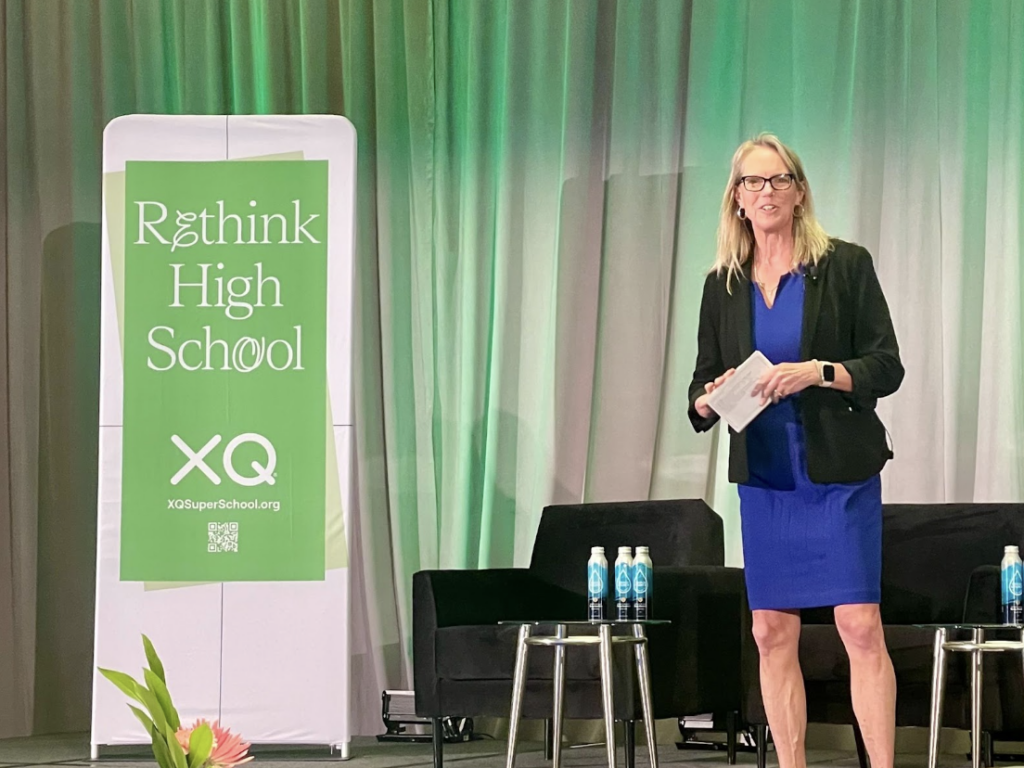
Mary Ryerse leading a panel on XQ.

Stepping into the Future

As we face the future of education, our educational systems must move beyond traditional metrics like Carnegie units. The journey towards whole child education, equity-centered systems, engaging learning experiences, and supportive signaling is akin to breaking in a well-worn pair of sneakers—a testament to resilience, innovation, and collaboration from educators, policymakers, and stakeholders to ensure every student can thrive and reach their full potential.

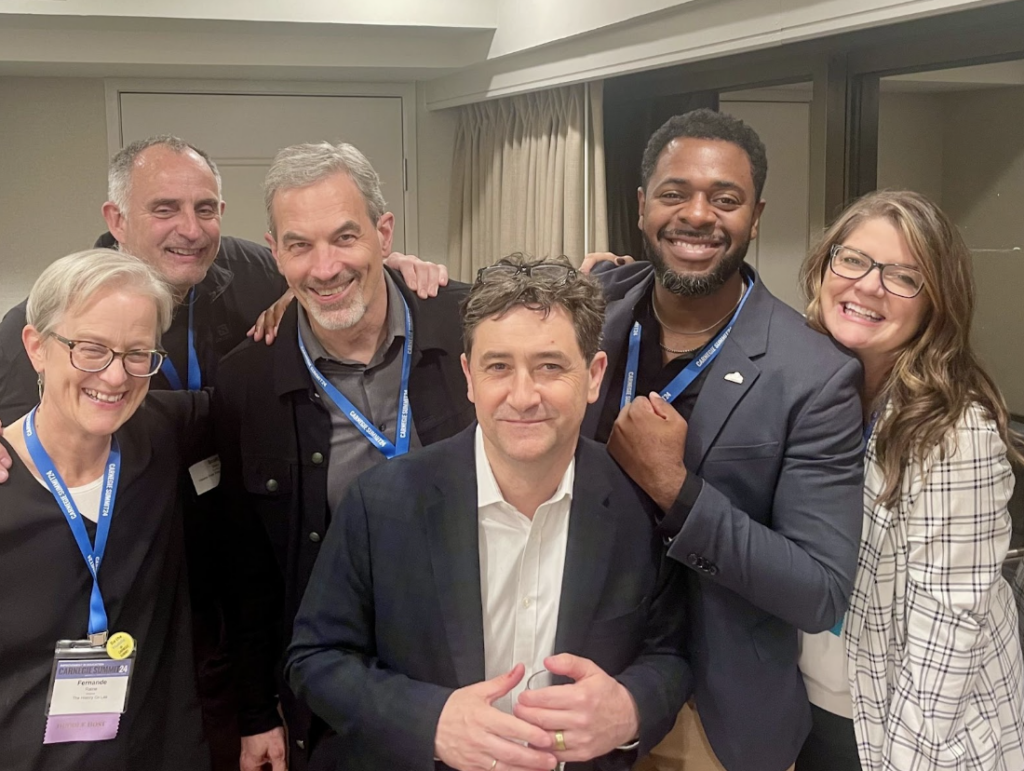
From left to right: Fernande Raine, Scott Bess, Tom Vander Ark, Tim Knowles, Byron Sanders, Rebecca Midles.

The post Sneakers, Signals, and Systems: A New Era in Education appeared first on Getting Smart.

from Getting Smart https://www.gettingsmart.com/2024/04/04/sneakers-signals-and-systems-a-new-era-in-education/

A Portrait As Activation, Interpretation and North Star

In October of 2022, a group of innovators set out to collaborate and “create an education system that is worthy of the students of Nevada.” This has manifested in one of the most intriguing state-level Portraits of a Leaner, and one that is mobilizing districts, educators and students. 

To date, the work has largely aligned with the design thinking framework in the following intervals:

  • Empathize (October 2022): 200 Nevadans gathered in Las Vegas to discuss building the future of learning together.
  • Define (October-November 2022): Community members and educators worked together to define what are the critical mindsets and skills that graduates need to possess.
  • Prototype (January 2023): “Piloting the portrait” 
  • Test (April 2023): Portrait Perspectives Panel where community members made sense of emerging data and engaged in a co-creation series to finalize a document that encompassed critical questions the Portrait must ask of learners.
  • Iterate: The portrait is finalized in June 2023 and continues to be deepened and interpreted as it is applied.

This process ensures community involvement and radical, distributed agency in identifying not only the core factors but also the implementation methods. Now, approximately 18 months into this process, the Nevada Future of Learning Network built to bring the Portrait to life, convened nearly 200 educators to work across these discrete teams and compare notes on what they’ve learned so far and what can be done going forward.

Early in the conversation, one of the attendees noted that this process was revelatory in the way that it highlighted and included learners. They said, “Why has it taken [schools] so long to realize that students are the End User and why we haven’t consulted them in the first place to design the future.”

Agency for Educators

Because the state portrait consists of driving (and beautiful) questions, districts and schools within the state can interpret them to serve their community best. The leaders shared that finding time to work on these challenges is one of the hardest parts of driving change and were grateful for the occasion to gather and design. 

A few standout examples were: Kelly Thorson, LIED, shared how their district wanted to re-emphasize STEM so they mapped new competencies onto the acronym STEM (Solving Problems, Trial and error, Effective Communication, Mental Perseverance). Then the district created codesigned branding across schools, created bingo cards that crowdsource data and enable educators and students to continue to refine their experiences to include competencies and enter in revolving raffle opportunities for gift cards. 

This example resonated strongly with many members of the group as it was seen as a great example of how to build motivation in the students (a common challenge shared by most of the attending districts and students.) Jason Smith, a teacher at Ries Elementary School, shared that after hearing about the bingo card example, he took to AI to create numerous bingo cards informed by motivating students. 

Lashon Fredericks, Principal at Delta Academy, found through numerous high-response polls that students were not demonstrating self-motivation for attending class. To respond to this, the school set out to equip students with a “why.” They leaned into workforce development, establishing mentors on campus and are leveraging Grab and Go’s Curriculum, Workspace Development Curriculum. Workforce development and other pathways-centric iterations could easily be mapped to any and all of the questions of the Nevada Portrait of a Learner. 

Agency for Students

Michelle Mendez-yela, also at Delta Academy, shared “Students know what they want you just have to ask them in the right way.” This was echoed by a student on the call who shared that the portrait enables her to move at her own pace and move ahead in her learning, developing her curiosity and self-advocacy. 

Another student, Adeline Carlson, shared: “As a high school student I really loved the conversation […] introducing agency and self-confidence to older students or even any student who has been taught by someone in their past that they need to be okay with not having their voices heard. As both a high school student and a worker in a setting with elementary kiddos it is so so important for our voices to be not only heard and appreciated, but for it to mean something in the bigger picture.” 

As shared in the previous section, the bingo cards that were developed in LIED apply to both students and educators. These boards not only reassured the competencies for the students on a regular basis but it gave them agency to ask their teachers questions like “When are these going to show up in your class,” building their agency and serving as a valuable accountability check to let students have a modicum of control over their learning. 

In Douglas County SD, Leslie Peters shared that although their district had a pre-existing PoG, they had never really used it effectively. Their model was called EPIC: Empowered, Prepared, Inspired and Connected. The renewed momentum in the state enabled the district to conduct a design challenge with the learners and a forthcoming design challenge with community business leaders to see “what skills resonate with you”

At the Las Vegas Academy of Arts, Robert Mars and his team are implementing new methods of assessment and creating opportunities for radically diverse and personalized demonstrations of learning. Whereas previously students may be asked to fill out a multiple choice test, students can now opt to do video/audio recordings, presentations and 1:1 meetings. The new portrait from the state enables this kind of iteration and interoperability with previously defined benchmarks for the school.

Moving Forward Together

The initiative in Nevada is energizing students and leaders alike to rethink learning goals and alignment such that all learners can have powerful learning experiences. Rather than serving as a rigid box, the state portrait is a great example of aligning on flexible, but critical, values and allowing agency at the local level to choose how it shows up for the community. 

In the spirit of the work of the Las Vegas Academy for the Arts, I created a found poem of things I was hearing from the participants. Consider my dancing in the face of multiple choice: 

Self-Portrait of Bighorn in a Blizzard

Design one dream of earth
and human activity where we
invite learners into a vibrant thriving
in any environment
white out or black out like
a bingo board all filled in.

It has taken long
to spot the box and
on our way out of it
put that bass in our walk.

Is it lazy, no,
smart, like a fox,
to plot yourself amidst the squiggle
to dance, waist up, in spite of winter
to use intelligence, human or otherwise
to STEM and STEM again
to spread belief like a storm, blanketing everything
to ask these beautiful questions
how might we
how must

The post A Portrait As Activation, Interpretation and North Star appeared first on Getting Smart.

from Getting Smart https://www.gettingsmart.com/2024/04/02/a-portrait-as-activation-interpretation-and-north-star/

frED Camp: The Legacy of Fred Rogers

By: Norton Gusky

On a chilly Saturday morning this March, a sold-out crowd of more than 250 educators got up early and drove from towns all over Western Pennsylvania to gather in a primary school gymnasium at the Ehrman Crest Elementary School in the Seneca Valley School District north of Pittsburgh. The educators celebrated the teachings of Fred Rogers as part of frED Camp. The Ehrman Crest Elementary School is a 2022 Time Magazine award-winning building that is a living example of how “the Fred Method” is based on intentional learning. 

The “Fred” of this day-long workshop’s title is Fred Rogers, creator and host of the groundbreaking television series “Mister Rogers’ Neighborhood.” Though many adults remember Rogers as a kindly presence on their childhood TV screens, his legacy includes extensive research into child development and a commitment to leveraging the technology of his day in groundbreaking ways. Beyond entertaining America’s kids, Rogers left behind a body of work that a growing community of educators are now using to improve the ways they teach and mentor children. 

“There’s a growing recognition that we see among teachers that this person they grew up loving for all sorts of different reasons — but mostly because he made them feel good when they were kids — is now someone who can guide them to become better at their jobs as educators and even as parents. It’s a really joyful thing,” says Ryan Rydzewski, co-author of When You Wonder, You’re Learning: Mister Rogers’ Enduring Lessons for Raising Creative, Curious, Caring Kids. 

The book, co-authored with Gregg Behr, was the inspiration for frED Camp. Since its release in 2021, teachers around the world have been applying “The Fred Method” in their classrooms, using technology — and findings from the science of learning and child development — to spark joyful, welcoming learning experiences. “We’ve been talking to teachers for three years now, and they’re always showing us their incredible work, saying ‘Oh, here’s the Fred-like thing I’m doing in my classroom,’” Behr says. “So we thought, ‘Why don’t we bring some of these folks together and see what happens?’”

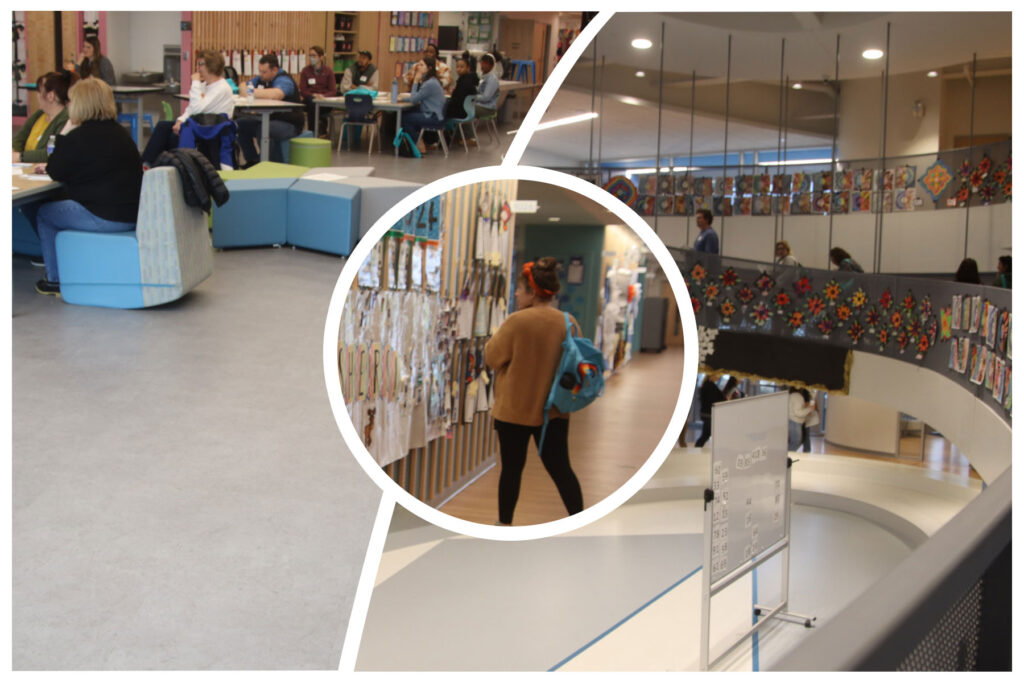
The program started with an opening plenary session highlighting how “Environment Drives Behavior” led by Anne Fullencamp from the Children’s Museum of Pittsburgh and Lauri Pendred, the principal at Ehrman Crest Elementary. They explained how every part of the building was designed to engage learners. Hallways become extensions of the classrooms. Even the playground incorporates space themes so play becomes an intentional activity. The center of the building, a spiraling staircase from the first to second floor showcases student artwork and provides opportunities for student voice. The staircase is also an example of how students were incorporated into the design process. It was the students who made the case for the pathway. 

The majority of the morning educators interacted with presenters at educator-led workshops. The educators shared great examples of the Fred Method in action throughout the Pittsburgh region. Anna Blake, a STEAM teacher for the Elizabeth Forward School District, and Melissa Unger, a STEAM teacher for the South Fayette School District, conducted a workshop “Capturing Creativity: Leveraging Engagement and Deepening Reflection through STEAM Learning.” According to Anna, “We are so honored to present at frED CAMP! I felt inspired as I walked in the door at the doors of Seneca Valley. So many chances to wonder and collaborate with Mr. Rogers in mind. So excited to connect and share learning! PD like this IS what fills up my bucket of love for teaching.”

“It’s refreshing because it’s not, ‘here’s one more thing you have to do,’” says Rydzewski. “Instead, it’s ‘here’s the value in what you already love to do.’ If you can do that in front of your kids, it’s going to elevate their learning. We know from science that when kids get swept up in the vortex of a teacher’s interest, then they get excited about learning all kinds of other things, too.”

It’s a lesson Fred Rogers knew well. For more than 30 years in Mister Rogers’ Neighborhood, he introduced viewers to countless guest stars: think Yo-Yo Ma, Wynton Marsalis, Julia Child, and beyond. “Whoever it happened to be, we remember their visits because we saw their passion for what they do,” says Behr. “Fred didn’t focus on their accomplishments or awards. Instead, he focused on the things that lit them up, and that light created the joyful learning atmosphere that still resonates a half-century later.” 

“What we’ve tried to do is make Fred’s lessons and his blueprints more accessible,” Behr says. “But it’s the practitioners who are going to make this stuff matter — and they are. They’re running with it. And their students are running right along with them.”

Jennifer Wachs, a media teacher for the South Allegheny School District, reinforced the impact of the day for practitioners, “What an absolute privilege it was to attend this year’s frED Camp! There was a tremendous amount of warmth and sense of community from the participants. We were all united by a profound love of children, and of course, Mr. Rogers. It was inspiring to witness the collective passion and dedication as presenters shared a host of innovative ideas for sparking curiosity and joy, and participants engaged in hands-on activities and meaningful discussions.  frED Camp reinforced the importance of creating a warm, inclusive, and stimulating learning environment that nurtures children’s social and emotional well-being. The day recharged my batteries and reaffirmed my belief in the transformative power of education.”

Next year’s frED Camp will be held at another venue that embodies its namesake’s legacy: Theperfy Fred Rogers Institute in Latrobe, Pennsylvania. Open to educators of all kinds — including teachers, early learning educators, librarians, parent leaders, afterschool directors, coaches, mentors, and more — frED Camp is set for March 15, 2025.

Norton Gusky is an educational technology broker and uses technology to empower kids, educators and communities. You can find him on Twitter at @ngusky.

The post frED Camp: The Legacy of Fred Rogers appeared first on Getting Smart.

from Getting Smart https://www.gettingsmart.com/2024/04/01/fred-camp-the-legacy-of-fred-rogers/

frED Camp: The Legacy of Fred Rogers

By: Norton Gusky

On a chilly Saturday morning this March, a sold-out crowd of more than 250 educators got up early and drove from towns all over Western Pennsylvania to gather in a primary school gymnasium at the Ehrman Crest Elementary School in the Seneca Valley School District north of Pittsburgh. The educators celebrated the teachings of Fred Rogers as part of frED Camp. The Ehrman Crest Elementary School is a 2022 Time Magazine award-winning building that is a living example of how “the Fred Method” is based on intentional learning. 

The “Fred” of this day-long workshop’s title is Fred Rogers, creator and host of the groundbreaking television series “Mister Rogers’ Neighborhood.” Though many adults remember Rogers as a kindly presence on their childhood TV screens, his legacy includes extensive research into child development and a commitment to leveraging the technology of his day in groundbreaking ways. Beyond entertaining America’s kids, Rogers left behind a body of work that a growing community of educators are now using to improve the ways they teach and mentor children. 

“There’s a growing recognition that we see among teachers that this person they grew up loving for all sorts of different reasons — but mostly because he made them feel good when they were kids — is now someone who can guide them to become better at their jobs as educators and even as parents. It’s a really joyful thing,” says Ryan Rydzewski, co-author of When You Wonder, You’re Learning: Mister Rogers’ Enduring Lessons for Raising Creative, Curious, Caring Kids. 

The book, co-authored with Gregg Behr, was the inspiration for frED Camp. Since its release in 2021, teachers around the world have been applying “The Fred Method” in their classrooms, using technology — and findings from the science of learning and child development — to spark joyful, welcoming learning experiences. “We’ve been talking to teachers for three years now, and they’re always showing us their incredible work, saying ‘Oh, here’s the Fred-like thing I’m doing in my classroom,’” Behr says. “So we thought, ‘Why don’t we bring some of these folks together and see what happens?’”

The program started with an opening plenary session highlighting how “Environment Drives Behavior” led by Anne Fullencamp from the Children’s Museum of Pittsburgh and Lauri Pendred, the principal at Ehrman Crest Elementary. They explained how every part of the building was designed to engage learners. Hallways become extensions of the classrooms. Even the playground incorporates space themes so play becomes an intentional activity. The center of the building, a spiraling staircase from the first to second floor showcases student artwork and provides opportunities for student voice. The staircase is also an example of how students were incorporated into the design process. It was the students who made the case for the pathway. 

The majority of the morning educators interacted with presenters at educator-led workshops. The educators shared great examples of the Fred Method in action throughout the Pittsburgh region. Anna Blake, a STEAM teacher for the Elizabeth Forward School District, and Melissa Unger, a STEAM teacher for the South Fayette School District, conducted a workshop “Capturing Creativity: Leveraging Engagement and Deepening Reflection through STEAM Learning.” According to Anna, “We are so honored to present at frED CAMP! I felt inspired as I walked in the door at the doors of Seneca Valley. So many chances to wonder and collaborate with Mr. Rogers in mind. So excited to connect and share learning! PD like this IS what fills up my bucket of love for teaching.”

“It’s refreshing because it’s not, ‘here’s one more thing you have to do,’” says Rydzewski. “Instead, it’s ‘here’s the value in what you already love to do.’ If you can do that in front of your kids, it’s going to elevate their learning. We know from science that when kids get swept up in the vortex of a teacher’s interest, then they get excited about learning all kinds of other things, too.”

It’s a lesson Fred Rogers knew well. For more than 30 years in Mister Rogers’ Neighborhood, he introduced viewers to countless guest stars: think Yo-Yo Ma, Wynton Marsalis, Julia Child, and beyond. “Whoever it happened to be, we remember their visits because we saw their passion for what they do,” says Behr. “Fred didn’t focus on their accomplishments or awards. Instead, he focused on the things that lit them up, and that light created the joyful learning atmosphere that still resonates a half-century later.” 

“What we’ve tried to do is make Fred’s lessons and his blueprints more accessible,” Behr says. “But it’s the practitioners who are going to make this stuff matter — and they are. They’re running with it. And their students are running right along with them.”

Jennifer Wachs, a media teacher for the South Allegheny School District, reinforced the impact of the day for practitioners, “What an absolute privilege it was to attend this year’s frED Camp! There was a tremendous amount of warmth and sense of community from the participants. We were all united by a profound love of children, and of course, Mr. Rogers. It was inspiring to witness the collective passion and dedication as presenters shared a host of innovative ideas for sparking curiosity and joy, and participants engaged in hands-on activities and meaningful discussions.  frED Camp reinforced the importance of creating a warm, inclusive, and stimulating learning environment that nurtures children’s social and emotional well-being. The day recharged my batteries and reaffirmed my belief in the transformative power of education.”

Next year’s frED Camp will be held at another venue that embodies its namesake’s legacy: Theperfy Fred Rogers Institute in Latrobe, Pennsylvania. Open to educators of all kinds — including teachers, early learning educators, librarians, parent leaders, afterschool directors, coaches, mentors, and more — frED Camp is set for March 15, 2025.

Norton Gusky is an educational technology broker and uses technology to empower kids, educators and communities. You can find him on Twitter at @ngusky.

The post frED Camp: The Legacy of Fred Rogers appeared first on Getting Smart.

from Getting Smart https://www.gettingsmart.com/2024/03/28/fred-camp-the-legacy-of-fred-rogers/

Design a site like this with WordPress.com
Get started